Archive for the ‘General Virology’ Category

Deadly Export

4 December, 2008

Hot on the heels of the arenavirus outbreak in South Africa recently – traced back to Zambia – comes the story of an unfortunate South African business traveller who took sick and then died in Brazil recently.  While it has been in the papers, as always, ProMED does it best:


Date: Wed, 3 Dec 2008 13:34:00 -0500 (EST)

From: ProMED-mail <promed@promed.isid.harvard.edu>

Subject: PRO/AH/EDR> Viral hemorrhagic fever – Brazil (02): (RJ) ex South Africa


VIRAL HEMORRHAGIC FEVER – BRAZIL (02): (RIO DE JANEIRO) ex SOUTH AFRICA

***********************************************************************

A ProMED-mail post

<http://www.promedmail.org>

ProMED-mail is a program of the

International Society for Infectious Diseases <http://www.isid.org>


Date: Tue 2 Dec 2008

Source: Ministry of Health, Brazil (in Portuguese trans. & summ.

Mod.MPP, edited]

<http://189.28.128.100/portal/aplicacoes/noticias/noticias_detalhe.cfm?co_seq_noticia=56538>


[The following additional information has been added to the Brazilian Ministry of Health statement included in the preceding ProMED-mail

post: Viral hemorrhagic fever – Brazil (RIO) ex South Africa: RFI, archive number 20081202.3792]


1. A 53-year-old man arrived in Brazil on 23 Nov [2008]. On 25 Nov [2008] he presented the 1st symptoms of a febrile hemorrhagic disease as yet undiagnosed.


2. On [28 Nov 2008], he went to 2 private hospitals in Rio de Janeiro, with a clinical picture of fever, chills, vomiting, hematuria, hepatomegaly, and small skin eruptions [?petechiae]. On [2 Dec 2008], the patient died.


5. One of the viruses suspected to be the cause of death of the patient is an [South African] arenavirus. It can be transmitted by direct contact with secretions or blood from rodents or from infected patients.


– —

Communicated by:

Naomi Bryant

Senior Information Analyst

National Travel Health Network and Centre (NaTHNaC) United Kingdom <http://www.nathnac.org/>


[Previously it was stated that there had been no reports of similar symptoms among health professionals who had contact with the patient, and that implementation of quarantine was not considered necessary.

Diagnoses of dengue, malaria, and ebola [hemorrhagic fever] had already been discarded. Other etiologies, such as leptospirosis, hepatitis, and hantaviruses will be investigated.


This additional new information suggests that the South African visitor had contracted his illness prior to arrival in Brazil, and not during travel within the country. The patient’s illness had been diagnosed as a viral hemorrhagic fever and the results of laboratory tests are awaited. There is as yet no direct evidence that the patient had contracted the novel arenavirus recently identified as the cause of an outbreak of disease associated with the treatment of a Zambian patient in South Africa. – Mod.CP]


Now it is a matter of fact that there are plenty of nasty arenaviruses and other haemorhhagic fever agents in South America: however, getting sick only two days after arrival would tend to point to an external (and probably South African) source for the infection.


Which, if it is an arenavirus, is rather worrying – given that we have seen such a thing only recently, and only in a very limited context.


I am sure the folk at the National Institute for Communicable Diseases (NICD) in Johannesburg, and especially the Special Pathogens Unit, who do surveillance for these sorts of nasties, are going to be busy – let us wish them luck.

———————————————————————————————————————

 And latest news (9/12/08): The Mail & Guardian web site carries this story as of 8th December.

SA man in Brazil did not die from arenavirus, says NICD

JOHANNESBURG, SOUTH AFRICA Dec 08 2008 14:35

The death of a South African man in Brazil was not caused by the arenavirus, the National Institute for Communicable Diseases (NICD) said on Monday.

The institute’s deputy director, Dr Lucille Blumberg, said laboratory tests had tested negative for the virus.


Tick-bite fever, acquired in South Africa, is the likely cause of the illness, as indicated by tests performed by the reference laboratory in Brazil.”

The fever, she said, was a well-documented cause of severe illness. It did not pose any risks to those who had been in close contact with infected people. — Sapa

And can be cured with antibiotics, seeing as it is caused by a rickettsial-type prokaryote.

Despair

25 November, 2008

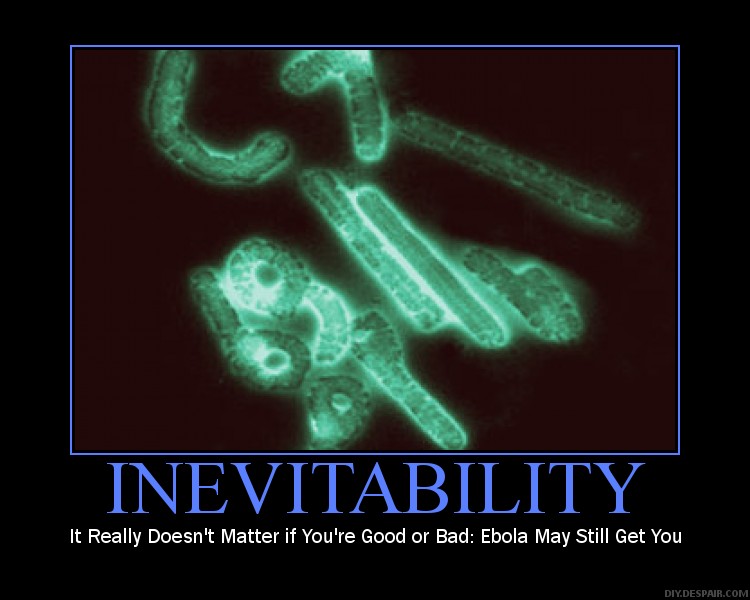
I have had much occasion to frequent the archives of Despair.com in search of demotivational posters with which to inspire my friends and colleagues…and now Alan Cann has given me the opening to display one of my better efforts.  He posted on a new Ebola virus found recently in western Uganda.

I will give you this….

ebola-poster1

Do corals get stress headaches?

20 November, 2008

The large DNA viruses – pox-, irido-, herpes-, asfar-, mimi- and baculoviruses and their ilk – have a deep and possibly complex evolutionary history, and there is considerable evidence to suggest long histories of co-speciation with host lineages.  Indeed, the herpesviruses – including those of particular interest to humans , 1 and 2 and varicella-zoster (chickenpox) and 8 (associated with Kaposi’s sarcoma) – seem to have co-speciated along with vertebrates, with human and simian cytomegaloviruses, for example.

Now there comes evidence from a metagenomic study (which should, of course, be metaviromic) that invertebrates such as corals also have a a variety of herpesviruses, and that these may well be stress-activated: Rebecca Thurber and colleagues, in the 25th November issue of PNAS, have published an analysis of the incidence and effects of hitherto-unknown herpesvirus-like agents found in finger corals in Hawaii.  Their abstract:

Metagenomic analysis indicates that stressors induce production of herpes-like viruses in the coral Porites compressa

During the last several decades corals have been in decline and at least one-third of all coral species are now threatened with extinction. Coral disease has been a major contributor to this threat, but little is known about the responsible pathogens. To date most research has focused on bacterial and fungal diseases; however, viruses may also be important for coral health. Using a combination of empirical viral metagenomics and real-time PCR, we show that Porites compressa corals contain a suite of eukaryotic viruses, many related to the Herpesviridae. This coral-associated viral consortium was found to shift in response to abiotic stressors. In particular, when exposed to reduced pH, elevated nutrients, and thermal stress, the abundance of herpes-like viral sequences rapidly increased in 2 separate experiments. Herpes-like viral sequences were rarely detected in apparently healthy corals, but were abundant in a majority of stressed samples. In addition, surveys of the Nematostella and Hydra genomic projects demonstrate that even distantly related Cnidarians contain numerous herpes-like viral genes, likely as a result of latent or endogenous viral infection. These data support the hypotheses that corals experience viral infections, which are exacerbated by stress, and that herpes-like viruses are common in Cnidarians.

Yet another demonstration – after the viromes of whole oceans – of the sheer brute power of modern sequencing technology and bioinformatics techniques, applied this time to a disease problem of oceanic invertebrates.  The authors again:

Environmental stress often results in coral bleaching, disease, and death. Increased temperature, nutrient loading, dissolved organic carbon pollution, and reductions in ambient seawater pH are of particular concern due to their effects on the coral-symbiont relationship, host homeostasis, microbial overgrowth, and skeletal deposition. To determine whether environmental perturbations shift the eukaryotic viral assemblage present in corals, these 4 parameters were manipulated, and the resulting viral consortia characterized through the generation of 6 metagenomes [!]

Basically, they purified virus-sized particles from seawater, extracted DNA, verified there was no cellular DNA present (by PCR for 16S and 18S rDNA), and amplified the viral DNA using a GenomiPhi phi29 plymerase-based genome amplification kit from GE Healthcare, and sent to 454 Life Sciences for pyrosequencing.

What came back was obviously a mountain of sequence data – which was archived at the San Diego State Center for Universal Microbial Sequencing – and then analysed for contigs or assemblable runs of sequences which looked like herpesvirus or other genomes.  The supplemental data to this paper gives a relationship dendrogram – which isn’t that informative, as it contains just one coral thymidylate kinase sequence, and that is grouped within a clade with human viruses with other vertebrate herpesviruses outside of those.

The final story, then, is that the intrepid coral viromicers (horrible, I know, but come up with a better one?) succeeded in showing that stresses do indeed activate herpes-like viruses in coral.  In their words:

The metagenomic and temporal experiments presented here demonstrate that exposure to stressors results in the production of a herpes-like virus or a consortium of herpes-like viruses in P. compressa corals.  Thermal stress, eutrophication, and decreasing seawater pH have each been shown to disrupt coral health. Increases in sea surface temperature causes coral bleaching and increased coral disease incidence (58, 59). Nutrient addition exacerbates coral diseases, and reduced pH results in loss of corallite deposition (60, 61). This study demonstrates that, in addition to symbiont loss and bacterial and fungal disease (62), temperature and nutrient elevation and pH reduction result in increased HLV production.

Another, more fundamental speculative comment:

Herpesviruses typically infect nervous tissue, and it is tempting to suggest that the herpes-like viruses in Cnidarians may have ancient origins, because Cnidarians are the first metazoans to develop rudimentary nervous systems….

So be kind to our poor fronded friends…they may be our close cousins in discomfort when stressed.

Zambia fever, again

30 October, 2008

It looks as though this is petering out – in its Johannesburg incarnation, anyway.  From Health24 30th October 2008:

The virus that killed four people and infected another appears to have been contained.

The virus, identified as a member of the arenavirus family, which also includes the germ [sic] that causes Lassa fever. “There are currently no additional suspected cases,” the National Institute for Communicable Diseases said in a posting dated October 26, based on information received last week. “The outbreak appears to be contained and has been confined to individuals with very close contact in a health-care setting.” ….

The patients first experienced flu-like symptoms, but the illness worsened over the course of a week with diarrh[o]ea, a sore throat and a rash on the face and throat. Bleeding was not a prominent feature among the fatal cases, all of which lasted about nine to 12 days and ended in rapid deterioration with troubled breathing and circulatory failure, the report said.

Reuters Health, October 2008

OK, so the outbreak appears to be winding down: no new cases, old cases resolved – and no clue yet as to where the virus came from, or what the reservoir is.

Another news item from the same source:

Genetic testing indicate that the mysterious haemorrhagic disease which killed three people in the country is a new type of arenavirus, the SABC reported on Monday.

“We don’t know why it is so pathogenic. It is a new virus, not like Lassa,” Dr Ian Lipkin of Columbia University in New York Lipkin told a news conference at a meeting of infectious disease experts.

And then this, on 31st October 2008, also from Health24:

Arenavirus identified: authorities
Last updated: Thursday, October 30, 2008

“A new type of arenavirus has been identified as the cause of the deaths of four people since September, specialists at the National Institute for Communicable Diseases (NICD) in Johannesburg said on Thursday.

“There is no doubt we are dealing with a newly emerged virus,” said Janusz Paweska, head of the special pathology unit at the NICD. The virus belongs to the “old world” arenavirus, but until two weeks ago, they did not know they were dealing with a new virus.
….
Virus still to be named
The NICD worked with a network of specialists globally, and the virus was identified by themselves and a laboratory in Atlanta in the USA. At a press conference in Johannesburg, they said a name was still being chosen for the virus.

Professor Robert Swanepoel, a consultant for the specialist pathogens unit, said they would have to settle on one which did not create negative connotations for the area from which the first patients came. Traditionally viruses are named after the area that the first patients are known to originate from, for instance the Ebola and Marburg virus.

Swanepoel said they would not want to wipe out tourism in an area or create fearful associations.

– (Sapa, October 2008)

Shades of the fuss surounding the naming of the hantavirus causing a fatal pulmonary disease first described from around the Four Corners region of the US around 1993: this was first called Four Corners virus, then, when people there objected, Muerto Canyon virus with the same result, then Sin Nombre virus [=virus without a name in Spanish]….

I could suggest Bamba zonke virus [=take all], but that is frivolous – and It doesn’t matter what it is called.  It is just a really good idea to get out there and find it, and all its potential relatives, in their natural hosts. 

So that we know what the potential threat is.

Zambia Fever Revisited

24 October, 2008

Apologies for not updating more often; little things like HIV Vaccine conferences get in the way…B-)  More on that later – for now, news:

From SAPA / News24.com today:

Virus: Nurse responds to meds
24/10/2008 14:31  – (SA)

Johannesburg – The nursing sister fighting an arenavirus is showing signs of responding to her treatment, although she is still in a serious condition, the Morningside Medi-Clinic said on Friday.

Meanwhile, the number of people being monitored after coming into contact with patients who had developed the viral haemorrhagic fever associated with the virus, has dropped from 94 to 31, spokesperson Melinda Pelser said.

Three people are known to have died from the virus.

Paramedic Hannes Els became ill after accompanying Cecilia van Deventer from Zambia to South Africa in September when it was thought she had tick bite fever, and clinic nurse Gladys Mthembu died before the virus, which is associated with rodents, could be identified.

“Antiviral treatment continues and there are indications that she is responding to this treatment,” said Pelser of the nursing sister currently being treated.

Monitoring of the remaining 31 people is done while they are at home and at work and so far nobody has presented with the virus.

And from close to two weeks ago:

Mystery virus identified
12/10/2008 16:39  – (SA)

Johannesburg – The mystery viral haemorrhagic fever which killed three people in South Africa has been provisionally identified as an arenavirus, the National Institute for Communicable diseases and the Department of Health said on Sunday.

“The causative agent of the disease… may be a rodent-borne arenavirus related to the lassa fever virus of West Africa,” said NICD’s Dr Lucille Blumberg.

She said tests done by the NICD and the Centres for Disease Control in Atlanta, US indicated that the disease seemed to be a kind of arenavirus.

Arenaviruses cause chronic infections in multimammatic mice – a kind of wild mouse – who excrete the virus in their urine which can then contaminate human food or house dust.

More tests needed

Viruses similar to the lassa fever virus have been found in rodents in Africa, but other than in West Africa, have not been found to cause diseases in humans.

Therefore further tests still need to be done to find out whether this current strain is an undiscovered member of the arenavirus and what its distribution is.

Arenaviruses are enveloped ss(-)RNA viruses with 2-component genomes.  The ones affecting humans are generally rodent-associated, and are transmitted to humans by contact with rodent urine and/or faeces.  Perhaps the best known example from Africa is Lassa fever, which is found in West Africa.

Lassa fever virions

Lassa fever virions: from Wikipedia

From the Centers for Disease Control and Prevention:

What are the Arenaviridae?

From the WHO:

New virus from Arenaviridae family in South Africa and Zambia – Update
13 October 2008 — The results of tests conducted at the Special Pathogens Unit, National Institute for Communicable Diseases (NICD) of the National Health Laboratory Service in Johannesburg, and at the Special Pathogens and Infectious Disease Pathology branches of the Centers for Disease Control in Atlanta, USA, provide preliminary evidence that the causative agent of the disease which has resulted in the recent deaths of 3 people from Zambia and South Africa, is a virus from the Arenaviridae family.

So we have what looks like a new arenavirus, popping up out of Zambia most unexpectedly.  People who knew the index case – Cecilia van Deventer – are most concerned, as they know of no risks that they are not also associated with.

Watch this space….

Zambia fever virus: latest

8 October, 2008

Latest links:

120 people under observation for killer virus” SABC, October 8th

“Killer-fever link found by luck ” Independent On-Line 08-10-08

And just as a reminder that life goes on: a Congo fever patient from here in South Africa.

Nobel Virology 2008

7 October, 2008

It gives me great and unalloyed pleasure, as someone acquainted with one of the new Nobellists, and who has followed the science behind the awards ever since the beginning, to feature the three virologists who were jointly awarded the Nobel Prize in Medicine for 2008.

http://www.nytimes.com/2008/10/07/health/07nobel.html?hp

Discoverers of AIDS and Cancer Viruses Win Nobel Prize – NYTimes.com via kwout

To quote the NY Times article, written by Lawrence K Altman:

“The Nobel Prize in Medicine was awarded Monday to three European scientists who had discovered viruses behind two devastating illnesses, AIDS and cervical cancer.

Half of the award will be shared by two French virologists, Françoise Barré-Sinoussi, 61, and Luc A. Montagnier, 76, for discovering H.I.V., the virus that causes AIDS. Conspicuously omitted was Dr. Robert C. Gallo, an American virologist who vied with the French team in a long, often acrimonious dispute over credit for the discovery of H.I.V.

The other half of the $1.4 million award will go to a German physician-scientist, Dr. Harald zur Hausen, 72, for his discovery of H.P.V., or the human papilloma virus. Dr. zur Hausen of the German Cancer Research Center in Heidelberg “went against current dogma” by postulating that the virus caused cervical cancer, said the Karolinska Institute in Stockholm, which selects the medical winners of the prize, formally called the Nobel Prize in Physiology or Medicine.

His discovery led to the development of two vaccines against cervical cancer, the second most common cancer among women. An estimated 250,000 women die of cervical cancer each year, mostly in poor countries.”

The news is all the more welcome, because I am very familiar with the entire history.  The HIV pandemic has paralleled most of my career: I remember vividly my then Honours student – now a distinguished Professor in her own right – coming to me in 1984 to tell me that “…they have found the virus that causes acquired immune deficiency syndrome”.  Again, it was greatly of interest when Harald zur Hausen initiated the work that would lead to his award, as it was some of the first hard evidence that viruses were implicated in cancer – which suddenly made learning and teaching Virology a whole lot more sexy.  Especially in view of the mode of transmission of the viruses concerned…I like to think I may have put more people off casual sex by talking about viruses like herpes, HPV and HIV and what they can do to you, than any ten school guidance counsellors – but I digress.

The news is also welcome because I now work with both HPV and HIV: thus, reward for the people who invented our main field of endeavour is especially pleasing.

 But as ever, the Nobel awards are not without controversy.  Altman again:

“In 1983, Dr. Montagnier and Dr. Barré-Sinoussi, a member of his lab at the Pasteur Institute in Paris, published their report of a newly identified virus. The Karolinska Institute said that discovery led to blood tests to detect the infection and to anti-retroviral drugs that can prolong the lives of patients. The tests are now used to screen blood donations, making the blood supply safer for transfusions and blood products.

The viral discovery has also led to an understanding of the natural history of H.I.V. infection in people, which ultimately leads to AIDS and death unless treated.

H.I.V. is a member of the lentivirus family of viruses. The French scientists were cited for identifying a virus they called L.A.V. (now known as H.I.V.) in lymph nodes from early and late stages of the infection.

“Never before has science and medicine been so quick to discover, identify the origin and provide treatment for a new disease entity,” the Karolinska Institute said.

…Nobel Foundation rules limit the number of recipients of its medical prizes to a maximum of three each year, and omissions often create controversy.

The dispute between Dr. Gallo and the French team spanned years and sprawled from the lab into the highest levels of government. Dr. Gallo, 71, now at the University of Maryland in Baltimore, worked for many years at the National Cancer Institute in Bethesda, Md.

While in Bethesda in 1984, a year after the French team’s report, Dr. Gallo reported finding a virus that he called H.T.L.V.-3 and that was later shown to be nearly identical to the French L.A.V. After additional studies, Dr. Gallo said cultures in his laboratory had accidentally become contaminated with the French virus.

In 1986, Dr. Gallo and Dr. Montagnier shared a prestigious Lasker award, given in the United States; Dr. Montagnier was cited for discovering the virus and Dr. Gallo for determining that it caused AIDS.

In 1987, President Reagan and Prime Minister Jacques Chirac of France signed an agreement to share royalties and credit for the discovery.

But Maria Masucci, a member of the Nobel Assembly, told Reuters on Monday that “there was no doubt as to who made the fundamental discoveries.”

Dr. Gallo told The Associated Press on Monday that it was “a disappointment” not to have been honored with the French team. Later, Dr. Gallo issued a statement congratulating this year’s Nobel Prize winners and said he “was gratified to read Dr. Montagnier’s kind statement this morning expressing that I was equally deserving.” “

We’ve been waiting for this for a long time…and the result is interesting indeed, for many of us virologists.  Satisfying too….  I remember wondering at the time how the US team could blithely rename a virus that appeared very similar to one described a year earlier – and was even more fascinated to see how the story unfolded, with LAV becoming HTLV-III becoming HIV, as eventually sense and taxonomy overtook hubris.

The HPV award seems not to be controversial at all, and Professor zur Hausen is seen by everyone I have spoken to as a most worthy recipient.  Now, just to get that vaccine into people who need it….

Deadly Zambian fever: deja vu all over again

7 October, 2008

The news media are presently fascinated by the appearance of what looks like a new and nasty virus from my old home country, Zambia: see a link to The Times article of 7th October for the official word.

Which is “Don’t Panic”, written in large, friendly letters across the face of the newspaper….

From The Times article by Sashni Pather:

Disease transmitted via bodily fluids

THE deputy director of the National Institute for Communicable Diseases has assured the public that there is no need to panic, despite the fact that four people have been killed by an unknown, highly contagious virus.

Doctor Lucille Blumberg, who also heads up the NICD’s epidemiology unit and consults to its special pathogens unit, referred to the death of Cecilia van Deventer, 36, as an “isolated case” and said test results were not yet available.

…A paramedic, Hannes Els, 33, who treated the critically ill Van Deventer in Zambia, and brought her to the Morningside Medi-Clinic in Sandton on September 12, died last Thursday after being infected with the highly contagious disease.

On Sunday a nurse and a cleaner, who had possibly been exposed to the disease, died.

Blumberg said: “The cause of death of the cleaner is still being investigated. We are busy conducting tests on all four deceased. The cleaner might not have been killed as a result of the virus.

“This is an isolated case. There have been no other reported cases in Lusaka, Zambia. “”

OK, so no obvious panic there, then – but disturbing echoes of another incident from 1996, when a Gabonese doctor was medevacced in to South Africa, and passed on an Ebola virus infection to a theatre nurse, Marilyn Lahana.  He recovered, and she died – and there was close to panic in the land, as chronicled here.  And here we are again….  Incidentally, anyone who wants to see how the first Ebola outbreaks of the electronic age unfolded can see a day-by-day history here, on my original Ebola pages.  Still accessible, to my surprise!

That wonderful institution that is ProMED – who were the first people to break hard news of the Kikwit Ebola outbreak back in 1995, came to the attention of the serious medical reporting world as a result – has a slightly different view of the whole thing – and some interesting details not in the general news story.  In this morning’s digest:

UNDIAGNOSED FATALITIES – SOUTH AFRICA ex ZAMBIA (02)
***********************************************
A ProMED-mail post
<http://www.promedmail.org>
ProMED-mail is a program of the International Society for Infectious Diseases
<http://www.isid.org>

[1]
Date: Mon 6 Oct 2008
Source: South African Broadcasting Corporation News online [edited]
<http://www.sabcnews.com/south_africa/health/0,2172,177844,00.htm>

A 4th person with viral haemorragic fever (VHF) symptoms has died. The virus has already claimed the lives of a Zambian national and 2 other people at the Morningside Clinic in Johannesburg. The woman was a cleaner at the clinic.

The National Health Department has issued an alert in Gauteng following these deaths. Unconfirmed tests indicate they may have died of [a] fatal viral haemorragic fever. An Outbreak Response and Tracking Team has been set up to contain any further spread. The department’s Zanele Mngadi says investigations are still underway into the cause of the deaths.

Mngadi confirmed the death of the 4th person, who was admitted at the Leratong hospital last night [5 Oct 2008]. The patient, who showed symptoms of VHF, was transferred to the Charlotte Maxeke Johannesburg
Academic Hospital, where she died. The health department says there is no need for South Africans to panic. The department’s Frew Denson says the fever is highly contagious but is only transmitted through body fluids.

It is reported that the virus can kill a person within 72 hours. VHF is an extremely infectious and life-threatening disease caused by [several different] viruses, including Ebola virus. The death rate [in the case of Ebola virus] can be as high as 90 percent. Symptoms vary but include fever, vomiting, diarrhea and bleeding.

Communicated by:
Rabelani Daswa <rabedaswa@gmail.com>

******
[2]
Date: Mon 6 Oct 2008
From: Amy Cantlay <inka@iwayafrica.com>

I have just read the posting (Undiagnosed fatalities – South Africa ex Zambia: RFI 20081005.3139) on your site, and it appears to be rather misleading. The chronological order of events (as I can gather) is as follows (None of this information has yet been confirmed.):

4 Sep 2008 – Index Case – female South African, (living in Zambia for many years) begins to suffer from flu-like symptoms.

9 Sep 2008 – She is slowly deteriorating. She sees multiple doctors in Lusaka.

11 Sep 2008 – She is admitted to hospital and deteriorates over night.

12 Sep 2008 – Paramedic is called in to evacuate her to South Africa.  He does the transfer, along with another Dr assisting.

13 Sep 2008 – Index Case dies.

14 Sep 2008 Paramedic starts to develop flu-like symptoms.

14-27 Sep 2008 – Paramedic slowly deteriorates.

27 Sep 2008 – Paramedic is diagnosed as very sick and medivaced [sic] to South Africa. Nurse who treated Index case begins to get flu-like symptoms.

30 Sep 2008 – Paramedic dies.

1 Oct 2008 – Nurse who treated Index Case is admitted to hospital.

5 Oct 2008 – Nurse who treated Index Case dies.

The information that I can gather is the following:

1. Incubation period is as little as 2 days (paramedic), but as long as 14 days (nurse).

2. Disease course is generally 4-7 days of flu-like illness with patient only becoming critically ill in 2nd week of disease.

3. Further information is that Index Case reportedly had an eschar on one of her feet, thought to be from a tick-bite. She had also been in contact with horses from Congo in the weeks preceding her illness. Transmission is hypothesized to be by 2 means: tick-borne 1st (which may have brought the disease into the human population from the animal population) followed by direct contact with bodily fluids (resulting in human to human transmission).

4. It appears further hospital staff are now critically ill in Zambia, though this has not been confirmed.

5. If the incubation period is as long as 2 weeks, then we should still be closely watching all “contact-cases” for any signs of the disease. Those in contact with the Index case should be in the clear by now, while those in contact with the paramedic and the nurse (as well as any hospital staff who are currently sick) are still at high risk. One should probably work on a 21-day incubation period/quarantine period to be safe.

6. Chances are this is a new virus (or new subtype of virus) in the [family _Filoviridae_]. The only 2 known viruses in this group are Ebola and Marburg. It looks as though [the infection] may have entered Zambia from the Democratic Republic of the Congo (DRC) through a tick (carried on a horse), but again this cannot be confirmed.

This comment assumes that labs in South Africa have already tested all known VHFs. It is unlikely to be pneumonic plague, as this would have been discovered in South Africa; however, it is still a possibility that this [putative] viral disease has been in the Southern Province of Zambia (and that the 4 reported cases seen there were not diagnosed or wrongly called pneumonic plague).

7. The important steps in control are 1. effective quarantine of sick patients, and 2. monitoring of all “in-contact” cases, with quarantine as soon as any signs of flu or fever are noted. The government should also ideally make a statement to calm the panic and prevent people from fleeing the capital (potentially carrying the disease countrywide). This disease only spreads to people who are in very close contact with sick individuals. Those family members who are potentially incubating the disease should be encouraged to stay
around Lusaka, so that signs can be picked up quickly and treatment issued rapidly….[section on use of ribavirin – effective only against Lassa fever – edited out].

Communicated by:
Dr Amy Cantlay BVSc.MRCVS <inka@iwayafrica.com>
Veterinarian
Mkushi, Zambia

[ProMED-mail thanks Dr. Cantlay for her commentary, which contributes some interesting detail. At this point, it would not be useful to speculate further on the identity of the infectious agent responsible for the deaths of the 4 Zambian patients. No doubt a firm diagnosis will be available shortly from a South African reference laboratory. Several different viruses cause viral hemorrhagic fever. Of these, Ebola, Marburg, Lassa or Crimean-Congo hemorrhagic fever viruses have not been recorded in Zambia up to the present. A comprehensive account of these and other viruses responsible for hemorrhagic fevers can be found at the US CDC website: <http://www.cdc.gov/ncidod/diseases/virlfvr/virlfvr.htm>.

So: an unknown fever-causing agent, possibly associated with a tick bite in the index case, but which seems definitely to be transmitted quite efficiently via exposure to (presumably) body fluids, in a hospital setting…which does not appear to be known strains / types of Marburg or Ebola viruses, or Crimean-Congo haemorrhagic fever virus.

Loose in Johannesburg…part of a greater conurbation housing some 9 million people….

Should we be worried??

And the answer would be – NO.

If Ebola didn’t spread out of Kikwit in 1995 – a city of 500 000+ with no decent infrastructure to speak of – even to get as far as Kinshasa, then why should it spread in Johannesburg, or even Lusaka, where the infrastructure is MUCH more sophisticated?

I will leave this with a couple of quotes from posts I compiled on Ebola back in August 1995 from the fondly-remembered virology group at bio.net:

“To: virology@net.bio.net
From: ED@molbiol.uct.ac.za (“Ed Rybicki”)
Subject: Re: The Ebola virus – the end of the civilized world
Date: 18 Aug 1995 05:53:07 -0700

I would say you – and many others – are being unnecessarily
frightened by a concerted media campaign designed at selling lurid
books and films.  Listen – for a change – to what experts tell you,
and react accordingly.

That is, RELAX!!!!!”

And:

“To: virology@net.bio.net
From: york@mbcrr.harvard.edu (Ian A. York)
Subject: Re: Ebola: the greatest threat, continued

In article <99792FA2E69@ida.ruc.dk>,  wrote:
>
>Ebola is another ballgame. There is no way to protect effectively
>against this disease, and we have seen at mutation of this virus, Ebola
>Reston, that evidently was airborn (luckily it only affects monkeys).


Ebola has killed less than 400 people in the past decade.  By contrast, typhoid fever kills over 600,000 people per year; measles kills 1,000,000 (one million) people per year.  If you think Ebola has the potential tokill anywhere near that many, you don’t understand the virus.  The Ebola outbreak in Kikwit *was* the worst-case scenario; *everything* went wrong.  300 deaths.  Not trivial.  But a tiny fraction of the real killers. 

Lobby and try to get measles vaccine in Africa, if you want to do some good.  So don’t waste your time worrying about Ebola.”

Amen to that!  Pity we have to keep revisiting The Threat From Darkest Africa – maybe we can sell the rest of the world some vaccines against them sometime soon…B-)
HIV: roots run deeper than we knew

2 October, 2008

I have previously posted a number of articles on “molecular archaeology” of viruses, and how one can use extant sequences, archived tissue samples, or even blood of pandemic survivors to speculate on the origins of specific viruses, of viruses generally, or on the nature of old pandemic strains.Now HIV falls under the spotlight – again – as the 2nd October issue of Nature publishes three articles (one letter, a commentary on it and an independent commentary) on the origins of HIV-1 pandemic strains.I picked up on the first news – evidence for an older-than-previously-thought origin for HIV-1 – via our local paper this morning. Now this is VERY impressive; they usually keep science news for a slow day, and here they were telling us about a Nature paper on the day it was published! Accessing Nature brought up the Nature News commentary by Heidi Ledford, titled “Tissue sample suggests HIV has been infecting humans for a century”. Essentially, the commentary summarises the findings of Michael Worobey of the University of Arizona and his colleagues, who managed to amplify and sequence HIV-specific cDNA and DNA from a paraffin-embedded lymph node biopsy dating from 1960 from a woman in Léopoldville (now Kinshasa) in what is now the DR Congo. To quote Ledford:

“Their results showed that the most likely date for HIV’s emergence was about 1908, when Léopoldville was emerging as a centre for trade.”

Their findings added credibility to an earlier demonstration of HIV-1 in a 1959 sample, also from Kinshasa. What was interesting was that the sequences of the two viruses differed by 12%: this indicates that there was already significant divergence in the HIV-1 strains infecting people as early as 1960, pointing to a longer history of human infection than the previous estimate of the 1930s.Which led on to the Comments section, where one finds gems like this:

“This is one of the most stupid discovery I have ever heard. You will blame every single human plague on Africa, This is against all the Theories of evolutionary biology where The descents of the people that lived in the area might have developed a kind of resistance instead of being vulnerable to a new strain of the Virus.”

And:

“HIV is older than your great-grandparents, uh-huh! And I’ll bet that the US bio weapons effort is just ecstatic about this deflection. So now these members of science play to the bio-jackboot population controllers with this ‘revelation’ that those sex-crazed Africans of course just couldn’t stop themselves from pulling chimpanzees (I thought the original scientific theory was “green monkeys”) out of the trees for a quickie.”

I couldn’t take this, so I replied:

“It continues to amaze me, as a teacher of virology who tells big classes every year where HIV comes from, how every year some clique of students takes the African origin of HIV personally, as a direct affront. I echo the correspondent above: it is a virus, people. Viruses infect animals, they infect people, and sometimes spread from one to the other – and back, if you are a zoo animal and catch something from your handler. The AIDS pandemic is an accident of sociology, demography, access to high-speed, long-distance travel – and truck routes, and truck drivers. It happens that it originated in Africa. So did the human race – only a lot longer ago. Inevitably, as humans encroached on apes, things get passed across. And don’t spread, much, until…someone puts a road through the village.Why don’t people get more exercised about the origins of HTLV, another retrovirus that almost certainly jumped from monkeys to humans? Except that happened many thousands of years ago, and in south-east Asia, not Africa. And for the same reasons: people eat monkeys and great apes. For that matter, it is speculated that chimpanzees got SIV-CPZ from vervet (I HATE the term “green”) monkeys – and that it may have caused a population bottleneck, some 100 000 years ago. I note that chimpanzees are known to eat vervets, incidentally – so they caught the virus the same way we did.

Ah, well…. In any case, Paul Sharp of the University of Edinburgh – and phylogenetics guru – and the godmother of HIV/SIV diversity, Beatrice Hahn of the University of Alabama (from whom I got the chimp-vervet virus link), have an independent commentary in the same issue, wherein they speculate on “The prehistory of HIV-1”. They make this very interesting comment:

“If the epidemic grew roughly exponentially from only one or a few infected individuals around 1910 to the more than 55 million estimated to have been infected by 2007, there were probably only a few thousand HIV-infected individuals by 1960, all in central Africa. Given the diverse array of symptoms characteristic of AIDS, and the often-long asymptomatic period following infection, it is easy to imagine how the nascent epidemic went unrecognized.”

They also make the important point that the findings of the Worobey group were replicated – with similar but non-identical virus sequences being found – by another group working independently with the same tissue sample. This is important because it nails down the findings more firmly, as HIV sequences within an individual do differ, and:

“…the distance along the evolutionary tree from the group M ancestor to the ZR59 or DRC60 sequences is much shorter than those between the ancestor and modern strains, consistent with the earlier dates of isolation of ZR59 and DRC60, and confirming that these viruses are indeed old”.

a, The HIV-1 genome fragments that were successfully amplified from DRC60 (red) and are available for ZR59 (black). The numbering for the HIV-1 sequences corresponds to the HXB2 reference sequence (Supplementary Table 1). b, The A/A1 subtree from the unconstrained (in which a molecular clock is not enforced) BMCMC phylogenetic analysis. 1960.DRC60A is the University of Arizona consensus sequence, and 1960.DRC60N is the Northwestern University consensus sequence (that is, the sequences independently recovered in each of the two laboratories). The DRC60 sequences form a strongly supported clade with three modern sequences also sampled in the DRC.

Reproduced with permission from Nature Publishing Group (RightsLink License No 2041420001096) from:
Direct evidence of extensive diversity of HIV-1 in Kinshasa by 1960
Michael Worobey, Marlea Gemmel, Dirk E. Teuwen, Tamara Haselkorn, Kevin Kunstman, Michael Bunce, Jean-Jacques Muyembe, Jean-Marie M. Kabongo, Raphaël M. Kalengayi, Eric Van Marck, M. Thomas P. Gilbert & Steven M. Wolinsky
Nature 455, 661-664(2 October 2008) doi:10.1038/nature07390

So where did the virus infecting humans come from? The best guess, from the paper and the commentaries, is that it originated – as do the extant chimpanzee virus supposed to have descended from the common origin – in chimpanzees somewhere in southeast Cameroon.How did it get into people? Sharp and Hahn again:

“The simplest explanation for how SIV jumped to humans would be through exposure of humans to the blood of chimpanzees butchered locally for bushmeat.”

No sex, no weird practices…just eating our cousins.  And how and why did it get to Léopoldville? Trade…and in those days before widespread truck routes, that would have been via rivers – which, Sharp & Hahn point out, drain from southeast Cameroon into the Congo River, which flows past what is now Kinshasa. The Worobey paper has some interesting history in it, documenting times of founding and rates of growth of cities in equatorial west Africa: Léopoldville/Kinshasa was and probably still is by far the fastest-growing of these, and was the earliest founded (in 1885). All that was needed to seed a pandemic, then, was that people infected by a virus as a result of butchering chimpanzees, moved some 700 km down natural trade routes to an emergent trade centre – and settled, and passed it on.Then, of course, it is the same old story, told so well by Jared Diamond in “Guns, Germs and Steel“: increased human population density and breakdown in social structure leads to increase in rate of transmission and incidence / prevalence of a disease agent, until it reaches the threshold necessary to break out. It is interesting that it took so long to become noticed – but then, HIV is passed on considerably less efficiently than Hepatitis B virus, so the pace of the epidemic was necessarily slow.But very sure….

Big viruses have little viruses….

28 August, 2008

Just when you’d heard of mimiviruses, and thought it couldn’t get any stranger…the same team now bring you “mamavirus“, so named because it’s bigger!

But wait, that’s not all: apparently the new viruses have their very own “virophages” – smaller viruses which parasitise mamavirus-infected cells, and so called because they look like and have homology to bacteriophages.

And that’s still not all…Helen Pearson in the 6th August online Nature News then makes a case for viruses being considered as being alive, on the strength of this parasitism – and its detrimental effect on the larger virus, in terms of aberrant assembly, lower yield in infected cells, and so on.

http://www.nature.com/news/2008/080806/full/454677a.html

Well, now…some of us have never thought otherwise, have we?  And despite all of the hype about how huge these viruses are, and how they blur the boundary between alive and dead – they don’t do they?  For all their complexity, mimi- and presumbably mamaviruses do exactly what all other viruses do: they obligately parasitise cellular organisms, and use their machinery (and especially ribosomes) to make viral components which asemble into particles.

And the news piece goes on:

“The discovery of a giant virus that falls ill through infection by another virus is fuelling the debate about whether viruses are alive.

“There’s no doubt this is a living organism,” says Jean-Michel Claverie, a virologist at the the CNRS UPR laboratories in Marseilles, part of France’s basic-research agency. “The fact that it can get sick makes it more alive.””

Ye-e-e-ssss?  Really?  And calling what is obviously a satellite virus – for all that it is a big satellite virus – a “virophage” is simply creating new terms where none are necessary.  Actually, they go one worse than that: the original article refers to the satellite as “Sputnik” throughout, in a breathtaking display of artistic licence.

But putting the outraged taxonomist in me aside, this is a truly amazing discovery, worth all of the hype: it shows that we really don’t know a lot about what is sitting in plain sight – in cooling tower water, in this case – let alone what is is sitting in deep oceans, in terms of viral biodiversity.

While the mamavirus is interesting enough, what should be called Mamavirus associated satellite virus rather than Sputnik, is even more so: satellite viruses are generally small and have very few genes, whereas this has 21 genes in a ~18 kb circular dsDNA genome, makes isometric particles 50 nm in size (which can be found within mamavirus particles), and in the words of La Scola et al.:

“…contains genes that are linked to viruses infecting each of the three domains of life Eukarya, Archaea and Bacteria. Of the 21 predicted protein-coding genes, eight encode proteins with detectable homologues, including three proteins apparently derived from APMV [Acanthamoeba polyphaga mimivirus], a homologue of an archaeal virus integrase, a predicted primase–helicase, a packaging ATPase with homologues in bacteriophages and eukaryotic viruses, a distant homologue of bacterial insertion sequence transposase DNA-binding subunit, and a Zn-ribbon protein. The closest homologues of the last four of these proteins were detected in the Global Ocean Survey environmental data set, suggesting that Sputnik represents a currently unknown family of viruses.  Considering its functional analogy with bacteriophages, we classify this virus as a virophage. The virophage could be a vehicle mediating lateral gene transfer between giant viruses.”

Fascinating indeed: this parasite upon a parasite – it replicates only in the “giant virus factory found in amoebae co-infected with APMV” – is bigger than many autonomous viruses infecting mammals, looks like it is at least partly derived from a bacterial virus in that it may integrate into its host (the mimivirus?) within a eukaryote, and may shuffle DNA around between other viruses.

I’m definitely working in the wrong field.