Archive for the ‘General Virology’ Category

There’s gold in them old veins….

26 August, 2008

I have often spoken of “molecular archeology” in my lectures, and of the possibility of identifying past epidemic / pandemic strains of human flu in particular, by looking at which viruses are recognised by antibodies from people who lived through the epidemics.

A new paper in Nature ups the stakes in this game considerably: a team led by one James E Crowe Jr describes how 32 survivors of the 1918 Spanish Flu pandemic – born in or before 1915 – were “mined” for antibodies, and seven donors additionally were shown to have circulating B cells which secreted antibodies which bound the 1918 H1N1 virus haemagglutinin (HA).  The team isolated 5 monoclonal antibodies from these subjects, and showed that these potently neutralised the infectivity of the virus and bound the HA of a 1930 swine virus, but did not cross-react with the HAs of more recent human  H1-containing viruses.

http://www.nature.com/nature/journal/vaop/ncurrent/abs/nature07231.html

Neutralizing antibodies derived from the B cells of 1918 influenza pandemic survivors : Abstract : Nature via kwout

 This achievement is undoubtedly a tour de force of modern molecular immunology – but is it useful?

Well, one very obvious fact is that people can obviously maintain significant levels of humoral immunity to viruses that infected them – in the words of the authors – “…well into the tenth decade of life.”  This is good news indeed for vaccinees who received vaccines for viruses which do not change much, like measles, mumps and poliomyelitis viruses.  However, given that influenza virus even of one H and N type can change so as to be unrecognisable in just a few years – the MAbs they generated did not react to any great extent with presumptively H1N1 human isolates from 1943, 1947, 1977 and 1999 – this is only of any use if the original virus were to be re-introduced somehow.

There was an intriguing statement in the paper which may shed some light on a long-running controversy as to the origin of the 1977 H1N1 pandemic, when the virus reappeared in humans for the first time since the early 1950s – allegedly as a result of an escape from a Soviet biowarfare lab.

The 1F1 antibody bound and neutralized the 1977 virus, albeit to a lesser degree than either the 1918 or the Sw/30 viruses … and to a minimal degree the 1943 virus”.

Ye-e-e-sssss…strange, that.  So the 1977 virus was antigenically more similar to 1930s era viruses than to one from 1943??

The proposed use of the findings also elicit biowar scenarios: for example, the fact that passive immunisation of people with antibodies to a particular virus can help them get over infection with it is purely academic for MAb to the 1918 virus – or is it?

I hope it is.
Viromics

25 June, 2008

Hot on the heels of the popular term genomics – defined by Wikipedia as “the study of an organism’s entire genome” – comes one for virologists: viromics.  There have been a number of articles in recent years on “viromes”, or the total viral genome content of the DNA found in certain biological sampling areas such as entire oceans or just in humans, so one might be forgiven for assuming that viromics was the study of entire viral genomes.

 But you might be wrong…for example, Applied Viromics of California have this to say:

“The term “viromics” was introduced on a biochemical pharmacology discussion conference in 2001 (Lotze MT and Kost TA. Cancer Gene Therapy. 2002 Aug; 9(8):692-9). It refers to “the use of viruses and viral gene transfer to explore the complexity arising from the vast array of new targets available from the human and murine genomes”.”

So: just about using viruses to study animals, then?  The Katze lab at the University of Washington – who I note have the word in their Web address – focus on:

…the use of genomic and proteomic technologies to study virus-host interactions and the varied strategies used by viruses to evade cellular defense mechanisms. We study a wide range of viral pathogens, including hepatitis C, influenza, Ebola, West Nile, SARS-associated coronavirus, herpes simplex virus, and human and simian immunodeficiency viruses.”

 So it’s studying human-virus interactions, then?  However, the Marine Microbiology Group at the Universrsity of South Florida has as its viromics interest

“…the interaction of viral genomes with their environments by sequencing several temperate/pseudotemperate marine phage genomes”.

 Much more like what I thought it was!  However, possibly the best definition I have seen is from a Nature Biotechnology Commentary on “Systems biology and the host response to viral infection“, which pops up the term “Systems virology” as a synonym for viromics.  the article states:

“There is increasing evidence from functional genomics experiments that the patterns of cellular response to a variety of viral infections may reflect the pathogenic properties of the viruses. We contend that dissection of the critical, and often subtly different, cellular pathways will eventually unveil opportunities for manipulating the host immune response to fight off viral infection, control pathogenesis or both.” 

And in a side box on viromics: 

“Innovations in sequencing technologies, particularly the rapid, high-throughput pyrosequencing platforms, continue to transform large-scale biology. … The fields of viral metagenomics and viral diagnostics are therefore poised for rapid expansion.”

Again – unsurprisingly, given that the Katze lab mentioned above is involved – a rather pathocentric approach, but all in all, a nice summary of current thinking.

So it is not the “what” so much as the “what it does” with viruses – at least, with the human virome.  Of course, for those of us with other interests, the new viromics can largely be concerned with discovery: there is a largely undescribed universe of viruses out there, in everything from seawater to duck ponds, biofilms to beehives, colons to parrots.  Cataloguing some of that diversity can only lead to new insights – which will lead to the kinds of questions that can be answered by “systems virology” approaches.

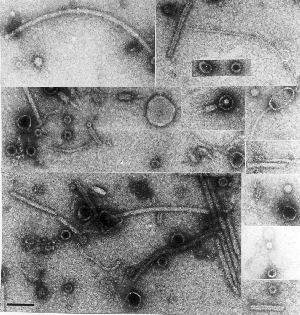
For instance, in my PhD thesis in 1984, I published an virus-like particles in plant extractselectron micrograph of a collection of unidentified particles found in preparations of known viruses, concentrated and partially purified from plant extracts.  there is a veritable zoo of things present, from a variety of fialments – some probably flagellae – to a motley collection of spheres and even some recognisable phages or parts thereof.  It has also been stuck on my office wall for the last ten years, since I found it kicking about in a drawer….

The point is, we generally find what we are looking for – and presume that what is present in the greatest abundance is just that, and then ignore everything else. 

Now we don’t have to do that any more: a metagenomic study of a particle-enriched preparation such as that seen on the right could yield fabulous riches, and unveil hitherto-unsuspected minor populations of plant viruses, unknown fungal and bacterial viruses, and even viruses infecting insects, which may be passively “vectored” by plants.

In a dramatic application of the worth of this sort of discovery, a major metagenomic project involving colony decline disorder of honeybees was described in MicrobiologyBytes recently: this involved sequencing all of the DNA and cDNA from many beehives, and doing a subtractive analysis to determine which possible pathogen was involved.

Other efforts under way in our laboratories in Cape Town include a study of the single-stranded circular DNA virome of grasses in Africa: this has resulted in six publications to date, and over 300 full mastrevirus genomic sequences in less than two years, and has radically altered our perception of both the diversity and the recombination potential of these commercially-important viruses.  This phenomenal progress has been enabled by recent technological breakthroughs – in this case, the use of bacteriophage phi29 DNA polymerase for isothermal “rolling circle” genome amplification, and cheap commercial sequencing.  This is rapidly diversifying into similar work on Beak and feather disease circoviruses in parrots, and even dsDNA viruses.

We are at the threshold of an era of significant discovery potential in virology, much as happened in the early 1990s with the advent of PCR – only more so.  The nice thing is that rapidly-developing sequencing techniques will allow ever-cheaper large-scale sequencing – so that finances will not be the limiting factor they may have been up to now, and developing countries can share in the viromic bounty.

And every now and then, the young people around will tell me what is going on – for which I am grateful.

PIPO, I see you…

30 May, 2008

Now here’s an interesting thing: a completely unsuspected gene – as in, on open reading frame (ORF) that actually DOES something – in one of the best-studied familes of plant viruses.  From the International Service for the Acquisition of Agribiotech Applications (ISAAA)’s CropBiotech Update 30 May 2008:

Scientists Discover Hidden Gene in Major Plant Virus Family

The virus family Potyviridae includes more than 30 percent of known plant virus species, most of which are of great agricultural significance such as the potato virus Y, turnip mosaic virus and wheat streak mosaic virus. Scientists from the Iowa State University, working with colleagues from the University College Cork in Ireland, have discovered a tiny gene present in all members of this virus family. Without this gene, the viruses are harmless.

Using a gene-finding software, the team identified a stretch of nucleotide bases that overlaps with a much larger and well characterized gene in potyviruses. They called the new gene pipo (short for pretty interesting potyvirus ORF). Alterations in the sequence of the pipo gene, while leaving the polyprotein amino acid sequence unaltered, were found to be lethal for the viruses.

The team led by Allen Miller and John Atkins are now working to determine the function of gene during infection as well as how the pipo protein is expressed from the viral genome. For this, the U.S. Department of Agriculture National Research Initiative (USDA-NRI) has awarded them with a $400,000 competitive grant.

For more information, visit \http://www.public.iastate.edu/~nscentral/ Read the paper published by PNAS at http://www.pnas.org/cgi/reprint/105/15/5897

Nice one, guys…$400 000 should buy a few more ORFs…B-)  Seriously, though, the dogma has been for years that potyviruses, like picornaviruses, have a single long (~10kb) ORF, which expresses a polypeptide from the genomic RNA which is cotranslationally processed into a number of different proteins – and that was all there was.  This discovery is like finding a new and secret drawer in an old and familiar chest of drawers, or an extra pocket in your trousers.  Or, as I did recently, that there wer two interior lights in my car which I had not known of for six years…but I digress.

In the words of the authors:

“We report the discovery of a short ORF embedded within the P3 cistron of the polyprotein but translated in the +2 reading-frame. The ORF, termed pipo, is conserved and has a strong bioinformatic coding signature throughout the large and diverse Potyviridae family. Mutations that knock out expression of the PIPO protein in Turnip mosaic potyvirus but leave the polyprotein amino acid sequence unaltered are lethal to the virus. Immunoblotting with antisera raised against two nonoverlapping 14-aa antigens, derived from the PIPO amino acid sequence, reveals the expression of an ~25-kDa PIPO fusion product in planta. This is consistent with expression of PIPO as a P3-PIPO fusion product via ribosomal frameshifting or transcriptional slippage at a highly conserved G1-2A6-7 motif at the 5′ end of pipo. This discovery suggests that other short overlapping genes may remain hidden even in well studied virus genomes (as well as cellular organisms)…”

They go on to tout the virtues of the “software package MLOGD”, which it turns out is from here (Firth AE, Brown CM (2006) Detecting overlapping coding sequences in virus genomes. BMC Bioinformatics 7:75), and is the Maximum Likelihood Overlapping Gene Detector.   They say:

“Tests show that, from an alignment with just 20 mutations, MLOGD can discriminate non-overlapping CDSs from non-coding ORFs with a typical accuracy of up to 98%, and can detect CDSs overlapping known CDSs with a typical accuracy of 90%. In addition, the software produces a variety of statistics and graphics, useful for analysing an input multiple sequence alignment.”

And yes, it does make nice pictures: see this and this for examples.

All of which simply goes to reinforce my conviction that virus genomes may be generally quite small, but small does not necessarily mean simple.  Small means having to compress information, reuse sequences – and overlap ORFs in unsuspected ways.

Painting With Viruses

21 May, 2008

Suhail Rafudeen should be a virologist…B-)  Here’s another piece of treasure from his Web trawling:

Public release date: 20-May-2008

Federation of American Societies for Experimental Biology

Scientists ‘paint’ viruses to track their fate in the body New study in the FASEB Journal describes a molecular ‘painting’ method to colors the culprit

Bethesda, MD-Biologists from Austria and Singapore developed a technique that adds a new twist on the relationship between biology and art. In an article recently published online in The FASEB Journal (http://www.fasebj.org) and scheduled for the August 2008 print issue, these researchers describe how they were able to coat-or paint-viruses with proteins. This breakthrough should give a much-needed boost to the efficiency of some forms of gene therapy, help track and treat viral disease and evolution, improve the efficiency of vaccines, and ultimately allow health care professionals track the movement of viral infections within the body. Specifically, the new method should make it easier to track and treat infectious diseases such as HIV/AIDS, influenza, hepatitis C, and dengue fever. And because viruses can also be used to introduce biotechnology drugs and replacement genes, and act as vaccines, this research should lead to new treatments for cancer, cardiovascular, metabolic and inherited disorders.

“This technology should provide a new tool for the treatment of many diseases,” said Brian Salmons, one of scientists who co-authored the study. “Even if you are working with a virus that is unknown or poorly characterized, it is still possible to modify or paint it. This is very interesting for emerging diseases.”

In the article, Salmons and colleagues explain how they mixed purified proteins (glycosylphophatidylinositol anchor proteins) with lipid membranes to make it possible to bind these proteins to the outer “skin” (the lipid envelope) of viruses. Even with the new paint job, the viruses remained infectious. While the experiment only involved one type of protein and two types of viral vectors, Salmons says the technique could be expanded and used to apply “paint” made up of other proteins, dyes, and a variety of unique markers.

“Biology and art converge daily: people paint their nails, color their hair, and tattoo their skin,” said Gerald Weissmann, M.D., Editor-in-Chief of The FASEB Journal. “Now this convergence has entered a new dimension as painted viruses permit scientists to track, cure and prevent disease.”

I think Dr Weissman may have an exciting life outside of science…B-)  But seriously, this is a VERY useful development: keeping viruses infectious while being able to track them, even in real time, and show where different viruses infecting the same cells end up…the possibilities expand as you think of them.

Truly little nanomachines, viruses: and now you can specify the colour.

Oxygen from viruses??

7 April, 2008

I thank my colleague Suhail Rafudeen for alerting me to this:

 “Some Of Our Oxygen Is Produced By Viruses Infecting Micro-organisms In The Oceans

ScienceDaily (Apr. 6, 2008) – Some of the oxygen we breathe today is being produced because of viruses infecting micro-organisms in the world’s oceans, scientists heard April 2, 2008 at the Society for General Microbiology’s 162nd meeting.

About half the world’s oxygen is being produced by tiny photosynthesising creatures called phytoplankton in the major oceans. These organisms are also responsible for removing carbon dioxide from our atmosphere and locking it away in their bodies, which sink to the bottom of the ocean when they die, removing it forever and limiting global warming.
“In major parts of the oceans, the micro-organisms responsible for providing oxygen and locking away carbon dioxide are actually single celled bacteria called cyanobacteria,” says Professor Nicholas Mann of the University of Warwick. “These organisms, which are so important for making our planet inhabitable, are attacked and infected by a range of different types of viruses.”

The researchers have identified the genetic codes of these viruses using molecular techniques and discovered that some of them are responsible for providing the genetic material that codes for key components of photosynthesis machinery.

“It is beginning to become to clear to us that at least a proportion of the oxygen we breathe is a by-product of the bacteria suffering from a virus infection,” says Professor Mann. “Instead of being viewed solely as evolutionary bad guys, causing diseases, viruses appear to be of central importance in the planetary process. In fact they may be essential to our survival.”

Viruses may also help to spread useful genes for photosynthesis from one strain of bacteria to another.

Adapted from materials provided by Society for General Microbiology, via EurekAlert!, a service of AAAS”

Fascinating concept: viruses as an essential link in the circle of life?!  Not so far-fetched, though: just because we know them largely because of their propensity to cause, and our fascination with, diseases that affect us and our livestock and crops…doesn’t mean that is all there is.

Viruses have been around as long as any other form of life, and it would be strange indeed if some form(s) of commensalism and/or symbiosis had not evolved.

…and see here for some fascinating speculations on the possible involvement of viruses with the origin of eukaryotes.

Who do you bind to, my lovely?

11 February, 2008

Hard on the heels of the revelation that it’s the shape of the receptor that matters for H5N1 and other flu virus binding to cells, rather than the receptor chemistry, comes the finding reported in the J Virology of Feb 2008  that there is a distinct difference in the receptor binding ability of the supposed  SARS coronavirus (SARSCoV) progenitor found in horseshoe bats, and SARSCoV itself – despite SARSthe viruses being very similar in genome organisation and indeed genome sequence.

SARSCoV isolates from humans bind angiotensin-converting enzyme 2 (ACE2) in order to gain entry into cells.  While the virus is very closely  related to isolates found in several Himalayan palm civets and a raccoon dog in Chinese live-meat markets, palm civets in particular outside markets were largely free from SARS-CoV infection – indicating to epidemiologists that this was not the natural animal reservoir of SARSCoV.  Other studies determined that there was a group of CoVs very similar to SARSCoV in horseshoe bats – but that these viruses differed from human isolates mainly in the N-terminal regions of their S proteins, which enable virus entry into host cells.  The SARS-like CoV (SL-CoV) S proteins have significant sequence divergence in the receptor-binding domain (RBD) from SARS-CoV S protein RBDs, including two deletions of 5 and 12 or 13 aa, and it has been predicted that SL-CoVs would not use ACE2 as a receptor.

In the absence of infectious isolates of SL-CoVs, these authors tested this hypothesis using an HIV-derived pseudovirus system: this used luciferase-expressing HIV-derived DNA constructs co-transfected into HeLa cells stably transduced with the ACE2 receptor gene from human, bat or civet, together with S gene-expressing plasmid constructs.  The system results in HIV-like virions containing RNA which expresses luciferase, with S protein on their surfaces.  Binding of pseudovirions to cells and their subsequent uptake was assayed by luminometry after addition of the luciferase substrate to cell lysates.

They found that that the bat SL-CoV S protein was unable to use ACE2 for cell entry regardless of the origin of the ACE2, and that the human SARS-CoV S could not use bat ACE2 as a functional receptor. Interestingly, after replacement of a small segment SLCoV S protein by the cognate sequence of SARSCoV S, the SL-CoV S protein also bound human ACE2.

The authors claim that this study reveals the “first example of host switching achievable for G2b CoVs [the taxonomic group including SL-CoVs] under laboratory conditions by the exchange of a relatively small sequence segment”.  They speculate that, given that bats may be coinfected by several CoVs, and that they associate at very high density, and CoVs have a tendency towards recombination, that it is reasonable to assume that bats act as a natural mixing vessel for CoVs, which can result in the emergence of novel viruses which could easily cross species barriers.

Adding fuel to the speculative fire is another paper in the same issue: this reports that there is evidence of a recombinant origin for SL-CoVs, and there is probably “…an uncharacterized SLCoV lineage that is phylogenetically closer to S[ARS]CoVs than any of the currently sampled bat SLCoVs.”

So let’s all just wait for the next one, shall we?

MicrobiologyBytes Archive

14 December, 2007

Before I established this site, I posted a number of guest blogs to do with viruses on Alan Cann’s very wonderful MicrobiologyBytes site. Here are links to all the virus-related ones.

Maybe Not Quite The End

Posted on January 15, 2008
Review of a paper describing the receptor for the H5N1 HA protein

Given the current scare over H5N1 influenza virus in swans in the UK, it is possibly timely to recall that I wrote a little while ago in MicrobiologyBytes about how easy it appeared to be for […]

Bandicoot Blues

Posted on November 30, 2007
Description of a unique newly-described virus that looks like a chimaera of a papillomavirus and a polyomavirus

Now that the dust has begun to settle after the launch of Merck’s much-hyped Gardasil genital papillomavirus vaccine – discussed in MicrobiologyBytes here and here – people are turning again to looking at the natural history […]

Hurting rather than helping?

Posted on November 21, 2007
Some news on the failure of the Merck Adenovirus 5-vectored HIV vaccine

It should not have escaped the eye of the interested bystander that there has been a most unfortunate and premature end to a HIV vaccine trial recently – and that something that had been tested as […]

A Deeper Meaning

Posted on November 10, 2007
Some microbiology-related poetry….

I inadvertently became a published literary critic a little while ago. A long-time English Department colleague asked me for some help interpreting the collected works of possibly the most important modern poet from South Africa, and […]

Don’t look now, they’re in your genes

Posted on September 14, 2007
Description of natural insertions of virus gene fragments into a variety of organisms and how they elicit pathogen-derived resistance

And they’re protecting you! If you’re an insect, that is. Or possibly a plant.
In a remarkable convergence of news, an Israeli group led by Ilan Sela described how Israeli acute paralysis virus, which is implicated in […]

To bee or not to bee

Posted on September 11, 2007
News of how a single virus is suspected in the causation of “colony collapse disorder” of bee hives in the USA

A major recent mystery in US agriculture has been the phenomenon of “colony collapse disorder” (CCD) in honey bees. […]

This is the End

Posted on August 29, 2007
H5N1 highly pathogenic avian influenza virus mutates…

This is the End. Or the beginning of the end. Or possibly, the end of the beginning?
To misquote the immortal Bill Shankly: “It’s not a matter of life and death: it’s much more important than that”.
Having […]

Rolling down the road

Posted on August 27, 2007
Musings on rolling circle replication in viruses

In my idle moments (alas, too few these days!) I often try to think up lists of rock songs with a virus theme: you know, like “Cucumo” by the Beech Boys… “I got them ol’ burnin’, […]

Rooting the tree

Posted on August 3, 2007
News on inferring “ancestor sequences” for HIV to help make broadly effective vaccines

While fossilized viruses have never been found, we can often infer probable lines of evolutionary descent by analysis of extant genomic sequences. This sort of molecular phylogenetic approach has thrown up all sorts of interesting […]

It’s Life, Jim, but not as we know it…

Posted on July 24, 2007
Exploring what it means to be “alive”

Which could well apply to viruses, my very own favourite organisms – after all, they don’t respire, grow, excrete or any of those other good things […]

A feeling for the molechism*

Posted on June 26, 2007
Musings on what viruses are.

I think it’s permissible, after working on your favourite virus for over 20 years, to develop some sort of feeling for it: you know, the kind of insight that isn’t […]

Plus ça change, plus c’est … le same Web, only better?

Posted on June 8, 2007
A personal history of teaching Virology via the Web.

My, how things do change… I found myself reflecting, while I was looking over the detritus on our Web server of some 13 years of posting pages on the Web. “Orphan” pages, unconnected […]

ViroBlogy: blogging with a virological bias

21 November, 2007

This is intended to be a weblog for informing people – and especially students in the Department of Molecular and Cell Biology at the University of Cape Town – about news of interesting developments in the general area of Virology as a discipline.

I – Ed Rybicki – will be updating this site on a regular basis, especially during term time.  It WILL form part of the curriculum…B-)  There will also be a teaching Wiki for student collaborative learning (watch this space).