See on Scoop.it – Virology News
This website provides information for the general
public on HPV (Human Papillomavirus), its links
with cervical cancer and genital warts, and the
HPV vaccination.
See on www.123againsthpv.co.uk
See on Scoop.it – Virology News
This website provides information for the general
public on HPV (Human Papillomavirus), its links
with cervical cancer and genital warts, and the
HPV vaccination.
See on www.123againsthpv.co.uk
See on Scoop.it – Virology News
I’m posting this because I found the graphic in a file folder on my computer and didn’t want to lose it. It’s originally from my profile of Bill Gates from last year’s Forbes Power List issue.
Amen!
See on www.forbes.com
See on Scoop.it – Virology News
Flow cytometry can now be officially used for the quantification of microbial cells in drinking water. The new analytical method provides much more realistic results than the conventional method, in which bacterial colonies are grown on agar plates.
Pretty much mirrors phage practicals we used to do in MCB here at UCT: tap water was always cleaner in terms of coliphages than bottled mineral water. I’d still go with phages over flow cytometry, though: it was exquisitely sensitive, and a LOT cheaper.
See on www.sciencedaily.com
See on Scoop.it – Virology News
“Numerous plant viruses that seriously damage agricultural crops are transmitted by insects. However, the mechanisms enabling virus transmission by vector insects have been poorly understood, in part, due to the lack of useful tools. A persistent-propagative plant virus replicates and encodes nonstructural proteins to form various cytopathological structures in their two types of hosts: plants and vector insects. Here, we took advantage of unique biological tools, including insect vector cell culture and RNA interference (RNAi) induced by synthesized dsRNA, to investigate the molecular mechanisms facilitating the efficient spread of Rice dwarf virus (RDV), a persistent-propagative plant virus, among cells and organs of leafhopper vector. Our experimental evidence shows that RDV exploited virus-containing tubules composed of nonstructural viral protein Pns10 to traffic along actin-based cellular machinery, allowing efficient cell-to-cell spread of the virus in leafhopper vector. Consistently, and in support of a function of Pns10 tubules as a determinant for viral spread in vector insect, the introduction of dsRNA from Pns10 gene into cultured insect vector cells or intact insect strongly inhibited such tubule formation, preventing efficient viral intercellular spread in the leafhopper in vitro and in vivo and subsequent transmission by the vector, without significant effect on viral multiplication in leafhopper cells.”
This paper has some of what HAVE to be some of the nicest confocal pics I have ever seen illustrating structures to do with viruses in cells – and explains an old mystery, which is – why do many plant-infecting viruses induce the formation of tubular structures? In this case, to spread the virus between cells of the vector. Nice!
See on www.plospathogens.org
See on Scoop.it – Virology News
A new vaccine strategy could make flu shots cheaper, safer, and easier to produce.
…scientists at the Friedrich-Loeffler-Institute (Germany’s Federal Research Institute for Animal Health), and biotech company CureVac in Tübingen have … designed a piece of mRNA encoding the hemagglutinin of the influenza strain H1N1. Cells use mRNA to shuttle the information contained in the genome from the nucleus into the periphery of the cell, where it is translated into a protein. By injecting synthetic mRNA into the skin of mice, the researchers coaxed the animals’ cells into producing the virus protein themselves. This elicited an immune response that later protected the animals from infection with otherwise lethal doses of influenza virus, the researchers reported online on 25 November in Nature Biotechnology.
Yessss….welll….ummmmm…. No, it wouldn’t be cheaper: RNA is EXPENSIVE to make under any circumstances. And there is a published alternative that would probably be MUCH easier: encapsidating mRNA made in cells via an alphavirus vector, in Tobacco mosaic virus coat protein!
Virology. 2007 Feb 20;358(2):321-33. Epub 2006 Oct 2.
Assembly of trans-encapsidated recombinant viral vectors engineered from Tobacco mosaic virus and Semliki Forest virus and their evaluation as immunogens.
Smith ML, Corbo T, Bernales J, Lindbo JA, Pogue GP, Palmer KE, McCormick AA.
See on www.wired.com
See on Scoop.it – Virology News
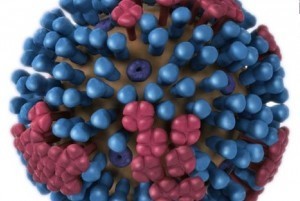
Note: number 1 is the article on “In vitro evolution of H5N1 avian influenza virus toward human-type receptor specificity” – that you read about here first.
ViroBlogy: serving the virology community…B-) Thank @MicrobeTweets!
Pandemic flu graphic courtesy of Russell Kightley Media
See on top25.sciencedirect.com
See on Scoop.it – Virology News
“In the third quarter of 2012, we announced that we had successfully produced significantly more than 10 million doses of H1N1 influenza VLP vaccine at our commercial-scale facility in North Carolina and completed the DARPA project. In addition, we announced FDA authorization to initiate a Phase I clinical trial with IDRI for an H5N1 VLP vaccine to explore the possibility of enhanced protection with one dose of vaccine, continued development of the quadrivalent seasonal flu vaccine, and signed a commercial agreement with Philip Morris Products for influenza vaccines in China,” said Andy Sheldon, President and Chief Executive Officer of Medicago. “In 2013, we expect to see results from at least three clinical trials, which would reinforce our position with governments and companies to secure revenues and grant opportunities.”
Read more here: http://www.sacbee.com/2012/11/09/4974415/medicago-announces-2012-third.html#storylink=cpy
Still Going Green: the sensible thing to do.
See on www.sacbee.com
See on Scoop.it – Virology News
“This is a concise, highly accessible introduction to medical virology, incorporating essential basic principles as well as a systematic review of viruses and viral diseases. It pays particular attention to developments in anti-viral therapy that are becoming increasingly effective in modern medicine. It is an ideal textbook for the information-overloaded student and an invaluable everyday companion for the busy professional who needs a good understanding of the current state of medical virology.
In keeping with the highly successful format of other Illustrated Colour Texts, it presents the subject as a series of succinct 2 page ‘learning units’, using a superb collection of clear illustrations and clinical photographs, concise yet comprehensive text and key point boxes to aid quick access to information and examination preparation.
So whether you are a medical student, junior doctor, medical scientist, trainee in infectious diseases or student on another allied medical course, this book is here to make your life easier! It will also provide a very solid foundation for any who plan to delve deeper into this fascinating field.”
It gives me great pelasure to be able to hype a book by colelagues from South Africa – and an eBook at that, given that it is available at a substantial discount for Kindle! I shall be downloading it soonest. Nice one, guys!
See on www.amazon.com
See on Scoop.it – Virology News
The great northwest of the U.S.is known for its natural beauty. It’s also a high-tech region with a highly educated public – …(To vaccinate, or not to vaccinate…a report that suggests you should:
See on www.vaccinews.net
See on Scoop.it – Virology News
MELBOURNE researchers have developed cows’ milk that can defend human cells against HIV.
Lead researcher, University of Melbourne’s Marit Kramski said they vaccinated pregnant cows – which cannot contract human immunodeficiency virus – with an HIV protein [Env?] and studied the first milk produced by the cow after birth.
HIV cases in Australia on the rise
Dr Kramski said this first milk, called colostrum, produced milk high in antibodies to protect its newborn against disease.
The researchers were able to inhibit the virus from infecting cells when “combing the virus cells with milk” [sic – I think they mean combining the virus with milk containing antibodies].
I think this is very interesting, and has potential for trial in monkeys – not humans, because there is the little problem of the antibodies that would go into a virucidal cream being from cows – meaning they would elicit an immune response, unlike the humanised anti-HIV monoclonals being made in plants by the Fraunhofer Institute.
Still, using cow’s milk is an inventive thing to do – and sounds like a very cheap source of antibodies. Except that colostrum is ONLY produced immediately after birth of a calf, so it will nothing like as cheap as milk.
See on www.heraldsun.com.au







 ViroBlogy