Muslim leaders enlisted to help stamp out polio

25 May, 2012

See on Scoop.itVirology News

GENEVA (Reuters) – The last three countries where polio is still paralyzing children — Afghanistan, Pakistan and Nigeria — said on Thursday that they have enlisted Muslim women and religious leaders to allay fears of vaccination and wipe out the disease.
Polio cases are at an all-time low worldwide, following its eradication in India last year, raising hopes but also fears about a threat of resurgence especially in sub-Saharan Africa unless remaining reservoirs of polio virus are stamped out.

Conflict and insecurity is preventing health workers from reaching hundreds of thousands of children in Afghanistan and Pakistan with doses of polio vaccine, health ministers said.

See on www.reuters.com

Radical Therapy for HIV-Infected People?

18 May, 2012

To mark HIV Vaccine Awareness Day, 18th May – Journal Club – Lucian Duvenage:

Excision of HIV-1 Proviral DNA by Recombinant Cell Permeable Tre-Recombinase

Mariyanna, L., Priyadarshini, P., Hofmann-Sieber, H., Krepstakies, M., Walz, N., Grundhoff, A., Buchholz, F., Hildt, E., Hauber, J., 2012. Excision of HIV-1 proviral DNA by recombinant cell permeable tre-recombinase. PloS One 7, e31576.

Introduction

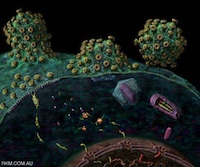
HIV Life Cycle. Russell Kightley Media, http://www.rkm.com.au

Highly active antiretroviral therapy (HAART) is a combination of drugs that has significantly elongated the lifespan HIV-infected people. HAART targets viral reverse transcriptase, protease and integrase. There are disadvantages including drug toxicity and the appearance of drug resistant HIV strains in people not adhering to or withdrawing from their treatment. There is a need for new therapies that not only block virus replication but also eliminate HIV from persistent viral reservoirs. An attractive option is Tre-recombinase, which been shown to excise provirus from the genomic DNA of infected cell cultures. The development of Tre recombinase is a previous publication (Sarkar, I., Hauber, I., Hauber, J., Buchholz, F., 2007. HIV-1 proviral DNA excision using an evolved recombinase. Science 316, 1912-5.)

The Tre recombinase was created from the Cre recombinase which is a well-known tool in mouse genetics. The authors were able to alter the specificity of the enzyme by many cycles of directed protein evolution.

The Cre recombinase precursor removes genomic DNA that is flanked by two loxP sites by recombination. The authors were able to alter the specificity for loxP sites to HIV-1 LTR (long terminal repeat) sites. LoxP and the HIV LTR had 50% sequence similarity.

The main problem with the development of antiviral agents is the delivery to infected cells in vivo, without causing adverse side effects.  There are many reported technologies for the delivery of macromolecules such as proteins, nucleic acids or peptides. The most popular currently is the use of protein transduction domains (PTD) also known as cell penetrating peptides (CPP) from different sources. These have been useful for the delivery of various genes and proteins, including site-specific recombinases. The best studied and most applied PTD’s are peptides derived from the basic domain of HIV-1 Tat. But recently a powerful cell permeable translocation motif (TLM) has been described. This TLM is derived from a hepatitis B virus surface antigen. This TLM peptide is able to enter cells very efficiently, without affecting the integrity of the cells, or interfering with intracellular signal transduction cascades.

This paper describes the delivery of Tre-recombinase into cells using these PTD’s including HIV Tat and the HBV TLM. These so-called cell-permeable Tre-recombinases could eventually be useful for antiretroviral therapy, especially for virus eradication.

Results

Proteins

Different protein fusions were created and expressed in E. coli ; Tre-recombinase is fused to His tag, with/without nuclear localisation signal (NLS) and with the PTD (HIV Tat) or TLM (translocation motif derived from hepatitis B) or TLM as an inverted repeat.

They tested the cellular toxicity of the protein at their highest concentration by alarmBlue assay in HeLa cells. The proteins were incubated with the cells for 48 h. None of the proteins had any significant effect on the cellular metabolism

Cell permeability

Interestingly, all of the proteins entered cells, even those without a PTD or nuclear translocation signal. The authors explain that the Cre enzyme precursor to Tre has been shown to transduce into mammalian cells without any help, and therefore it is likely that the Tre enzyme shares this property. The authors did remark that the signal intensities were higher for those proteins with a PTD, indicating higher transduction efficiency.

Analysis of Tre activity in HeLa cells

A transient reporter assay demonstrated the activity of the Tre fusions: The reporter construct contains the target LTR sites that flank a puromycin resistance gene. Tre enzyme activity results in the loss of this gene, and gives a smaller PCR product using primers that anneal to the vector backbone. Cells transfected with the reporter construct were incubated with the 1 µM of the various proteins for 5 hours. The positive control was co-transfected with a construct expressing the Tre enzyme. PCR was performed on DNA extracted from cells after 48 hours. The presence of the smaller PCR product indicated that recombination had happened, as in the positive control. All of the proteins had varying degrees of activity, but notably the protein with the TLM PTD had the highest activity, with no un-recombined product detected by the PCR.

The authors went on to demonstrate that the Tre fusion proteins were active on at the genomic level, i.e. on chromosomal DNA. They used cells with the reporter construct was stably integrated into the genome.

Interaction of proteins with LTR sequences in living T-cells

Co-immunoprecipitation (ChIP) assays were done on using HIV-1 -infected T-cells (CEM-SS) to demonstrate the interaction of two of the Tre fusion proteins with the HIV LTR target sequences. The results showed that the proteins interacted with target LTR sequences in the genome of infected T-cells.

Microarray

The authors performed a transcriptome anaylsis on cells exposed to the Tre fusion proteins, using human whole genome microarrays. They concluded that the proteins were unlikely to have a significant effect on gene expression in the host cells, as very few genes were regulated more than 2.5-fold.

Recombination of the full-length HIV proviral genome:

Up to this point, the Tre fusion proteins had been shown to be capable of excising reporter construct gene flanked by LTR sequences both at the episomal level and the chromosomal level. The authors also showed that the proteins bind to the target sequences in HIV-infected living T cells.

It was essential that the Tre fusions could excise that HIV proviral genome from the chromosomal DNA of HIV-infected cells. The aouthors generated HeLa cells and T cells infected with pseudotype HIV-1. These are cells with the full-length HIV provirus integrated into the genome.They chose one of their proteins (TLM fusion showing highest activity in the reporter assays) for transduction into these cells. After transduction, PCR was performed to detect the HIV circular recombination product. They found that the recombination activity increased in a dose-dependent manner in both the HeLA cells and the T-cells. They also sequenced the PC products and were able to confirm HIV sequences.

Discussion

Some novel therapies for the treatment of HIV focus on the eradication of the virus in infected individuals. These include RNA-based technologies such as RNA aptamers, siRNA and ribozymes, but while these have shown to reduce viral load and viral replication, they have so far failed in virus eradication. A recent approach aimed at virus eradication is the reduction of surface CCR-5 receptors, through the expression of engineered zinc finger nucleases. This results in fewer CCR-5 surface receptors and could prevent new infection by CCR-5 tropic HIV.

The other approach is the use of site specific recombinases like Tre, which can excise the provirus from the host genome, thus potentially eradicating the virus from the individual. Ideally, the gene expressing Tre could be delivered to and expressed in target cells using a viral vector. But there are safety concerns as most of these are derived from pathogenic viruses. Therefore it may be advantageous to deliver the Tre enzyme directly to host cells. One way of doing this is through protein translocation domains (PTD’s). Protein transduction domains (PTD’s) can deliver bioactive molecules, including genes, siRNA, proteins or liposomes into all types of cells in vitro and furthermore into various organs in vivo. But they have not been applied yet for human use. PTD’s are easily fused to any target protein through cloning and expression of the fusion protein. The LTM used in this paper, derived from hepatitis B virus surface antigen, has low immunogenicity and high spreading capacity.

One strategy of using cell-permeable Tre enyme could be to harvest T-cells from the patient by apheresis and transduce them in vitro. They could then potentially be expanded and reinfused into the patient. This could complement or even replace gene transfer procedures.

In this paper the expressed Tre fusion proteins could enter cells and act on the target sequences to excise the HIV provirus from the genome, but the Tat fusion and the TLM fusion had higher activity than those that didn’t have a PTD tag. In particular, fusion to the newly described domain (TLM) from hepatitis B was resulted highest activity. This may explained by the fact that, in contrast to HIV Tat, TLM does not rely on endocytosis to enter cells. This might preserve enzyme activity and protein half-life.

In conclusion, cell permeable Tre enzyme could eventually be useful as an anti-HIV therapy in the post-HAART era.
Measles — United States, 2011 MMWR

16 May, 2012

See on Scoop.itVirology and Bioinformatics from Virology.ca

“In 2000, the United States achieved measles elimination (defined as interruption of year-round endemic measles transmission) (1). However, importations of measles into the United States continue to occur, posing risks for measles outbreaks and sustained measles transmission. During 2011, a total of 222 measles cases (incidence rate: 0.7 per 1 million population) and 17 measles outbreaks (defined as three or more cases linked in time or place) were reported to CDC, compared with a median of 60 (range: 37–140) cases and four (range: 2–10) outbreaks reported annually during 2001–2010. This report updates an earlier report on measles in the United States during the first 5 months of 2011 (2). Of the 222 cases, 112 (50%) were associated with 17 outbreaks, and 200 (90%) were associated with importations from other countries, including 52 (26%) cases in U.S. residents returning from abroad and 20 (10%) cases in foreign visitors. Other cases associated with importations included 67 (34%) linked epidemiologically to importations, 39 (20%) with virologic evidence suggesting recent importation, and 22 (11%) linked to cases with virologic evidence of recent importation. Most patients (86%) were unvaccinated or had unknown vaccination status.


The increased numbers of outbreaks and measles importations into the United States underscore the ongoing risk for measles among unvaccinated persons and the importance of vaccination against measles (3).”


Amen!!  It is VERY revealing that so many cases were associated with imported virus infections – 90%!!  And almost HALF of those came from Europe, rather than from some developing country.


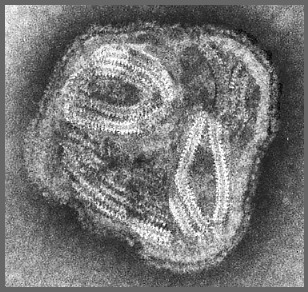
I thank Linda Stannard for the paramyxovirus EM

See on www.cdc.gov

Journal Virol Methods – A simple, rapid and efficient way to obtain infectious clones of potyviruses

16 May, 2012

See on Scoop.itVirology and Bioinformatics from Virology.ca

“The availability of an infectious cDNA clone is a prerequisite for genetic studies on RNA viruses. However, despite important improvement in molecular biology techniques during the last decades, obtaining such clones often remains tedious, time-consuming and rather unpredictable. In the case of potyviruses, cDNA clones are frequently unstable due to the toxicity of some viral proteins for bacteria. The problem can be overcome by inserting introns into the viral sequence but this requires additional steps in the cloning process and depends on the availability of suitable restriction sites in the viral sequence or adjunction of such sites by mutagenesis. Homologous recombination in yeast rather than in vitro restriction and ligation can be used to build infectious clones or other viral constructs. This paper describes how, by using recombination in yeast and fusion PCR, infectious intron-containing clones were obtained within a few weeks for two strains of watermelon mosaic virus (WMV, Potyvirus), whereas previous attempts using “classical” cloning techniques had failed repeatedly. Using the same approach, intronless infectious clones of two other potyviruses, zucchini yellow mosaic virus (ZYMV) and papaya ringspot virus (PRSV), were obtained in less than two weeks.”


I am a sucker for good techniques like this one: long ago I helped invent a technique for idiot-proof cDNA cloning of the 3′ of the genome (Pappu et a., J Virol Methods. 1993 Jan;41(1):9-20), and have kept a watchful eye on potyvirus genome cloning ever since – and it is a challenge, because they are >10kb in length.  This is an elegant solution to an old problem.

See on www.sciencedirect.com

Small Things Considered: Are Phages the Answer?

15 May, 2012

See on Scoop.itVirology News

by S. Marvin Friedman

“The emergence of multiple drug-resistant bacterial strains, the prevalence of recalcitrant biofilm configurations, and the reluctance of the pharmaceutical industry to initiate new antibiotic discovery programs have led to the development of a formidable population of bacterial pathogens that is increasingly difficult to control. After a long but successful era of research that had all but eliminated serious threats from bacterial infections, we are now facing this dire problem once again. In response, researchers have recently been exploring alternative approaches to antibiotic therapy including identifying chemical agents that antagonize quorum sensing and thus prevent population-wide expression of virulence genes, as well as employing either intact bacteriophages or their isolated lysins to directly kill their pathogenic bacterial hosts. Lysins kill Gram-positive bacteria by hydrolyzing the peptidoglycan in the cell wall, thereby causing cell lysis. Gram-negative bacteria are immune to their action because their outer membrane does not allow the lysins access to their peptidoglycan. I will now summarize two recent papers that use intact phages to combat two important bacterial pathogens, both in vitro and in vivo.”


As a new-minted phage enthusiast, and a fan of Small Things Considered, I am more than happy to reblog this.  I think phages may well be the answer to multiply- or extreme-resistant bugs, and in the long term will probably prove to be a better answer than antibiotics in general.


After all, they can evolve – and penicillin can’t.  Moreover, we can select them out of the environment and then select them rigorously in the lab, to pretty much get anything we want.


You gotta love viruses…B-)

See on schaechter.asmblog.org

Apple Goes To Kaspersky For Virus Advice

15 May, 2012

See on Scoop.itVirology News

Apple is no longer the safe choice for computer shoppers as various malicious software downloads have become available over the last several months.


I watch and wait nervously….

See on www.inquisitr.com

Taking Truvada to Prevent H.I.V. Also Comes With Risks

15 May, 2012

See on Scoop.itVirology News

Taking Truvada daily can help people in at-risk groups prevent H.I.V. infection, but the consequences of loose adherence go beyond contracting the virus.

A panel of advisers to the Food and Drug Administration took a historic step last week when they recommended that the agency for the first time approve a drug that healthy people can take once a day to prevent H.I.V. infection.
Such a pill has long been a goal of research, something that might help stem a global epidemic that is still causing two million new worldwide cases each year, including 50,000 in the United States.

But the panel members worried about how to make sure doctors and patients would use the drug correctly. Otherwise, they said, the potential harm could be huge — not just to those taking the pill, but also to their sexual partners.


While this is a very important step towards preventing HIV infection, it is equally important to remember that it IS only a step – and not the final solution.  Condoms remain the better option, in that a barrier is better than a drug; however, the chemical option may help curb the spread of the virus where other measures have not.


Until we get vaccines!!

See on www.nytimes.com

Shingles Vaccine Deemed Safe in Large Study

11 May, 2012

See on Scoop.itVirology News

The shingles vaccine is “generally safe and well tolerated,” according to a study of nearly 200,000 patients.

Shingles, or herpes zoster, is a painful rash caused by reactivation of chickenpox virus that has remained dormant in the body. Up to 1 million Americans, more than half of whom are 60 or older, are diagnosed with shingles every year, the researchers write.

Researchers analyzed data of 193,083 vaccinated patients aged 50 or older for certain side effects that could be related to the shingles vaccine.

The researchers found no increased risk in the first six weeks after vaccination for stroke, heart disease, infections of the brain or spinal cord or other brain diseases, Bell’s palsy, or Ramsay-Hunt syndrome, which can occur when the virus that causes shingles affects the facial nerve near an ear.

An increased risk of allergic reaction was found in the first week after receiving the shingles vaccine.

A majority of these reactions involved an inflammatory response at the injection site, involving symptoms such as redness, swelling, and mild pain.

See on www.webmd.com

Ostrich culling almost complete

11 May, 2012

See on Scoop.itVirology News

“CAPE TOWN – The Western Cape Agriculture Department on Monday said it planned to complete the culling of ostriches affected by bird flu in the Karoo by the end of this week.

Agriculture MEC Gerrit van Reinsburg met with industry players in Oudtshoorn earlier.

More than 40,000 ostriches have been culled since the initial outbreak of avian influenza in March 2011.

The European Union also imposed a ban on South African ostrich exports at a cost of hundreds of millions of rand to affected farmers.

The EU imported 90 percent of South Africa’s ostrich meat.

The department’s Wouter Kriel said, “The Department of Agriculture will conclude the culling operation that has been ongoing for the past year in the ostrich industry. The last 360 ostriches will be culled this week.”

The department said it would monitor the area carefully in the following weeks.

The department will in the next three months apply to the EU for the resumption of ostrich exports.

According to the department, the entire Klein Karoo Valley, home to about 70 percent of the country’s ostrich industry, was affected by the outbreak.

The affected farmers received R50 million in compensation from the national government.”


And you know why they have to cull them, when there ARE vaccines available?  Because the EU does not like ostriches with antibodies to influenza viruses.  Because they steadfastly refuse to step into the 21st century, and allow use of tests which disciminate vaccinated and infected birds.

See on www.eyewitnessnews.co.za

FDA advisers back first drug to prevent HIV – AIDS/HIV -Drug News –

11 May, 2012

See on Scoop.itVirology News

The first drug shown to prevent HIV infection won the endorsement of a panel of federal advisers Thursday, clearing the way for a landmark approval in the 30-year fight against the virus that causes AIDS.

In a series of votes, a Food and Drug Administration advisory panel recommended approval of the daily pill Truvada for healthy people who are at high risk of contracting HIV, including gay and bisexual men and heterosexual couples with one HIV-positive partner.

The FDA is not required to follow the panel’s advice, though it usually does. A final decision is expected by June 15.

Read more: FDA advisers back first drug to prevent HIV – AIDS/HIV -Drug News – http://www.health.am/ab/more/fda-advisers-back-first-drug-to-prevent-hiv/#ixzz1uYkFqEmo

See on www.health.am