ScienceDirect.com – Virus Research – Genomic characterization of seven distinct bat coronaviruses in Kenya

8 May, 2012

See on Scoop.itVirology News

“To better understand the genetic diversity and genomic features of 41 coronaviruses (CoVs) identified from Kenya bats in 2006, seven CoVs as representatives of seven different phylogenetic groups identified from partial polymerase gene sequences, were subjected to extensive genomic sequencing. As a result, 15–16 kb nucleotide sequences encoding complete RNA dependent RNA polymerase, spike, envelope, membrane, and nucleocapsid proteins plus other open reading frames (ORFs) were generated. Sequences analysis confirmed that the CoVs from Kenya bats are divergent members of Alphacoronavirus and Betacoronavirus genera. Furthermore, the CoVs BtKY22, BtKY41, and BtKY43 in Alphacoronavirus genus and BtKY24 in Betacoronavirus genus are likely representatives of 4 novel CoV species. BtKY27 and BtKY33 are members of the established bat CoV species in Alphacoronavirus genus and BtKY06 is a member of the established bat CoV species in Betacoronavirus genus. The genome organization of these seven CoVs is similar to other known CoVs from the same groups except for differences in the number of putative ORFs following the N gene. The present results confirm a significant diversity of CoVs circulating in Kenya bats. These Kenya bat CoVs are phylogenetically distant from any previously described human and animal CoVs. However, because of the examples of host switching among CoVs after relatively minor sequence changes in S1 domain of spike protein, a further surveillance in animal reservoirs and understanding the interface between host susceptibility is critical for predicting and preventing the potential threat of bat CoVs to public health.”


We need to start worrying about MORE viruses from bats??  I knew those caves were a bad idea….

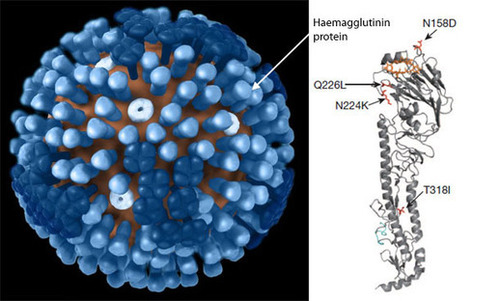
Graphic from Russell Kightley Media

See on www.sciencedirect.com

Protalix Soars on FDA Approval of Gaucher Drug: Tel Aviv Mover

7 May, 2012

See on Scoop.itVirology News

“Protalix BioTherapeutics Inc. soared in Tel Aviv trading after the biopharmaceutical company’s first product won approval from the U.S. Food and Drug Administration.

Protalix expects approval to sell its Gaucher disease drug in Israel soon, Aviezer said. Israel has at least 500 patients affected with the illness, he said. The company also is awaiting a regulatory decision in the European Union.
“This is a biotechnology milestone as it it the first time the FDA has approved a product that was engineered in plant cells, as opposed to mammalian or bacterial-based systems,” Yoav Kedar, a biotechnology consultant for Clal Finance Brokerage Ltd., said in an interview. “The approval will better position the company to receive approvals in Europe, Israel and Brazil.”
Gaucher disease can cause fat to build up in the liver, spleen, bone marrow and nervous system. About 1 in 14 individuals of Ashkenazi Jewish ancestry carries the mutated gene that can cause the illness, and as many as 1 in 500 present a form of the disorder.”


This is a seriously big deal, and I have blogged on it here before: this is a plant-made bio-better, now licenced for human use as a therapeutic ofr a nasty genetic disease.  It should compete well, given that other offerings are made in mammalian cells – and one manufacturer’s output was recently shut down completely due to a viral infection of their cell cultures, which is what led to accelerated approval for Protalix’s product.


Going green…you know the rest.

See on www.bloomberg.com

Landes Bioscience Journals: Human Vaccines & Immunotherapeutics

7 May, 2012

See on Scoop.itVirology News

Rapid production of influenza vaccine antigen is an important challenge when a new pandemic occurs. Production of recombinant antigens in plants is a quick, cost effective and up scalable new strategy for influenza vaccine production.  In this study, we have characterized a recombinant influenza haemagglutinin antigen (HAC1) that was derived from the 2009 pandemic H1N1 virus and expressed in tobacco plants. Volunteers vaccinated with the 2009 pH1N1 oil-in-water adjuvanted vaccine provided serum and lymphocyte samples that were used to study the immunogenic properties of the HAC1 antigen in vitro. By 7 d post vaccination, the vaccine fulfilled the licensing criteria for antibody responses to the HA detected by haemagglutination inhibition and single radial hemolysis. By ELISA and ELISPOT analysis we showed that HAC1 was recognized by specific serum antibodies and antibody secreting cells, respectively. We conducted a kinetic analysis and found a peak of serum HAC1 spec antibody response between day 14 and 21 post vaccination by ELISA. We also detected elevated production of IL-2 and IFNγ and low frequencies of CD4+ T cells producing single or multiple Th1 cytokines after stimulating PBMCs (peripheral blood mononuclear cells) with the HAC1 antigen in vitro. This indicates that the antigen can interact with T cells, although confirming an effective adjuvant would be required to improve the T-cell stimulation of plant based vaccines. We conclude that the tobacco derived recombinant HAC1 antigen is a promising vaccine candidate recognized by both B- and T cells.


Fraunhofer USA, waving the Green Vaccine flag: way to go….

See on www.landesbioscience.com

Setting up a platform for plant-based influenza virus vaccine production in South Africa

5 May, 2012

A virus-like particle formed by influenza virus haemagglutinin budding out of plant cells. By Russell Kightley Media

See it also on Scoop.itVirology News

Our (very) recently-published article on plant-made flu vaccines in BMC Biotechnology:

Setting up a platform for plant-based influenza virus vaccine production in South Africa

Elizabeth Mortimer, James M Maclean, Sandiswa Mbewana, Amelia Buys, Anna-Lise Williamson, Inga I Hitzeroth and Edward P Rybicki

Background
During a global influenza pandemic, the vaccine requirements of developing countries can surpass their supply capabilities, if these exist at all, compelling them to rely on developed countries for stocks that may not be available in time. There is thus a need for developing countries in general to produce their own pandemic and possibly seasonal influenza vaccines. Here we describe the development of a plant-based platform for producing influenza vaccines locally, in South Africa. Plant-produced influenza vaccine candidates are quicker to develop and potentially cheaper than egg-produced influenza vaccines, and their production can be rapidly upscaled. In this study, we investigated the feasibility of producing a vaccine to the highly pathogenic avian influenza A subtype H5N1 virus, the most generally virulent influenza virus identified to date. Two variants of the haemagglutinin (HA) surface glycoprotein gene were synthesised for optimum expression in plants: these were the full-length HA gene (H5) and a truncated form lacking the transmembrane domain (H5tr). The genes were cloned into a panel of Agrobacterium tumefaciens binary plant expression vectors in order to test HA accumulation in different cell compartments. The constructs were transiently expressed in tobacco by means of agroinfiltration. Stable transgenic tobacco plants were also generated to provide seed for stable storage of the material as a pre-pandemic strategy.

Results
For both transient and transgenic expression systems the highest accumulation of full-length H5 protein occurred in the apoplastic spaces, while the highest accumulation of H5tr was in the endoplasmic reticulum. The H5 proteins were produced at relatively high concentrations in both systems. Following partial purification, haemagglutination and haemagglutination inhibition tests indicated that the conformation of the plant-produced HA variants was correct and the proteins were functional. The immunisation of chickens and mice with the candidate vaccines elicited HA-specific antibody responses.

Conclusions
We managed, after synthesis of two versions of a single gene, to produce by transient and transgenic expression in plants, two variants of a highly pathogenic avian influenza virus HA protein which could have vaccine potential. This is a proof of principle of the potential of plant-produced influenza vaccines as a feasible pandemic response strategy for South Africa and other developing countries.”

I have mentioned time and again that going green is the sensible thing to do: here is a concrete example of how my research group is trying to go about it.  This is a very sensible technology for rapid-response vaccine production, and especially for emerging or orphan or pandemic virus threats.  We got really good expresion levels of H5N1 HA protein via transient expression in plants, and have already started on pandemic H1N1 HA expression.  Let’s hope some governmental types in SA take some notice!

I thank Russell Kightley Media for the specially-commissioned graphic of budded HA-only VLPs.


HIV/AIDS: New book tracks the epidemic to its origins

4 May, 2012

See on Scoop.itVirology News

We’ve all heard the myths and hypotheses about the origins of the epidemic caused by the HI virus, but a new book, “Tinderbox: How the West Sparked the AIDS Epidemic and How the World Can Finally Overcome It”, sheds more light on where it all began.


I’ve covered this before, but it’s a nice review – complete with spoilers like how Beatrice Hahn and team have shown that a chimpanzee SIV from Cameroon is the closest relative of HIV-1 group M viruses.  The gun doesn’t smoke more than that.

See on www.plusnews.org

Religious sites ‘riskier than porn for viruses’ – Ninemsn

4 May, 2012

See on Scoop.itVirology News

CIO TodayReligious sites ‘riskier than porn for viruses’NinemsnWeb wanderers are more likely to get a computer virus by visiting a religious website than by peering at porn, according to a study released on Tuesday.


I love it: Dawkins was right!  Religion IS a virus….

See on news.dc1.ninemsn.com.au

Flu research: How to make bird flu transmissible…

4 May, 2012

See on Scoop.itVirology News

“On April 27th, after much toing and froing, the Dutch government gave Ron Fouchier of the Erasmus Medical Centre in Rotterdam permission to submit his paper on bird flu to Science.”


And so it FINALLY comes to pass – two papers that SHOULD have been published weeks ago, finally see the light.

See on 9thlevel.ie

Mutant flu paper is finally published, reveals pandemic potential of wild viruses | Not Exactly Rocket Science | Discover Magazine

3 May, 2012

See on Scoop.itVirology News

“It’s finally out. After months of will-they-won’t they and should-they-shouldn’t-they deliberations, Nature has finally published a paper about a mutant strain of bird flu that can spread between mammals.”


This is the Kawaoka paper, which in fact was the LESS contentious one.  Ed Yong in Discover magazine comes up with four important themes from the paper, which to my mind show we were right to agitate and demand that the material be published.


One: H5N1 can evolve to spread between mammals with worrying ease

Two: There appear to be two traits that make for a transmissible virus – specificity and stability.

Three: It’s not the mutations that matter, but what they do. Or, don’t miss the wood for the trees.

Four: Wild viruses are almost there.


One and four are the important points: flu viruses can evolve quickly and easily, and wild H5N1 is nearly at the point that it will leap into mammals.  The virus is endemic in several countries, like Indonesia, where wild birds, tame birds, pigs and people rub shoulders on a daily basis: this is a natural melting pot for influenza virus reassortment and adaptation, that may at any moment see a pandemic virus burst out.

Or not – it may as easily be a H7NX virus that will be The Big One.

But it is as well to be prepared – and censorship wasn’t going to allow that.

Thanks @AJCann for alerting me to this.

See on blogs.discovermagazine.com

An examination of the bacteriophages and bacteria of the Namib desert

30 April, 2012

See on Scoop.itVirology News and here

“Bacteria and their viruses (called bacteriophages, or phages), have been found in virtually every ecological niche on Earth. Arid regions, including their most extreme form called deserts, represent the single largest ecosystem type on the Earth’s terrestrial surface. The Namib desert is believed to be the oldest (80 million years) desert. We report here an initial analysis of bacteriophages isolated from the Namib desert using a combination of electron microscopy and genomic approaches. The virus-like particles observed by electron microscopy revealed 20 seemingly different phage-like morphologies and sizes belonging to the Myoviridae and Siphoviridae families of tailed phages. Pulsed-field gel electrophoresis revealed a majority of phage genomes of 55-65 kb in length, with genomes of approximately 200, 300, and 350 kb also observable. Sample sequencing of cloned phage DNA fragments revealed that approximately 50% appeared to be of bacterial origin. Of the remaining DNA sequences, approximately 50% displayed no significant match to any sequence in the databases. The majority of the 16S rDNA sequences amplified from DNA extracted from the sand displayed considerable (94-98%) homology to members of the Firmicutes, and in particular to members of the genus Bacillus, though members of the Bacteroidetes, Planctomycetes, Chloroflexi, and delta-Proteobacteria groups were also observed.”

This serves as a neat, if slightly dated, little introduction to my latest endeavour – and an account of a field trip this last week into the Namib Desert.

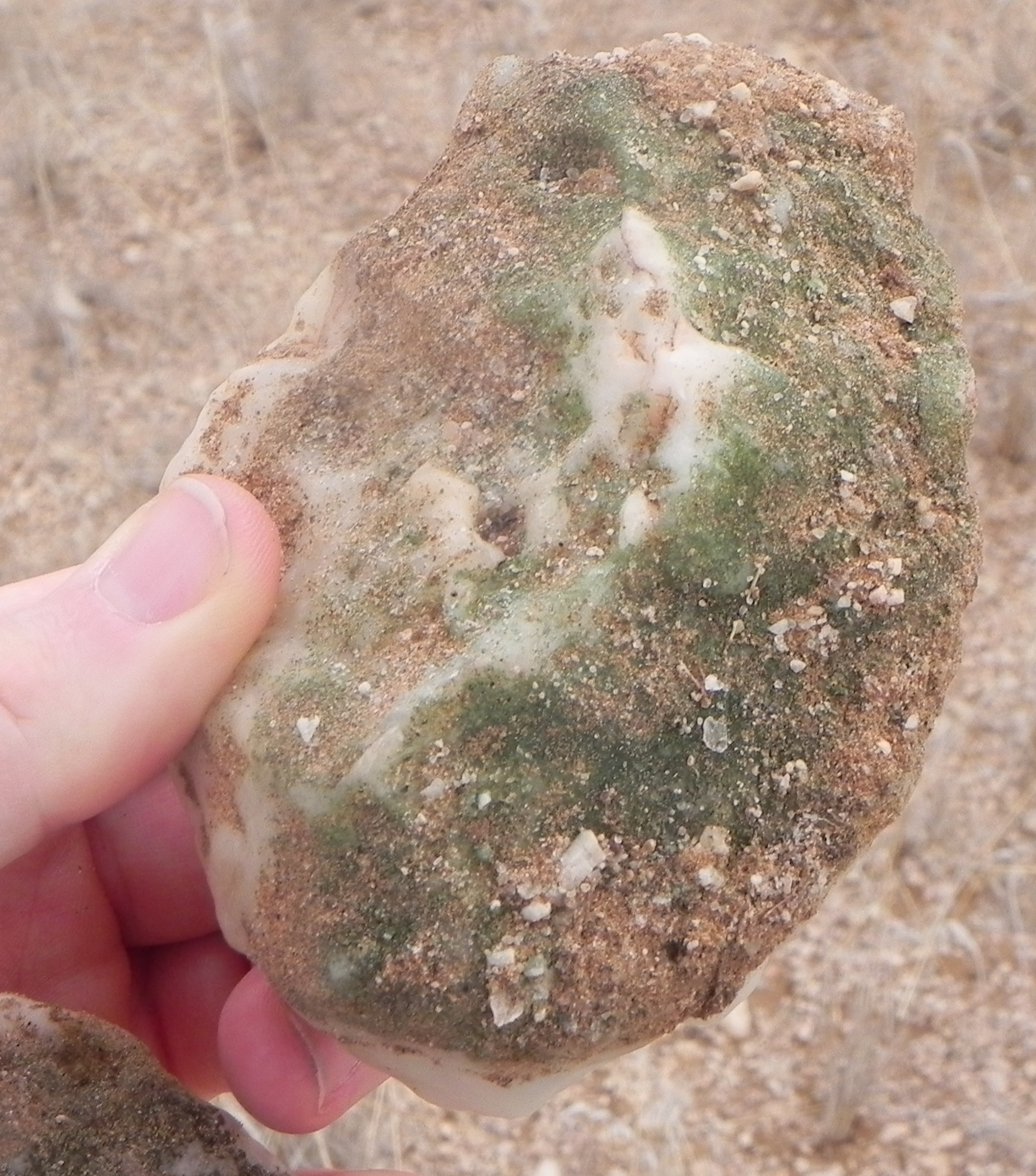
I was fortunate enough some time ago to have been invited by Don Cowan, presently of University of Pretoria, to accompany his team to the Gobabeb Research and Training Centre inland of Walvis Bay, in Namibia’s Namib Desert.  They work on extremophiles, and the Namib is a great environment for mining bugs that can withstand high salt and temperatures and severe desiccation – oh, and photosynthesise underground, hiding under semi-tranlucent quartz rocks embedded in the surface soil.  The thinking was that, given my long-time interest in viral diversity and newly-acquired means to do oceanic viromics, I would be interested and even of some help.

And so it has come to pass: I will have my very own hypolith (=rock-colonising blue-green algae) scrapings and the result of diafiltration and concentration of washings of a good few kilos of red dune sand to play with as far as virus genome sequencing and even EM and analytical centrifugation go.

Typical quartz-associated hypolith

We will have fun in the coming months…that, and we will obviously HAVE to go back to Gobabeb, to further investigate whatever it is we find.  A terrible, harsh place, but SOMEONE has to go there…B-)

Nothing beside remains...boundless and bare
The lone and level sands stretch far away
PB Shelley, Ozymandias

Env-less endogenous retroviruses are genomic superspreaders

30 April, 2012

See on Scoop.itVirology News

Endogenous retroviruses (ERVs) differ from typical retroviruses in being inherited through the host germline and therefore are a unique combination of pathogen and selfish genetic element. Some ERV lineages proliferate by infecting germline cells, as do typical retroviruses, whereas others lack the env gene required for virions to enter cells and thus behave like retrotransposons. We wished to know what factors determined the relative abundance of different ERV lineages, so we analyzed ERV loci recovered from 38 mammal genomes by in silico screening. By modeling the relationship between proliferation and replication mechanism in detail within one group, the intracisternal A-type particles (IAPs), and performing simple correlations across all ERV lineages, we show that when ERVs lose the env gene their proliferation within that genome is boosted by a factor of ∼30. We also show that ERV abundance follows the Pareto principle or 20/80 rule, with ∼20% of lineages containing 80% of the loci. This rule is observed in many biological systems, including infectious disease epidemics, where commonly ∼20% of the infected individuals are responsible for 80% of onward infection. We thus borrow simple epidemiological and ecological models and show that retrotransposition and loss of env is the trait that leads endogenous retroviruses to becoming genomic superspreaders that take over a significant proportion of their host’s genome.


I love it: retroviruses that choose to spread WITHIN a cell’s genome, rather than between cells.  Safe little niche, as long as it keeps dividing!

See on www.pnas.org