Archive for the ‘Uncategorized’ Category

Refutation of some rank nonsense

15 August, 2025

I had the misfortune today to follow a link to my page on History of Discovery of Viruses, which is included in Cann’s Principles of Molecular Virology that I revised in 2023 for a 7th Edition. This landed me here, which I thought was a serious page on the history of Virology – but I was very wrong.

Very, very wrong.

Instead, it is a densely-written, pseudoscientific collection of incorrect assumptions, applications of hopelessly dated definitions, and bold statements of “fact” that are entirely horseshit. I have commented there, but I doubt my comment will survive. Instead, I reproduce it here for your delectation. Or amusement. Don’t bother to be outraged and accuse me of anything that proves to me that you are a virus denialist, because I shall simply delete it.

“Given that you refer to me, I feel at liberty to comment on your entire piece of “work” that you have laid out here.

That is, that it is a complete and unmitigated crock of shit. The seemingly blind insistence that early workers with viruses did not isolate an “organism” or satisfy Koch’s Postulates – which were, by the way, just that and not rules – presumes that their observations were invalid and that, by extension, all modern virology is based on falsehoods.

Which, as a virologist of nearly fifty years standing, I can categorically state is a complete and utter crock of shit, as I stated previously.

Don’t you think science has advanced since Beijerinck, Mayer and Ivanovsky? Don’t you think that the invention of the electron microscope and discovery of both DNA AND RNA as genetic materials (the latter only for viruses and viroids) has shown us that, yes indeed, there ARE “sub-microscopic” pathogens that are acellular and which have to use cellular ribosomes to complete their life cycles – unlike any other form of life.

I have used the discovery of TMV – which text you apparently refer to (https://rybicki.blog/2012/02/07/a-short-history-of-the-discovery-of-viruses-part-2/) – and various other discoveries about TMV to tie together the scientific discoveries about viruses, over an 80+ year period. That is, the demonstration that an “acellular” fluid could cause plant disease, through to the precise localisation of every atom in the structure of TMV virions by X-ray crystallography. I have included this in a textbook that you should obviously read (https://www.sciencedirect.com/book/9780128227848/canns-principles-of-molecular-virology), in that it would illuminate some gaping voids in your knowledge and in your understanding.

Moreover, people working in my lab have, as others have done elsewhere, recreated infectious virus genomes by synthesis of DNA oligonucleotides and subsequent use of them to infect plants – and mammalian cells. Viruses are real, therefore, and any amount of hand-waving on your behalf will not alter that fact.”

Plasticity of viral genomes and new receptors

15 July, 2024

I was prompted to go on a bit of a rave – pardon, to expand on some long-held opinions – on Bluesky the other day (@edrybicki.bsky.social) after reading this post from Daniel Goldhill (@influenzal.bsky.social):

“I wrote a short piece about a new flu subtype (H19) which uses a surprising receptor. We’ve known about glycans terminating in sialic acid as a receptor for flu for 70 years but the virus still surprises us! Great work by Karakus et al.

I quoted his comment – “Perhaps, the ancestors of all extant viruses had to be flexible in their ability to switch to new receptors.” by saying:

“And perhaps quite a few still are??”

So let me expand a bit on that: it’s a bit dismaying how many people are still wedded to the “one enzyme/protein, one function” paradigm – which was never true, and which basically was a convenient fiction to make biochemists happy. The fact is that proteins are happy to bind to ANYTHING you can think of, and probably quite a few that you can’t, by simple virtue of accidental molecular complementarity, somewhere in their structure – and given that classic virus envelope glycoproteins are pretty big AND multimerised, that’s a lot of structure. Meaning that, like any good scientist, envelope proteins can hold more than one receptor in mind, and some of their binding may be completely adventitious AT FIRST – however, if it is selected for (more virions enter cells, or do it faster), then suddenly it becomes a virtue, and – new tissue tropisms / higher infectivity result(s). I am spurred on here by the example of SARS-CoV-2 S protein, which has mutated in front of our morbidly fascinated eyes since early 2020 to increase its binding affinity to human ACE2 by orders of magnitude, which has resulted in greatly increased infectivity and a significant increase in R0 for virions.

Thus, expecting that any given given viral membrane glycoprotein will only bind ONE receptor is naive: it will bind one (or more) WELL, and others badly – until selection occurs, because the new property is a survival mechanism when faced with neutralising Abs, for example. Viruse genomes are plastic: they change quickly to adapt to adverse environments, and even small changes that confer only slight advantages, will be selected for, and then reselected and improved over time. That this could result in the HA of an influenzavirus being first, able to bind another molecule than the sialic acid-bearing glycoproteins that are the canonical receptors; second, improving that binding by selection of mutations that improve binding affinity; third, losing the ability to bind the original receptor while preserving the new interaction, should not come as a surprise to any serious virologist. Moreover, these sorts of receptor changes / additions are almost certainly still going on, rather than being an ancestral condition.

And yes, this is going into the new edition of Cann’s Principles of Molecular Virology, whenever that comes out 😁

First WHO/MPP mRNA Technology Transfer Programme Meeting

5 October, 2023

Westin Hotel, Cape Town, South Africa

17-21 April 2023

In June 2021 the World Health Organisation (WHO) and the Medicines Patent Pool (MPP) announced the establishment of a Technology Transfer Programme for mRNA vaccines in South Africa. The centre to enable this was to be hosted by Afrigen Ltd, the Biovac Institute and the South African Medical Research Council (SAMRC), and would share technology and expertise with another 14 biomanufacturing partners distributed among low and middle-income countries (LMICs), in a hub-and-spoke model.

The Programme has four main objectives:

  1. To establish or enhance sustainable mRNA vaccine manufacturing capacity in regions with no or limited capacity;
  2. To introduce new technologies in LMICs and promote regional research and development;
  3. To strengthen regional biomanufacturing expertise and workforce development;
  4. To develop regulatory capabilities and personnel to support and accelerate regional approval and distribution of mRNA vaccines.

The meeting in Cape Town was the first of a proposed annual series between Programme partners and international stakeholders, with the objective of reviewing the progress of the Programme, sharing experience on vaccine development among the partners, and discussing business models, IP issues and regulatory aspects pertaining to mRNA vaccines. Martin Friede of WHO, the coordinator of their Initiative for Vaccine Research, introduced the context and objectives for the meeting – and popped up frequently throughout the course of it to offer comment on the WHO’s view of the Programme. Over 200 delegates attended, with a very healthy representation from partner institutions and their scientists, making this – for a change – an LMIC-dominated meeting.

Rick Bright – CEO of Bright Global Health – set the stage for later presentations with a very valuable account of the lessons learned from the WHO’s Technology Transfer Programme for influenza vaccines, that ran from 2006-2016 and assisted 9 of the original 14 LMIC vaccine manufacturing partners to develop or strengthen influenza vaccine manufacturing. This was followed by an overview of the Programme by WHO/MPP, then a report on implementation at the Centre for mRNA Technology Development and Transfer at Afrigen Ltd. in Cape Town by the Afrigen CEO, Petro Terblanche. She reported that since the launch in July 2021, the Centre now had all main equipment in place, had successfully produced COVID-19 mRNA vaccine at lab scale, was presently scaling up to commercial production levels, and had run numerous training sessions for partner country personnel.

There followed an informative session on business models, including a presentation on technoeconomic modelling of mRNA manufacture by Zoltan Kis of the University of Sheffield, who proposed the concept of having a facility to routinely make biologics such as monoclonal antibodies (mAbs), with a bolt-on mRNA facility that would do two campaigns a year – 188 000 doses/year at 50 ug/dose – to keep the facility “warm”.

Sessions on the global regulatory environment and the development agenda helped inform delegates of the complexities of both topics, with a heavyweight panel from as varied a collection as the Ministry of Health in Argentina, the European Investment Bank, the German Federal Ministry for Economic Cooperation and Development (BMZ), the Islamic Development Bank and the International Finance Corporation discussing investment and business development.

Tuesday the 18th kicked off with a session presented by the Medicines Patent Pool, which outlined the IP strategy suggested for the Programme, and a brief summary of the IP landscape. Given the plethora of patents applied for with the huge upsurge of interest in mRNA technology with the COVID-19 pandemic, the MPP sought to simplify the fraught process of due diligence by anyone wishing to enter this field by compiling a living database called VaxPal, a free resource providing information on the patent status of COVID-19 vaccines worldwide. This includes information not only on Moderna, BioNTech and CureVAC’s vaccines, but also on lipid nanoparticle (LNP) formulation and modifications to RNA such as use of modified nucleotides, capping enzymes and RNA terminal sequences leading to improved expression.

In what was one of the most important set of talks at the meeting, the 15 partner institutions – with 7 of 15 companies / institutes having “Bio” in their name – were then given a slot each to describe their actual or proposed implementation of mRNA vaccine technology. The single most impressive aspect of a number of these was the sheer size of their established biomanufacturing capacity.

Bio-Manguinhos from Brazil has developed since 1976 into a major national vaccine producer, with more than 233 million doses of vaccines –153 million doses of COVID-19 vaccine alone – to the Brazilian National Immunisation Program (PNI), as well as 5.4 million vials/syringes of biopharmaceuticals and 26.5 million in vitro diagnostic tests. Their proposed targets for mRNA vaccines were influenza viruses (100M doses) and leishmania, as well as flaviviruses like yellow fever virus, for which they are one of the world’s largest producers. They are also continuing to develop an alphavirus-based self-replicating RNA vaccine.

Biofarma from Indonesia is also a major vaccine producer, with a pentavalent diphtheria, tetanus, pertussis, hepatitis B, and Haemophilus influenzae type b vaccine for children, as well as supplying two-thirds of the world’s polio vaccines.

Darnitsa in the Ukraine has since since 2002 had GMP certification, harmonised with the EMEA, and presently has the biggest pharmaceutical sales in Ukraine with 181 products and 60+ in development.

Incepta Pharmaceuticals Ltd in Indonesia was established in 2001 and was producing drugs by 2011. It now has 10 000 employees, makes 255 generics including insulin, and can make recombinant viruses and bacteria, subunit proteins and native organism cultures. They make immunoglobulins to snake venom along with others, and plan to make mRNA vaccines for rotaviruses, human papillomaviruses (HPVs), influenza viruses and Nipah virus.

The Pakistan NIH has operated since 1967, with 7 Institutes, and full manufacturing of vaccines and biologics, such as mAb therapeutics. They would put mRNA manufacturing into the existing facility, and want to aim at rabies and cancer vaccines – with outbreak preparedness as their main aim.

Polyvac in Vietnam comprises 4 vaccine manufacturers, and make measles / MR, rotavirus and bivalent OPV for EPI requirements, as well as test kits. They have R&D and animal facilities and technical services in-house, and want to make mRNA vaccines for COVID-19, HPVs and dengue viruses.

Sinergium Biotech in Argentina was started 2009 and now employs 1500 people. They make 200 million doses of vaccine per year – and teamed with CSL, Seqirus and Pfizer for influenza and Prevenar vaccines, and MSD for HPV, BCG and hepatitis A vaccines, and made 250 million doses of AstraZeneca’s SARS-CoV-2 vaccine. They also make mAbs as therapeutics; have developed baculovirus/insect cells as a new biologics production platform, and are now developing mRNA with the help of Quantoom Biosciences’ midi scale equipment for GMP manufacture (see below), with the facility to be finished by end 2024.

Torlak from Serbia is a 100-year-old national manufacturer of vaccines and sera, and has been making inactivated influenza vaccines from 1962 – 500 000 doses/yr . They also make tetanus and DPT vaccines, viper venom antisera, and diagnostics for a variety of disease agents including flu and other respiratory pathogens, polio- and enteroviruses, rubella virus and VHFs and arboviruses. They have R&D facilities and a production area for mRNA, and and have fill-and-finish facilities onsite. They are aiming at making mRNA vaccines for multivalent influenza, as they already make conventional flu vaccines, and want to look at making BCG and a vaccine for rabies virus as part of an elimination campaign.

African partner facilities that manufacture vaccines and biologics are the Instituts Pasteur de Dakar and Tunis, BioGeneric Pharma from Egypt, and the Biovac Institute in South Africa. IPD in Senegal were established in 1896, and have been functioning as vaccine manufacturers since 1937 with yellow fever virus. They have a “Project Madiba”: this aims at making vaccines for Africa in Senegal with IPD as a Centre of Excellence, with a new vaccine and biotech hub in new premises. They aim to make 30 million doses/yr of YFV vaccine using egg-based manufacture, and to expand into using viral vectors for measles and rubella, develop their fill and finish facility, and establish mRNA vaccine manufacturing in the facility for Rift Valley fever and Crimean-Congo haemorrhagic fever viruses. IPT in Tunisia was established in 1893, and is presently a biomedical research institute that covers 10 diseases of national interest, has 23 diagnostic labs, has made antisera and BCG from 1927 to 1999. They make therapeutic sera for snake bite and scorpion stings and for rabies. They were made part of a taskforce for SARS-CoV-2 mRNA vaccines, but 2 gaps are how to get trained personnel and infrastructure – with Quantoom again featuring.

 Aspirational partners are Biovaccines Nigeria, who want to expand COVID and HIV vaccine capacity, and make vaccines for outbreak viruses like Lassa, ChikV, Rift Valley fever and Ebola; Biovax Kenya, who will produce their first vials of polio vaccine by 2025 or 2026 and progress from fill and finish through formulation to R&D. BioGeneric Pharma in Egypt has a large drug production capacity, with biologics and vaccines as future expansion areas as they still mainly do fill and finish, albeit for mAb-based therapeutics like Rituximab. They are presently implementing mRNA production technology from Afrigen. Biovac Ltd. in Cape Town has GMP fill and finish capability, used for the EPI market in South Africa, and is only starting to make drug substance. They will be involved in mRNA vaccine formulation and vialling.

A manufacturing and process development session was led by Afrigen personnel, with Caryn Fenner describing the SARS-CoV-2 mRNA vaccine as their 1st-gen product, with 2nd gen developments being a search for freedom to operate post-COVID, together with improving thermostability, and reducing cost of goods by, inter alia, making their own lipids. José Castillo of Quantoom Biosciences then described their modular lab to production scale mRNA synthesis and formulation technology, that has been adopted by Synergium and IPT, and has just been installed at Afrigen. Lab scale production will be established at the University of Cape Town as a training/preclinical lab for Afrigen. Quantoom have machinery that uses disposable 20 ml reaction vessels, can make mRNA at 5-6 g/litre with >90% capping and polyA tailing, and at 8.1% of the cost of conventional manufacture. They claim to have met a BMGF-specified target of US25c/dose.

While the concept of “keeping production capacity warm” by doing only a couple of production campaigns a year for mRNA vaccines had been touted earlier by Rick Bright, Sotiris Missailidis of Bio-Manguinhos and others stated that that this would not in fact be feasible in the context of a routine production facility, and in fact all facilities wanting to make such vaccines should start with a desirable routine product such as influenza or an EPI vaccine, and make it throughout the year.

Martin Friede of WHO introduced the topic on the Wednesday morning of what exactly people should be looking at making mRNA vaccines for. He described one of the most important key drivers of adoption as being PPDP, or probability of policy development and success, with key considerations being would the product be better than existing interventions or competing products, and would it have sufficient efficacy to justify its use. He gave the example of pertussis as an unlikely target for a vaccine given the cheapness and efficacy of existing products, and that a schistosomiasis vaccine would be unlikely to be supported given the efficacy of a very cheap drug therapy. His team at WHO had accordingly developed vaccine value profiles and preferred product characteristics to inform decision making. Adeeba Kamarulzaman of the WHO Science council reviewed RNA-based vaccines for infectious disease and virus-induced cancers, asking what pathogens should be targeted, what would be the advantage of mRNA vaccines over other strategies, and what would be the added value of mRNA vaccines. WHO had developed a framework for assessing the value of mRNA vaccines that involved identification of pathogens from existing WHO/CDC/CEPI priority lists; identification of key indicators such as regional and global burden of disease, biological and clinical feasibility of a mRNA vaccine, its impact, and characteristics such as durability or immunity, breadth of protection and vaccine regimens; and the positioning of mRNA vaccines within existing R&D and global health ecosystems. She concluded that we need increased durability, breadth, stability; to establish the safety of different routes of administration; modification of mRNA to include innate immune adjuvants; and to improve and simplify manufacture.

Amin Khan, associated with Afrigen as an advisor, noted that mRNA was rapidly becoming big business, with Moderna and Pfizer able to invest their COVID windfall profits – but that new products may not accessible to LMICs. He also pointed out that it was not only mRNA that could be exploited in modern biotechnology: RNAi was being used in food crops for various purposes; dsRNA was being used for pest control at prices of <US$1/gram; veterinary health was a new market for viral vectors and mRNA-based vaccines, with saRNA vaccines being used in pigs already. He predicted that mRNA vaccines would continue to improve, as would ways of getting it into cells – and that we should look beyond LNPs for delivery. He said that mRNA reduces the barriers to entry for vaccines: the technology was less capital-intensive than others, with a smaller infrastructure footprint vs. cell culture, which would more easily allow multi-product facilities and cell-free manufacturing processes. The fact that it was a platform manufacturing process allowed different products to be made in exactly the same way, with shorter lead times. However, he also thought that manufacturing alone was insufficient for sustainability, and that a mRNA R&D ecosystem was badly need for the various manufacturers. Addressing potential targets for the technology, he said that several lists already existed with various agencies, and that the meeting had thrown up several more so far – like HPV, HBV, rabies, Rift Valley fever, and flaviviruses. His opinion on mRNA vaccines for flu was that their reactogenicity and the fact that they don’t seem to work that well means he will stick with old vaccine till that’s fixed!

Drew Weissman of the University of Pennsylvania, a pioneer in this field – and who was subsequently awarded a Nobel Prize in Physiology or Medicine – gave possibly the best talk of the meeting, on what we know or don’t know about mRNA technologies. He mentioned that mRNA was injected into animals as early as 1990, then used as a therapeutic for brain tumours by 1992  – but that there was no efficacy, so most researchers lost interest in working on it. An interesting fact was that there are 17 innate cellular sensors that recognise RNA as foreign, so RNA can be highly inflammatory – but that this depends on whether or not it is modified, as native tRNAs that have up to 25% of their bases modified are essentially inert, whereas bacterial tRNAs that are not modified are highly reactogenic in mammals. Uracil modifications reduced inflammation, whereas modifications of other bases did not – and modified mRNAs translated much better also. He mentioned that LNPs were developed for siRNA delivery and have already been approved by the FDA.

In terms of durability of immune response to mRNA vectored proteins, in their lab proteins were produced over 10 days in cells, and could be seen in lymph nodes. As an important example, influenza virus HA mRNA gave 50x the immune response compared to conventional killed vaccine, in terms of numbers of HA-specific cells in germinal centres and numbers of plasma cells. Immunity also lasted a year or more in mice. Experiments with HIV-1 Env-encoding mRNA showed that mRNAs were much better than protein at eliciting T follicular helper cells (Tfh): these form germinal centres and boost B cell responses, and in mice one gets a huge increase in IL6, which aids Tfh generation – with the ionisable cationic lipid in LNPs being responsible. This interacts with the inside of endosomes with pH drop, with different lipids being shown to have different effects. Interestingly, adding CpG and other adjuvants all made responses worse, as these induced type 1 Ifns which block Tfh formation. However, using cytokine-encoding mRNAs could boost T cell responses quite well. In trials with more than 20 model genes, only HIV-1 env mRNAs did not elicit neutralising antibodies (nAbs).

A recent development was the demonstration that they could make one-component NPs with ionisable dendrimers: these could be “tuned” for differential organ targeting, were stable at 4oC for months, and formulation could be really easy as mRNA and the single lipid can be mixed on site as needed. Weissman noted that mRNA can be lyophilised but multilipid LNPs cannot, complicating the cold chain. He thought that single lipid LNPs would be desirable as they were much more stable for storage. In response to a question, Weissman noted that allergy-specific mRNAs were possible: non-adjuvanting LNPs and mRNAs elicit Treg responses that prevent eisinophilic responses, so one could get allergen tolerance.

Amin Khan also noted in question time that the regulatory environment was very challenging in South Africa, as the SA Health Products Regulatory Authority (SAHPRA) unusually required commercial level GMP for clinical trial material, which is a self-imposed hurdle compared to other countries. It was a problem that lipids often are not made at commercial GMP, and many have not been tested in humans, which could delay implementation of new products.

A session on mRNA vaccines for HIVs was introduced by Glenda Gray of the SAMRC, Larry Corey of the Fred Hutchinson Cancer Center, and William Schief of Scripps. Gray gave the broad strategy for producing HIV-1 vaccines, and mentioned that a major difference to SARS-CoV-2 vaccines was that nAbs to key targets in SARC-CoV-2 were easily elicited, whereas this was not the case with HIV. Corey pointed out that it was probably the HIV vaccine infrastructure that enabled such rapid development of SARS-CoV-2 vaccines, and that addition of the mRNA platform to HIV vaccine research was valuable even if it was not the only or final platform. Bill Schief reiterated that the SARS-CoV-2 vaccine approach would not work for HIV given the sheer diversity of HIV-1 isolates – but that the currently-popular germline-targetting HIV vaccine design required too many antigens to be made for the sequential dosing that this required, so that mRNA was possibly the answer [one has to admit to not subscribing to this paradigm at all – Ed]. One novel aspect of new work was the demonstration that HIV Env displayed on self-assembling carrier nanoparticles could be delivered via mRNA, with 100ug of mRNA giving much higher median values for Ab binding titres than 100ug of protein, with better affinity. To a question on whether it was feasible to deliver the multiple doses of vaccine required for germline targeting, Glenda Gray pointed out that in South Africa dolutegravir and depoprovera were currently given six- or three-monthly with good compliance – so yes, it could work. Another point that came up was that mixing multiple HIV-1 env genes in the same dose of mRNA vaccine could lead to aberrant trimer assembly of mismatched Envs, so was probably undesirable.

A session on malaria was illuminating for the sheer difficulties involved in working with Plasmodium spp., not the least of which is that there are over 5000 antigens – and no universal correlate of protection. Annie Mo from NIAID said that the RTS,S/AS01 nanoparticle/adjuvant combo was now accepted as protecting children from disease; the R21/Matrix-M vaccine displayed a lot more antigen per nanoparticle, and was already approved in Ghana and Nigeria. Faith Osier (Imperial College) said that there were 250 million cases/yr, of whom 600 000 died. People do become immune to malarial disease if not infection by constant exposure: children can get severe disease, and older people much less so, and possibly even only subclinical infections. Melissa Kapulu from KEMRI, Kenya, described how they could do live human challenge in partially immune people – an advantage of working in an endemic area like Kenya. Faith stated that mRNA would allow really rapid testing of candidates given the advantages of the platform for displaying different antigens via the same platform.

Thursday morning was a major political extravaganza, with the Director-General of WHO, the South African Ministers of Health, Science and Innovation and Trade and Industry coming for a photo op and briefing. 

Flaviviruses were next up, with Alan Barrett from the Texas UTMB giving background on flavivirus diseases and existing vaccines, Justin Richner from Univ Illinois describing work on mRNA candidate vaccines, and Erin Staples from the USA CDC looking at policy and market considerations for new vaccines.

Barrett described how a major problem with flaviviruses was their serological cross-reactivity, which meant that most antisera to the viruses could mediate antibody-dependent enhancement of infection in cell culture, and that even nAbs could enhance infection at low concentration – but apart from dengue viruses, and the fact that Zika virus Abs could enhance yellow fever virus infection, it was not really known whether this happened in natural infections. A feature of immunity to the viruses was that nAb titres waned with time, whereas non-nAb titres persisted. However, the live attenuated YFV vaccine was highly successful and gave effective life-long protection, and other live candidates such as dengue vaccines looked to be similarly successful. The inactivated TBEV vaccine, however, required multiple boosters. There was no human vaccine for West Nile virus, however, and the inactivated tick-borne encephalitis virus vaccine required boosters, and antigenicity was affected by the use of formalin for inactivation.

Richner’s lab has made mRNA candidate vaccines for a wide range of flaviviruses, using the strategy of delivering the PrM-E polygene for natural self-cleavage and subsequent assembly into budded virus-like particles. These elicited protective Ab responses including nAbs, with titres close to those found in natural infections. Both CD4 and CD8 T-cell responses were also elicited for DENV and YFV vaccines. An advantage of using mRNA was that it avoided the severe adverse events associated with live attenuated vaccines, and one could engineer epitopes to stop ADE. They found that removing the conserved immunodominant fusion loop epitopes in ZIKV allowed equivalent nAb titres with no ADE in vaccinated mice. They got durable immunity that was stable for 6-13 months.

Staples spoke on potential indications for new flavivirus vaccines, and in particular West Nile and Zika viruses. WNV vaccines would probably target older adults in areas with increased disease incidence as this would significantly reduce neuroinvasive disease and deaths in this group. ZIKV vaccines would target women of reproductive age  – and potentially males – during outbreaks, and in endemic areas would target children >9 months and adults. She flagged vaccine cost as a problem, though, with JEV and YFV live vaccines being between US$0.10 – 1.50/dose, and Dengvaxia for dengue viruses presently pitched at US$100/dose, even for children. She closed with the observations that single manufacturers could be overwhelmed by outbreak demand, which was also true even for the multicentre-manufactured YFV vaccines in 2016-2017.

In the now-standard discussion on what the targets should be, Alan Barrett observed that JEV was possibly the best candidate for a mRNA vaccine: only low levels of nAb were needed, and there were licenced vaccines to compare it to. Richner had the idea to make a pentavalent dengue and Zika vaccine combination. Erin Staples suggested that replacing the inactivated vaccines was a good idea to start with. Sotiris Missailidis of Bio-Manguinhos remarked that they were the biggest producer of YVF vaccines – and that while they were developing DENV mRNA vaccines with GSK, their YFV was a very good cheap vaccine which gave lifelong protection, so they saw no need to replace it.

Mélika Ben Ahmed (IPT) presented a strategy for a mRNA-based Leishmania vaccine involving the genes for one sand fly salivary protein and four Leishmania proteins, chosen to be conserved between different species of parasite and to elicit a Th1 response, as well as to be well presented by APCs.

Ali Mirazimi (Public Health Agency, Sweden) gave a keynote talk on CCHFV. His strategy is to develop vaccines to prevent infection of animals, in turn preventing human infections. He noted that DNA vaccines encoding the Gn and N protein genes protect both mice and macaques from infection, indicating the feasibility of mRNA vaccines. Anita McElroy (Univ Pittsburgh) stressed the importance of nAbs to Gn in protection. They would plan to use Gn/Gc genes in mRNA, even though there was evidence that N protein alone is partly protective.

Alexander Bukreyev (UTMB Texas) described their promising work on filovirus, Lassa virus, and hantavirus mRNA vaccines. An Ebola Zaire GP-based vaccine was protective in mice; so too GP genes from Marburg and Ravn marburgviruses – and use of both GP and VP40 genes allowed in vivo production of VLPs, and 100% protection at lower doses. Lassa virus GPC-encoding mRNA elicited good binding Ab but poor nAb responses, but was protective for both prefusion-stabilised and native proteins. In a test of possible rapid response to Andes hantavirus, which emerged in 2019 in Argentina, they tested Gn and Gc protein genes in both modified and unmodified mRNAs: both were protective in mice against disease, but not infection.

Mani Margolin (Afrigen) described how respiratory syncytial virus vaccines would be their next mRNA vaccine target after SARS-CoV-2. He said that “We have been shown time and time again that we have to do this for ourselves” – and that Afrigen was well equipped to do this for Africa.

Kanta Subbarao (Doherty Inst.) noted that the whole process for selection of strains to update seasonal influenza vaccines would have to change with mRNA vaccines, and new assays and reagents would have to be developed – but that it would be possible to wait longer to make predictions as the process would be much faster, with no reassortant strains of virus needing to be made.

It was suggested in discussion that neuraminidase (NA) could easily be added to mRNA vaccines, that better antigens could be designed – and that seasonal influenza vaccines might not be the ideal “placeholder” while waiting for a pandemic, but that RSV might be. It was also noted that mixing mRNAs for different HA proteins could be a problem, as mixed trimers could result, which could jeopardise immune responses.

The last day was a stand-alone tuberculosis vaccine session, with Martin Friede  saying that mRNA vaccines were a good opportunity to accelerate tuberculosis vaccine development. In a few years there would be several countries able to make small volumes of GMP vaccines to test – and that it was critical to identify other things that can be made to keep facilities going, as TB was the Big One we needed to solve. Mark Hatherill (Director, SA TB Vaccine Initiative, SATVI) described the current TB vaccine pipeline, referencing the WHO Global TB Report, with 14 candidates plus BCG in pipeline. He noted that while BioNTech had a new mRNA vaccine entering clinical trials, in 2012 there were 12 candidates, mainly Phase 1 with 1 in Phase 3 – but that in 2022 6 had fallen out, 6 were still in and static, and there were 8 new candidates, but in 2022 there were only 3 candidates in Phase 1, and 6 in Phase 3. Thus, there was no backup plan if Phase 3 trials did not deliver. He stated that modelling shows that an adult/adolescent vaccine that was only 40% effective would have greater impact than an infant vax with 80% efficacy, because of the effect on transmission.

The highlight of the session, though, was Munya Musvosvi (SATVI)’s description of new potential protein targets that could elicit robust T-cell responses, arrived at by analysis of bacterial peptides bound by MHCs in people who did not progress to disease. These were PE13 and CPT10, with Wbbl1 and PPE18 as possible additions, with all of these involved in various aspects of bacterial growth. SATVI were making “polygenes” for these antigens with Patrick Arbuthnot’s lab at Univ Witwatersrand, for a truly novel African mRNA vaccine candidate. Munya mentioned that their platform could also readily be adapted for rational antigen or gene selection for vaccines for other difficult pathogens.

Conclusion

This was an exciting and informative meeting, that will inform future thinking on the applicability of mRNA technology for different vaccines, and also on its applicability in the setting of LMICs. Negative aspects that emerged were that the technology probably cannot be used for everything – pertussis was Martin Friede’s example of a bad target, given that the antigens are not proteins – and that mixing mRNAs to broaden responses could be a problem if it led to aberrant assembly of HIV or influenza virus Env/HA trimers, or of different HPVs, for example. The positives were that even small facilities could produce many millions of doses of vaccines, and that the simplicity of the platform meant that problems encountered in conventional production platforms when switching products would not feature with mRNA manufacture. The surprising revelations of the number and sophistication of vaccine manufacturing centres in LMICs also boded well for application of the technology, as add-ons to existing facilities with established cGMP.

Cann’s Principles of Molecular Virology, 7th Edition – revised by Ed Rybicki

3 November, 2022

In August 2019, Kattie Washington of Elsevier’s Cambridge MA office wrote to me to inform me that Alan J Cann had declined to develop the 7th Edition of his long-running franchise, and had suggested that I revise it instead. This was most unexpected and a signal honour, as I was of the opinion since the 1st Edition (in 1993) that this was the first Virology textbook that organised things they way I had in my lectures since the early 1980s – that is, he described viruses and how they work in a comparative way, from first encountering a host cell, through replication and expression, to exiting the cell – and I had avidly subscribed to subsequent editions and recommended it to my Virology classes.

I was getting along quite well by early 2020, and I see Elsevier had even put up a pre-order page promising publication by June 2021: this of course did not happen, for a number of reasons – chief among which were that The Good Wife and I were running the Virology Africa Conference in February 2020 in Cape Town, that the COVID-19 pandemic was declared shortly thereafter, and that I unexpectedly became Head of our Molecular and Cell Biology Department in mid-2020. Accordingly, I ended up during a hard lockdown in South Africa not only trying to remotely manage a biggish Department, but also trying to convert 40+ undergraduate lectures into narrated Powerpoint AND video AND PDF presentations to fulfill my teaching obligations, that I had stupidly not minimised when I became HoD.

Oh, I battled on when I had time, but that was in short supply until I thankfully reached the end of my sentence – pardon, HoD tenure – in December 2021, at which point I dived back in.

It turns out that adapting a textbook, however much you liked it, is no trivial thing. I had to marry Alan’s well-established vision with my own equally well-established thinking about teaching Virology, and update what was by then a 6 year-old book – in the middle of a pandemic that was and still is rewriting our understanding of viruses and immunology to a pretty significant extent. Thanks to COVID, and to my weakness for Ebola and other viruses that kill people in messy ways, I added a new Chapter on Panics & Pandemics:

New pathogenic viruses are being discovered all the time, and changes in human activities result in the re-emergence of known viruses, or the emergence of new or previously unrecognized diseases. Most of the viruses of concern are either arboviruses – transmitted by arthropods, in which they also multiply – or are derived from zoonotic infections, entering the human population from direct or indirect contact with wild animals. The potential of certain groups of viruses such as arbo-, hanta-, influenza A, filo-, paramyxo- and coronaviruses to cause serious and unexpected outbreaks of disease is explored, together with the potential of viruses to be used as bioweapons.

I also got halfway through another new Chapter on Viruses in Biotechnology, sparked by all of the frantic vaccine development for SARS-CoV-2, but reluctantly decided that it was stretching the revision out just a bit too far, so I culled it – until the next Edition.

Right now, I have finished all the proofreading, and Elsevier published the book on February 24th 2023.

I like this as a cover: SARS-CoV-2 against the background of a cell in which the virus is replicating, from Russell Kightley Media.

Links to buy the book:

Elsevier’s home site

Amazon Kindle site

So thanks, Andreas Schiermeyer, for pre-ordering a copy AND providing some names for Chapter 1; thanks Mart Krupovic for critting Chapter 3 and providing some Figures; thanks Aris Katzourakis for Figures and thanks Guru Alan J Cann for passing on the baton!

Twitter, where art thou?

5 April, 2022

A strange thing happened to me at the end of February: I got banned from Twitter FOR LIFE*. (see update at end)

Yes, for LIFE: @edrybicki, my handle for 12+ years and which has 4000-odd followers, is no more.

How, you ask? After all, I’m not a malignant orange narcissist, or someone guilty of war crimes, or someone who peddles lies about vaccines or diseases, or threatens violence to all and sundry.

Except, according to Twitter Central, I AM that last thing.

Some context here: my long-time Twitter and social media friend Ian Mackay put up the next in a long series of cat pictures that he takes in his garden, while walking his cats – all dressed up in their little harnesses. This is it:

mackay cat

To which I replied, in the spirit of things,

“@MackayIM Come near me with that feckin’ lead and I rip your face…”

It was a bit of a surprise later that I discovered I couldn’t tweet anything – and when I reloaded Twitter on my browser to fix it, I get this message:

So I submit an appeal, with the facts of the case, and get this:

Hello,

After investigating your appeal, we have determined that your account posted content that was threatening and/or promoting violence in violation of the Twitter Terms of Service. Accordingly, your account has been suspended and will not be restored.

I looked up why, and got this:

Specifically, for:

“Violating our rules against posting violent threats. You may not threaten violence against an individual or a group of people.”

I submitted ANOTHER appeal, with the facts as shown, and got this:

Hello,

We’re reviewing your appeal. 

We’ll respond as soon as possible, and we appreciate your patience while we review your account. 

Thanks,

Twitter

And…nothing. I have tried to submit appeals again twice, and get exactly the same responses, meaning there are NO humans in the loop AT ALL.

Let me reiterate: this was in response to a picture of a CAT wearing a harness and standing on its hind legs, looking aggressive. This was in NO way a threat of violence against anyone, or demonstrating aggression. It was harmless, in Ian’s (@mackayim) own words in an email supporting my previous appeal:

Re: Case# 0255238514: Appealing an account suspension – @edrybicki    [ ref:_00DA0K0A8._5

Please Twitter support, this was friendly banter and the mimicry of a cat!

This was not violent or in any way intending harm to me as the recipient.

Could you revoke this block? There is no harm done here.

Still nothing.

I have pointed out that ” I am a well-respected Twitter user who uses his account to inform the lay public and students about viruses, and in fact directly for teaching University-level undergraduates and informing people about vaccines”, and that I have never – in more than 12 years – threatened anyone with anything. Moreover, I have even extolled the virtues of using Twitter and other social media for teaching purposes – see here – and firmly believe in this, and am now unable to do it.

Nothing.

I am now in a situation where I have to get the 5-odd essential articles I used to pick up on every day second-hand, via emails from sympathetic tweeps or from my students. I also cannot engage in idle banter with the MANY folk I used to interact with, and I seriously miss it. I am also getting messages via platforms as diverse as LinkedIn, ResearchGate and Facebook asking me what happened to @edrybicki – and I can only say “ask Twitter”.

So please do that, won’t you, if you see this?

Thank you.

* And what do you know: thanks to a vigorous campaign by Ian Mackay and Larry Lynam, and MANY people who read this post and tagged Twitter Support – I got my account back! No apologies, and in fact, they demanded I delete my “humorous” tweet, but @edrybicki is back!! Thanks, all!! B-)

Insertion of SARS-CoV-2 sequences into human cell genomes

13 May, 2021

Updated 31/05/2021 – see end.

RE-updated 10/06/2021 – see end

A group of researchers who claimed in a preprint a while ago that they could show integration of SARS-CoV-2 genomic sequences into the genome of cultured human cells has now doubled down, with a Proc Natl Acad Sci paper (!!) further claiming proof of ability to insert in cultured cells, and of proof of insertion in patient tissue.

The authors were investigating their hypothesis that inserted fragments of viral genomes that were not infectious, were responsible for the phenomenon of prolonged positive PCR tests in patients who had completely recovered from COVID-19, and who did not shed infectious virions. They investigated this by transfecting HEK293 cells with human LINE1 transposable element-encoding plasmids, then infecting them with SARS-CoV-2. The addition of LINE1 was “To increase the likelihood of detecting rare integration events“. They isolated DNA from cells 2 days post-infection, and did PCR amplification of the N gene from gel-purified “large fragment DNA” that they claim was successful. While they claim this as proof of reverse transcription and integration of the SARS2 N gene into genomic DNA, they went further and subjected extracted cell DNA to Nanopore long-read sequencing. This resulted in their finding evidence of integration of 63 instances of the whole or part of the genomic 3′-terminal N gene in a variety of chromosomal locations, flanked by host DNA sequences in 2 cases and on one side in 61, with a 20 bp direct repeat with “a consensus recognition sequence of the LINE1 endonuclease” in the two whole sequence instances. There appeared to be preferential insertion into exon-associated sites. The integrated DNA was mainly from the 3′ end of the SARS2 genome.

Figure by Ed Rybicki, copyright 2021

Repeating this analysis with SARS2-infected HEK293T and Calu3 cells that had not been transfected with LINE1 DNA gave 7 integrations, again characteristic of a LINE1-type mechanism, and again preferentially associated with exons.

Another claim they make is that integrated sequences can be expressed. They tested this by looking at published RNA-seq data for SARS2-infected cells and organoids from a variety of human tissues, and “found” a number (0.004 – 0.14% of all SARS2-specific reads) of “chimaeric reads”, or virus-human gene fusions in RNA. The abundance of these reads, correlated with the level (=concentration?) of viral RNAs, and most mapped to the SARS2 N gene – which makes the most abundant mRNAs. An important observation was the following:

“Single-cell analysis of patient lung bronchoalveolar lavage fluid (BALF) cells from patients with severe COVID … showed that up to 40% of all viral reads were derived from the negative-strand SARS-CoV-2 RNA …. Fractions of negative-strand RNA in tissues from some patients were orders of magnitude higher than those in acutely infected cells or organoids”,

because they go on to say (after admitting that they showed no chimaeric sequences in patient BALF samples), that:

“in some patient-derived tissues, where the total number of SARS-CoV-2 sequence-positive cells may be small, a large fraction of the viral transcripts could have been transcribed from SARS-CoV-2 sequences integrated into the host genome”.

Yes. Well. Ummmm…no. Seriously, no. Aside from the objections that others have raised – such as the fact that the way they analysed other data as well as their own undue notice of what could very well all be artefactual chimaeras – they do not appear to have a very deep understanding of how ssRNA+ viruses replicate, or that there may be circumstances – such as in dead or dying cells, or bits of cells resulting from processes such as apoptosis – where there is NOT a superabundance of ssRNA+ compared to RNA-. For example, in the “acutely infected cells” – presumably in culture – virus is replicating vigorously, and there could be expected to be a lot of progeny immature virions in addition to the double-membrane-enveloped replication complexes, which is where the RNA- is, engaged in making more ssRNA+. In quiescent, dying or dead cells, on the other hand, one would imagine all the assembling virions had budded, that replication would probably have stopped due to depletion of resources – and that only the replication centres, safe and protected from RNAses by their vesicle membranes, would be left. These might also form stable exosome-like structures, which would be a good thing to look for. Moreover, replication complexes are largely dsRNA – that is, essentially equal amounts of + and – strand RNA, which would account for their observations with no integration of viral RNA being required.

However, my objections are mainly directed at the model system they used in the first instance. The use of cultured cells in the first instance, and transfection of them with LINE1 elements for over-expression of RT in the second, is pretty much guaranteed to “force” outcomes that are highly unusual in natural infections. This is akin to saying “See, if I force-feed mice with 100x the recommended dose of X in the presence of known mutagens, it causes cancer!!” It is a TOTALLY artificial situation, done in a transformed human cell line, that has VERY little relevance to the real world. 

Of course, they also did the experiment in two cell lines without LINE1 transfection – and found a lower number of integrations. There is ALWAYS a chance (albeit very small) that a nucleic acid – RNA or DNA – could be integrated into a somatic cell, via illegitimate recombination or LINE1 element-mediated insertion. HOWEVER: integration of a random piece of SARS2 genome would almost certainly do nothing in that cell; moreover, even if the whole genome inserted, the cell would be killed by T-cells the same way an infected cell is – and they did not find very much more than N or partial N genes integrated, which is a tiny fraction of the relatively huge genome. It could be that the virus 3′ end has some unusual properties – it is an origin of replication for the virus genome, after all – that favour mRNAs deriving from it interacting with LINE1 transposition machinery, and being (occasionally) integrated.

While they had a hypothesis that integrated sequences were responsible for positive PCR tests long after “recovery” from infection, their evidence does not support this because they have not shown that all of the sequences targetted by PCR primers are present in the genomes of patients, or even of cells in their experiments. Presence of a product for just one viral gene does not constitute a positive diagnosis. Moreover, there is evidence for SARS2 reactivation months after initial infection, which could be explained far more easily by viral persistence in immune privileged sites, such as has also been demonstrated for Ebola virus disease. This persistence, or even the survival of dsRNA forms of the genome or even of fragments of it in dormant replication centres, would be a far more likely reason for persistence of PCR positivity.

However, and this is the important point I wanted to make, the ONLY way an insertion from SARS2 (or anything else) could cause any sort of a problem is if that insertion results in runaway malignant transformation (a lot more unlikely than the insertion event itself), or if it inserts into germline cells (egg, sperm precursors) AND is passed on to progeny. There, the probabilities start getting very, very small indeed.

So: a fuss about nothing, is what this “result” is. I bet you they could have showed the same for ANY RNA under the same set of conditions – and it would still mean nothing. You are a LOT more likely to have bits of nucleic acid from lettuce or tomatoes insert into gut cells, given you eat them FAR more often, and in quantities FAR greater than you are exposed to from a virus – and has anyone ever reported a problem with those?

No.

So don’t worry about this much-hyped “discovery”.

Added 31/05/2021:

Aaaaaaaand…here’s someone who disliked the paper enough to refute it thoroughly, by experiment, no less! Nathan Smits et al. used nanopore long-read sequencing to show they could find NO proof of SARS2 sequences flanked by human DNA, in a context where they COULD find integrated single genomes of HBV, and multiple LINE insertions.

Human genome integration of SARS-CoV-2 contradicted by long-read sequencing

Abstract

A recent study proposed severe acute respiratory syndrome coronavirus 2 (SARS-CoV-2) hijacks the LINE-1 (L1) retrotransposition machinery to integrate into the DNA of infected cells. If confirmed, this finding could have significant clinical implications. Here, we applied deep (>50x) long-read Oxford Nanopore Technologies (ONT) sequencing to HEK293T cells infected with SARS-CoV-2, and did not find any evidence of the virus existing as DNA. By examining ONT data from separate HEK293T cultivars, we resolved the complete sequences of 78 L1 insertions arising in vitro in the absence of L1 overexpression systems. ONT sequencing applied to hepatitis B virus (HBV) positive liver cancer tissues located a single HBV insertion. These experiments demonstrate reliable resolution of retrotransposon and exogenous virus insertions via ONT sequencing. That we found no evidence of SARS-CoV-2 integration suggests such events in vivo are highly unlikely to drive later oncogenesis or explain post-recovery detection of the virus.

Added 09-06-2021

…and then someone else actually went and found SARS2 RNA in degraded lung tissue!

Persistence of SARS-CoV-2 RNA in lung tissue after mild COVID-19

On Dec 1, 2020, we reported a successful case of double-lung transplantation from a SARS-CoV-2 seropositive donor 105 days after the onset of mild COVID-19.1 Although repeated quantitative (q)RT-PCR analyses of donor nasopharyngeal swabs were negative, this technique detected RNA of the SARS-CoV-2 N gene (delta Ct 35) from a biopsy of the right lung taken during organ procurement. Viral culture of this biopsy was negative and donor-to-recipient transmission did not occur. Complementary orthogonal methods were needed to corroborate and interpret the qRT-PCR results.Therefore, we did ultrasensitive single-molecule fluorescence RNA in-situ hybridisation with RNAscope technology on formalin-fixed paraffin-embedded sections of the same lung biopsy (appendix p 1), and compared the results with those of a lung biopsy from a deceased patient with acute COVID-19 (figure A and Bappendix p 2). We stained 14 slides of the donor lung biopsy, each containing one 5 μm section, as follows: five slides with a probe for the N gene; five slides with a probe for the S gene; and four slides with probes for N and S. A probe for the basigin gene, which has been proposed to encode an alternative host recipient for SARS-CoV-2, served as a positive control on the ten slides stained for N or S only.2 We identified characteristic RNAscope puncta in three out of nine slides for the N probe, and in six out of nine slides for the S probe (figure C and D). These puncta appeared to be located in clumps of sloughed-off material, and no cells or cell nuclei could be discerned in this debris-like tissue. [my emphasis]

Endlessly revisiting a bad idea

10 December, 2019

I see, in my travels through TwitterSpace (thanks @evelienadri!) that the ICTV is mulling a major rework of virus taxonomy – and that they’re wanting, among other things, to

  1. have a binomial nomenclature system, like cellular organisms
  2. work some Latin into it.

A downloadable paper on this is provided here.

Now as a sometime Study Group Chair (two different groups of plant viruses; Bromoviridae and Geminiviridae), member of a third (Potyviridae) and longtime member of (since 1987) and contributor to the ICTV, I am frankly aghast that we are revisiting territory that we left behind more than fifty years ago. It was recognised then that viruses are not like cell-based organisms, and that we had a chance to get away from the straitjacket of Latinate binomials imposed on us several hundred years ago. And now – we are to return to binomials, and to Latin, yet??

No! Please, no! The idea has exercised me and some others sufficiently to cause a bit of a Twitter storm:

The problems with virus taxonomy and nomenclature, such as they are, are largely the making of folk who ignore established and customary rules, and establish names like “Marseillevirus”: what is this? The name gives absolutely no idea; neither does “mimivirus”, which I still think was named after someone’s dog.

Bean golden mosaic begomovirus, on the other hand, very aptly describes the type member of the genus Begomovirus, as does Panicum streak mastrevirus – both geminiviruses (family Geminiviridae) in good standing. Plant virologists seem to have been the most law-abiding of ICTV members, and it was from their ranks that the idea of using generic names as identifiers first came from, as in the usage shown above.

Now what could possibly be wrong with yellow fever flavivirus, or its relative hepatitis C hepacivirus? Very descriptive of exactly which virus you mean, rather than calling them flavivirus YF35 or hepacivirus H1, or some such gobbledegook.

I realise that virology has a problem with the enormous number of sequences that appear to be whole virus genomes, that no-one knows what to do with. The answer is that a sequence is NOT a virus, until it is shown to be one – at which point it can get a name, based on its phylogenetic relationships.

Jumbling up names that have been in common usage for many years is going to be resisted; having a taxonomic scheme that reverses the order by which virologists have known things, more so. Why bother?? What is so wrong with our present naming system, that we have to so drastically change it – and moreover, have species names that may be completely different to the common names of actual viruses?

I see no good reason to get in line with the rest of biology: viruses are, after all, the most numerous lifeforms on the planet; cramming them into an archaic straitjacket devised for organism with legs or leaves, and grudgingly extended to microbes, is simply retrograde.

So let’s not do it. Please?!

Influenza and History of Discovery of Viruses ebooks

14 November, 2019

I discover to my annoyance that the Apple Store changed the access URLs to my two ebooks without informing me – so I am re-advertising them here. Who knows, I may get more sales!

Influenza is available in the US Store via this link; Discovery of Viruses via this one. Please buy: you’ll be funding my impending retirement!

A new vaccine hope for African horse sickness, from an unlikely source

22 November, 2018

MEDIA RELEASE:

A new vaccine hope for African horse sickness, from an unlikely source

FOR IMMEDIATE RELEASE | 22 NOVEMBER 2018


Researchers at the University of Cape Town’s ​Biopharming Research Institute (BRU)​ have created a promising new vaccine candidate to help prevent the devastating effects of African Horse Sickness (AHS). And they’re producing it in tobacco plants.

“We’ve got a vaccine candidate that’s extremely immunogenic,” says Prof Ed Rybicki, Director of the BRU. “It also produces neutralising antibodies when administered to healthy horses.” That means that the vaccine works really well in initial tests, but needs to be tested against an actual outbreak of AHS before it can be sold. BRU recently published these results in the respected Veterinary Research​ journal.

The need for an effective AHS vaccine is pressing. The disease is a devastating one, particularly in Africa, with up to 90% of infected horses dying in some outbreaks. The current commercial vaccine is known as a live-attenuated vaccine, and while it remains effective, it carries some risks. According to Prof Alan Guthrie, Director of the ​Equine Research Centre​ at the University of Pretoria and a former collaborator on this project, live vaccines can and occasionally do cause outbreaks of their own.

“There are two problems with a live-attenuated virus vaccine – reassortment of the genome and reversion to virulence,” he says. “Both can lead to outbreaks, which is what happened in the Cape in three different AHS outbreaks over the last 15 years – in 2004, 2011, and 2014.”

This is why other parts of the world don’t use the currently-available vaccine, says Guthrie. And this is a looming threat, as a changing climate allows the midge that carries the virus to spread to new parts of Europe and the United Kingdom.

According to ​Sue Dennis, PhD candidate and lead author on this study, the BRU’s plant-produced vaccine doesn’t carry any of these risks, which makes it suitable for use around the world.

“We’ve used tobacco plants to produce four different virus proteins that automatically assemble to form a virus-like particle (VLP). It looks the same as the virus, just without any genetic material; so it cannot replicate or infect horses with the disease.”

This VLP is the vaccine – when injected into an animal, the immune system produces antibodies to the virus that will fend off the real thing and protect the animal from disease. Dennis says that initial results look very promising, but there is more work to be done.

“When we tested the plant-produced vaccine in healthy horses, we saw an immune response at the same level as the live vaccine,” she says. When first testing vaccines in live animals, the most important thing is to show that the animal’s health is not affected, and that the immune system produces neutralising antibodies – the best indication that the vaccine will work against the live virus. On both counts, the BRU study has been a success.

“The presence of neutralising antibodies is a strong indication that horses will be protected from the virus,” she says. “But to confirm that the vaccine offers complete protection, we need what’s called a live challenge.”

In addition, the VLPs produced by Dennis and colleagues represent just one strain of AHSV; they are currently working on producing vaccines against the other strains.

This success builds on more than 10 years of work at the BRU producing VLPs and other proteins in tobacco plants. In particular, years of work on bluetongue virus, which is related to AHS virus, has contributed to this breakthrough.

The next step is to test the protective power of the vaccine in horses against a challenge with live, virulent AHSV (the so-called live challenge), to see whether this promising vaccine candidate can stand up against the live virus. If it does as well as the current live-attenuated vaccine, BRU researchers believe they will be well on their way to a new global AHS vaccine.

This research was funded in part by the ​Technology Innovation Agency​, and related intellectual property has been protected through UCT’s ​Department of Research, Contracts and Innovation​, who receive a rebate from the DST National IP Management Office (NIPMO) to support patenting.


About BRU

The Biopharming Research Unit​ (BRU, Department of Molecular and Cell Biology at ​UCT) ​ makes recombinant proteins in plants for use as diagnostics or vaccines for human and animal diseases. The Unit comprises research groups led by Professor Ed Rybicki, Associate Professor Inga Hitzeroth and Dr Ann Meyers, and boasts the largest portfolio of biotechnology patents at UCT, as well as the largest molecular biotechnology portfolio in South Africa. ​

http://www.mcb.uct.ac.za/mcb/BRU-home


About UCT

The University of Cape Town (UCT) is the leading research-intensive university in South Africa and on the African continent, with a tradition of academic excellence that is respected worldwide. ​

http://www.uct.ac.za


About RCI

Research Contracts and Innovation (RC&I) acts as the liaison between UCT’s research community and the private sector with regards to intellectual property protection, commercialisation and business development activities. ​

http://www.rci.uct.ac.za


For media enquiries, please contact Dr Ann Meyers on 021 650 5712 | ann.meyers @uct.ac.za. To read the full paper, go to ​https://veterinaryresearch.biomedcentral.com/articles/10.1186/s13567-018-0600-4​.


Press release written and distributed for the Biopharming Research Unit by ​ScienceLink​.


Teaching Virology With Social Media

12 July, 2018

I have had a Web presence since we first had access to the Web, here at the University of Cape Town, back in 1994: a few of us had discovered this new and shiny thing, and asked our IT Services if UCT had a server – to be told “Yes, but you can’t use it”. We – my colleague Vernon Coyne and I – quickly disabused them of this notion, and got unfettered access to what was then a very primitive Webiverse. Imagine: we were still using FTP and Gopher to move stuff around on the internet at the time; we also had to compose our self-taught HTML using Windows Notepad, for browsers like Cello that didn’t support graphics!

I pretty quickly got the notion that one could teach Virology via the Web, and set up teaching pages from 1995 or so that survived until UCT’s Big Clean Up a few years ago, which basically killed the whole legacy Web environment for us. Delightfully primitive they were, at first: I blogged about this here two years ago, noting that the ONLY record of all that work was via the Wayback server, that has an admirable if slightly spotty set of historical links to material that does not survive anywhere else.

Contents

Something that was potentially more valuable though, and which I pioneered at UCT from 1995, was the real-time updating of virological news – started in 1995 with the Ebola Zaire outbreak in Kikwit in the DRC, and commemorated here 20 years on. I was essentially compiling a daily digest of news on the Kikwit outbreak, and later also on others, and also on Marburg, via sources such as ProMed and internet discussion groups. It all started with an essay by my 1994 Honours student, Alison Jacobson, that was one of the first things I put up on the Web. This subsequently ended up being one of the only sources of information on the virus available online for a while, which terrified Alison, and which I commemorated here.

Occurrences_of_Ebola 2

I used this material at the time to inform undergrad students in second-and third-year courses as to what was going on in the moment – and give them cutting-edge material for exam purposes even after my section(s) of their course(s) had finished.

Inevitably things changed and moved on, and I got busy doing other career-related things – then my long-time internet guru Alan Cann introduced me to the concept of regular blogging via WordPress, and slicker news aggregators such as Scoop.it, and Twitter. The site you’re on right now is of course the blog site I set up in 2007 as a teaching blog for Virology, after guesting on his MicrobiologyBytes site a number of times – and I see with some sadness that his site no longer exists. I did things with ViroBlogy like blogging in detail in 2008 on a great paper describing single-round replication of a West Nile virus vaccine candidate – and then asking a detailed question on it in the 3rd year Defence and Disease course exam, despite there being no coverage of it during the course.

I also signed up for Twitter as @edrybicki in 2008 – mainly to tweet about cups of coffee and Marmite-coated biscuits, it would seem, although I see H1N1pdm flu getting to South Africa got a mention.

_edrybicki_coffee_-_Twitter_Search

I then started up Virology News in 2012 on the Scoop.it site, again following The Guru Cann, for disseminating a wider, more general set of news about viruses to a wider audience. Oh, and news about zombies. And sometimes Led Zeppelin too B-)

Virology_News___Scoop_it

Scoop.it turned out to be an excellent add-on to my existing sites, as it could be set up to automatically tweet anything I put up in it, or put it up on my WordPress ViroBlogy site. This actually marked the start of a new endeavour to supply up-to-date information to students of virology, as well as interested lay folk, despite the fact that I was not teaching undergrads between 2010 and 2017 because of secondment to a job as Academic Liaison to UCT’s Research Portal Project.

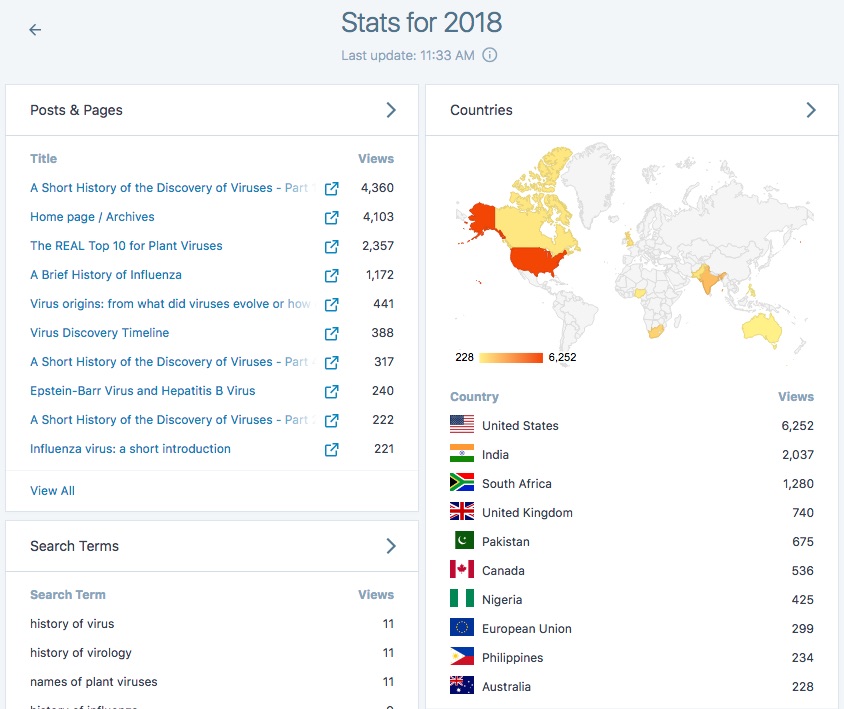
In any case, the blog site and Scoop.it site and being on Twitter kept me current with news in Virology, and were really useful in informing the two ebooks I published in 2015 on  “A Short History of the Discovery of Viruses“ and “Influenza Virus – Introduction to a Killer“, as well as the Introduction to Molecular Virology I am currently writing. The excerpts from those books that I trialled on this site – and tweeted about – have led to high and consistent page accesses from all over the world, as people search for things like “history of virus”.

Stats_‹_ViroBlogy_—_WordPress_com

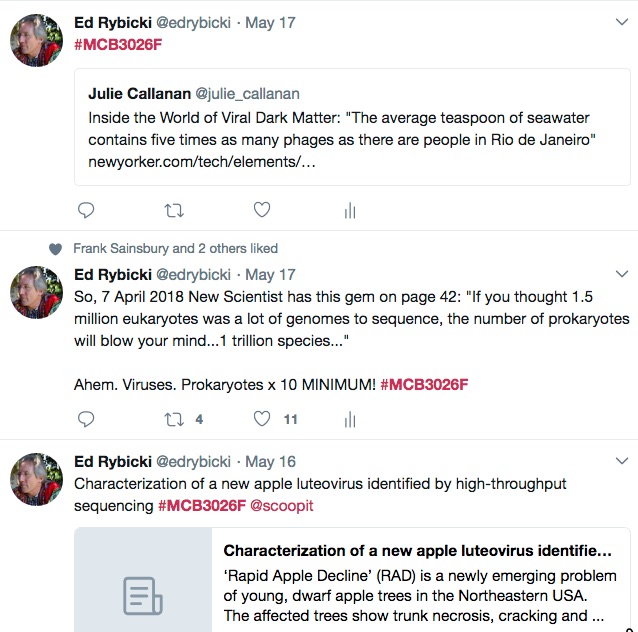
What this has led up to, as I am now teaching undergraduates again, is the use of my Web-based news and other people’s materials via Twitter to inform students in the various modules I teach about current outbreaks, new discoveries and exciting developments in Virology and One Health. I tell them upfront in my first lecture that I want them to look at @edrybicki, ViroBlogy and Virology News, and that I will regularly be highlighting things of relevance to them. For instance, my daily trawl through Twitter invariably throws up a few papers I want to read, papers I think students should be interested in, and some news on outbreaks or breakthroughs. I then simply hashtag those with the course code, possibly add a comment, and retweet.

Cursor_and__edrybicki__MCB2020F_-_Twitter_Search

The value of this exercise can be seen in the fact that even well after I finished lecturing, students in the MCB2020F course were able to pick up on outbreak information that simply didn’t exist in that 5-lecture window weeks earlier – and give me material back in their final exam answers to the question “Describe one important virus disease outbreak this year and what it affected [3 marks]” that I had not taught them, from as short a time as 5 days previously. Which I commemorated thus, while marking their exam B-)

edrybicki__MCB2020F_-_Twitter_Search

I did the same thing for a third-year Viromics course, and while I got fewer non-lecture material-based answers, the value of pointing students to alternative material was again confirmed.

viromics edrybicki__MCB3026F_-_Twitter_Search

I shall continue to do this over the next three years of formal lecturing, for the simple reason that it engages students in the productive use of social media – and makes them go out and find information you didn’t have to teach them. You are warned, MCB2020F / 3026F / 3023S / 3024S and 2022S: hashtags, blogs, Scoops…are all waiting for you B-)