Archive for the ‘Uncategorized’ Category

Landes Bioscience Journals: Human Vaccines & Immunotherapeutics

7 May, 2012

See on Scoop.itVirology News

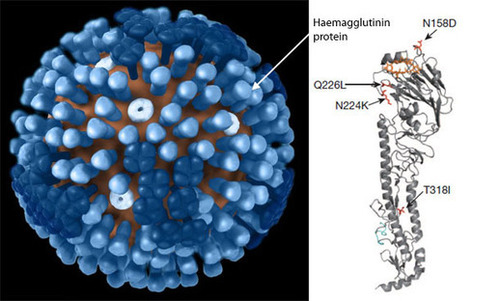
Rapid production of influenza vaccine antigen is an important challenge when a new pandemic occurs. Production of recombinant antigens in plants is a quick, cost effective and up scalable new strategy for influenza vaccine production.  In this study, we have characterized a recombinant influenza haemagglutinin antigen (HAC1) that was derived from the 2009 pandemic H1N1 virus and expressed in tobacco plants. Volunteers vaccinated with the 2009 pH1N1 oil-in-water adjuvanted vaccine provided serum and lymphocyte samples that were used to study the immunogenic properties of the HAC1 antigen in vitro. By 7 d post vaccination, the vaccine fulfilled the licensing criteria for antibody responses to the HA detected by haemagglutination inhibition and single radial hemolysis. By ELISA and ELISPOT analysis we showed that HAC1 was recognized by specific serum antibodies and antibody secreting cells, respectively. We conducted a kinetic analysis and found a peak of serum HAC1 spec antibody response between day 14 and 21 post vaccination by ELISA. We also detected elevated production of IL-2 and IFNγ and low frequencies of CD4+ T cells producing single or multiple Th1 cytokines after stimulating PBMCs (peripheral blood mononuclear cells) with the HAC1 antigen in vitro. This indicates that the antigen can interact with T cells, although confirming an effective adjuvant would be required to improve the T-cell stimulation of plant based vaccines. We conclude that the tobacco derived recombinant HAC1 antigen is a promising vaccine candidate recognized by both B- and T cells.


Fraunhofer USA, waving the Green Vaccine flag: way to go….

See on www.landesbioscience.com

HIV/AIDS: New book tracks the epidemic to its origins

4 May, 2012

See on Scoop.itVirology News

We’ve all heard the myths and hypotheses about the origins of the epidemic caused by the HI virus, but a new book, “Tinderbox: How the West Sparked the AIDS Epidemic and How the World Can Finally Overcome It”, sheds more light on where it all began.


I’ve covered this before, but it’s a nice review – complete with spoilers like how Beatrice Hahn and team have shown that a chimpanzee SIV from Cameroon is the closest relative of HIV-1 group M viruses.  The gun doesn’t smoke more than that.

See on www.plusnews.org

Religious sites ‘riskier than porn for viruses’ – Ninemsn

4 May, 2012

See on Scoop.itVirology News

CIO TodayReligious sites ‘riskier than porn for viruses’NinemsnWeb wanderers are more likely to get a computer virus by visiting a religious website than by peering at porn, according to a study released on Tuesday.


I love it: Dawkins was right!  Religion IS a virus….

See on news.dc1.ninemsn.com.au

Flu research: How to make bird flu transmissible…

4 May, 2012

See on Scoop.itVirology News

“On April 27th, after much toing and froing, the Dutch government gave Ron Fouchier of the Erasmus Medical Centre in Rotterdam permission to submit his paper on bird flu to Science.”


And so it FINALLY comes to pass – two papers that SHOULD have been published weeks ago, finally see the light.

See on 9thlevel.ie

Mutant flu paper is finally published, reveals pandemic potential of wild viruses | Not Exactly Rocket Science | Discover Magazine

3 May, 2012

See on Scoop.itVirology News

“It’s finally out. After months of will-they-won’t they and should-they-shouldn’t-they deliberations, Nature has finally published a paper about a mutant strain of bird flu that can spread between mammals.”


This is the Kawaoka paper, which in fact was the LESS contentious one.  Ed Yong in Discover magazine comes up with four important themes from the paper, which to my mind show we were right to agitate and demand that the material be published.


One: H5N1 can evolve to spread between mammals with worrying ease

Two: There appear to be two traits that make for a transmissible virus – specificity and stability.

Three: It’s not the mutations that matter, but what they do. Or, don’t miss the wood for the trees.

Four: Wild viruses are almost there.


One and four are the important points: flu viruses can evolve quickly and easily, and wild H5N1 is nearly at the point that it will leap into mammals.  The virus is endemic in several countries, like Indonesia, where wild birds, tame birds, pigs and people rub shoulders on a daily basis: this is a natural melting pot for influenza virus reassortment and adaptation, that may at any moment see a pandemic virus burst out.

Or not – it may as easily be a H7NX virus that will be The Big One.

But it is as well to be prepared – and censorship wasn’t going to allow that.

Thanks @AJCann for alerting me to this.

See on blogs.discovermagazine.com

Env-less endogenous retroviruses are genomic superspreaders

30 April, 2012

See on Scoop.itVirology News

Endogenous retroviruses (ERVs) differ from typical retroviruses in being inherited through the host germline and therefore are a unique combination of pathogen and selfish genetic element. Some ERV lineages proliferate by infecting germline cells, as do typical retroviruses, whereas others lack the env gene required for virions to enter cells and thus behave like retrotransposons. We wished to know what factors determined the relative abundance of different ERV lineages, so we analyzed ERV loci recovered from 38 mammal genomes by in silico screening. By modeling the relationship between proliferation and replication mechanism in detail within one group, the intracisternal A-type particles (IAPs), and performing simple correlations across all ERV lineages, we show that when ERVs lose the env gene their proliferation within that genome is boosted by a factor of ∼30. We also show that ERV abundance follows the Pareto principle or 20/80 rule, with ∼20% of lineages containing 80% of the loci. This rule is observed in many biological systems, including infectious disease epidemics, where commonly ∼20% of the infected individuals are responsible for 80% of onward infection. We thus borrow simple epidemiological and ecological models and show that retrotransposition and loss of env is the trait that leads endogenous retroviruses to becoming genomic superspreaders that take over a significant proportion of their host’s genome.


I love it: retroviruses that choose to spread WITHIN a cell’s genome, rather than between cells.  Safe little niche, as long as it keeps dividing!

See on www.pnas.org

CDC: 2011 was worst measles year in US in 15 years – BusinessWeek

21 April, 2012

See on Scoop.itVirology News

“Last year was the worst year for measles in the U.S. in 15 years, health officials said Thursday.

There were 222 cases of measles, a large jump from the 60 or so seen in a typical year. Most of the cases last year were imported — either by foreign visitors or by U.S. residents who picked up the virus overseas.

U.S. children have been getting vaccinated against the measles for about 50 years. But low vaccination rates in Europe and other places resulted in large outbreaks overseas last year.

So far this year, 27 U.S. cases have been reported and it’s too early to gauge whether 2012 will be as bad as last year. But with large international events like the London Olympics coming up, health officials are urging everyone — particularly international travelers — to make sure they’re fully vaccinated.”


And so it begins…the collapse of what used to be near-universal anti-measles vaccination, resulting in re-importation of the virus to places where it had almost been eradicated.

See on www.businessweek.com

Vietnam’s new war: Incurable mystery virus [=EV71] kills 19 kids to date — RT

21 April, 2012

See on Scoop.itVirology News

“Hanoi has asked the World Health Organization for help to cure a virulent disease affecting children. Symptoms include blistering on hands, feet and mouths accompanied by high fever and eventual organ failure.

Nineteen children died from the illness in 2011 alone.
The virus spreads through direct contact with an infected person’s oral discharges or saliva, the fluid from burst blisters or the stool of infected persons.
The Red Cross mission in Vietnam reports the disease has already infected over 28,000 children this year, which is more than 10 times the number of infected children in the same period last year.
According to the International Federation of Red Cross and Red Crescent Societies (IFRC), last year a record 110,000 children became infected, with 169 deaths.
The hand, foot and mouth disease (HFMD) disease mostly affects children under three years old (80 per cent of totals cases) the Red Cross said. There is no known treatment for HFMD.”


The virus is EV71, a picornavirus similar to the polioviruses and hepatitis A virus – so hardly a “mystery virus”.  There are also a number of vaccines in the pipeline for the disease, including one highlighted here a while ago.

See on rt.com

USUTU VIRUS – POTENTIAL RISK OF HUMAN DISEASE IN EUROPE

21 April, 2012

See on Scoop.itVirology News

Usutu virus (USUV) is an African mosquito-borne flavivirus, member of the Japanese encephalitis antigenic group. This avian virus is transmitted by arthropod vectors (mainly mosquitoes of the Culex pipiens complex). It is well known that free-living birds, including migratory species, have the potential to disperse certain pathogenic microorganisms. Usutu virus has recently been introduced to Europe and is spreading through Austria, Hungary, Italy, Spain and Switzerland, causing disease in birds and humans. Like West Nile virus, USUV may become a resident pathogen in Europe and the consequences for public health should be considered. Many different biotic and abiotic factors affect the survival of the virus in a new environment and influence the efficiency of its geographical dispersal

See on www.eurosurveillance.org

Russell Kightley’s Scientific Illustration Blog: Influenza Virus Structure Animation

19 April, 2012

See on Scoop.itVirology News

“I have just created an animation of a rotating influenza virus. The sequence begins with a still of the cutaway virus with various parts labelled. The labels disappear and the virus rotates, then returns to the starting graphic. This is in high definition and looks good full screen on a 27″ iMac. It is the latest addition to my YouTube Channel.”


Definitely, graphics courtesy of Russell Kightley Media…B-)  STRONGLY commended!

See on blog.kightleys.com