Via Scoop.it – Virology News
My family and I just watched “Contagion” on pay TV – and were most impressed. Reasonably true to life, all sorts of realistic scenarios, Ian Lipkin appearing as an extra – and one wonderful quote: “Someone doesn’t have to weaponise the bird flu. The birds are doing that”. Contagion is only a movie – but that’s so true. Oh, and an uncredited appearance by Darren Martin’s wonderful recombination analysis package, RDP 2.0 – at 1hr 15 min from the end.
Archive for the ‘Uncategorized’ Category
Weaponising bird flu? We don’t need to weaponise no bird flu….
28 February, 2012
Virology Africa 2011: viruses at the V&A Waterfront 2
19 December, 2011 We thank Russell Kightley for permission to use the images
Marshall Bloom (Rocky Mountain Laboratories, NIAID) opened the plenary session on Thursday the 1st of December, with a talk on probing the pathogen-vector-host interface of tickborne flaviruses. Although thoroughly infected with a rhinovirus, he held our attention most ably while reminding us that while many flaviviruses are tick borne, the hard and soft body ticks that vector them are very phylogenetically different – as different as they are from spiders – meaning that if similar flaviruses replicated in them, these viruses may have much wider host range than we know.
He pointed out that while about 95% of the virus life cycle takes place in a tick, transmission to a vertebrate means suddenly adapting to a very different host. Infection in ticks is persistent, as befits their vector role – but vertebrate infection generally is not. It was interesting, as a sometime plant virologist, to hear that they look for dsRNA as a marker for replication, and do Ab staining for it: the technique was invented with plant viruses, and very few other virologists seem to appreciate that dsRNA can be quite easily isolated and detected.
They compared Vero and tick cells for virus replication, and saw significant differences: while tick cells could go out to 60+ days and look fine, Vero cells were severely affected at much shorter times post infection. There was also 100-fold less virus in tick cells, and prominent tubular structures in old infected tick cells. He noted that ticks evade host defences quite efficiently: eg they suppress host clotting during feeding, and there is huge gene activation in the tick during feeding. In another study to envy, they are doing array work on ticks to see what is regulated and how.
Linda Dixon (Institute for Animal Health, Pirbright, UK) recounted her lab’s work on African swine fever (ASFV), a poxvirus-like large DNA virus. The virus is endemic to much of Africa, and keeps escaping – and there is no effective vaccine to prevent spread, so regulation is by slaughter. There are 3 types of isolate, with the most highly pathogenic causing up to 10% fatality and a haemorrhagic syndrome. She described how in 2007 the virus had spread from Africa to Georgia, then in 2009 to southern Russia and all way to the far north, in wild boar.
There are more than 50 proteins in the dsDNA-containing virion; two infectious forms similar to the poxviruses with multilayer membranes and capsid layers can form, and neutralising Ab play no part in protection as a result. They studied the interaction of viruses with cells and the immune system, and compared the genomes of pathogenic and non-pathogenic strains, in order to understand how to develop an effective vaccine.
The biggest differences were large deletions in non-virulent isolates, including genes coding for proteins responsible for binding to RBC, and various immune evasion multicopy genes. They planned to target regions to delete to make an attenuated virus for vaccine. They had found non-essential genes involved in immune evasion, and ones that lower virulence, and had been systematically cutting them out. She noted that pigs can be protected if they survive natural infection and if vaccinated with TC-attenuated virus, and can be protected by passive transfer of Abs from immune pigs – which indicated that an effective live vaccine was very possible.
Subunit vaccines were being investigated, and they had found partial protection with baculovirus-expressed proteins. They were doing genome-wide screens for protective Ag, and were pooling Ags expressed from predicted ORFs in immunization trials – up to 47 Ags without reduction in specific T cell responses.

Discovery One
My former labmate Dion du Plessis (Onderstepoort Veterinary Institute, OVI) made a welcome return to Cape Town, with a talk entitled “2011: A Phage Odyssey”. He explained the title by noting the distinct resemblance of P1 coliphage to the Discovery One spacecraft dreamed up by Arthur C Clarke and Stanley Kubrick – and then went on to exuberantly and idiosyncratically recount a brief history of bacteriophages and their use in biotechnology since their discovery. A revelation from his talk was that the first discovery of phages was probably described by a gentleman named Hankin, in 1896 in Annales de l’Institut Pasteur: he
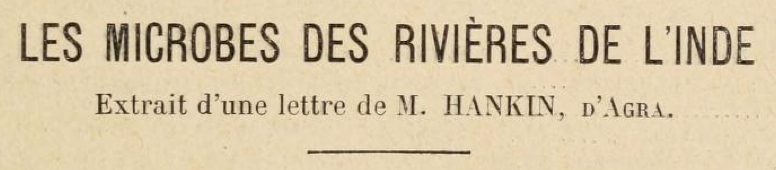
The 1896 paper from Annales de l'Institut Pasteur
showed that river water downstream of cholera-infested towns on the Jumma river in India contained no viable Cholera vibrio – and that this was a reliable property of the water. We were also introduced to the concept of turtles as undertakers in the Ganges….
He took us through the achievements of the Phage Group of Max Delbruck and others – where science was apparently fun, but also resulted in the establishment of modern molecular biology – through to the use of phages as exquisitely sensitive indicators immunochemistry studies in the 1960s.
All too soon we got to the modern uses of phages, with 3 types of gene library – random peptide, fragmented gene, and antibody V regions – being used to make recombinant phage tail proteins to be used for “panning” and enrichment purposes, in order to select either specific antibodies or antigens. Dion manages a research programme at OVI aimed at developing a new generation of veterinary vaccines – and has for some years now been making significant progress in generating reagents from a chicken IgY single-chain Fv phage display library.
Carolyn Williamson (IIDMM, UCT) gave us an update on CTL epitopes associated with control of HIV-1 subtype C infections. She said that it was now known that genome-wide association studies (GWAS) gives you certain HLAs which are associated with low viral load, and others with high – meaning that to some extent at least, control of infection was down to genetic luck. She noted that they and others had shown that CTL escape was quick: this generally happened in less than 5 weeks in acute phase infections.
They had looked for evidence of a fitness cost of CTL escape – and shown that it exists. She noted that this meant that even if one has “bad” HLA genes, if one was infected with a virus with fitness cost mutations from another, that one could still control infection.
It had been shown that “controllers” mainly have viruses with attenuating mutations, or have escapes in the p24 region – and it was a possible vaccine strategy to include these mutated epitopes in vaccines to help people with infections control their infections.
An interesting topic she broached was that of dual infections – there was the possibility of modelling if infection with two different viruses results in increased Ab neutralisation breadth, and if one would get different results if infections were staggered, possibly with increased nAb evolution if isolates were divergent. She noted it was possible to track recombination events with dual virus infections too.
It was interesting that, as far as Ab responses went, there were independent responses to 2 variants and one could get a boost in Ab titres to the superinfecting virus, but not a boost to Abs reacting with the originally-infecting virus
Carolyn was of the opinion that HIV vaccines needed to include CTL epitopes where escape is associated with fitness cost. She also reiterated that superinfection indicated that one can boost novel responses, which I take to mean that therapeutic applications are possible.
Ulrich Desselberger (University of Cambridge) is a long-time expert on rotaviruses and the vaccines against them, and it was a pleasure to finally hear him speak – and that he was mentoring young people in South Africa. He said that more than a third of children admitted to hospital worldwide were because of rotavirus infections, meaning that the viruses were still a major cause of death and morbidity – and they were ubiquitous.
He reviewed the molecular biology and replication cycle of rotaviruses in order to illustrate where they could be targeted for prevention of infection or therapy, and noted that drugs that interfere with lipid droplet homeostasis interfere with rotavirus replication because 2 viral proteins associated proteins of lipid droplets.
He stated that there were lots of recent whole-genome sequences – we already there were many types, based on the 2 virion surface proteins; we now know that other genes are also highly variable. As far as correlates of immunity were concerned, VP7 & 4 were responsible for eliciting neutralising Ab. Additionally, protective efficacy of VP6 due to elicitation of non-neutralising Ab had been shown in mice – but not in piglets, and not convincingly in humans. Abs to VP2, and NSP2 and 4 were also partially protective in humans. It was interesting that protection was not always correlated with high titre nAb responses.
He noted that in clinical disease primary infections partially protected against subsequent infections which are normally milder; subsequently no disease was seen even when infection occurred. Cross-protection occurred at least partially after initial infection, and this got better after more exposure. There was evidence one could get intracellular neutralisation by transcytosed Ab, and especially to VP6. Ab in the gut lumen was a good indication of protection.
As far as the live modern vaccines were concerned, Merck’s Rotateq elicited type-specific nAb, with 9% of recipients shedding live virus. GSK’s Rotarix gets elicits cross-reactive nAb and one gets 50% of recipients shedding virus.
While the vaccines seemed safe, he noted that where vaccines had been introduced, efficacy ranged from 90% in the USA and Europe, down to as low as 48% in Bangladesh, Malawi and SA, due to type mismatch, and that efficacy was correlated inversely with disease incidence and child mortality generally. He mentioned that there had been much VLP work, but that none of the candidates was near licensure.
Johan Burger (Stellenbosch University) spoke on one of the more important non-human virus problems in our immediate environment – specifically, those affecting wine grape production in our local area. He opened by stating that SA now produced 3.7% of the world’s wine, making grapes a nationally and especially locally important crop. Leafroll disease was a major worldwide problem – as well as being the reason for the wonderful autumn reddening seen in grapevines, it also significantly limited production in affected vineyards. His laboratory has done a lot of work in both characterising viruses in grapevine, and trying to engineer resistance to them. Lately they were also investigating the use of engineered miRNAs as a response to and means of controlling, virus infection.
His group has for a couple of years been involved in “metaviromic” or high-throughput sequencing studies of grapevines, with some significant success in revealing unsuspected infections. In this connection, he and Don Cowan pointed out that they had lots of data that they ignore – but which we should keep and study, as a resource for other studies not yet thought of.
As far as Johan’s work went, novel viruses kept popping up, including grapevine virus E (GVE), which hitherto had only been found in Japan. They were presently looking at Shiraz disease, which was unique to SA, and was still not understood. This was infectious, typified by a lack of lignification which led to rubbery vines, and kills plants in 5 years. It also limits the production of the eponymous grapes – a crime when SA shirazes seem to be doing so well!
Veterinary Virology and Vaccines parallel session.
I again dodged the clinical / HIV session because of my personal biases, and was again treated to a smorgasbord of delight: everyone spoke well, and to time, and I was really gratified to see so many keen, smart young folk coming through in South African virology. It was also very interesting to see highly topical subjects like Rift Valley fever and rare bunyavirus outbreaks being thoroughly covered, so I will concentrate on these.
P Jansen van Veeren (NICD, Johaanesburg) was again a speaker, this time representing his absent boss, Janusz Paweska. He gave an account of the 2010 Rift Valley fever outbreak in SA, and epidemiological findings in humans – something of keen interest to me. He said there had been some forecasting success for outbreaks in East Africa; however, there were long gaps between outbreaks, which were generally linked to abnormal rainfall and movement of mosquito and animal hosts. RVFV isolates differed in pathogenicity but were structurally and serologically indistinguishable – because virulence was due to the NSs protein, and not a virion component. He recounted how artificial flooding of a dambo in Kenya resulted in a population boom in the floodwater Aedes mosquitoes responsible for inititating an outbreak, and then of the Culex which maintained the epidemic. He said there was a strong correlation between viral load and disease severity.
In terms of South African epidemiology, there had been smaller outbreaks from 2008 round the Kruger National Park (NE SA), then in the Northern Cape and KZN in 2009. People had been infected from autopsy of animals, and handling butchered animal parts. The 2010 outbreak started in the central Free State after an unusually wet period, and had then spread to all provinces except Limpopo and KZN. In-house serological methods at the NICD were validated in-house too: these were HAI screening and IgM and IgG ELISAs and a virus neutralisation test. They had got 1600+ samples of human serum, and confirmed 242 cases of disease and 26 deaths for 2010.
He noted that with winter rains there was a continuous outbreak in the Western Cape, and in 2011 the epidemic had started again in the Eastern and Western Cape Provinces, but has since tailed off. Some 82% of human cases were people who occupationally handled dead animals, although there was some possibility of transmission by mosquitoes.
In human cases there was viraemia from 2-7 days, with IgM present transiently from 3 days at low level. They had sequenced partial GP2 after PCR from 47 isolates, and showed some recombination occurring. The 2010 isolates were very closely related to each other, and to a 2004 Namibian isolate. There had been no isolation from mosquitoes yet.
Two talks on FMDV followed: Belinda Blignaut (OVI and Univ Pretoria) spoke on indirect assessment of vaccine matching by serology, and Rahana Dwarka (OVI) on a FMDV outbreak in KZN Province in 2011. Belinda’s report detailed how 6 of 7 serotypes of FMDV occur in SA, with SAT-1 and -2 and O the most common – and that vaccines needed to be matched to emerging strains. This was done by indirect vaccine matching tests such as serological r-value, determined by the ratio of the reciprocal serum titre to the heterologous virus against that to the homologous virus. They had put 4 different viruses into cattle and got sera to test a range of 26 newly isolated viruses. While they had not got sequence from the test panel viruses, indications were that topotype 3 viruses are antigenically more disparate and that a vaccine consisting of topotype 1 or 2 antigens may not be effective in the control of FMD.
In introducing Rahana’s talk, the chair (Livio Heath, OVI) mentioned that there had been 5 different major animal pathogens causing outbreaks in SA over the last 3 years – and that they had to produce reagents and validate tests for ASFV, classical swine fever (CSF) and FMDV, etc, with each outbreak. Rahana described how they had neutralisation assays and blocking and competition ELISA for FMDV, as well as a big database of isolates from buffalo in KZN – so they were well-placed to type viruses found in cattle in the region.
C van Eeden (Univ Pretoria) had an intriguing account of their investigation of the occurrence of an orthobunyavirus causing neurological symptoms in horses and wildlife. Horses seem to be particularly vulnerable to many of the viruses involved in such disease, and so are a useful sentinel species. Shuni virus was first isolated from Culicoides midges and sheep and a child in Nigeria in the 1960s. SA workers subsequently found it in some livestock and Culex mosquitoes and in horses. The virus was shown to be a neurologic disease agent in horses and wildlife – then disappeared for some 30 years, much like Ebola. There is apparently a new research unit at UP with a BSL3 lab, so they are well equipped to do tests with the virus.
Ms van Eeden noted that the incidence of encephalitic disease in humans and animal in SA is underreported, and the causes are mainly unknown – a revelation to me! Horses are susceptible to many of the agents, and are useful sentinels – workers have identified flavi- and alphaviruses in some outbreaks, but many are not IDed. They had done cell culture and EM on samples from an ataxic horse: they got a bunyavirus-like virus by EM, and did bunya-specific PCR, and got Shuni virus back. Sequence relationships showed no linkage to type of animal or date, in subsequent samplings from horses, crocodiles, a rhino and a warthog, and from blood, brain and spinal cord. All positive wildlife were sampled in Limpopo Province; horses only from most other provinces.
She noted that latest cases were neurological, whereas previously these were mainly febrile. The virus accounted for 10% all neurological cases, with a 50% fatality rate. She noted further that vets often work without masks or gloves, and so had no protection from exposure in such cases…. There was no idea on what the vector was, but they would like to test mosquitoes, etc. Ulrich Desselberger suggested rodents may be a reservoir, but they don’t know if this is true.
Stephanie van Niekerk (Univ Pretoria) investigated alphaviruses as neurological disease agents in African wildlife. The most common alphaviruses in SA are Sindbis and Middelburg viruses. Old World alphaviruses are usually not too bad, and cause arthritic and febrile symptoms, while New World cause severe neurological diseases. Sindbis was been found in SA outbreaks in 1974. However, Stephanie noted that a severe neurological type had appeared since 2008 in horses. Accordingly, they looked at unexplained cases in wildlife in the period 2009-2011: brain and spinal cord samples were investigated for all cases. They found alphavirus in a number of rhinos, buffalo, warthog, crocodiles and jackal – and all except for one rhino were Middelburg virus. They want to isolate viruses in cell culture, and increase the size of regions used for cDNA PCR. Stephanie said the opinion was that the values of the animal involved justifies the development of vaccines.
Virology Africa 2011: viruses at the V&A Waterfront 1
12 December, 2011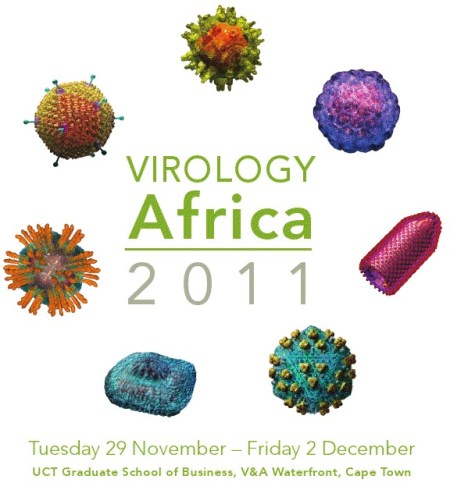 We thank Russell Kightley for permission to use the images
Anna-Lise Williamson and I again hosted the Virology Africa Conference (only the second since 2005!), at the University of Cape Town‘s Graduate School of Business in the Victoria & Alfred Waterfront in Cape Town. While this was a local meeting, with just 147 attendees, we had a very international flavour in the plenaries: of 18 invited talks, 9 were by foreign guests. Plenaries spanned the full spectrum of virology, ranging from discovery virology to human papillomaviruses to HIV vaccines to tick-borne viruses to bacteriophages found in soil to phages used as display vectors, and to viromes of whole vineyards. There were a further 52 contributed talks and 41 posters, covering topics from human and animal clinical studies, to engineering plants for resistance to viruses.
 A special 1-day workshop on “Human Papillomaviruses – Vaccines and Cervical Cancer Screening” preceded the main event: this was sponsored by Merck Sharp & Dohme, Roche and Aspen Pharmacare, and had around 90 attendees. Anna-Lise Williamson (NHLS & IIDMM, UCT) opened the workshop with a talk entitled “INTRODUCTION TO HPV IN SOUTH AFRICA – SCREENING FOR CERVICAL CANCER AND VACCINES”, and set the stage for Jennifer Moodley (Community Health Dept, UCT) to cover health system issues around the prevention of cervical cancer in SA, and the newly-minted Dr Zizipho Mbulawa (Medical Virology, UCT) to speak on the the impact of HIV infection on the natural history of HPV. This last issue is especially interesting, given that HIV-infected women may have multiple (>10) HPV types and progress faster to cervical malignancies, and HPV infection is a risk factor for acquisition of HIV. The Roche-sponsored guest, Peter JF Snijders (VU University Medical Center, Amsterdam), gave an excellent description of novel cervical screening options using primary HPV testing, to be followed by two accounts of cytological screening in public and private healthcare systems in SA, by Irene le Roux (National Health Laboratory Service) and Judy Whittaker (Pathcare), respectively. Ulf Gyllensten (University of Uppsala, Sweden) described the Swedish experience with self-sampling and repeat screening for the prevention of cervical cancer, especially in groups that are not reached by standard screening modalities. Hennie Botha and Haynes van der Merwe (both University of Stellenbosch) closed out the session with talks on the effect of the HIV pandemic on cervical cancer screening, and a project aimed at piloting adolescent female vaccination against HPV infection in Cape Town.
The next part of the Workshop overlapped with the Conference opening, with a Keynote address by Margaret Stanley (Cambridge University) on how HPV evades host defences (sponsored by MSD), and another by Hugues Bogaert (HB Consult, Gent, Belgium)) on comparisons of the cross-protection by the two HPV vaccines currently registered worldwide (sponsored by Aspen Pharmacare). Margaret Stanley’s talk was a masterclass on HPV immunology: the concept that such a seemingly simple virus (only 8 kb of dsDNA) could interact with cells in such a complex way, was a surprise for all not acquainted with the viruses. Bogaert’s talk was interesting in view of the fact that the GSK offering, which has only only two HPV types, raises far higher titre antibody responses than the MSD vaccine with four HPV types, AND seems to elicit better cross-protective antibodies: this should help inform choice of product from the individual point of view. However, the fact that MSD seems able to respond better to national healthcare system tenders in terms of price per dose is also a major factor in the adoption stakes.
The Conference proper started with a final address by Barry Schoub, long-time but now retired Director of the National Institute of Virology / National Institute of Communicable Diseases in Johannesburg, and also long-time CEO of the Poliomyelitis Research Foundation (PRF): this is possibly the premier funding agency for anything to do with viruses in South Africa, and a major sponsor of the Conference. He spoke on the history of the PRF, and how it had managed to shepherd an initial endowment of around 1 million pounds in the 1950s, to over ZAR100 million today – AND to dispense many millions in research project and bursary funding in South Africa over several decades.
 The first session segued into a welcoming cocktail reception and registration at the Two Oceans Aquarium in the V&A Waterfront: this HAS to be one of the only social events for an academic conference where the biggest sharks are the ones in the tank, and not in the guest list! I think people were suitably blown away – as always, in the aquarium – and the tone was set for the rest of the meeting. The wine and food were good, too.
 The first morning session of the conference featured virus hunting and HIV vaccines, as well as plant-made vaccines and more HPV. W Ian Lipkin (Columbia University, USA) opened with “Microbe Hunting” – which lived up to its title very adequately, with discussion of a plethora of infectious agents. As well as of the methods newly used to discover them, which include high-throughput sequencing, protein arrays, very smart new variants on PCR…. I could see people drooling in the audience; the shop window was tempting enough to make one jump ship to work with him without a second thought. He said that probably 99% of vertebrate viruses remain to be discovered, and that advances in DNA sequencing technology were a major determinant in the rapidly-increasing pace of discovery. He made the point that while the emphasis in the lab had shifted from wet lab people to bioinformatics, he thought it would move back again as techniques get easier and more automated – meaning (to me) that there is no substitute for people who understand the actual biological problems. It was interesting that, while telling us of his work on the recently-released blockbuster “Contagion” – where “the virus is the star!” – he showed a slide with a computer in the background running a recombination detection package called RDP, which was designed in South Africa. It can also be seen in the trailer, apparently. Darren Martin will not be looking for royalties or screen credits, however.
Don Cowan (University of the Western Cape) continued the discovery theme, albeit with bacteriophages as the target rather than vertebrate viruses. It is worth emphasising that phages probably represent the biggest source of genetic diversity on this planet – and given how even the most extreme of microbes have several kinds of viruses, as Don pointed out, it is possible that this extends to neighbouring planets too [my speculation – Ed]. He occupies an interesting niche – much like the microbes he hunts – in that he specialises in both hot and cold terrestrial desert environments, which are drastically understudied in comparison to marine habitats. He made the interesting point that metagenome sequencing studies such as his own generate data that is in danger of being discarded without reuse, given that folk tend to take what they are interested out of it and neglect the rest.
 Anna-Lise Williamson (NHLS, IIDMM, UCT) then described the now-defunct SA AIDS Vaccine Initiative vaccine development project at UCT. It is rather sobering to revisit a project that used to employ some 45 people, and had everything from Salmonella, BCG, MVA, DNA and insect cell and plant-made subunit HIV vaccines in the pipeline – and now employs just 5, to service the two vaccines that made it into into clinical trial. The BCG-based vaccines continued to be funded by the NIH, however, and the SA National Research Foundation funds novel vaccine approaches. Despite all the funding woes, the first clinical trial is complete with moderate immunogenicity and no significant side effects, and two more are planned: these are an extension of the first – HVTN073/SAAVI102 – with a Novartis-made subtype C gp140 subunit boost, and the other is HVTN086/SAAVI103, which compprises different commbinations of DNA, MVA and gp140 vaccines.
It was clear from the talk that if South Africa wants to support local vaccine development, the government needs to support appropriate management structures to enable this – and above all, to provide funding. However, all is not lost, as much of the remaining expertise in several of the laboratories that were involved in the HIV vaccine programme can now involve themselves in animal vaccine projects.
Plant-made HPV16 VLPs
Ed Rybicki made it an organisational one-two with an after-tea plenary on why production of viral vaccines in plants is a viable rapid-response option for emerging or re-emerging diseases or bioterror threats. The talk briefly covered the more than 20 year history of plant-made vaccines, highlighting important technological advances and proofs of concept and efficacy, and concentrated on the use of transient expression for the rapid, high-level expression of subunit vaccines. Important breakthoughs that were highlighted included the development of the Icon Genetics TMV-based vectors, Medicago Inc and Fraunhofer USA’s recent successes with H5N1 and H1N1 HA protein production in plants – and the Rybicki group’s successes with expression of HPV L1-based and E7 vaccine candidates. The talk emphasised how the technology was inherently more easily scalable, and quicker to respond to demand, than conventional approaches to vaccine manufacture – and how it could profitably be applied to “orphan vaccines” such as for Lassa fever.
Ulf Gyllensten had another innings in the main conference, with a report on a study of a possible linkage of gene to disease in HPV infections – which could explain why some people clear infections, and why some have persistent infections. They used the Swedish cancer registry (a comprehensive record since the end of the 1950s) to calculate familial relative risk of cancer of the cervix (CC): relative risk was 2x for a full sister, the same for a mother-daughter pair and the risk for a half sister was 50% higher while risk was not linked to non-biological siblings or parents, meaning the link was not environmental. A preliminary study found HLA alleles associated with CC, and increased carriage of genes was linked to increased viral load. A subsequent genome wide association study using an Omni Express Bead Chip detecting700K+ SNPs yielded one area of major interest, on Chr 6 – this is a HLA locus. They got 3 independent signals in the HLA region and can now potentially link HPV type and host genotype for a prediction of disease outcome. Again, the kinds of technology available could only be wished for here; so too the registry and survey options.
Molecular and General Virology contributed talks parallel session
I attended this because of my continued fascination with veterinary and plant viruses – and because Anna-Lise was covering the Clinical and Molecular session – and was not disappointed: talks were of a very high standard, and the postgraduate students especially all gave very good accounts of themselves.
Melanie Platz (Univ Koblenz-Landau, Germany) kicked off with a description of a fascinating interface between mathematics and virology for early warning, spatial awareness and other applications. She gave an example using a visual representation of risk using GIS for Chikungunya virus, based on South African humidity and temperature data going back nearly 100 years: this had a 3D plot model, into which one could plug data to get predictions of mosquito likelihood. They could generate risk maps from the data, to both inform public and policy / planning. They had a GUI for mobile devices for public information, including estimates of risk and what to do about it, including routes of escape.
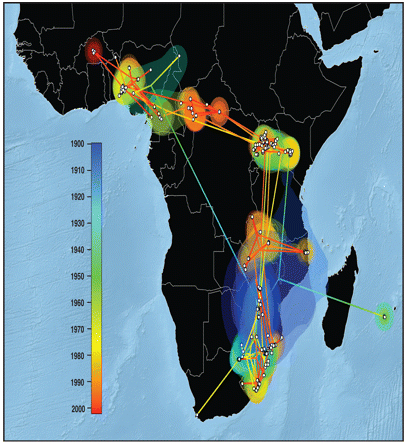
Cover Illustration: J Virol, October 2011, volume 85, issue 20
This was followed by one of my co-supervised PhD students, Aderito Monjane – who recently got the cover of Journal of Virology with his paper on modelling maize streak virus (MSV) movement and evolution, so I will not detail more here. However, even as a co-supervisor I was blown away by the fact that he was able to show animations of MSV spread – at 30 km/yr, across the whole of sub-Saharan Africa.
Christine Rey of Wits University provided another state-of-the-art geminivirus talk, with an account of the use of siRNAs and derivatives for silencing cassava-infecting geminiviruses. They were using genomic miRNA precursors as templates to make artificial miRNAs containing viral sequences, meaning they got no interference with nuclear processing and there was less chance of recombination with other viruses, a high target specificity, and the transgenes would not be direct targets of virus-coded suppressors. They could also use multiple miRNAs to avoid mutational escape. The concept was successful in tobacco, and they had got transformation going well for cassava, so hopes were high for success there.
Dionne Shepherd (UCT) spoke on our laboratory’s 15+ year work on engineered resistance in maize to MSV. She pointed out that the virus threatens the livelihood of 200 million+ subsistence farmers in Africa, and is thought to be the biggest disease concern in maize – which is still the biggest edible crop in Africa. Most of the work has been described elsewhere with another journal cover; however, new siRNA-based constructs still under investigation were even more effective than the previous dominant negative mutant-based protection: the latter gave 50-fold reduction in virus replication, but silencing allowed > 200-fold suppression of replication.
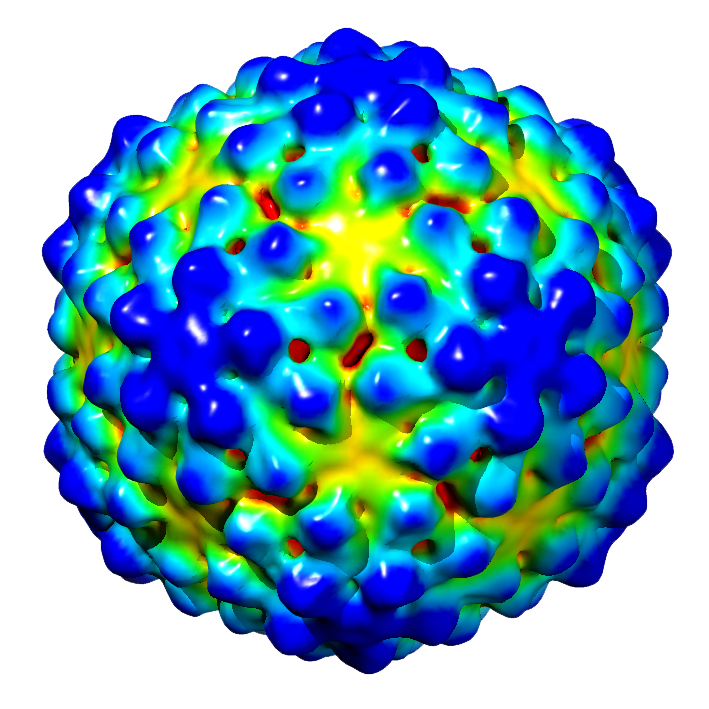
2-colour surface rendition of HcRNAV
Arvind Varsani – a former UCT vaccinology PhD who is now a structural biology and virology lecturer at Univ Christchurch (NZ) – described what is probably the first 3D structure of a virus to come out of Africa. This was of a 30 nm isometric ssRNA virus – Heterocapsa circularisquama RNA virus (HcRNAV) – infecting a dinoflagellate, which is one of the most noxious red tide bloom agents and is a major factor in killing farmed oysters. The virus apparently controls the diatom populations. There are two distinct strains of virus, and specificity of infection is due to the entry process, as biolistic bombardment obviates the block. The single capsid protein probably has the classic jelly-roll β-barrel fold, but they observe a new packing arrangement that is only distantly related to the other ssRNA (+) virus capsids known. They will go on to look at structural differences between strains that change cell entry properties.
FF Maree from the Onderstepoort Veterinary Institute and the Univ Pretoria spoke on structural design of FMDV to improve vaccine strains: they wished to engineer viruses by inserting the cell culture adapted HSPG-binding signature sequence and to mutate capsid residues to increase the heat stability of SAT-2 subtype virus vaccines. If they put the signature sequence in a SAT1 virus, they found it could infect CHO cells – which do not express any of 4 integrins that FMDV binds to, but are far better for large-scale production of the virus than the BHK cells used till now. It was also possible to increase hydrophobic interactions in the capsid by modeling: eg a VP2 Ser to Tyr replacement gave a considerably better thermal inactivation profile to the virus.
Daria Rutkowska (Univ Pretoria) detailed how African horsesickness orbivirus (AHSV) VP7 protein had significant potential as a scaffold that could act as a vaccine carrier. The native protein formed as trimers assembled in a VP3+VP7 “core” particle; however, the VP7 when expressed alone could form soluble trimmers – and the “top” domain hydrophilic loop can tolerate large inserts. The group had very promising FMDV P1 peptide responses from engineered VP7 constructs, including protection of experimental animals.
P Jansen van Veeren of the National Institute of Communicable Disease in Johannesburg finished off the session, with a description of the cellular pathology caused by Rift Valley fever bunyavirus (RVFV) in mice in acute infections. The virus seems to have been of particular international interest recently as a potential bioterror agent; however, global warming is also responsible for its mosquito vector spreading outside of its natural base in Africa to the Arabian peninsula, and there are fears of the virus getting into Europe soon. While there are vaccines against the virus, including a live attenuated version, none are licenced for human use. It was interesting to hear that the viral NP appears to be the main immunogen, as there are massive amounts of NP produced in infection, and huge responses to it in infected animals – and NP immunisation protects mice. There is a good Ab response but it is not neutralising, while NP is released independently of other proteins from infected cells. The liver is the major target of virus infection, with a bias to apoptosis of hepatocytes and severe inflammatory responses. Viral load is linked to these effects and is much lower in vaccinees. Immunisation reduces liver replication markedly; that in the spleen less so. A screen of cytokines and other gene responses showed a big down-regulation of many genes in non-vaccinated mice to do with cytokines, and down-regulation of B and T cells and NK cells. He thinks recombinant vaccine candidates should have both the surface glycoproteins and the NP in order to be effective – and that there is a major need for proper reagents for big animal studies.
A sting in the tale
12 November, 2011This blog links to Small Things Considered, over there at the ASM site, and this month they have a great blog post – dealing with “…pyocins made by Pseudomonas aeruginosa“.
Which turn out to probably be co-opted phage tails, some of them complete with contractile mechanisms – but all with no head and therefore no genetic payload.
Interesting phenomenon – and now one that is being being put to use to target specific troublesome bacteria, and possibly even eukaryotes.
I am beginning to love phages – which is a good thing, as they represent by far the biggest group of organisms on our planet!
Antibodies from plants are GOOD for you!
29 July, 2011It gives me great pleasure to (re)trumpet the news that – at long last – a monoclonal antibody made in plants that neutralizes a wide range of HIV-1 variants, is going into Phase 1 clinical trial.
The MAb 2G12 is made in transgenic tobacco plants: these are grown in batches of 250 kg, harvested, and the MAb extracted under conditions of Good Manufacturing Practice (GMP). Simple enough…yet it took years, a great deal of money, and significant exchanges with the regulatory authorities to get the clinical trial of plant-made pharmaceuticals approved. From the Fraunhofer Institute news website:
Clinical tests for medicines made from genetically modified plants
Antibodies that have been produced in tobacco plants will now for the first time be tested in a clinical study. The decision was announced at a press conference in London on Tuesday July 19th 2011.
UK regulators have approved Europe’s first clinical trial of a monoclonal antibody produced from genetically modified plants. This landmark decision sets the stage for the testing, in humans, of an anti-HIV product made from genetically modified tobacco plants. It will open the door for trials of additional plant-derived medicines treating a range of diseases.
The trial will test the safety of a plant-derived antibody designed to stop the transmission of HIV between sexual partners when applied directly to the vaginal cavity. If proven safe in the 11 participants, the researchers can then go on to test the effectiveness of the product.
The clinical trial marks the culmination of the EU Framework 6 Pharma-Planta project, which was launched by a consortium of 30 academic and industrial partners in 2004 with €12 million in funding from the European Union. The primary goal was to develop an approved manufacturing process for recombinant pharmaceutical proteins made in plants and take one such product through all the development stages including the pivotal clinical trial.
This also represents a reward for years of perseverance by Professor Rainer Fischer, coordinator of the Pharma-Planta FP6 project and Director of the Fraunhofer IME. From the press release:
Professor Julian Ma, scientific coordinator for Pharma-Planta and Professor of Molecular Immunology at St George’s, University of London, said: “This is a red letter day for the field. The approval from the MHRA for us to proceed with human trials is an acknowledgement that monoclonal antibodies can be made in plants to the same quality as those made using existing conventional production systems. Many people did not ever believe that it could be achieved.”
Amen to that, brother Julian…! Readers of this blog will know we are big fans of farmed pharmaceuticals – and this is another big step along that road.
Google where you might go to die
31 May, 2011Working on the assumption that it’s always best to know where you might contract something that could kill you, Google brings you….dengue!
The fabulous vanishing virus: XMRV
9 May, 2011From The Scientist of today:
“Another study fails to find XMRV in chronic fatigue patients
The latest in a string of studies searching for a mouse virus in patients suffering from chronic fatigue syndrome has failed to turn up evidence of the pathogen, XMRV. The study, which was published online last week in the Journal of Virology, couldn’t detect XMRV in 100 people with chronic fatigue syndrome, including 14 of the patients who tested positive in the 2009 Science study that originally posited a link between the virus and the syndrome. University of Utah in Salt Lake City virologist Ila Singh, who led the new study, suggests (as have others) that the XMRV previously found in chronic fatigue patients was a result of contamination in the lab. But Judy Mikovits, senior author of that 2009 Science paper and virologist at the Whittemore Peterson Institute for Neuro-Immune Disease, is standing by her findings. “We have complete confidence in every bit of the results in the Science paper,” she told ScienceInsider.”
Well, she would say that, wouldn’t she? And who would blame her…but time to start looking somewhere else, folks!
Just when you thought it was safe….
12 September, 2010…to have a hamburger. ProMED, those wonderful people who brought you Ebola case by case, describe a new way to rot your brain. Read on.
New sporadic prion disease
Date: Fri 13 Aug 2010
Source: Science Daily [edited]
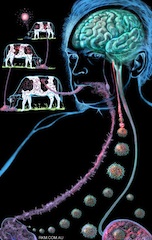
BSE Transmission
New sporadic prion protein disease:
variably protease-sensitive prionopathy shares genotype characteristics with Creutzfeldt-Jakob
A new sporadic prion protein disease has been discovered. Variably protease-sensitive prionopathy (VPSPr), as it has been named, is the 2nd type of complete sporadic disease to be identified since Creutzfeldt-Jakob disease (CJD) was reported in the 1920s. The landmark finding from the National Prion Disease Pathology Surveillance Center at Case Western Reserve University is published in the August [2010] issue of Annals of Neurology [see abstract below].
Normally, the human prion protein gene comes in 3 types due to its
capability to encode prion proteins that contain only the amino acid
methionine, commonly identified as M, both methionine and valine, commonly identified as V, or only for the amino acid valine at position 129. Therefore, when it comes to the prion protein gene unaffected people can be identified as 129MM, 129MV or 129VV. Sporadic CJD (sCJD), which is the most common human prion disease, can affect patients who have any one of the 3 types of the prion protein gene.
In 2008, Pierluigi Gambetti and Wen-Quan Zou, with collaborators, reported the discovery of this novel disease, which affected patients who exhibit only one of the 3 types of the prion protein gene. In this follow-up study, they discovered that all 3 genetic groups can be affected also by this novel disease which now joins sCJD in displaying this feature. However, VPSPr is associated with an abnormal prion protein that exhibits characteristics very different from those of sCJD, as well as other prion diseases, suggesting that it may be caused by a different mechanism, perhaps more akin to other neurodegenerative diseases, such as Alzheimer’s disease. This finding may exemplify, for the 1st time, the possibility that the prion protein affects the brain with different mechanisms.
While examining cases received at the National Prion Disease Pathology Surveillance Center where he is the director, Dr Gambetti observed that a subset of cases had clinical and pathological features quite different from those of all known types of human prion diseases. Further, after being tested for prion proteins via the Western blot [technique] — the gold standard of prion disease diagnosis — the cases were negative. Dr Gambetti then collaborated with Dr Zou, associate director at the center, to solve the riddle of a disease that exhibited some features of a prion disease in histopathological examination but was negative using the standard Western blot test.
Dr Zou’s lab performed a full characterization of the disease and discovered that the VPSPr-associated abnormal prion protein formed a ladder-like electrophoretic profile on Western blotting. “When I obtained the 1st Western blot result of these cases with a different antibody against prions, I was surprised that these cases consistently exhibited this particular profile; one that I had never seen in my more than 10 years of work on human prion diseases,” Dr Zou, assistant professor of pathology at Case Western Reserve School of Medicine, recalls. This ladder-like profile is quite distinctive and very different from the profile of common prion diseases. “Discovery of this unique type of prion provides solid evidence that this novel disease may possess a pathogenesis that is different from that of the major prion diseases currently known,” Dr Zou adds.
Despite extensive research, a relatively large group of neurodegenerative diseases associated with dementia remain undefined. Before being discovered and characterized, VPSPr was one of the undefined dementing diseases. The discovery of VPSPr is chipping away at that group. In the 2 years since its discovery, more than 30 cases have been reported.
“If, as the current evidence indicates, the VPSPr mechanism of affecting the brain is different from that of other sporadic prion diseases, such as sCJD, the discovery of VPSPr would also provide the 1st example that the prion protein may spontaneously damage the brain with different mechanisms,” concludes Dr Gambetti, professor of pathology at Case Western Reserve School of Medicine. “This might apply to other dementing illnesses as well, and has implications for the strategies that need to be followed to attain a cure.”
Drs Gambetti and Zou, along with their extensive research team, plan to further characterize the abnormal prion protein associated with VPSPr as well as other important features of the protein, such as the disease’s propensity for transmission upon inoculation and its replication in test tubes. These features in VPSPr will be compared with those of sCJD to obtain a complete picture of how the abnormal prion protein attacks the brain in these 2 diseases.
– — communicated by: ProMED-mail rapporteur Mary Marshall
[The following is the reference for the paper discussed above followed by the authors’ abstract: Zou WQ, Puoti G, Xiao X, Yuan J, Qing L, Cali I, et al. Variably protease-sensitive prionopathy: A new sporadic disease of the prion protein. Ann Neurol. 2010 Aug;68(2):162-72. ().
Department of Pathology, National Prion Disease Pathology Surveillance Center, Case Western Reserve University, Cleveland, Ohio.
Abstract
Objective: The objective of the study is to report 2 new genotypic forms of protease-sensitive prionopathy (PSPr), a novel prion disease described in 2008, in 11 subjects all homozygous for valine at codon 129 of the prion protein (PrP) gene (129VV). The 2 new PSPr forms affect individuals who are either homozygous for methionine (129MM) or heterozygous for methionine/valine (129MV). Methods: A total of 15 affected subjects with 129MM, 129MV, and 129VV underwent comparative evaluation at the National Prion Disease Pathology Surveillance Center for clinical, histopathologic, immunohistochemical, genotypical, and PrP characteristics. Results: Disease duration (between 22 and 45 months) was significantly different in the 129VV and 129MV subjects. Most other phenotypic features along with the PrP electrophoretic profile were similar but distinguishable in the 3 129 genotypes. A major difference laid in the sensitivity to protease digestion of the disease-associated PrP, which was high in 129VV but much lower, or altogether lacking, in 129MV and 129MM. This difference prompted the substitution of the original designation with “variably protease- sensitive prionopathy” (VPSPr). None of the subjects had mutations in the PrP gene coding region. Interpretation: Because all 3 129 genotypes are involved, and are associated with distinguishable phenotypes, VPSPr becomes the 2nd sporadic prion protein disease with this feature after Creutzfeldt-Jakob disease, originally reported in 1920. However, the characteristics of the abnormal prion protein suggest that VPSPr is different from typical prion diseases, and perhaps more akin to subtypes of Gerstmann-Straussler-Scheinker disease.
VPSPr is not linked to eating infected meat. However, like CJD, the new condition happens sporadically. It was 1st identified because of the fast-advancing form of dementia seen in those affected. They were also unable to speak or move. But tests for CJD proved negative. Further molecular examination as described above has shown VPSPr was a prion disease, but one which looked very different to those already known. – Mod.CP]
Enough said. Just more to worry about…B-)
Seen in Melbourne
26 April, 2010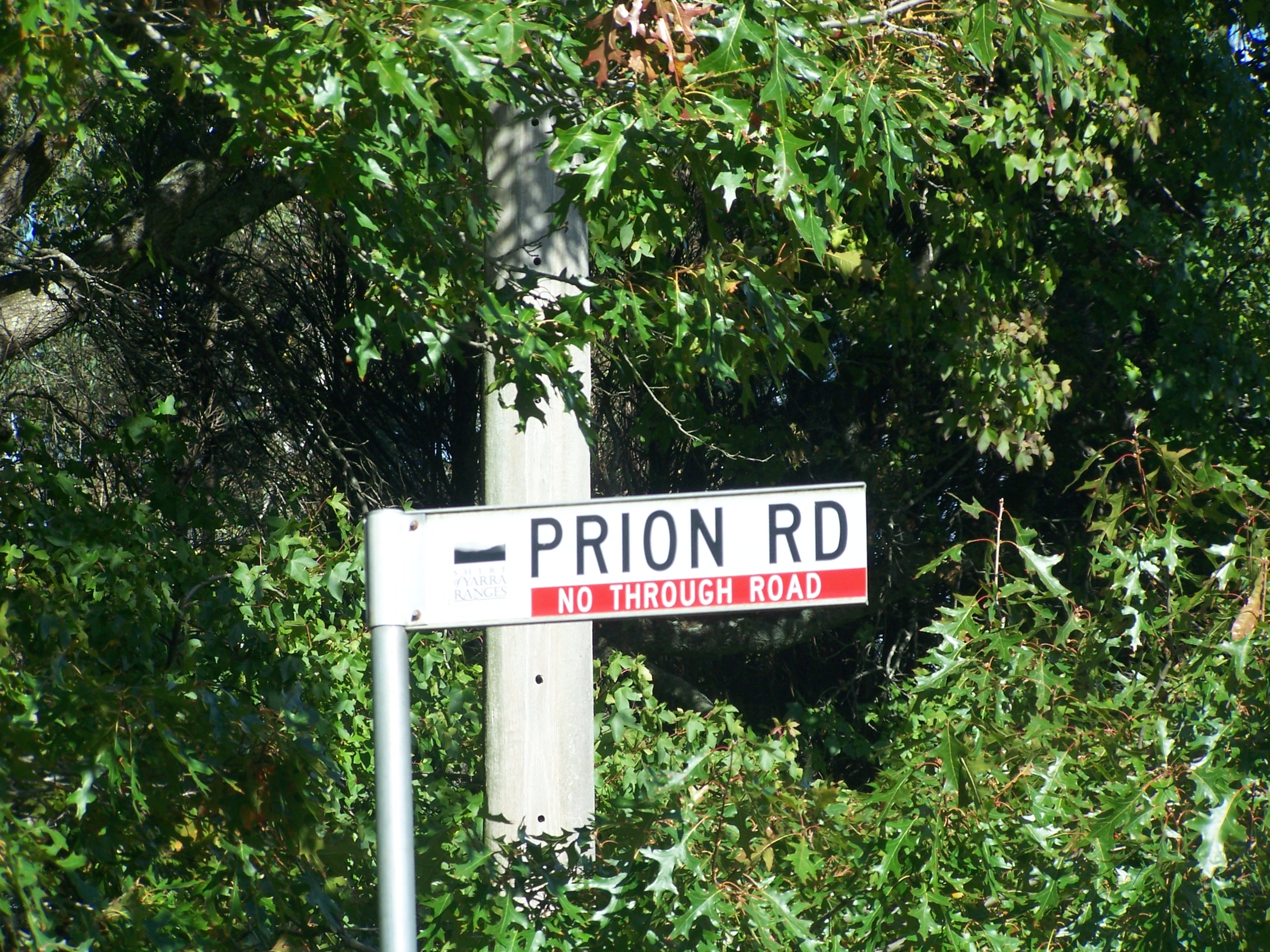
One Way Traffic....
Enough said. Thanks to John Hamill for spotting it, and then reversing so I could record it.
ViroBlogy in Top 50 Biology Research Blogs
17 March, 2010While self-puffery is to be deplored, it is always nice when someone else does it: like Emily Johnston at Medicalicious, who writes:
I’m writing this to let you know about a new featured post we just made over here at Medicalicious entitled, “Top 50 Biology Research Blogs.” I thought you and your readers at Viroblogy might find it to be a very interesting article. Please do let me know if you have any feedback — http://medicallabtechnicianschool.org/2010/top-50-biology-research-blogs/
So g’wan over…I note we are in excellent company in the Microbiology Division: MicrobiologyBytes is there; so too Small Things Considered, Vince Rcaniello’s Virology Blog, and a new one to me, Microbiology Blog from Horizon Press.
I shall have to update more often…B-)


 ViroBlogy