Archive for the ‘Vaccines: General’ Category

Guest Blog: HIV Vaccines

18 March, 2009

You remember we had a competition, end of last year?  Well, the runner-up of same – Dorian McIlroy – has claimed his prize by writing a guest blog.  Clayton, that means you have to do two…?!

And Dorian writes on a subject close to our collective hearts, here in the Subunit Vaccine Group at Univ of CT: HIV vaccines, and how T-cell vaccines in particular may not be down and out after all.  I note that he refers to two published papers that were topics of talks at the recent AIDS Vaccine Conference here at UCT recently, which was covered here in ViroBlogy: always useful to have your material on the verge of being published when you talk…!

HIV vaccine candidates – The return of the recombinants…

Towards the end of 2007 Merck interrupted a large scale clinical trial of a candidate HIV vaccine based on recombinant adenovirus. As well as showing no protective effect, there was a worrying tendency for vaccinees with serum antibodies to the vector – serotype 5 adenovirus (Ad5) – to show greater susceptibility to HIV infection than volunteers receiving placebo injection. This looked like the end of the road for adenovirus-based vaccines, and maybe even for any strategy based on recombinant viruses. However, two recent papers indicate that there may yet be considerable mileage in this approach.

The first, from Dan Barouch’s team in Boston, shows how recombinant adenoviruses could be made considerably more effective. One of the big drawbacks with these recombinant viruses is that repeated injections do not give an immunological booster effect. That is, even though the immune response to a single injection can be strong, there is not much increase after a second, or a third injection of the same recombinant virus. This happens because as well as inducing an immune response to the target antigen (SIV gag, for example), the recombinant virus vector induces an immune response against itself. So when the recombinant virus is injected a second time, it is neutralized by the antibodies induced by the first injection. 

The Barouch paper shows that it is possible to get round this problem by using two recombinant adenoviruses with different serotypes, so that the second injection can provide an effective boost. Giving macaques two injections of SIV gag-recombinant Ad5 gave a good response to the first injection, but no boost. Using an SIV-gag recombinant Ad26 for the first injection, then using the Ad5 recombinant for the second, gave a 9-fold higher T-cell response measured by IFNgELISPOT than two doses of Ad5 recombinant.

So far, so good – but does this immune response translate to protection from infection?

Well, yes and no. After intravenous challenge with highly pathogenic SIVmac251, all animals in all groups were infected, so none of the animals were completely resistant to SIV. Peak viral load in the group vaccinated with Ad26/Ad5 was 1.4 log lower than in the control group, and about a log lower in the group vaccinated with Ad5/Ad5. Set-point viral load was also much lower in the Ad26/Ad5 group compared to the control group, so replication of the challenge virus was controlled to some extent in the animals that received the most effective vaccination protocol.

Overall there are two messages here. The first is that it is possible to do much better than the strategy that failed in the Merck trial, that employed three injections of Ad5 recombinant viruses. That’s the good news. The bad news is that even with a much more effective vaccination, in terms of the T-cell response, the protection against infection, although significant, was relatively modest. This means that vaccine candidates based on T-cell immunity alone are never going to work……. or does it?

Which brings me to the second paper, from Louis Picker’s group in Oregon. The big novelty here is the generation of recombinant rhesus macaque cytomegalovirus (CMV) expressing SIV proteins, that are tested as vaccine candidates in the SIV Mac model.

Why on earth would anyone want to try out CMV, when other recombinant (adeno- and pox-) viruses have been so disappointing? The difference is in the lifestyles of the viruses involved. Both adeno and poxviruses provoke acute infections, whereas CMV both in humans and apparently, in macaques, causes a lifelong infection, in which active viral replication is held in check largely by a robust T-cell response. When the immune response is compromised, as in AIDS patients, or transplant recipients receiving immunosuppressive drugs, CMV infection often reactivates, which can cause serious illness, and even be life-threatening. Because of the persistent nature of both the virus and the cellular immune response, a high-level of effector-memory T-cells (TEM, not to be confused with Transmission Electron Microscopy) specific for CMV are maintained in CMV+ individuals (who probably make up about half of the world population, in case you were wondering).

TEM have two interesting characteristics from a HIV vaccine point of view. Firstly, they are armed and dangerous. If they see their cognate viral antigen, they can either kill the infected cell, or secrete cytokines. Secondly, they migrate to mucosal sites, rather than lymph nodes, so they are in the right place to stop HIV infection after sexual transmission. More sedate central-memory T-cells (TCM), on the other hand, hang around the blood and lymph nodes, and do not immediately have anti-viral effector functions. Their response to HIV infection might be too late to be any use, as the first rounds of productive viral infection occur in the mucosa, not the draining lymph nodes.

Picker’s group points out that most memory T-cells that remain months after a recombinant adenovirus vaccination are TCM, not TEM, and set out to test the hypothesis that using a recombinant virus (CMV) that naturally gives a strong TEM response might be more effective in protecting against SIV infection at a mucosal site. So they generated recombinant, replication competent macaque CMV carrying genes for SIV gag, a Rev-Tat-Nef fusion protein, and an intracellular form of Env. Cells infected with these viruses expressed high levels of the recombinant proteins, and animals inoculated subcutaneously with them became persistently infected – just like wild-type CMV infection.  As predicted, high levels of SIV-specific TEM were found in the blood, and in broncho-alveolar lavage (which is a relatively convenient way to obtain mucosal T-cells). More than one year after vaccination, animals were submitted to a mucosal challenge (intrarectal, if you really want to know) with SIVmac239, which is the same strain as that used to produce the recombinant CMV.

The details of the viral challenge are interesting. In order to simulate a real infection, a low viral dose was used, and this means that not all control animals get infected. So the challenge was repeated weekly until infection (detected by plasma viral load) was observed. I have turned the data from the paper into Kaplan-Meier curves, and used the log-rank test to compare the two groups (BTW: if Louis Picker is reading this, that’s the test you should have used). With p=0.03, survival without infection was significantly prolonged by vaccination, and 4 out of 12 vaccinated macaques were resistant to mucosal challenge. These four animals did not have a latent or cryptic infection, as no SIV DNA or RNA was detectable in CD4 T-cells in blood or lymph nodes, and CD8+ T-cell depletion did not result in viral rebound.
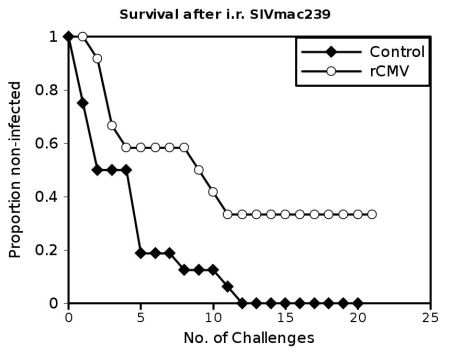
recombinantviruses_032009_html_48846d22This was without any neutralizing antibodies, so for the first time a T-cell vaccination strategy has been shown to confer protection against infection (not just better control of viral load after infection, as with recombinant adenoviruses) in at least some vaccinated animals. Although 33% protection is not enough, at least things are going in the right direction.

So what’s the catch? Well, there are two really. Firstly the SIV sequences in the vaccine and challenge virus were identical. The vaccination strategy may not be so effective against a heterologous challenge, that would be more representative of the real-world. Secondly, the vaccination provokes a persistent infection with a genetically-modified virus, that (unlike other recombinant viruses and gene therapy vectors) remains infectious, so it’s hard to see how this kind of vaccine could be licensed for clinical trials.

Nevertheless, I think this paper is telling us – at last – what kind of T-cell response vaccines should be aiming to induce. Now all we need to do is solve the neutralizing antibody problem, and we’ll really be cooking with charcoal….

Dorian McIlroy
Dorian.Mcilroy@univ-nantes.fr

Umm…no, they don’t

28 November, 2008

For shame, New Scientist!!  There I go recommending you to all and sundry – and especially my students – as a fount of general scientific knowledge, and you do this!!  In the 22nd November issue – freshly on my desk, down here in the Deepest South – there is, under the column heading “60 Seconds”, the following snippet:

Shot thwarts warts

A human papilloma virus vaccine already approved in women to prevent cervical cancer has proved equally effective in men against genital wartswhich can lead to cervical cancer in women. In a trial of the vaccine in 4000 men only three recipients developed HPV-related lesions compared with 31 who received a placebo.

Note the bolded section: BECAUSE IT IS VERY WRONG. 

No, New Scientist, genital warts in men do NOT lead to cervical cancer in women: warts in men and women are caused by a number of what are termed “low risk” viruses (for low cancer risk), and especially by HPV types 6 and 11 – which are two of the types included in Merck’s Gardasil.  The other two types in this vaccine – which are the same ones as in GlaxoSmithKline’s Cervarix – are the high cancer risk HPV types 16 and 18.  Which do NOT cause genital warts, in men or women: rather, they cause inapparent infections of the epithelial tissue of the penis in men, and of the vaginal and cervical mucosa in women. 

The lesions can most often only be seen in both men and women after they have been painted with an acetic acid solution – hence the name “aceto-white lesion”.

The fact that warts are apparently prevented in men is a very welcome development: this means that in all likelihood the other infections will be prevented too, and men will not be able to transmit HPV 16 and 18 to women.

Which is presumably what you meant.

AIDS Vaccine 2008: Cape Town

26 November, 2008
I was a presenter and rapporteur at this, one of the biggest of this series I have been to – over 900 delegates – held in the Cape Town International Convention Centre (CTICC) in October 2008.  This represents the first time that the organisers, the Global HIV Vaccine Enterprise, have held one of these annual conferences outside of North America or Europe – and certainly the first time in such a high HIV prevalence area (~11%).
The Abstract Book of the conference is now online, courtesy of the journal AIDS & Human Retroviruses, which prompts my publishing the written version of my rapporteur’s report, on Vaccine Concepts and Design.  The oral version had a lot more pictures and Star Wars references in it, but this one is more serious.  A more condensed version will also appear as part of a combined rapporteur’s report in the journal Human Vaccines sometime soon.


AIDS Vaccine 2008, Cape Town – Vaccine Concepts and Design

Ed Rybicki, Institute of Infectious Disease and Molecular Medicine, University of Cape Town

The fallout cloud from the failed STEP and Phambili clinical trials of the Merck adenovirus 5-vectored vaccines cast a long shadow over the conference, and especially over the area of vaccine concepts and design.  Inevitably, there was debate over whether or not T-cell response-based vaccines should ever be tested on a large scale again; and there appeared to be an intense and renewed interest in broadly-neutralising antibodies, and how to elicit them.  It was understandable, then, that those of whose stock in trade is T-cell vaccines were a little apprehensive going into this meeting: however, there was much to excite and much to enthuse, and in particular, several lines of evidence suggesting that T-cell vaccines are not dead and should still be vigorously pursued.

The conference opening was memorable for a number of reasons: among these was the Sizophila Choir of HIV+ folk from Cape Town, who moved many to tears with their amazing harmonies and hymns to ARVs.  Another, very important reason was the presence of South Africa’s new Minister of Health, Barbara Hogan: for the first time in years in a major forum, a senior member of the SA Government affirmed that HIV causes AIDS, and that the search for a vaccine was of paramount importance to SA and the rest of the world.

Arthur C Clarke’s Third Law states that “When an elderly and distinguished scientist says something is possible, he is almost certainly correct”: it was a pleasure, therefore, to hear the certainly distinguished Stanley Plotkin (Sanofi Pasteur / Univ Penn., PA) close the evening with a calm and reasoned explanation of why he thinks vaccines against HIV are possible.  He noted that HIV is not the only vaccine to see major difficulties in its development – and cited measles and CMV as object examples.  He suggested that multivalent vaccine(s) and regular boosters may be necessary; that the immune response needs neutralising Ab and CD4+ and CD8+ cells, in blood and mucosa – and pointed out that these are feasible to produce for other vaccines, so why not for HIV?

The most important Keynote/Plenary talks from the point of view of T-cell vaccines were those by Julie McElrath (Fred Hutchinson Cancer Res Inst, Seattle, WA; Plenary Session 1) on immune responses in the STEP trial; Tony Fauci (NIAID/NIH; Special Keynote) on future strategy, and Bruce Walker (Mass Gen / Harvard U; Plenary 2) on correlates of protective T-cell immunity.  Julie McElrath’s analysis of the STEP data was sobering, and potentially depressing, but there was a positive message: she said that T-cell epitope recognition as a result of the Merck Ad5 vaccine was inadequate, so we needed to use different strategy – such as a protein vaccine, which should almost certainly be adjuvanted for increased immunogenicity.  Tony Fauci summed up current strategic thinking very well, with his analogy of a radio dial, with Discovery and Development at opposite sides: he said that the failure of all large-scale vaccine trials to date meant we should turn the dial back to Discovery, with more focus on innate immunity, animal models and adjuvants, before any more large-scale trials were done.  Bruce Walker’s message, after an exhaustive analysis of “elite controllers”, was that these people have weaker CD8+ T-cell responses to HIV antigens – but they are significantly more Gag-focussed, and that stronger Env responses are correlated with increased risk of progression to AIDS.  His most important comment was that the Merck vaccine / STEP trial result was a failure of product, not of the concept, and that we are not barking the wrong tree with T-cell vaccines.

A novel introduction at the Conference was Special Session 02, Innovations in AIDS Vaccine Discovery: this was chaired by Wayne Koff (IAVI, NY), and had the objective of highlighting novel strategies for vaccine development.  K Reed Clark (Nationwide Children’s Hospital, Columbus, OH) presented a case for “reverse immunisation”, or using a DNA construct to express a humanised neutralising mAb: he used rAAV1 DNA to express scFv-h-C2-C3 IgG2 constructs for sustained delivery of neutralising Ab in macaques.  Sterilising immunity was achieved following NAb gene transfer in the face of a pathogenic SIV challenge, and he achieved sustained (1 yr) circulating levels of 200-400 ug/ml.  As a possible downside, there was an idiotypic anti-NAb response in animals which became  infected.  Sanjay Phogat (IAVI, NY) spoke on the use of immune complexes as vaccines: he used neutralising and non-neutralising MAb complexed to gp120 with an adjuvant (AdjuplexLAP) to generate quick and durable neutralising antibody responses against the Env protein, with immune sera neutralising 6 out of the 10 clade B viruses tested – far better and at much higher titre than adjuvanted gp120 alone.  Clayton Beard (Carolina Vaccine Inst, UNC, NC) had as his goal the use of a chimaeric live alphavirus (VEE) to create a simple self-replicating entity that presents the major antigens of HIV in vivo until an appropriate immune response suppresses its growth, leaving the recipient immune to HIV.  His almost complete redesign of VEE resulted in a virus expressing SIV/HIV Env and a SIV Gag modified to bind the VEE genomic encapsidation  signal, which replicates to titres of ~106/5 ml culture in Ghost cells.  All in all, this session was a welcome addition to the programme, and very well received.

Session OA02 – T-Cell Vaccines and Animal Models – contained several interesting approaches to T-cell vaccines.  Brad Jones (Univ Toronto) opened with a description of how T-cells specific for LINE-1 (long interpersed nuclear element) retrotransposon proteins were effective at eliminating HIV-1 and HIV-2-infected cells: apparently APOBEC-3 family proteins inhibit LINE-1 transposition, and HIV Vif interference with APOBEC allows aberrant LINE-1 expression in HIV-infected cells, which leads to MHC presentation of the LINE-1 proteome, and CTL killing of the affected cells.  A LINE-1-specific T-cell clone recognised, and killed within 2 hours, cells infected with 42 HIV isolates (37 of them primary isolates) from all subtypes, and HIV-2 isolates.  He argued that LINE-1 proteins represented a novel, stable vaccine target as they lacked variability, and speculated that anti-LINE-1 responses could be a part of natural control of HIV, as their T-cell clone was derived from an elite controller.  David Garber (Emory Univ, GA) spoke on the optimisation of modified vaccinia virus Ankara (MVA) to reduce expression of irrelevant antigenic targets: his group had essentially reduced the vector to immediate-early expression only outside of cells used for propagation, as well as lessening its immune evasion capacity by targetted deletions.  Modified vectors with gag and env genes performed 3-5 fold better than MVA in macaques, and it was possible to tune responses for better CD8+ or multifunctional responses.  Tomáš Hanke (Univ Oxford) presented a “universal T-cell vaccine”, HIVconsv: this was a DNA vaccine encoding a spectrum of T-cell epitopes separated by junction regions, derived from the HIV-1 proteome, concentrating on Gag and Pol, with some Env and Vif epitopes.  The vaccine potentially had 270 of a documented 1100 possible HIV-1 CD8+ T-cell epitopes.  T-cells from HIV-infected subjects were stimulated by vaccine epitopes: 11 of 12 subjects reacted to 2 or more peptide pools (covering, indicating good coverage.  Macaque immunisation resulted in a strong, broad response as assessed by ELISpot assay.  His hope was that the vaccine would redirect responses compared to natural infection, so as to negate immunodominance of one or a few epitopes.

Symposium 03 – Next Generation Vaccine Vectors – was a highlight of the Conference, with a number of excellent presentations.  Dan Barouch (Beth Israel Deaconess Med Ctre, Harvard) gave a tour de force talk on what amounted to a rerun of the Merck Ad5 vaccine efficacy trial in macaques, with a gag-only heterologous Ad26/Ad5 or Ad35/Ad5 vaccination regime.  The Ad26/Ad5 combination was best, 2x the Ad35/Ad5 response, which was 2x the Ad5/Ad5 response.  The Ad26/Ad5 regime gave long-term (500 day) durable partial protection against challenge, with a 3x greater breadth of epitope responses than to Ad5/Ad5.  The 26/5 regime elicited a good memory Gag-specific response, and similar to what Bruce Walker had said for elite human controllers, there was a significant correlation of the height and breadth of the Gag–specific response, and reduction of viral load.  Dan repeated Walker’s earlier comment, with some significant evidential weight to his iteration: the STEP trial was a failure of product, not of concept.

Louis Picker (Oregon Health & Science Univ, OR) discussed how a kinetic mismatch between replication and development of T-cell clones at the site of infection could result in infection taking hold – and further, that live attenuated SIV vaccines elicited mainly effector memory (EM) cells, whereas prime-boost vaccine regimes elicited mainly central memory (CM) cells.  His group used rhesus CMV – known to elicit mainly EM-dominated responses, and which can infect and reinfect monkeys, which remain infected lifelong – to vector SIV rev, nef, tat and gag genes into macaques.  In contrast to the CM response of Ad5-vectored genes, these elicited EM responses, enriched in bowel and lung and other mucosa.  Very weak Ab responses with no NAb were seen.  Protection against infection was seen in macaques challenged by repeat low-dose intrarectal SIV, with control groups infected at a median of two doses, and vaccinees taking 8: replication of virus was eliminated or controlled very early in infection, apparently by a CD8+ T-cell independent mechanism.  His message was that the CMV vaccine and the EM cell response drastically cut down transmission.

Anna-Lise Williamson (IIDMM, Univ Cape Town) closed out the session with an account of the vaccine development efforts in Cape Town under the auspices of the SA AIDS Vaccine Initiative (SAAVI).  Her group has brought a DNA and an MVA-vectored heterologous prime-boost multigene HIV vaccine combination to the point of human trial after successful broad-spectrum immunogenicity trials in baboons; however, they are also developing M bovis Bacillus Calmette-Guerin (BCG) auxotrophs and the limited host range Lumpy skin disease capripoxvirus (see also P16-02) as vectors, with very promising baboon and macaque immunogenicity results with HIV genes.  Additionally, the group has gone a long way in developing Pr55Gag and chimaeric Gag virus-like budded particles (VLPs) as vaccines, with good evidence of significant T-cell response boosts by VLPs of DNA-or BCG-primed immunity in mice and baboons.

An important sub-theme at the Conference was DNA vaccines: there has been a lot of disparaging talk in recent years concerning their potential efficacy; however, in the post-STEP era, the usurping adenovirus vectors have lost some popularity, and it seems the original genetic vectors have a new lease on life. 

George Pavlakis (NCI, Frederick, MD) in talk OA05-01 gave a masterly account of how electroporation of optimised DNA vaccines hugely enhanced humoral and mucosal responses.  He made the point forcefully that DNA vaccines had the advantage that there was no immune response to the vector, and that their preparation was rapid, scalable and safe – and that “increased expression improves the DNA vaccine result”.  He noted that different forms of antigen affect the immune response that electroporation as a means of delivery increases both antigen expression and immunogenicity; that natural cytokines delivered as DNAs were effective molecular adjuvants (eg: IL-12, IL-15), and that heterologous combinations such as DNA+protein, or DNA+viral vectors could be very effective.  In macaque vaccination experiments using gag, pol, nef and vif genes in combination with chemokine fusions, the group was able to get very high (30 000 sfu/106 cells) Ifnγ ELISpot results, with ~0.3% of total circulating T-cells being Ag-specific, and high serum Ab response.  They got a balance of central memory and effector CD4+/CD8+ cells, which is a shift of the type of response (central memory CD4+) obtained with previous DNA vaccines.

David Weiner (Univ Pennsylvania, PA) spoke in S03 on a very similar theme – electroporation and molecular adjuvants – and reiterated that optimisation of DNA yielded excellent results.  He also added manufacture as an optimization parameter, noting that it was now possible to get ~15 mg/ml of plasmid DNA: this allowed much higher, less dispersed doses of DNA.  He also noted that electroporation (EP) changes the phenotype of the response.  They tested an SIV DNA vaccine with IL-12, IL-15 or RANTES DNA as adjuvants in macaques: challenge showed IL-12, RANTES gave viral loads 2 log less than IL-15 DNA adjuvanted or DNA vaccine alone.  Concentrated DNA was as good an immunogen as Ad5, and much better when used with IL-12 DNA: there was increased magnitude of individual responses and increased polyfunctionality.

Fiona Tanzer (IIDMM, Univ Cape Town) in OA02-02 gave an excellent example of how to improve a DNA vector.  She used elements from Porcine circovirus (PCV) to significantly enhance expression from and immunogenicity of an already good DNA vector, increasing HIV Ag-specific Ifnγ ELISpot scores by 3 – 5-fold in mice using only 172 bases from the capsid gene promoter of PCV inserted upstream of a HIV-1 polygene vaccine construct. 

Taken together, these talks give an indication that DNA vectors for T-cell and other vaccines are alive and kicking, and on the verge of another growth phase in their deployment.  Improvements in manufacturing, antigen expression levels and DNA delivery, and parallel advances in the use of co-expressed molecular adjuvants, all herald a new era in heterologous prime-boost studies for HIV and other vaccines.

Two posters – one an oral abstract – stood out for me as vaccine design highlights of the very rich and well-attended sessions.  Darrin Martin (IIDMM, Univ Cape Town) spoke briefly on P19-08: designing a recombination-proof HIV vaccine.  His bioinformatic approach identifies “cold spots” for recombination in the HIV-1 genome, and suggests targets for polyepitope-based vaccines.  Champiat et al. (P12-15) found that APOBEC is a T-cell target in HIV+ people: this further extends the range of invariant, HIV-induced potential T-cell vaccine targets. 

A few plant production-related HIV vaccine posters caught the eye, as my group has been involved in this for years, and it is a field with much promise but as yet, no few realised achievements.  Cherni et al. (P02-03) presented interesting data on gp41 MPR on Hepatitis B virus core particles made in plants; Andersson et al. (P12-08) demonstrated that transgenic Arabidopsis expressing p24 is orally immunogenic; Meyers et al. (P12-10) showed that plant-produced vaccine-relevant HIV Ag boosted DNA primed T-cell responses; Regnard et al. (P18-08) showed that plant production of HIV antigens could be significantly increased by used of a replicating geminivirus-derived vector.

 As for other posters, Welte and Walwyn (Univ Witwatersrand, SA) in P01-01 demonstrated elegant mathematical modelling of acute infection and vaccine design – and Guerbois et al. (LB-32) had truly excellent expression of budded Gag-ΔV1V2Env particles from a measles-vectored vaccine. 

All in all, then, the HIV vaccine enterprise is battered but still functional.


Nobel Virology 2008

7 October, 2008

It gives me great and unalloyed pleasure, as someone acquainted with one of the new Nobellists, and who has followed the science behind the awards ever since the beginning, to feature the three virologists who were jointly awarded the Nobel Prize in Medicine for 2008.

http://www.nytimes.com/2008/10/07/health/07nobel.html?hp

Discoverers of AIDS and Cancer Viruses Win Nobel Prize – NYTimes.com via kwout

To quote the NY Times article, written by Lawrence K Altman:

“The Nobel Prize in Medicine was awarded Monday to three European scientists who had discovered viruses behind two devastating illnesses, AIDS and cervical cancer.

Half of the award will be shared by two French virologists, Françoise Barré-Sinoussi, 61, and Luc A. Montagnier, 76, for discovering H.I.V., the virus that causes AIDS. Conspicuously omitted was Dr. Robert C. Gallo, an American virologist who vied with the French team in a long, often acrimonious dispute over credit for the discovery of H.I.V.

The other half of the $1.4 million award will go to a German physician-scientist, Dr. Harald zur Hausen, 72, for his discovery of H.P.V., or the human papilloma virus. Dr. zur Hausen of the German Cancer Research Center in Heidelberg “went against current dogma” by postulating that the virus caused cervical cancer, said the Karolinska Institute in Stockholm, which selects the medical winners of the prize, formally called the Nobel Prize in Physiology or Medicine.

His discovery led to the development of two vaccines against cervical cancer, the second most common cancer among women. An estimated 250,000 women die of cervical cancer each year, mostly in poor countries.”

The news is all the more welcome, because I am very familiar with the entire history.  The HIV pandemic has paralleled most of my career: I remember vividly my then Honours student – now a distinguished Professor in her own right – coming to me in 1984 to tell me that “…they have found the virus that causes acquired immune deficiency syndrome”.  Again, it was greatly of interest when Harald zur Hausen initiated the work that would lead to his award, as it was some of the first hard evidence that viruses were implicated in cancer – which suddenly made learning and teaching Virology a whole lot more sexy.  Especially in view of the mode of transmission of the viruses concerned…I like to think I may have put more people off casual sex by talking about viruses like herpes, HPV and HIV and what they can do to you, than any ten school guidance counsellors – but I digress.

The news is also welcome because I now work with both HPV and HIV: thus, reward for the people who invented our main field of endeavour is especially pleasing.

 But as ever, the Nobel awards are not without controversy.  Altman again:

“In 1983, Dr. Montagnier and Dr. Barré-Sinoussi, a member of his lab at the Pasteur Institute in Paris, published their report of a newly identified virus. The Karolinska Institute said that discovery led to blood tests to detect the infection and to anti-retroviral drugs that can prolong the lives of patients. The tests are now used to screen blood donations, making the blood supply safer for transfusions and blood products.

The viral discovery has also led to an understanding of the natural history of H.I.V. infection in people, which ultimately leads to AIDS and death unless treated.

H.I.V. is a member of the lentivirus family of viruses. The French scientists were cited for identifying a virus they called L.A.V. (now known as H.I.V.) in lymph nodes from early and late stages of the infection.

“Never before has science and medicine been so quick to discover, identify the origin and provide treatment for a new disease entity,” the Karolinska Institute said.

…Nobel Foundation rules limit the number of recipients of its medical prizes to a maximum of three each year, and omissions often create controversy.

The dispute between Dr. Gallo and the French team spanned years and sprawled from the lab into the highest levels of government. Dr. Gallo, 71, now at the University of Maryland in Baltimore, worked for many years at the National Cancer Institute in Bethesda, Md.

While in Bethesda in 1984, a year after the French team’s report, Dr. Gallo reported finding a virus that he called H.T.L.V.-3 and that was later shown to be nearly identical to the French L.A.V. After additional studies, Dr. Gallo said cultures in his laboratory had accidentally become contaminated with the French virus.

In 1986, Dr. Gallo and Dr. Montagnier shared a prestigious Lasker award, given in the United States; Dr. Montagnier was cited for discovering the virus and Dr. Gallo for determining that it caused AIDS.

In 1987, President Reagan and Prime Minister Jacques Chirac of France signed an agreement to share royalties and credit for the discovery.

But Maria Masucci, a member of the Nobel Assembly, told Reuters on Monday that “there was no doubt as to who made the fundamental discoveries.”

Dr. Gallo told The Associated Press on Monday that it was “a disappointment” not to have been honored with the French team. Later, Dr. Gallo issued a statement congratulating this year’s Nobel Prize winners and said he “was gratified to read Dr. Montagnier’s kind statement this morning expressing that I was equally deserving.” “

We’ve been waiting for this for a long time…and the result is interesting indeed, for many of us virologists.  Satisfying too….  I remember wondering at the time how the US team could blithely rename a virus that appeared very similar to one described a year earlier – and was even more fascinated to see how the story unfolded, with LAV becoming HTLV-III becoming HIV, as eventually sense and taxonomy overtook hubris.

The HPV award seems not to be controversial at all, and Professor zur Hausen is seen by everyone I have spoken to as a most worthy recipient.  Now, just to get that vaccine into people who need it….

HIV: roots run deeper than we knew

2 October, 2008

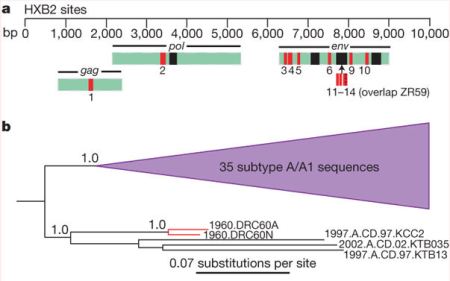
I have previously posted a number of articles on “molecular archaeology” of viruses, and how one can use extant sequences, archived tissue samples, or even blood of pandemic survivors to speculate on the origins of specific viruses, of viruses generally, or on the nature of old pandemic strains.Now HIV falls under the spotlight – again – as the 2nd October issue of Nature publishes three articles (one letter, a commentary on it and an independent commentary) on the origins of HIV-1 pandemic strains.I picked up on the first news – evidence for an older-than-previously-thought origin for HIV-1 – via our local paper this morning. Now this is VERY impressive; they usually keep science news for a slow day, and here they were telling us about a Nature paper on the day it was published! Accessing Nature brought up the Nature News commentary by Heidi Ledford, titled “Tissue sample suggests HIV has been infecting humans for a century”. Essentially, the commentary summarises the findings of Michael Worobey of the University of Arizona and his colleagues, who managed to amplify and sequence HIV-specific cDNA and DNA from a paraffin-embedded lymph node biopsy dating from 1960 from a woman in Léopoldville (now Kinshasa) in what is now the DR Congo. To quote Ledford:

“Their results showed that the most likely date for HIV’s emergence was about 1908, when Léopoldville was emerging as a centre for trade.”

Their findings added credibility to an earlier demonstration of HIV-1 in a 1959 sample, also from Kinshasa. What was interesting was that the sequences of the two viruses differed by 12%: this indicates that there was already significant divergence in the HIV-1 strains infecting people as early as 1960, pointing to a longer history of human infection than the previous estimate of the 1930s.Which led on to the Comments section, where one finds gems like this:

“This is one of the most stupid discovery I have ever heard. You will blame every single human plague on Africa, This is against all the Theories of evolutionary biology where The descents of the people that lived in the area might have developed a kind of resistance instead of being vulnerable to a new strain of the Virus.”

And:

“HIV is older than your great-grandparents, uh-huh! And I’ll bet that the US bio weapons effort is just ecstatic about this deflection. So now these members of science play to the bio-jackboot population controllers with this ‘revelation’ that those sex-crazed Africans of course just couldn’t stop themselves from pulling chimpanzees (I thought the original scientific theory was “green monkeys”) out of the trees for a quickie.”

I couldn’t take this, so I replied:

“It continues to amaze me, as a teacher of virology who tells big classes every year where HIV comes from, how every year some clique of students takes the African origin of HIV personally, as a direct affront. I echo the correspondent above: it is a virus, people. Viruses infect animals, they infect people, and sometimes spread from one to the other – and back, if you are a zoo animal and catch something from your handler. The AIDS pandemic is an accident of sociology, demography, access to high-speed, long-distance travel – and truck routes, and truck drivers. It happens that it originated in Africa. So did the human race – only a lot longer ago. Inevitably, as humans encroached on apes, things get passed across. And don’t spread, much, until…someone puts a road through the village.Why don’t people get more exercised about the origins of HTLV, another retrovirus that almost certainly jumped from monkeys to humans? Except that happened many thousands of years ago, and in south-east Asia, not Africa. And for the same reasons: people eat monkeys and great apes. For that matter, it is speculated that chimpanzees got SIV-CPZ from vervet (I HATE the term “green”) monkeys – and that it may have caused a population bottleneck, some 100 000 years ago. I note that chimpanzees are known to eat vervets, incidentally – so they caught the virus the same way we did.

Ah, well…. In any case, Paul Sharp of the University of Edinburgh – and phylogenetics guru – and the godmother of HIV/SIV diversity, Beatrice Hahn of the University of Alabama (from whom I got the chimp-vervet virus link), have an independent commentary in the same issue, wherein they speculate on “The prehistory of HIV-1”. They make this very interesting comment:

“If the epidemic grew roughly exponentially from only one or a few infected individuals around 1910 to the more than 55 million estimated to have been infected by 2007, there were probably only a few thousand HIV-infected individuals by 1960, all in central Africa. Given the diverse array of symptoms characteristic of AIDS, and the often-long asymptomatic period following infection, it is easy to imagine how the nascent epidemic went unrecognized.”

They also make the important point that the findings of the Worobey group were replicated – with similar but non-identical virus sequences being found – by another group working independently with the same tissue sample. This is important because it nails down the findings more firmly, as HIV sequences within an individual do differ, and:

“…the distance along the evolutionary tree from the group M ancestor to the ZR59 or DRC60 sequences is much shorter than those between the ancestor and modern strains, consistent with the earlier dates of isolation of ZR59 and DRC60, and confirming that these viruses are indeed old”.

a, The HIV-1 genome fragments that were successfully amplified from DRC60 (red) and are available for ZR59 (black). The numbering for the HIV-1 sequences corresponds to the HXB2 reference sequence (Supplementary Table 1). b, The A/A1 subtree from the unconstrained (in which a molecular clock is not enforced) BMCMC phylogenetic analysis. 1960.DRC60A is the University of Arizona consensus sequence, and 1960.DRC60N is the Northwestern University consensus sequence (that is, the sequences independently recovered in each of the two laboratories). The DRC60 sequences form a strongly supported clade with three modern sequences also sampled in the DRC.

Reproduced with permission from Nature Publishing Group (RightsLink License No 2041420001096) from:
Direct evidence of extensive diversity of HIV-1 in Kinshasa by 1960
Michael Worobey, Marlea Gemmel, Dirk E. Teuwen, Tamara Haselkorn, Kevin Kunstman, Michael Bunce, Jean-Jacques Muyembe, Jean-Marie M. Kabongo, Raphaël M. Kalengayi, Eric Van Marck, M. Thomas P. Gilbert & Steven M. Wolinsky
Nature 455, 661-664(2 October 2008) doi:10.1038/nature07390

So where did the virus infecting humans come from? The best guess, from the paper and the commentaries, is that it originated – as do the extant chimpanzee virus supposed to have descended from the common origin – in chimpanzees somewhere in southeast Cameroon.How did it get into people? Sharp and Hahn again:

“The simplest explanation for how SIV jumped to humans would be through exposure of humans to the blood of chimpanzees butchered locally for bushmeat.”

No sex, no weird practices…just eating our cousins.  And how and why did it get to Léopoldville? Trade…and in those days before widespread truck routes, that would have been via rivers – which, Sharp & Hahn point out, drain from southeast Cameroon into the Congo River, which flows past what is now Kinshasa. The Worobey paper has some interesting history in it, documenting times of founding and rates of growth of cities in equatorial west Africa: Léopoldville/Kinshasa was and probably still is by far the fastest-growing of these, and was the earliest founded (in 1885). All that was needed to seed a pandemic, then, was that people infected by a virus as a result of butchering chimpanzees, moved some 700 km down natural trade routes to an emergent trade centre – and settled, and passed it on.Then, of course, it is the same old story, told so well by Jared Diamond in “Guns, Germs and Steel“: increased human population density and breakdown in social structure leads to increase in rate of transmission and incidence / prevalence of a disease agent, until it reaches the threshold necessary to break out. It is interesting that it took so long to become noticed – but then, HIV is passed on considerably less efficiently than Hepatitis B virus, so the pace of the epidemic was necessarily slow.But very sure….

There’s gold in them old veins….

26 August, 2008

I have often spoken of “molecular archeology” in my lectures, and of the possibility of identifying past epidemic / pandemic strains of human flu in particular, by looking at which viruses are recognised by antibodies from people who lived through the epidemics.

A new paper in Nature ups the stakes in this game considerably: a team led by one James E Crowe Jr describes how 32 survivors of the 1918 Spanish Flu pandemic – born in or before 1915 – were “mined” for antibodies, and seven donors additionally were shown to have circulating B cells which secreted antibodies which bound the 1918 H1N1 virus haemagglutinin (HA).  The team isolated 5 monoclonal antibodies from these subjects, and showed that these potently neutralised the infectivity of the virus and bound the HA of a 1930 swine virus, but did not cross-react with the HAs of more recent human  H1-containing viruses.

http://www.nature.com/nature/journal/vaop/ncurrent/abs/nature07231.html

Neutralizing antibodies derived from the B cells of 1918 influenza pandemic survivors : Abstract : Nature via kwout

 This achievement is undoubtedly a tour de force of modern molecular immunology – but is it useful?

Well, one very obvious fact is that people can obviously maintain significant levels of humoral immunity to viruses that infected them – in the words of the authors – “…well into the tenth decade of life.”  This is good news indeed for vaccinees who received vaccines for viruses which do not change much, like measles, mumps and poliomyelitis viruses.  However, given that influenza virus even of one H and N type can change so as to be unrecognisable in just a few years – the MAbs they generated did not react to any great extent with presumptively H1N1 human isolates from 1943, 1947, 1977 and 1999 – this is only of any use if the original virus were to be re-introduced somehow.

There was an intriguing statement in the paper which may shed some light on a long-running controversy as to the origin of the 1977 H1N1 pandemic, when the virus reappeared in humans for the first time since the early 1950s – allegedly as a result of an escape from a Soviet biowarfare lab.

The 1F1 antibody bound and neutralized the 1977 virus, albeit to a lesser degree than either the 1918 or the Sw/30 viruses … and to a minimal degree the 1943 virus”.

Ye-e-e-sssss…strange, that.  So the 1977 virus was antigenically more similar to 1930s era viruses than to one from 1943??

The proposed use of the findings also elicit biowar scenarios: for example, the fact that passive immunisation of people with antibodies to a particular virus can help them get over infection with it is purely academic for MAb to the 1918 virus – or is it?

I hope it is.

West Nile virus vaccine: almost a replicant

2 June, 2008

West Nile virus – a member of the family Flaviviridae – has insidiously spread halfway around the world from its origins in Africa, in just a few years.  It invaded the east coast of the USA, probably from the Middle East,  via either infected birds, mosquitoes, humans, or another vertebrate host in around 1999; since then it has spread all the way across the continent to the west coast, and has become truly endemic. 

Virions have a regular icosahedral-type structure, despite being enveloped, as a result of a structured nucleocapsid and a highly-structured array of envelope glycoprotein.  They contain a positive strand RNA genome of ~11 kb with a single long open reading frame that is translated as a polyprotein of about 3400 amino acids, which is then processed into individual regulatory and structural proteins.

The virus subtype spreading in North America – lineage 1 – causes encephalitis in humans, unlike the enzootic variant circulating in birds and animals in Africa.  It also cause severe mortality – near 100% in experimentally infected animals – among American Crows and other corvids: a feature of the spread of the disease has been dead crows found in and around towns in the USA.  A feature of lineage 1 viruses is their infection of horses and other equines as well – with up to one in three clinically-infected horses dying.  The human impact, however, is seen as a major problem: systemic febrile illness develops in ~20% of those infected with WNV, while severe neurologic illness developes in <1% of persons infected – with mortality rates of 5 -14% among persons with neurologic symptoms in recent US, Romanian, Russian, and Israeli outbreaks.

There has been a concentrated effort to develop a human vaccine or vaccines since the onset of the US epidemic – horse vaccines are already commercially available – and our knowledge of the virus has benefitted greatly as a result.  This includes a detailed structure for the virus, obtained by cryoelectron microscopy image reconstruction.

http://www.purdue.edu/uns/html4ever/031009.Kuhn.westnile.html

Purdue team solves structure of West Nile virus via kwout

 Now a team led by Alexander Khromykh from Brisbane in Queensland, Australia, writing in the May issue of Nature Biotechnology, have described a novel “single-round infectious particle” DNA vaccine against WNV which significantly increases protection in mice to lethal challenge with the live virus.   In the words of the authors:

“We augment the protective capacity of a capsid-deleted flavivirus DNA vaccine by co-expressing the capsid protein from a separate promoter. In transfected cells, the capsid-deleted RNA transcript is replicated and translated to produce secreted virus-like particles lacking the nucleocapsid. This RNA is also packaged with the help of co-expressed capsid protein to form secreted single-round infectious particles (SRIPs) that deliver the RNA into neighboring cells. In SRIP-infected cells, the RNA is replicated again and produces additional virus-like particles, but in the absence of capsid RNA no SRIPs are formed and no further spread occurs. Compared with an otherwise identical construct that does not encode capsid, our vaccine offers better protection to mice after lethal West Nile virus infection. It also elicits virus-neutralizing antibodies in horses. This approach may enable vaccination against pathogenic flaviviruses other than West Nile virus.”

Adapted by permission from Macmillan Publishers Ltd: Nature Biotechnology 26, 571 – 577, 20 April 2008 doi:10.1038/nbt1400 Single-round infectious particles enhance immunogenicity of a DNA vaccine against West Nile virus, David C Chang et al., copyright 2008

This is a very clever use of fundamental knowledge of virus structure and assembly: the virus envelope proteins – E and prM – can form budded particles if expressed in isolation; if expressed with the capsid protein, the particles encapsidate RNA with the appropriate encapsidation signal to form virions.  The DNA vaccine encodes a transcriptional unit corresponding to a viral genome which lacks only the capsid protein gene, as well as a separate capsid gene under back-to-back cytomegalovirus (CMV) promoters.  Thus, cells transfected with the DNA vaccine can produce both virus-like prM and E protein and membrane particles (VLPs), or pseudovirions which in addition contain a capsid and the engineered (=lacking capsid protein gene) genome.  While both are highly immunogenic, the pseudovirions can additionally infect other cells to release replicative genomic RNA, which can produce VLPs but not pseudovirions, as the capsid protein-encoding RNA is not encapsidated.  Thus, initial transfection leads to release of particles which allow a single subsequent round of VLP production, but no further spread of the replicative RNA.

A very clever trick – and worthy of being repeated for a number of related pathogenic flaviruses, including dengue and yellow fever viruses.

Even if the particles can’t pass the Voight-Kampff test…B-)


Bird Flu Vaccine Launched – But For Whom?

22 May, 2008

The online 20 May issue of Nature News trumpets the release and marketing of a new H5N1 bird flu vaccine: GlaxoSmithKline’s Prepandrix has just been approved by the European Commission. 

Published online 20 May 2008 | Nature | doi:10.1038/news.2008.844

Bird flu vaccine to hit the shelves

Europe approves pandemic vaccine; countries must decide own strategies.

Tony Scully

The European Commission has approved a new vaccine against the H5N1 bird flu virus — the first vaccine designed to ward off a future pandemic. But how the drug, called Prepandrix, will be deployed by national governments remains unclear.The vaccine, produced by the UK drug giant GlaxoSmithKline, is aimed at the H5N1 strain currently circulating in birds as epidemiologists think that this is the most likely strain to cause a human pandemic. H5N1, which originated in south-east Asia and is carried by migrating birds and domestic poultry, has caused 382 human cases and 241 deaths worldwide since 2003.

Prepandrix targets an antigen from an H5N1 strain called A/Vietnam/1194/04, which has been detected in birds in Asia, Europe and Africa. Clinical tests have shown that the vaccine is also effective against other closely related variants of H5N1, such as H5N2. The release of the vaccine is seen as a gamble that any future pandemic strain will closely resemble the Vietnamese version used to derive the vaccine.

The article goes on to describe how “The first orders for Prepandrix were placed last year by Finland and Switzerland, before it had been approved by the European Commission. In 2007, sales for Prepandrix totalled US$284 million worldwide….”

Yes.  Well.  Um.  Where is the pandemic going to hit first?  Finland?  Switzerland?  I doubt it.  How about Indonesia, Thailand, Vietnam, Turkey, Egypt…or, horror of horrors, India or China?  All the places which will need a LOT of doses, cheap.

Do they stand any chance of getting them?  Not unless they have preordered.  And not – in the case a pandemic strikes – unless they are willing to take military action to prise their stocks out of the hands of the governments in the developed countries where the vaccines are made.

A senior WHO official stated the case very succinctly, at the Virus Africa virology conference in Cape Town in November 2005: “You people in the developing countries will be on your own if the pandemic comes.  You need to make your own vaccine…”.

We wait in hope.

Influenza vaccines from plants??

22 April, 2008

I should have known Alan Cann would find this one; it’s just too good to miss – so I am going to add to what he said, as a way of further exploring what they could/should have done, as a result of discussions in our Journal Club this morning.

Alan wrote:

Influenza vaccines from plants

Posted by ajcann on April 16, 2008

 Our major defense against infection with influenza viruses is immunization of individuals with an annually updated vaccine that is currently produced in chicken eggs, with a global annual capacity of about 400 million doses, a scale of production insufficient to combat a pandemic. Furthermore, at least six months is required between the identification of new virus strains to be included in the vaccine formulation and the manufacture of bulk quantities. Uncertainties over the robustness of egg-based vaccine production are intensified even further by the emergence of H5N1 strains that are highly virulent to both chickens and eggs. There is a need to develop alternative vaccine production systems capable of rapid turnaround and high capacity. Recombinant subunit vaccines should circumvent some of the concerns regarding our current dependence on egg-based production.This paper reports on the production and evaluation of domains of influenza haemagglutinin (HA) and neuraminidase (NA) fused to the thermostable enzyme lichenase. All vaccine targets were produced using a plant-based transient expression system (Nicotiana). When tested in ferrets, vaccine candidates containing these engineered plant-produced influenza HA and NA antigens were highly immunogenic, and were protective against infection following challenge with homologous influenza virus. This plant-based production system offers safety and capacity advantages, which taken together with the protective efficacy data reported, demonstrates the promise of this approach for subunit influenza vaccine development.

A plant-produced influenza subunit vaccine protects ferrets against virus challenge
Influenza and Other Respiratory Viruses 2008 2: 33–40

There are a couple of interesting features of this paper, chief among them being the complete obscurity of the reasons why they use lichenase fusions, and what exactly their “launch vector” – which is what they use to express their proteins transiently – is.  Because the reference they give is incorrect – it is to a journal they erroneously call “Influenza”, which is not listed by PubMed, and turns out to be Influenza and Other Respiratory Viruses in fact – and is unavailable at our institution.  I am assuming, given the system uses a CaMV 35S promoter to drive RNA production, and they talk of “viral replication and target sequence expression from the [TMV] CP subgenomic mRNA promoter”, that the vector is a TMV-based replicon.  I was alerted by colleagues at the Journal Club to the fact that the same group used the same system – pBID4 “launch vector”, fusions to lichenase – for production of a HPV E7 vaccine in plants.  And referred to the same paper as this one does, for the vector and constructs.   Aargh!  I still don’t know why lichenase fusions are such a good idea!! 

A hint is given in the E7 paper: they say that “…these LicKM fusion proteins alone are able to activate both innate and adaptive antigen-specific immune responses”.  But they found in the paper under discussion here that alum was needed to get the best response…and they got the best yield AND immunogenicity out of their NA protein, which was expressed as a (presumably) soluble truncated native protein.  So the reason is still obscure.

The purification section of this paper is also woefully inadequate: saying “…recombinant antigens were enriched by ammonium sulphate precipitation followed by immobilised metal affinity chromatography and anion exchange chromatography, with dialysis after each step, to at least 80% purity” is NOT a method!  It is an anecdote, fit for a 1-minute talk maybe, but NOT for the Methods section of a paper.  Naughty, naughty!

Another interesting thing is the complexity of the vaccine constructs – again, exactly the same type of constructs as made for HPV E7; assembly-line vaccine producers, these guys!  These consist of the Gene of Choice (GoC) with a poly-His tag AND a KDEL (ER retention) tag at the C-terminus, AND the signal sequence of Nicotiana tabacum PR1a protein at their N-terminus.  This means (a) proteins get into the ER lumen, (b) get retained in the ER, (c) can be purified by Ni or other metal affinity column.  In addition to being fused to LickM.  Granted, the PR1 signal sequence is lost and the His tags can be removed – but the proteins still have significant “other” constituents – which is rather frowned on in a vaccine intended for humans.

I am also interested that they did not do the standard thing with their plant-produced HA GD protein and test for haemagglutination / RBC binding: this was in any case superseded by the fact that the vaccines were protective and antisera elicited by them worked in HI [haemagglutination-inhibition] assays, but it has long been regarded as a necessary first step.  I like these guys’ approach: forget the biochemistry; let’s see if it works!

All in all, a good paper despite our criticisms, which points up the very distinct possibility of being able to use plant production of influenza virus antigens for the rapid production of effective vaccines.

But I wish they’d included some more details….

So there IS light at the end of the tunnel

1 April, 2008

After the shock of the second failure of an HIV-1 vaccine in Phase III trials recently – detailed to some extent here – we were surely due some relief.

And it is here: William Borkowsky and team have just published in AIDS and Human Retroviruses a paper which describes what amounts to successful “autologous immunisation” of a paediatric HIV-infected cohort by a series of progressively longer treatment interruptions, or drug holidays. 

The children, who ranged in age from 4 to 19, were all on HAART or highly active anti-retroviral drug therapy, and all had initially undetectable viral loads.  The subjects in the experimental arm of the trial were given a series of drug holidays of progressively increasing length over up to 17 cycles of treatment in some cases.  In the words of the authors:

“Increased HIV-specific immune responses and decreased HIV RNA were seen in those children who have had >10 cycles of antiretroviral discontinuations of increasing durations acting as autologous virus vaccinations. Other studies may have failed due to an insufficient number of exposures to HIV; most of the studies had fewer than six drug interruptions.”

This is a quite momentous finding: given that it is known that increased CD8+ T-cell responses to Gag proteins of HIV are correlated with decreased viral load in infected patients, this means that many times-repeated exposures of immunocompetent people to live virus seems to successfully elicit suitable immunity and reduce viral load, just as a vaccine could be wished to do.

But in all the vaccine trials, and in previous treatment interruption trials, no more than 4 vaccinations or 6 drug interruptions were performed – which may mean, given the lack of persistence of T-cell as compared to antibody responses, that simply too few treatments have been given in the past.

So is the solution to dose people considerably more often in prophylactic vaccine trials aimed at protecting against HIV infection? 

And possibly with subunit vaccines (such as our recent offering…B-) or killed whole-virus vaccines instead of “genetic vaccines” such as the DNA and virus-vectored HIV gene vaccines which have been so popular up to now?

We need to explore these possibilities – and to explore them soon.  There is a lot riding on the outcome….