The haplotype-resolved genome and epigenome of the aneuploid HeLa cancer cell line

16 August, 2013

See on Scoop.itVirology News

The HeLa cell line was established in 1951 from cervical cancer cells taken from a patient, Henrietta Lacks. This was the first successful attempt to immortalize human-derived cells in vitro1. The robust growth and unrestricted distribution of HeLa cells resulted in its broad adoption—both intentionally and through widespread cross-contamination2—and for the past 60 years it has served a role analogous to that of a model organism3. The cumulative impact of the HeLa cell line on research is demonstrated by its occurrence in more than 74,000 PubMed abstracts (approximately 0.3%).

 Haplotype resolution facilitated reconstruction of an amplified, highly rearranged region of chromosome 8q24.21 at which integration of the human papilloma virus type 18 (HPV-18) genome occurred and that is likely to be the event that initiated tumorigenesis. We combined these maps with RNA-seq6and ENCODE Project7 data sets to phase the HeLa epigenome. This revealed strong, haplotype-specific activation of the proto-oncogene MYC by the integrated HPV-18 genome approximately 500 kilobases upstream, and enabled global analyses of the relationship between gene dosage and expression. 

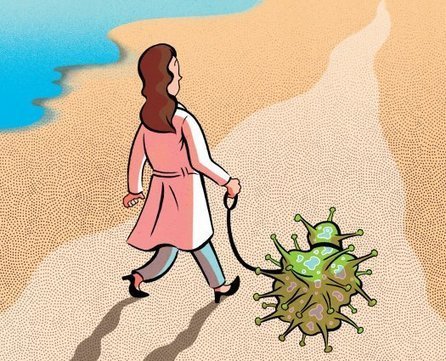
Cervical cancer / HPV graphic from Russell Kightley Media

Ed Rybicki‘s insight:

We have known for years that HeLa cells contain integrated HPV-18 genome(s) – now we know that they can be very probably causally linked to the cervical cancer that killed Ms Lacks, and led to her immortal cells becoming so much a part of modern molecular biology.

This is a tour de force in modern biology, and shows that, even 62 years later, new findings are coming out of old material.

Even if it is immortal – which poor Ms Lacks was not.

See on www.nature.com

A baculovirus-mediated strategy for full-length plant virus coat protein expression and purification

16 August, 2013

See on Scoop.itVirology and Bioinformatics from Virology.ca

Background

Garlic production is severely affected by virus infection, causing a decrease in productivity and quality. There are no virus-free cultivars and garlic-infecting viruses are difficult to purify, which make specific antibody production very laborious. Since high quality antisera against plant viruses are important tools for serological detection, we have developed a method to express and purify full-length plant virus coat proteins using baculovirus expression system and insects as bioreactors.

Conclusions

The expression of a plant virus full-length coat protein fused to the baculovirus Polyhedrin in recombinant baculovirus-infected insects was shown to produce high amounts of the recombinant protein which was easily purified and efficiently used to generate specific antibodies. Therefore, this strategy can potentially be used for the development of plant virus diagnostic kits for those viruses that are difficult to purify, are present in low titers or are present in mix infection in their plant hosts.


Baculovirus image from own collection

Ed Rybicki‘s insight:

I love the way plant virology / biotechnology now makes use of the whole spectrum of mol biol: this paper uses cDNA clones of an RNA plant virus, via E coli, to make recombinant baculoviruses, to express a fusion protein in insect cells – to make sera for detection of the plant virus by ELISA and other serological assays.

I’m biased because my lab uses ALL of these techniques (and I would have made the protein via agroinfiltration in plants), but this sort of science has really come of age.  One that I have lived through, incidentally, as cloning was VERY young when I started out – and ELISA had only just been invented.

I also know Renato quite well – so parabens, meu amigo!

See on www.virologyj.com

Scientists develop method that ensures safe research on deadly flu viruses

14 August, 2013

See on Scoop.itVirology News

The strategy will enable healthy molecules in human lung cells to latch on to these viruses and cut the bugs up before they have a chance to infect the human host.

Ed Rybicki‘s insight:

Excellent idea: engineer in sequences that allow naturally-occurring miRNA sequences in the human, but not the ferret lung, to snip the viral DNA so that it cannot cause a problem.

HOWEVER: do you suppose they have considered what happens when the engineered influenza virus, were it to go wild, mutates so as to avoid getting the snip?

See on www.sciencedaily.com

[H7N9] Bird Flu Experiments Proposed

10 August, 2013

See on Scoop.itVirology News

A group of 22 prominent influenza researchers have today (August 7) published a letter in both Natureand Science, stressing the need for a new wave of controversial studies on the H7N9 bird flu virus—so-called “gain-of-function” experiments that deliberately engineer mutant viruses to identify mutations that would make naturally occurring strains more transmissible or virulent in mammals.

This subtype of flu had no history of infecting humans until three cases were reported in China this March. Since then, H7N9 has infected at least 133 people and killed 43. Warmer summer weather and the recent closure of the country’s live bird markets have helped to contain the outbreak, but as colder months approach, researchers fear that the virus could re-emerge.


Ed Rybicki‘s insight:

Seriously, if work is not done on this rather nasty virus – especially in view of potential human-to-human transmission, recently noted in Virology News – in parallel with similar work on H5N1, the scientific community will be missing the opportinity to make real headway in understanding how it is that influenza A viruses become more transmissible and virulent in humans.

See on www.the-scientist.com

Patenting viruses doesn’t restrict research–it gives an incentive to do more research.

8 August, 2013

See on Scoop.itVirology News

In June, the U.S. Supreme Court ruled that people can’t patent isolated human genes, which it considers a product of nature, but they can patent something exceptionally similar: cDNA, a synthesized copy from which someone has removed the noncoding parts. Given that fine line, it’s not entirely clear how the decision will play out in practice or how it will affect work on nonhuman genes. But it’s a hot area of debate.

Earlier this year, Dutch scientists received a patent from their country on the newly discovered MERS virus that killed at least 30 people. The researchers had isolated the virus in their laboratory from a sample sent by a Saudi doctor. The Saudi Ministry of Health protested that the patent would restrict research and lead to more deaths; the World Health Organization (WHO) said it would investigate the legality and take action. But they’ve got it backward. Patents are one of the best tools for quickly fighting disease.

Ed Rybicki‘s insight:

Definitely!  I hate to say it out loud, in this era of "openness", but if you DON’T patent things sometimes, you may well have messed up the use of it for ever – because no-one commercial will touch anything that isn’t protected / protectable.

Which means that funky new vaccine you just published on without protecting it will be forever "an interesting paper", but never a product.

The NIH labs, for example, patent everything novel that passes through – because then they have a say in how it is commercialised, and can stop it being blocked by some company that wants to keep its own proprietary product current for that much longer.

Our lab has quite a big patent portfolio, for example: we have something like 14 patent families, and over 60 individual country patents, which gives us a reasonable stock-in-trade when it comes to licencing things to companies.  It has also given us leverage in getting money to work on new / improved versions of vaccines, for example, which has helped keep the lab afloat for a goodly number of years now!

We also negotiated rights to licencing / commercialisation for certain things, such as guarantees for low pricing for South Africa and Africa, keeping all rights for Africa and sharing rights elsewhere, and so on.

So they can be a tool for good, as well as all the other things they are accused of being!


Thanks, Arvind Varsani, for alerting me to this.

See on www.popsci.com

Immunogenic assessment of plant-produced human papillomavirus type 16 L1/L2 chimaeras

7 August, 2013

See on Scoop.itVirology News

Cervical cancer is caused by infection with human papillomaviruses (HPV) and is a global concern, particularly in developing countries, which have ~80% of the burden. HPV L1 virus-like particle (VLP) type–restricted vaccines prevent new infections and associated disease. However, their high cost has limited their application, and cytological screening programmes are still required to detect malignant lesions associated with the nonvaccine types. Thus, there is an urgent need for cheap second-generation HPV vaccines that protect against multiple types. The objective of this study was to express novel HPV-16 L1-based chimaeras, containing cross-protective epitopes from the L2 minor capsid protein, in tobacco plants. These L1/L2 chimaeras contained epitope sequences derived from HPV-16 L2 amino acid 108–120, 56–81 or 17–36 substituted into the C-terminal helix 4 (h4) region of L1 from amino acid 414. All chimaeras were expressed inNicotiana benthamiana via an Agrobacterium-mediated transient system and targeted to chloroplasts. The chimaeras were highly expressed with yields of ~1.2 g/kg plant tissue; however, they assembled differently, indicating that the length and nature of the L2 epitope affect VLP assembly. The chimaera containing L2 amino acids 108–120 was the most successful candidate vaccine. It assembled into small VLPs and elicited anti-L1 and anti-L2 responses in mice, and antisera neutralized homologous HPV-16 and heterologous HPV-52 pseudovirions. The other chimaeras predominantly assembled into capsomeres and other aggregates and elicited weaker humoral immune responses, demonstrating the importance of VLP assembly for the immunogenicity of candidate vaccines.


Ed Rybicki‘s insight:

Find trumpet – blow…B-)

See on onlinelibrary.wiley.com

Could We Soon See a Vaccine for HIV?

4 August, 2013

See on Scoop.itVirology News

The Elizabeth Glaser Pediatric AIDS Foundation (EGPAF) is a nonprofit organization dedicated to preventing pediatric HIV infection and eliminating pediatric AIDS through research, advocacy, and prevention, care, and treatment programs.

Ed Rybicki‘s insight:

Nah.  Not for years…B-(

See on www.pedaids.org

Biosecurity Implications of New Technology and Discovery in Plant Virus Research

4 August, 2013

See on Scoop.itVirology News

Human activity is causing new encounters between viruses and plants. Anthropogenic interventions include changing land use, decreasing biodiversity, trade, the introduction of new plant and vector species to native landscapes, and changing atmospheric and climatic conditions. The discovery of thousands of new viruses, especially those associated with healthy-appearing native plants, is shifting the paradigm for their role within the ecosystem from foe to friend. The cost of new plant virus incursions can be high and result in the loss of trade and/or production for short or extended periods.


We present and justify three recommendations for plant biosecurity to improve communication about plant viruses, assist with the identification of viruses and their impacts, and protect the high economic, social, environmental, and cultural value of our respective nations’ unique flora:


1) As part of the burden of proof, countries and jurisdictions should identify what pests already exist in, and which pests pose a risk to, their native flora;


2) Plant virus sequences not associated with a recognized virus infection are designated as “uncultured virus” and tentatively named using the host plant species of greatest known prevalence, the word “virus,” a general location identifier, and a serial number; and


3) Invest in basic research to determine the ecology of known and new viruses with existing and potential new plant hosts and vectors and develop host-virus pathogenicity prediction tools.


These recommendations have implications for researchers, risk analysts, biosecurity authorities, and policy makers at both a national and an international level.


TMV image courtesy of Russell Kightley Media


Ed Rybicki‘s insight:

Amen, brothers and sister, amen!!  Points 1 and 3, especially, and especially here at home in South Africa!!


It is a bizarre thing: our country has a large share of the worlds’s plant biodiversity, yet it is EXTRAORDINARILY hard to get ANY money to do plant virology.


Which is why I do biotechnology, vaccinology and human virology these days.


It only make sense, though: if you don’t know what is present in your plants in terms of viromes, then you don’t know what the potential threats are to whatever it is you want to grow.  As it is, South Africa is not actually that good aplce to grow anything: we’re too dry, and there simply isn’t the amount of arable land or decent soil that our northern neighbiours have.


Which is why we should be looking at THEIR plant viral diversity….

See on www.plospathogens.org

PBVAB 5 Verona June 2013: Session 7

3 August, 2013

Suzanne Huddy, a postdoc in our lab, kindly took some notes in a session I moderated at the 5th PBVAB in Verona this year.

Little did she know this is just my way of easing her in to doing this more often…B-)  Thanks, Sue!

Session 7: Manufacturing and Production Systems Developments

Moderator: EP Rybicki

Andreas Schaaf from Greenovation Biotech GmbH presented on “BryotechnologyTM en route to the clinic”, highlighting a production platform based on the moss Physcomitrella patens.  The overriding advantage of this system is that the moss is haploid and therefore genome modification is fairly straight forward with timelines for modifications similar to that of yeast systems.  Physcomitrella patens is also fairly unique since it has a very high occurring rate of homologous recombination (HR).  These traits along with the fact that the genome is sequenced and annotated allow fairly simple customization of the genomic background.  Using this, they have glyco-engineered strains and have removed plantized glycosylation completely.

Other than the products mentioned on their website (www.greenovation.com), they are currently working on α-galactosidase for treating Fabry disease.  Fabry disease is a rare genetic lysosomal storage disorder which results in the accumulation of lipids in the kidney, autonomic nervous system and cardiovascular system cells.  They are also working on the production of recombinant human β glucocerebrosidase for the treatment of Gaucher disease.  Interestingly, these are the same products produced by Protalix Therapeutics.

Stefan Schillberg from the Fraunhofer IME presented on “Co-MoFarm- Contained molecular farming: Controlled contained systems for high yield consistency”.  The CoMoFarm project has been funded for 3.5 years under the European Commission 7th Framework programme.  This project focused on the development of high-yielding plant-based production systems for recombinant proteins.

The presentation initially contrasted the production capability of the various plant platforms employed by this group using both HA (influenza hemagglutinin) and the human M12 antibody as protein products.  The production platforms included Arabidopsis and rice suspension cells, tobacco plants, roots and suspension cells, and moss suspension cultures.  The results presented highlighted the fact that one production platform is not necessarily optimal for all recombinantly expressed proteins, although the traditional tobacco leaves and BY-2 suspension cultures did produce the highest expression levels.  By further optimization of cultivation parameters (including media components), expression levels could be increased by up to 30 fold.  The presentation also showed that expression could also be improved by co-expression of the target protein with a fluorescent marker, DsRed.  In short, this allows the development of higher expressing lines through the non-invasive selection single elite expressing cells by flow-cytometry.  Stephan Schillberg also presented on the groups development of non-invasive monitoring systems for plant cell health and productivity.

The presentation was ended with a comparison on the cost of production of M12 antibody in either tobacco plants or BY-2 cells grown in 200 L bioreactors.  While the cost of producing this product in tobacco plants was less per gram of the product, the time for production in BY-2 cells was much shorter.  Details of the costing can be found at http://comofarm.org/useruploads/files/CoMoFarm_2013-6.pdf, where CoMoFarm have kindly made the presentation given in Verona available.

Pascal Drake from St. George’s University of London presented on “Hydroponic cultivation of tobacco for the production of recombinant pharmaceutical proteins by rhizosecretion”.  This presentation looked at the production and optimization of antibodies and Cyanovirin-N (CV-N) (a cyanobacterial protein which displays virucidal activity) in hydroponically cultivated tobacco plants.  Data was shown that suggested the inclusion of PGRs (plant growth regulators) and a nitrate source in the hydroponic medium could increase the concentration of the protein of interest in the medium.  Hydroponic cultivation has some advantages over traditional cultivation of tobacco plants.  Plants are cultivated in chemically defined media, therefore there is better control over the process and in this way this system approaches cell fermentation processes.  Additionally, fully processed secreted proteins can be harvested over the lifetime of the plant and purification can be simplified since the medium does not contain as many proteins as a whole leaf extract.  A “nifty” way of doing a western blot was also shown- basically, transgenic plants are germinated on nitrocellulose paper; this paper can then be used directly for a western blot since the protein of interest would have been secreted directly from the roots of the plant onto the membrane.  After development of the blot, the presence of the protein is seen in “root-shaped” pattern.

Bertrand Magy from the Institute of Life Sciences at the University catholique de Louvain, Belgium presented on the “Development of suspension cells as a competitive production system for antibodies”.  This research looked at designing an optimized antibody scaffold that can be combined with different variable regions in order to produce high levels of functional antibodies.  Initially, the expression of different IgG isotypes (human, rat and mouse) with the same variable region was investigated in tobacco and Arabidopsis thaliana suspension cells.  Bertrand showed that while antibodies accumulated in the extracellular medium, degradation occurred according to the isotype.  In this case, A. thaliana was also shown to be the better producer.  As is the case with many other cell suspension-based expression, the yield of antibody could be optimized by manipulating the growth medium.  Levels of antibody production of >30 mg/L could be achieved.

Moratorium on using live rinderpest virus lifted for approved research

30 July, 2013

See on Scoop.itVirology News

Benefits of future research should be carefully balanced against potential risks

Paris, 10 July 2013 – A moratorium on using live rinderpest virus for approved research has been lifted by the Food and Agriculture Organization of the United Nations and the World Organisation for Animal Health (OIE).

The moratorium followed the adoption of a Resolution in May 2011 by all OIE Member Countries that urged members to forbid the manipulation of rinderpest virus containing material unless approved by the Veterinary Authority and by FAO and OIE.

The two organizations have now put in place strict criteria and procedures to follow in order to obtain official approval for any research proposals using rinderpest virus and rinderpest virus-containing materials. One of the most crucial requirements is that the research should have significant potential to improve food security by reducing the risk of a reoccurrence of the disease. This procedure replaces an earlier complete ban on handling the virus.

Rinderpest was formally declared eradicated in 2011, but stocks of rinderpest virus continue to exist in laboratories. In June 2012, a moratorium on handling the virus was imposed after an FAO-OIE survey found that the virus continues to be held in more than 40 laboratories worldwide, in some cases under inadequate levels of biosecurity and biosafety.

When rinderpest was officially eradicated, FAO and OIE member countries committed themselves to forbid the manipulation of rinderpest virus-containing material unless approved by the national veterinary authority as well as by FAO and OIE.

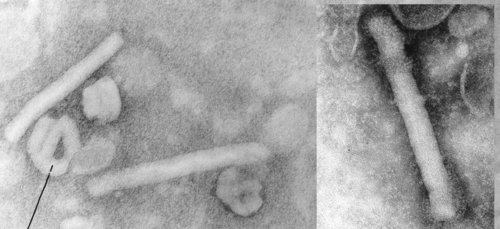
Paramyxovirus EM courtesy of Linda Stannard

Thanks to Len Bracher for alerting me to this.

Ed Rybicki‘s insight:

This is an interesting sequel to the eradication of wild rinderpest virus, which I have covered in some detail here on ViroBlogy: see here (https://rybicki.wordpress.com/2010/11/05/rinderpest-gone-but-not-forgotten-yet/) and here (https://rybicki.wordpress.com/2011/08/03/deliberate-extinction-now-for-number-3/).

The article covers an interesting prospect: that it may be possible to use attenuated, safe vaccines against the related peste des petits ruminants virus (PPRV) not only to protect against any resurgence of rinderpest, but also to eradicate this rather nasty virus.

Which is, apparently, spreading at rather an alarming rate, and is an obstacle to small ruminant production (http://www.fao.org/ag/againfo/resources/documents/AH/PPR_flyer.pdf).

So maybe this is “Now for Number 4!” time.

See on www.oie.int