Genome and proteome analysis of 7-7-1, a flagellotropic phage infecting Agrobacterium sp H13-3

1 June, 2012

See on Scoop.itVirology and Bioinformatics from Virology.ca

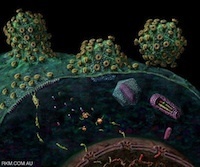
“The flagellotropic phage 7-7-1 infects motile cells of Agrobacterium sp H13-3 by attaching to and traveling along the rotating flagellar filament to the secondary receptor at the base, where it injects its DNA into the host cell.”


This is an interesting paper, because it describes a phage infecting Agrobacterium – and touches on a subject that has intrigued me for years, which is: How does a phage which attaches to a flagellum, get its genome inside the cell?  This throws some mud onto a previous model, which suggested a passive mode of transport like a well-oiled nut moving towards the head of a bolt, as in this case that would result in transport the other way.  Expectr more on this topic!


Image sourced from the paper

See on www.virologyj.com

What Do Human Parasites Do with a Chloroplast Anyway?

1 June, 2012

See on Scoop.itVirology News

“Apicomplexans are an important group of pathogens that include the causative agents of malaria, toxoplasmosis, and cryptosporidiosis. These single-celled eukaryotic parasites evolved from photosynthetic algae. A remnant chloroplast, called the apicoplast, is a telltale hold-over from this more benign past in the ocean. 1The apicoplast is essential for parasite growth and development and therefore a potential target for drug therapy. The fact that humans and animals lack chloroplasts suggests that using approaches to target the apicoplast may provide parasite specificity. What are the critical functions of the apicoplast that should be targeted? In addition to the obvious medical relevance this question has broader biological implications. Why do organisms maintain an ancient symbiotic relationship when the initial rationale for this relationship has fallen by the evolutionary wayside? A new study by Yeh and DeRisi provides important clues. Their work demonstrates that antibiotic-induced loss of the apicoplast in cultured malaria parasites can be chemically rescued by providing isopentenyl-pyrophosphate (IPP) in the medium. IPP is generated by the apicoplast resident isoprenoid biosynthesis pathway and is apparently the one apicoplast metabolite that the parasite cannot live without in the red blood cell. This finding could be of great importance for the development of drugs and vaccines. The ability to produce and maintain parasite lines that lack the apicoplast also offers exciting experimental possibilities for the future.”


Great review – and malaria is important enough to be considered an honorary virus (B-), so it is appropriate to cover it here.  The review also illustrates yet another aspect of the fascinating evolutionary propensity for eukaryotic algae, themsleves the result of endosymbiosis between a photosynthetic prokaryote and a eukaryote, for themselves becoming endosymbionts.

See on www.plosbiology.org

Superresolution imaging of HIV in infected cells with FlAsH-PALM

29 May, 2012

See on Scoop.itVirology News

“Imaging protein assemblies at molecular resolution without affecting biological function is a long-standing goal. The diffraction-limited resolution of conventional light microscopy (∼200–300 nm) has been overcome by recent superresolution (SR) methods including techniques based on accurate localization of molecules exhibiting stochastic fluorescence; however, SR methods still suffer important restrictions inherent to the protein labeling strategies. Antibody labels are encumbered by variable specificity, limited commercial availability and affinity, and are mostly restricted to fixed cells. Fluorescent protein fusions, though compatible with live cell imaging, substantially increase protein size and can interfere with their biological activity. We demonstrate SR imaging of proteins tagged with small tetracysteine motifs and the fluorescein arsenical helix binder (FlAsH-PALM). We applied FlAsH-PALM to image the integrase enzyme (IN) of HIV in fixed and living cells under experimental conditions that fully preserved HIV infectivity. The obtained resolution (∼30 nm) allowed us to characterize the distribution of IN within virions and intracellular complexes and to distinguish different HIV structural populations based on their morphology. We could thus discriminate ∼100 nm long mature conical cores from immature Gag shells and observe that in infected cells cytoplasmic (but not nuclear) IN complexes display a morphology similar to the conical capsid. Together with the presence of capsid proteins, our data suggest that cytoplasmic IN is largely present in intact capsids and that these can be found deep within the cytoplasm. FlAsH-PALM opens the door to in vivo SR studies of microbial complexes within host cells and may help achieve truly molecular resolution.”


Beautiful pictures, a great technique – and one which may allow ~1 nm resolution imaging inside cells in the near future.  Oh, and incidentally showed that HIV capsids persist all the way to the nuclear membrane.

See on www.pnas.org

Nano Patents and Innovations: Powerful New Approach To Attack Flu Virus

28 May, 2012

See on Scoop.itVirology and Bioinformatics from Virology.ca

An international research team has manufactured a new protein that can combat deadly flu epidemics.

The paper, featured on the cover of the current issue of Nature Biotechnology, demonstrates ways to use manufactured genes as antivirals, which disable key functions of the flu virus, said Tim Whitehead, assistant professor of chemical engineering and materials science at Michigan State University.

See on nanopatentsandinnovations.blogspot.fr

ProMED-mail | MEASLES UPDATE 2012 (22)

28 May, 2012

See on Scoop.itVirology and Bioinformatics from Virology.ca

ProMED Mail is possibly THE premier infectious disease updating service in the world today, having sprung to fame during the Kikwit Ebola outbreak in 1995.  This is one of a series of posts on measles, which is documenting a very disturbing trend: the incidence of the disease is increasing in places where it should have been eradicated, because well-educated and sophisticated communities are not vaccinating their children – or themselves.


One very telling quote from the post:

“Measles is highly infectious so we must all do
everything possible to prevent the spread of it, particularly with an outbreak on our doorstep. … MMR vaccination is the only way to prevent
measles. If parents haven’t arranged for their children to be vaccinated – it’s not too late to have the jab. Parents don’t realise that measles is not just a case of a few spots – it can be a very serious illness. Symptoms include fever, cough, soreness of the eyes and a rash which spreads rapidly over the body. Serious complications affect one in 15 children. These include chest infections, fits, encephalitis (swelling of the brain), and brain damage. In very serious cases, measles can kill.”

See on www.promedmail.org

Pandemic 2009 H1N1 vaccination produces antibodies against multiple flu strains

27 May, 2012

See on Scoop.itVirology News

“The pandemic 2009 H1N1 vaccine can generate antibodies in vaccinated individuals not only against the H1N1 virus, but also against other influenza virus strains including H5N1 and H3N2.”


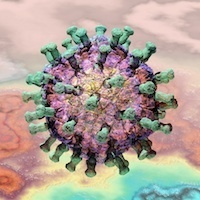
And a possible reason for this could be that the H1N1pdm virus’ haemagglutinin is a natural “ancestral” sequence – the kind that HIV vaccine researchers are looking for for gp120/160, which have been shown to elicit a wider spectrum of cross-reacting antibodies than “evolved” proteins, or ones that have been selected for antigenic escape in humans for a good few viral generations.


Flu vaccine graphic by Russell Kightley Media

See on www.eurekalert.org

Risk factors for West Nile virus – by Dr Pandula Siribaddana – Helium

27 May, 2012

See on Scoop.itVirology News

“The disease is more common in temperate and tropical geographical areas and usually the disease is said to be found in Africa, Middle East and West Asia. But, from recent times, almost all American states have got affected and from time to time there are outbreaks of large number of patients with West Nile Disease.”


Useful little review on the how/why/what of WNV.  Including the fact that we Africans have been living with it forever…B-)

See on www.helium.com

Trends in Intussusception Hospitalizations Among US Infants Before and After Implementation of the Rotavirus Vaccination Program, 2000–2009

27 May, 2012

See on Scoop.itVirology News

“A small increase in intussusception rates was seen among infants aged 8–11 weeks, to whom most first doses of rotavirus vaccine were given, but no sustained population-level change in overall intussusception hospitalizations rates in US infants was observed after implementation of the US rotavirus vaccination program. Although an association between intussusception and rotavirus vaccination cannot be established by this ecologic analysis alone, even if the low risk with the first dose exists, it is outweighed by the well-documented benefits of vaccination of US infants”

This is a big deal- a very important, big deal: human rotavirus kills more than 500 000 people a year (mainly very little), and rotavirus vaccines have been bedevilled with the suspicion that they cause telescoping of the intestine, or intussusception.  Which can be fatal, and is not something you want happening to your healthy baby.

However, and however: I have taught my students for years to be aware of relative risks when talking about vaccines, and there is absolutely no doubt that even the Wyeth vaccine could have been considered “safe” in a developing country environment, where the threat of death due to diarrhoea and dehyderation caused by rotavirus, would have been far greater than any threat from the vaccine.

I thank Rusdsell Kightley Media for the rotavirus graphic

See on jid.oxfordjournals.org

African monkey meat that could be behind the next HIV

25 May, 2012

See on Scoop.itVirology News

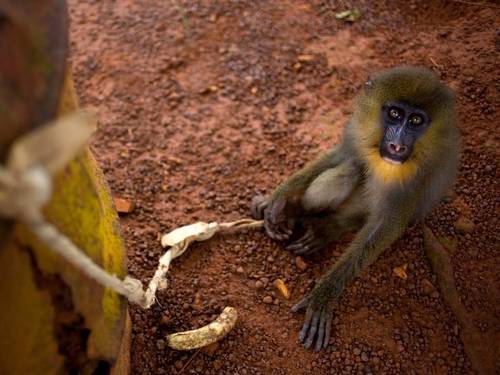
Eighty per cent of the meat eaten in Cameroon is killed in the wild and is known as “bushmeat”. The nation’s favoured dishes are gorilla, chimpanzee or monkey because of their succulent and tender flesh. According to one estimate, up to 3,000 gorillas are slaughtered in southern Cameroon every year to supply an illicit but pervasive commercial demand for ape meat .

“Everyone is eating it,” said one game warden. “If they have money they will buy gorilla or chimp to eat.”

Frankie, a poacher in the southern Dja Wildlife reserve who gave a fake name, said he is involved in the trade because he can earn good money from it, charging around £60 per adult gorilla killed. “I have to make a living,” he said. “Women come from the market and order a gorilla or a chimp and I go and kill them.”

 ————————————————————-

This is a big deal – and not because as, in the words of the article, “Britain is at risk from an outbreak caused by the lethal Ebola or Marburg viruses contained in illegal imports of bush meat from Africa”.


Because AFRICA is at risk from such diseases – and the death toll will be much higher here, where the standard of care is so much lower than in Europe.


And because we are losing the closest relatives that we as humans have – to human greed for meat.  How despicable, and how sad, is that?

See on www.independent.co.uk

Flu shot offers surprising benefits for pregnant women; Vaccine may fight stillbirth, preterm birth, and very low birth weight

25 May, 2012

See on Scoop.itVirology News

A new study announced Tuesday finds the H1N1 flu vaccine not only can protect you from getting sick but can actually benefit your baby.

Researchers from the University of Ottawa in Canada examined data from more than 55,000 child births in Ontario during an outbreak of H1N1, comparing mothers who were vaccinated to those who weren’t.

While prior research has found that pregnant women can safely get the flu shot at any stage of their pregnancies — something many doctors vehemently support — the new findings associate H1N1 vaccinations with a significantly reduced risk of stillbirth, preterm birth, and very low birth weight.

“These are all significant results, but especially interesting is the finding that the vaccinated mothers were one-third less likely to have a stillborn child,” said study researcher Deshayne Fell, a graduate student at McGill University who works with the birth record database. “This is one of the only studies large enough to evaluate the association between maternal flu vaccination and stillbirth — a very rare event.”


So much for the disinformation about dangers to pregnant women: in fact, Spanish Flu and the recent H1N1 pandemic were both especially dangerous for unprotected pregnant women.

See on www.nydailynews.com