Venter can do WHAT for influenza??

5 June, 2010

I have kept out of commenting on what J Craig Venter and others have done recently, given that many others have done so, and done so well – however, there is recurring mention of what “this technology” could do for influenza vaccines specifically, which has both puzzled and intrigued me, given a distinct lack of obviousness.

So I will comment, if only to clarify this issue for me and anyone else who cares.

To give some background, the New Scientist issue of the 29th of May has a guest editorial by J Craig Venter, Clyde Hutchison and Hamilton Smith, where they discuss some of the implications of their having made a totally synthetic and viable Mycoplasma mycoides genome (see also Science, DOI: 10.1126/science.1190719).

So what, exactly, is it they did?  OK, so they spent US$40 million or so constructing a genome, in segments, from sequence information housed in an electronic database, via chemical synthesis of long stretches of DNA.  They then assembled these segments into a singular genome in yeast, and then inserted this into cells of the closely-related Mycoplasma capricolum which had been stripped of their genomes – and incidentally, rendered unable to destroy the incoming genome as “foreign”, by a process which is now proprietary.  These cells then expressed the new DNA, which allowed them to multiply, and to take on all of the characteristics of the synthetic M mycoides, given that all of the original cell constituents from the original bug (proteins, mRNA, membranes, etc) would be turned over in time, and become those specified by the new genomes.

This is a big deal – a really, really big deal – but at the same time, they themselves recognise it is an incremental step in a long series of steps that started with Arthur Kornberg’s lab making the first complete synthetic and viable genome of a virus (phiX174) by in vitro synthesis from virion DNA, polymerase and nucleotides.  In fact they modestly point out that this is not even the first  complete cell genome that has been synthesised; it is the largest, however, and the one that worked.  They were not so modest in missing out a few other landmarks before their own complete synthesis of phiX174 in 2003, however: for example, the first synthesis of a functional plasmid, and the first generation of a RNA virus genome from a cDNA copy, and the complete synthesis of an infectious poliovirus genome, are not mentioned.

So what is it they did not do?

Well, they did not “create life”, however much even relatively respectable publications might claim they did: life is a lot more complex than chemicals, and people have “rebooted” cells before with exogenous genomes; what they did is not really qualitatively different to infecting a cell with a synthetic virus.

They have also not done anything that is immediately useful: their new organism differs from the original only in having a few genes missing, and a long literary message and ownership-encoding “watermark” inserted.

More positively, they have also most emphatically not opened the floodgates for bioterrorists to mail order complete poxvirus or anthrax genomes: as I have noted here previously,

“…There are more than enough nasty agents out there that are relatively easy to obtain, and do simple kitchen-based microbiology with, to keep entire cave complexes and Montana libertarian enclaves busy for years, without resorting to complicated molecular biology”.

Or spending $40 million dollars.  And I will say it again….

So aside from the details, what have they done?  In the NS editorial, Venter et al. say this:

“We now have the means to design and build a cell that will define the minimal set of instructions necessary for life, and to begin the design of cells with commercial potential, such as fuel production from carbon dioxide. We can assemble genome-sized stretches of DNA that can also be used to mix and match natural and synthetic pieces to make genomes with new capabilities.

Synthesising DNA in this way is still expensive, but we expect the cost to fall dramatically. This may make the complete synthesis of genomes competitive with the alteration of natural genomes to add new capabilities to bacterial cells. It should also be practical to synthesise simple eukaryotes, such as yeast, to which it is already possible to add extra chromosomes. The construction of large pieces of synthetic DNA and their introduction into a receptive cytoplasm is no longer a barrier. The limits to progress in synthetic biology are now set by our ability to design genomes with particular properties.”

Right: so what they have done is set the benchmark for what is possible – rather than what should be done.

Because it is a lot easier to do things such as they propose by other ways – as is pointed out in the companion article to the NS editorial.  For that matter, I am sure one could more easily end up with a completely synthetic and much larger cellular genome by incrementally replacing genome chunks by homologous recombination or transposon-mediated insertion / Cre-Lox deletion, and have it cost far less and be less subject to error, than by synthesising it de novo.

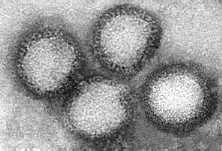
Influenza virus - Copyright Russell Kightley Media

And how does any of this relate to influenza vaccines?

The only comment I can find in the NS article that sheds light on this is the comment:

“As soon as next year, the flu vaccine you get could be made synthetically,” he [Venter] says.

Except that this has been possible for years already, after the poliovirus synthesis…?  I think it was rather a badly-chosen example rather than any actual plan; however, there is not a lot of point in making a synthetic influenza virus genome, given that the attenuated originals already work quite well as vaccines – and we don’t yet understand how to specify avirulence in influenza, so any synthetic version would necessarily be a copy of an extant version.

So hype rather than fact for ‘flu; promise rather than substance for carbon dioxide sequestration and biofuels – but still the coolest thing since sequencing your own dog…B-)

Seen in Melbourne

26 April, 2010

One Way Traffic....

Enough said.  Thanks to John Hamill for spotting it, and then reversing so I could record it.

Second Workshop on Molecular Farming in Australia

15 April, 2010

I was privileged to attend – and give the first presentation in – this workshop, on April 12-13 this year, at Monash University’s Clayton Campus in Melbourne. While it was small – about 25 people all told – I think what was discussed was very interesting. Even more interesting was the discussion of where the technology should be taken in Australia, given the science environment there has many similarities to the South African situation.

The workshop included some 20-odd people, mainly from the School of Biological Sciences at Monash in Melbourne, but with representation from  the University of Cape Town, Southern Cross University (NSW), the Agri-Science in Queensland, the University of Queensland, and –importantly for the implications of this kind of work – the Australian Department of Defence.

I kicked off proceedings with a Keynote Address on “Viruses, vaccines and plants:  The Cape Town experience”: this was essentially an account of my laboratory’s work on plant-made vaccines and other pharmaceutically-important molecules over the last 15 years, focussing on optimisation of expression of relevant molecules, and our work on Human papillomavirus (HPV), HIV and influenza virus vaccines in particular.  I emphasised that optimisation requires one to look at molecule, gene, vector, expression host, expression modality and intracellular localisation – and that there was no substitute for an empirical determination of optimisation parameters.

In the first session – Plant-Made Vaccines – chaired by Diane Webster of Monash, Sadia Deen of Monash described her work on making an experimental mouse vaccine against the causative agent of fowl cholera,  Pasteurella multocida.  Expression of the OmpX protein via transient agroinfiltration of N benthamiana was successful, as was protection of mice against lethal challenge by injection of freeze-dried leaf powder with alum as adjuvant.  Interesting features for me were that the vaccine was apparently better than the E coli-produced version, and that it was apoplast-targetted – meaning purification could be very simple.

Assunta Pelosi of Monash then described an investigation of the in vivo fate in mice of the B subunit of the E coli enterotoxin (LTB) that had been produced in plants and then and formulated in different ways.  Hairy root culture-produced protein was most protected and released antigen latest regardless of formulation; otherwise, LTB produced in N benthamiana leaves or tomato fruit was released in stomach or duodenum if formulated in aqueous (=apple juice + honey) media, and in the duodenum and ileum if formulated in lipid (=peanut butter) media.  There seemed to be no difference in how much LTB went all the way through the animals regardless of origin or formulation.  I was interested in the possibility of an enhanced adjuvant effect with protein produced in N benthamiana compared to other routes of production, as this has been documented for other proteins – and this is apparently being investigated, using protein produced in different Nicotiana spp.

Session 2 – Plants as Production Systems – was chaired by me, and featured a fascinating mix of production of an exciting new product, a chemical engineering view of production of antibodies via plant tissue culture, and  an introduction to the very significant industrial potential of sugarcane and/or sugarcane processing infrastructure for biopharming.

Diane Webster of Monash described her group’s work on expression of soluble human-derived RAGE, which has potential both as a diabetes therapy to lessen uptake by the ordinarily membrane-linked receptor of advanced glycation end-products (AGE), and as a reagent for advanced assay techniques.  She described how the Ig-like protein was very difficult to make in insect cells, and how the E coli or yeast-made versions were useless because of lack of or inappropriate glycosylation.  sRAGE could be made successfully in plants; addition of a KDEL ER retention signal adversely affected yield, while a His-tag did not.  While yield was only ~0.6% of total soluble protein (TSP), they could get 70% recovery of a 90% pure protein – which was identical to mammalian RAGE in terms of –S-S- bridges and functionality as assessed by surface plasmon resonance.  It was interesting that use of ICON vectors did not appear to help increase yield.

Pauline Doran, of the Dept Chemical Engineering and the School of Biological Sciences at Monash, gave a fascinating account of her experiences with plant tissue culture as a production vehicle for biopharming.  Her first point was that there are important trade-offs with bioreactor vs. whole plant production: for example, production of biomass was more expensive for the former, but purification of final product was probably cheaper.  It was also much easier and more reproducible to control a wide variety of environmental and growth conditions for tissue cultures.  She described years worth of experience of making anti-S mutans monoclonal Abs in transgenic suspension cultured tobacco cells, shooty teratomas derived from transgenic plants using Agrobacterium tumefaciens, and hairy root cultures produced via A rhizogenes transformation.  Production over years was most consistent for root cultures, while levels of mAb production were similar initially for roots and suspension cultured cells.  An important consideration in how to make the Abs was that suspension cultured cells produced significant amounts of proteases via the apoplast, so that secreted Abs could be degraded – which is why it was better to retain them in the ER.  Rhizosecretion form root cultures was a useful means of production; however, adsorption to vessel walls was a major problem even though it could be blocked using proteins or PVP.  The talk was valuable for laboratory-end scientists because it showed up practical problems – and solutions – not often dealt with during the research and development phase of biopharming research.

Peter Twine of the Queensland CRCSIIB recounted how they had been given Aus $28 million over 7 years to improve value in sugar in Australia.  He noted that Australia could handle 40 million tonnes of cane in some 40 processing stations annually – so very little further investment would be needed to get much more product than the bagasse, sugar and ethanol that the crop was presently used to produce.  In terms of biomass, a cane field could produce 50-100 tonnes / ha / yr, which could be significantly improved by strategic backcrossing.  Value enhancements which had already been made included production of Barrecote – a biodegradable waterproof coating for recyclable paper – as well as a GI-lowering agent, and PHB (for production of plastics) that was 3-4 times cheaper than E coli-produced material.  He said what was wanted for sugarcane was an Agrobacterium transformation protocol, as well as chloroplast transformation: this would allow significant expression enhancement as well as reliable transgenesis.  The talk was valuable both as an informational window into a well established industrial-scale biotechnology, and as a window into possibilities for use of the established biomass processing infrastructure for biopharming purposes: for example, discussion after the talk ranged around the significant potential for use of even only a small fraction of that infrastructure – for example, one processing mill – to produce potentially very large amounts of lower-end pharmaceuticals (high volume, low cost), such as enzymes or nutraceuticals.

The last Monday session was a Student Forum, chaired by Rob Shepherd from Monash.  Giorgio De Guzman (Monash) described how their team had systematically investigated production of LTB in hairy root cultures of tobacco, tomato and petunia: he mentioned that a distinct advantage of hairy root cultures was that they grew rapidly, and required only simple media with no hormones.  They showed that tobacco and petunia cultures gave the best yields (60-70 ng/g root), and that while there was some negative correlation of growth with expression level, this was least for petunia.  Optimum growth of cultures was reached after 22 days, and rhizosecretion peaked at 20 days.  What was most interesting to me was that it was possible to regenerate plants from root cultures: this would allow seeding and preservation of good producer lines as seed rather than as root cultures, with the option or re-establishing root cultures again as needed.  An added bonus was that such cultures seemed to grow better than the original cultures, with the same recombinant protein yield.

Huai-Yian Ling (Monash) gave a talk on a topic close to my heart: this was the use of plants to produce candidate pandemic influenza virus vaccines.  She specifically addressed the potential problem for oral vaccine development of the high alkaloid content of the tobaccos that are otherwise very well suited for pharming, due to their ease of propagation, high biomass per plant, and prolific seed production, by crossing transgenic H5 haemagglutinin (HA)-producing N tabacum with a N glauca line in which alkaloid production had been silenced by siRNA.  She determined that a plant codon-optimised HA gene expressed best, and gave 13 ug/g leaf tissue in the line used for crossing.  The hybrid progeny had no alkaloid, but also only produced HA at levels <1 ug/g.  Lyophilisation allowed this to be concentrated to 64 ug/g, which would be sufficient for oral immunisation experiments.  She planned to see whether a LEA protein from a resurrection plant would protect the HA.

The final talk – and of only two in the whole workshop which did not involve transgenic plants or recombinant protein expression – was by Sylvia Malory (Southern Cross Univ).  She had studied the possibility of “mining” rice domestication genes in the rice relative Micolaena stipoides: this grass is a drought-, frost- and shade tolerant perennial which produces rice-like seed.  Her approach was to exploit the extensive sequence and map databases for rice and other grasses so as to rapidly extract relevant genetic information for homologues of important rice genes from whole-genome shotgun sequencing runs of M stipoides DNA.  Traits of interest included reduced plant height, non-shattering seeds, increased yield, controlled seed dormancy, photoperiod insensitivity, drought tolerance and disease and insect tolerance.  For me the interest in this talk was that the potential for crossover between the biopharming and crop improvement spheres seems to get closer and closer with improvements in technology such as pyrosequencing, in that crop targets such as secondary metabolite engineering can also be exploited for pharming.

The final session of the Workshop on the Tuesday morning was left to me to summarise what the strategic directions of the existing and future “Molecular Farming Network” in Australia could be.  I approached the topic by summarising where I thought the biopharming field was presently in terms of direction and priorities – which was that the latter had shifted from the largely “vaccines in edible transgenic plants” hype of early years, to a more mature appreciation that transiently-expressed proteins in non-food plants were the way to go, and that the preference for products should be enzymes, reagents, diagnostics,  and then therapeutics, and animal vaccines – with human vaccines as a long-term goal.  This notwithstanding, I highlighted the fact that transiently-expressed plant-made candidate vaccines for H5N1 and H1N1 influenza and for noroviruses were probably the quickest emergency response vaccines ever made, which was a very important niche for the technology. 

My impression from the workshop, and from discussions with various folk, was that this particular biotechnology in Australia is presently under-developed, despite the presence in Australia (and apparently, mainly at Monash University) of considerable expertise and potential products.  I caution against the single-minded pursuit, for example, of “edible” or even of oral vaccines, where injectable versions may well work better and be cheaper to produce, simply because much less active ingredient is needed.  I also urge that the production of various reagent- or diagnostic-related products be pursued more vigorously, given that there is either no regulatory barrier to overcome, or – for animal products in particular – a far lower one than exists for products made for use in humans.

And I thank Amanda Walmsley, John Hamill, Rob Shepherd and Assunta Pelosi for looking after me so well.
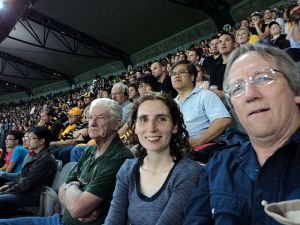
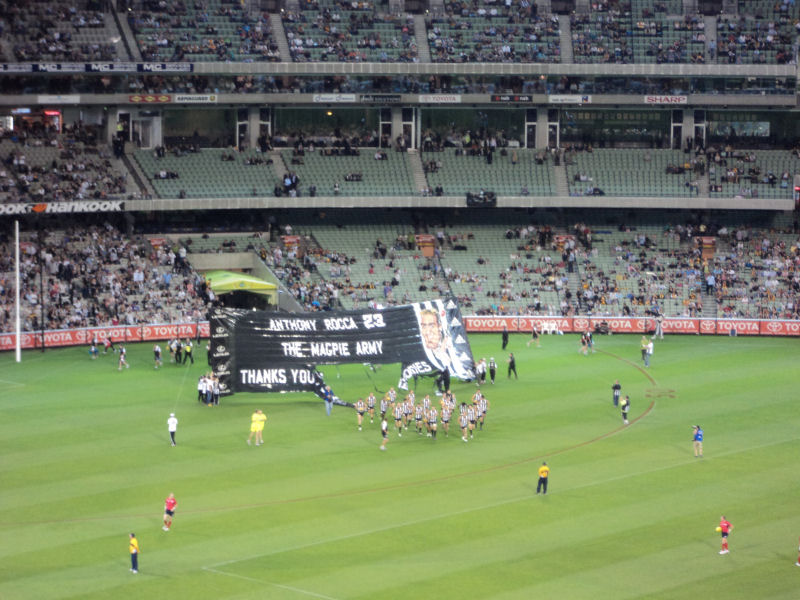
Assunta and Ed at the MCG, watching Collingwood play Hawthorne in the AFL
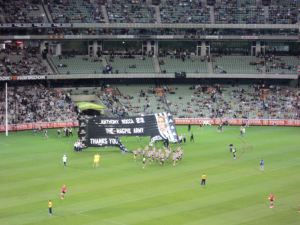
The Melbourne Cricket Ground: awesome....
dsRNA: new-new therapy, or…?

1 April, 2010

We plant virologists – or almost-former plant virologists, in my case – have a slightly cynical attitude towards the all-new, all-encompassing craze among cell biologists and mainstream virologists that is siRNA, and all its purported applications.

This is because the phenomenon of RNA silencing was first discovered in the context of unexpected resistance in transgenic plants to the homologous virus, mediated by transgenes that either produced no measurable amount of protein, or mRNAs that were not translatable.  The phenomenon was known as “post-transcriptional gene silencing” back then, among plant molecular biologists and virologists – until, that is, it was taken up by the mammalian and insect cell biology folk, whereupon its origins were quickly forgotten, and the Nobels went to…well, let us just say, not to whom some folk thought they ought.

But I digress:  suffice it to say that siRNA has now been amply demonstrated to be not only the eukaryotic cell’s (and especially those of plants) adaptive nucleic acid-based immune response to virus infection, but also a widely used means of regulation of gene expression (see here).  Needless to say, its potential uses for gene and disease therapy are also multiplying daily – which is when people forget the roots of the science.   At first sight, the New Scientist issue of 23rd March – which has an excellent article on the use of siRNA-based strategies to combat insect pests – goes some way to redressing that, given that the science has found its way back to plants.  It is especially interesting that delivering siRNA-eliciting constructs in insects can be achieved by simply feeding them dsRNA of the appropriate sequence, rather than by use of chemically-altered or encapsulated material.

 However, and here’s where one can see that no-one except plant virologists reads the plant virology literature (the converse being untrue, naturally), a problem crops up when the article goes on to discuss whether or not dsRNA is safe.  In a side box in the article, this is said:

Is it safe?

Using gene silencing, or RNA interference (RNAi) to target specific pests while leaving other species unharmed sounds like an enormous step forward. But can we be sure that the key ingredient – double-stranded RNA (dsRNA) – won’t have unexpected side effects in people?

Although most RNA in cells is single-stranded, all plants and animals also produce dsRNA to regulate the activity of their own genes. “There are lots of dsRNAs in the plant and animal products that we eat every day,” says Michael Czech, a molecular biologist at the University of Massachusetts Medical School in Worcester, who is exploring ways to use RNAi to treat type II diabetes. “Those RNA molecules are rapidly chopped up by the enzymes in our gut and are non-toxic.”

There is also a second line of defence in the form of enzymes in our blood that break down dsRNA. “You could inject dsRNA into primates at moderate doses and nothing would happen, [my emphasis]” says Daniel Anderson of the David H. Koch Institute for Integrative Cancer Research at the Massachusetts Institute of Technology, who is designing drugs based on RNAi.

Ummmm…sorry, that simply isn’t true: as long ago as the early 1970s, plant and fungal virologists had hit on the idea of using antibodies specific for dsRNA to detect the molecules in extracts of hosts infected with dsRNA (and even ssRNA) viruses.  Here’s two examples of papers from then:

Detection of mycoviruses using antiserum specific for dsRNA.
Moffitt EM, Lister RM.  Virology. 1973 Mar;52(1):301-4.

Immunochemical detection of double-stranded ribonucleic acid in leaves of sugar cane infected with Fiji disease virus.
Francki RI, Jackson AO.  Virology. 1972 Apr;48(1):275-7.

And of course, using antibodies to dsRNA implies that one can raise them in the first place…which, as I recall (my career started shortly afterwards, and I read these papers), was as a consequence of raising antisera to dsRNA-containing phytoreovirus and cryptovirus virions.  It was later found that sera to synthetic ds oligoribonucleic acids also detect dsRNAs – all of which means that injection of dsRNAs is likely to elicit antibodies against them.  With who knows what corollaries…because not too many plant virologists were too worried about long-term effects in the mainly bunnies that they injected.

Of course, the route to dsRNA pesticide effects is via the insect gut – and the same New Scientist article has this to say about dosing humans thus:

“There are lots of dsRNAs in the plant and animal products that we eat every day,” says Michael Czech, a molecular biologist at the University of Massachusetts Medical School in Worcester, who is exploring ways to use RNAi to treat type II diabetes. “Those RNA molecules are rapidly chopped up by the enzymes in our gut and are non-toxic.”

Ye-es…they would say that, wouldn’t they?  And no-one knew you could make Abs to dsRNA before someone noticed phytoreovirus antiserum bound dsRNA – so it would be a very interesting exercise to assay sera from individuals or animals previously exposed to multiple rounds of dsRNA rotavirus infection, and see whether these contained dsRNA-specific Abs, wouldn’t it?  The NS article negates some of its own reassurances by saying:

So there is good reason to think sprays containing dsRNAs lethal to insects, or plants modified to produce them, will pass all the safety tests. However, if the RNA was altered in a way that allows it to get into human cells, perhaps as a result of changes intended to make it persist longer in the environment, it might cause problems. “If you modify the dsRNA – by encapsulating it or changing the RNA molecule – then you are imposing a new chemistry that could have toxic effects on humans,” Czech cautions.

Yeah – like encapsidating it like a virus does….

And it is all probably a bit of a sideshow, in that we are in fact exposed to dsRNAs in our diet all the time: especially if one eats organic, the fresh fruits and uncooked vegetables will be rife with dsRNA-containing fungal viruses; even material containing ss+RNA viruses contains significant amounts of replicative form dsRNA  (including insect material, BTW) – so a little more used as pesticide probably wouldn’t hurt.

We hope.

Rift valley fever: a problem – and a solution?

17 March, 2010

Rift valley fever virions: Linda Stannard, UCT

It was an interesting week, what with a Rift valley fever virus (RVFV) outbreak in South Africa associated with two human deaths – and an excellent journal club presentation (thanks, Liezl!) on a new candidate virus-like particle vaccine made in insect cells.  RFV was in fact worked on in the 1960s at UCT in the old Virus Research Unit under the legendary Dr Alfred Polson at the then Medical School (see pictures link here) – and a couple of folk even got infected while trying to purify it, but we won’t speak of that.

First, the news:

Health-e (Cape Town)

South Africa: Rift Valley Fever Update – a Total of 21 Cases Have Been Confirmed

15 March 2010  press release

The following is a statement by [South African] Deputy Minister of Health Dr Molefi Sefularo, MP, pertaining to the recent deaths from Rift Valley Fever in South Africa.

As of 15 March 2010, a total of 21 human laboratory confirmed cases of River [sic] Valley Fever (RVF) have been confirmed – all acquired in Free State – with two deaths. This brings a total to 22 human cases of RVF – with one in Northern Cape.

Most of these cases reported direct contact with RVF-infected livestock and or linked to farms with confirmed animal cases of RVF. The human cases are; farmers, veterinarians and farm workers. Additional suspect cases are currently being tested.


While there is no specific treatment, the majority of persons affected will recover completely. People should avoid contact with the tissues of infected animals, refrain from drinking unpasteurised milk and prevent mosquito bites to avoid becoming infected. Farmers and veterinarians should wear protective clothing when handling sick animals or their tissues. There is no routine vaccine available for humans.


Rift Valley Fever (RVF) is a viral disease that can cause severe disease in a low proportion of infected humans.

The virus is transmitted by mosquitoes and causes outbreaks of abortion and deaths of young livestock (sheep, goats and cattle). Humans become infected from contact with infected tissues of livestock and less frequently from mosquito bites. In sub-Saharan Africa the mosquitoes which transmit the virus do not enter human dwellings but feed on livestock outdoors at night. The disease occurs throughout Africa and Madagascar when exceptionally heavy rains favour the breeding of the mosquito vectors.

Clinical features in humans

Typically illness is asymptomatic or mild in the vast majority of infected persons, and severe disease would be expected to occur in less than 1% of infected persons.

Key symptoms:

The incubation period (interval from infection to onset of symptoms) for RVF varies from two to six days.

  • Sudden onset of flu-like fever and/or muscle pain.
  • Some patients develop neck stiffness, sensitivity to light, loss of appetite and vomiting.

Symptoms of RVF usually last from four to seven days, after which time the immune response becomes detectable with the appearance of antibodies and the virus gradually disappears from the blood.

Severe form of RVF in humans includes:

  • Vision disturbances
  • Intense headache, loss of memory, hallucinations, confusion, disorientation, vertigo, convulsions, lethargy and coma and;
  • Haemorrhagic Fever [rarely – Ed.]

The public living in the affected areas is encouraged to seek medical attention at their nearest Health facilities, should they have any of the above symptoms.

This is an unusual outbreak, because these normally occur only in high summer rainfall regions near the tropics, on the African east coast – and not far inland in essentially arid distinctly sub-tropical areas, like the Free State and Northern Cape.

However, there is news at hand that may be of use in the future: while there is currently no human vaccine, and veterinary vaccines are apparently so attenuated as to require several applications to be effective, SM de Boer and colleagues in The Netherlands claim that subunit VLP vaccines derived by envelope glycoprotein expression in insect cells appear to confer complete protection in vaccinated animals.

Vaccine. 2010 Mar 8;28(11):2330-9. Epub 2010 Jan 5.

Rift Valley fever virus subunit vaccines confer complete protection against a lethal virus challenge.

de Boer SM, Kortekaas J, Antonis AF, Kant J, van Oploo JL, Rottier PJ, Moormann RJ, Bosch BJ.

“Here we report the evaluation of two vaccine candidates based on the viral Gn and Gc envelope glycoproteins, both produced in a Drosophila insect cell expression system. Virus-like particles (VLPs) were generated by merely expressing the Gn and Gc glycoproteins. In addition, a soluble form of the Gn ectodomain was expressed and affinity-purified from the insect cell culture supernatant. Both vaccine candidates fully protected mice from a lethal challenge with RVFV. Importantly, absence of the nucleocapsid protein in either vaccine candidate facilitates the differentiation between infected and vaccinated animals using a commercial recombinant nucleocapsid protein-based indirect ELISA”.

Great accomplishments; great paper – and I note that if you can do it in insect cells, you can do it in plants…just like influenza viruses.

Because, as de Boer et al. state in their Introduction:

“Although the overall case-fatality rate is estimated at 0.5–1.0%, recent outbreaks show considerably higher numbers. The high case-fatality rates combined with the potential of rapid spread via its vector explains the recognition of RVFV as a potential bioterrorism agent by the United States government. Given the impact of RVF outbreaks on livestock, the human population, and the economy, there is an urgent need for a safe and effective vaccine.” [my emphases]

And one backed by the US Government – which used to work on it as a bioterror agent, according to Wikipedia.  Ah, well: some day they’ll just want to do it because it’s the humanitarian thing to do.  Like now, possibly: DARPA is funding Fraunhofer USA to the tune of $4.4 million to make H1N1 vaccines in plants, following their successes over the last couple of years in especially transiently expressing HA proteins.

Going green: the sensible thing to do.

ViroBlogy in Top 50 Biology Research Blogs

17 March, 2010

While self-puffery is to be deplored, it is always nice when someone else does it: like Emily Johnston at Medicalicious, who writes:

I’m writing this to let you know about a new featured post we just made over here at Medicalicious entitled, “Top 50 Biology Research Blogs.” I thought you and your readers at Viroblogy might find it to be a very interesting article. Please do let me know if you have any feedback — http://medicallabtechnicianschool.org/2010/top-50-biology-research-blogs/

So g’wan over…I note we are in excellent company in the Microbiology Division: MicrobiologyBytes is there; so too Small Things Considered, Vince Rcaniello’s Virology Blog, and a new one to me, Microbiology Blog from Horizon Press.

I shall have to update more often…B-)

Re-engineering AAV

8 February, 2010

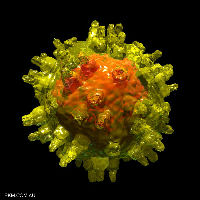
Adeno-associated virus (AAV) virion. Copyright Russell Kightley Media

Tweaking virus vectors used for gene therapy to change their receptor specificity is not necessarily new – but it has seldom been done (at least, to my mind) as elegantly as is reported in January’s Nature Biotechnology.  Asokan et al. report on

Reengineering a receptor footprint of adeno-associated virus enables selective and systemic gene transfer to muscle
Nature Biotechnology 28, 79 – 82 (2010)
Published online: 27 December 2009 | doi:10.1038/nbt.1599

From the abstract:

We generated a panel of synthetic AAV2 vectors by replacing a hexapeptide sequence in a previously identified heparan sulfate receptor footprint with corresponding residues from other AAV strains. This approach yielded several chimeric capsids displaying systemic tropism after intravenous administration in mice. Of particular interest, an AAV2/AAV8 chimera designated AAV2i8 displayed an altered antigenic profile, readily traversed the blood vasculature, and selectively transduced cardiac and whole-body skeletal muscle tissues with high efficiency. Unlike other AAV serotypes, which are preferentially sequestered in the liver, AAV2i8 showed markedly reduced hepatic tropism.

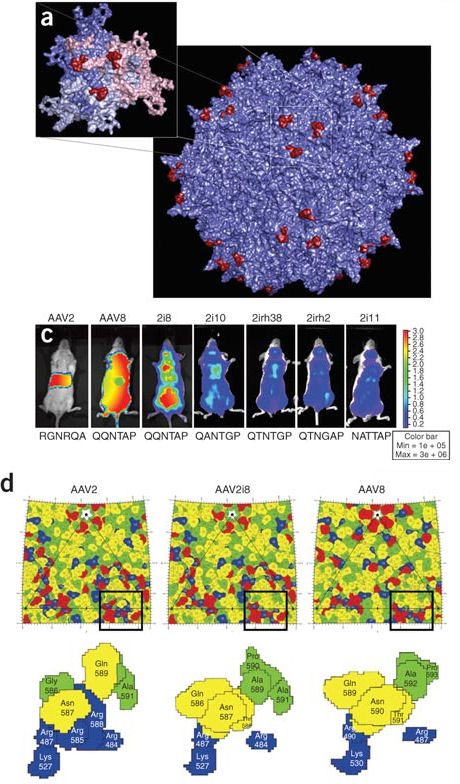
What impressed me most about the paper was the excellent modelling graphics: the authors were able to show, in simple 3-D atomic models, just how their mutations had changed the surface archotecture of the virus in question.  The whole-animal imaging was also very useful in showing very simply how effective their different constructs were.

(a) Three-dimensional structural model of the AAV2 capsid highlighting the 585–590 region containing basic residues implicated in heparan sulfate binding. Inset shows VP3 trimer, with residues 585-RGNRQA-590 located on the innermost surface loop highlighted in red. VP3 monomers are colored salmon, blue, and gray. Images were rendered using Pymol. (c) Representative live animal bioluminescent images of luciferase transgene expression profiles in BALB/c mice (n = 3) injected intravenously (tail vein) with AAV2, AAV8, AAV2i8 and structurally related AAV2i mutants (dose 1 × 10¹¹ vg in 200 μl PBS) packaging the CBA (chicken beta actin)-Luc cassette. All AAV2i mutants show a systemic transduction profile similar to that of AAV8, with AAV2i8 showing enhanced transduction efficiency. Bioluminescence scale ranges from 0–3 × 10⁶ relative light units (photons/sec/cm2). Residues within 585–590 region in each AAV2i mutant is indicated below corresponding mouse image data. (d) Comparison of AAV2, AAV2i8 and AAV8 capsid surface residues based on schematic “Roadmap” projections. A section of the asymmetric unit surface residues on the capsid crystal structures of AAV2 and AAV8, as well as a model of AAV2i8, are shown. Close-up views of the heparan sulfate binding region and residues 585–590 reveal a chimeric footprint on the AAV2i8 capsid surface. Red, acidic residues; blue, basic residues; yellow, polar residues; green, hydrophobic residues. Each residue is shown with a black boundary and labeled with VP1 numbering based on the AAV2 capsid protein sequence.

Adapted by permission from Macmillan Publishers Ltd: Nature Biotechnology 28, 79 – 82 copyright (2010)

Changing the tissue specificity of a well-characterised and often-used vector virus such as AAV in this way is an extremely useful thing to have done: it probably lowers the potential toxicity of the vector – by avoiding the liver – while preserving useful features such as the higher-level expression afforded by use of AAV2.

…and here they come…

8 February, 2010

…Big Pharma, to the biopharming revolution, that is.  Following on from earlier news about Protalix’s glucocerebrocidase successes, comes this latest snippet from Nature Biotechnology:

Pfizer stakes a claim in plant cell–made biopharmaceuticals

Mark Ratner

On December 1, Pfizer became the first big pharma to commit to take to market a late-stage biologic drug produced in plant cells. It acquired rights to taligurase alfa, a form of the enzyme glucocerebrosidase in development for the treatment of Gaucher’s disease, from Protalix Biotherapeutics in Carmiel, Israel. Protalix has completed phase 3 studies and has submitted a new drug application for the drug, also known as prGCD, eyeing US marketing approval in 2010. At the request of the US Food and Drug Administration (FDA) last year, the company has already begun supplying prGCD to patients in the US under an expanded access program and similarly to patients in the EU under a compassionate-use protocol [my emphasis – Ed].

Very interesting development, this: while Bayer led the way in acquiring plant expression vector maestros Icon Genetics a couple of years ago, there has not been much interest by Bigger Pharma in getting hold of the plant-expressed biologics startups – but expect things to change, starting now.

Ratner goes on, quoting Yuri Gleba of Icon / Bayer:

…Icon’s Gleba acknowledges that Protalix’s success in product development with prGCD shows they have a keen business sense. “If you are not strong on one side you have to compensate by being excellent on another, and by all accounts, they are,” he says. The deal with Pfizer and the approval of prGCD “should open the floodgates, in my opinion,” he says. “It is by far the most significant development in the plant-made pharmaceuticals arena right now.”

The floodgates are opening; Big Pharma is at the door – finally!

Measles in Zimbabwe

22 January, 2010

As if they didn’t have enough to deal with, what with the after-effects of economic collapse and hyperinflation – oh, and there was that cholera epidemic – Zimbabwe is facing an outbreak of measles that has already killed at least 10 people.  ProMED reports that members of an “Apostolic sect” – one of many fundamentalist evangelical movements in this part of Africa – had a meeting, at which the disease was probably spread to the children. 

Paramyxovirus virion, showing envelope and helical nucleocapsid. Linda Stannard, UCT

The sect apparently does not believe in vaccination.  In the words of a prior ProMED report,

“Most of the cases were among members of religious groups that shun conventional medical treatment as a matter of adherence to their faiths.  Health officials in some of the measles-affected areas have been forced to enlist the assistance of the police to force members of an apostolic sect to immunise their children.”

The outbreak is part of a bigger, countrywide epidemic, which has apaprently killed more than 40 people since December 2009, with

“…fatalities …almost doubled from 22 on 29 Dec 2009 to at least 41 currently, and the number of suspected cases countrywide has increased from 340 to 1052 during the same period…”

Truly unbelievable to me how people continue to allow children to die because of religious or other unfounded beliefs – but this is nothing new.  Witness the polio vaccination fiasco in Nigeria in recent years, which seriously dented the WHO’s campaign to eradicate the wild-type virus; in fact, witness the utterly witless campaign in the UK and other supposedly developed countries to “naturally vaccinate” children by exposure to wild-type viruses.  However, love them or hate them, the US seems to have it right: in many states, children may not attend school if unvaccinated – and their parents may be fined or even jailed.

In South Africa, parents of children starting school have to show a vaccination certificate – which is as it should be.

So it wasn’t so bad…THIS time.

13 January, 2010

Influenza A viruses mixing in susceptible hosts


I have been waiting with great interest to see what would happen in the wrong northern hemisphere 2009-2010 winter season with the Mexican – sorry; politically incorrect, aka pandemic H1N1 – flu – and it has pretty much happened, and it wasn’t nearly as bad as it could have been.

From ProMED:


INFLUENZA PANDEMIC (H1N1) (05): VACCINE UPDATE

**********************************************

A ProMED-mail post
Date: Mon 11 Jan 2010
Source: Reuters News [edited]

Countries re-think swine flu vaccine orders

– ——————————————-

The United States said on Monday [11 Jan 2010] it had cut in half its order for influenza pandemic (H1N1) 2009 virus vaccine from Australia’s CSL Ltd, but said it is not certain how far orders from other suppliers will be trimmed. While U.S. officials are still calculating how much swine flu vaccine they will need, it is becoming increasingly clear that the United States will not need all 251 million doses it ordered from 5 companies. …

Several other governments have started to cut orders for [pandemic] H1N1 vaccines because the pandemic has not turned out to be as deadly as originally feared and most people need only one dose, not 2, to be fully protected.

…Germany’s Bild newspaper reported that the German government had agreed to cut its vaccine order with GlaxoSmithKline Plc by one-3rd. The newspaper said the agreement would save states about 133 million euros (USD 193 million). On Friday [8 Jan 2010], Britain said it was in talks with Glaxo about reducing supplies. ….

…While the pandemic is slowing down in North America, the World Health Organization said on Monday [11 Jan 2010] the virus was still active in parts of central, eastern and southeastern Europe, North Africa and South Asia. Governments are torn between trying to encourage companies to make influenza vaccine and wasting money on doses that are never given. But bulk antigen — the vaccine before it is put into a syringe – — can be stored and might be used in next year’s seasonal vaccine.

The U.S. government was still promoting vaccination, reminding people that influenza is unpredictable and that [pandemic] H1N1 could come back in a 3rd wave. One potentially large market for the vaccine is children. Children under 10 need 2 doses of vaccine to be fully protected and some U.S. school districts were planning more vaccination clinics this week to get children a 2nd dose. …
[Byline: Maggie Fox]

– —

Communicated by:
ProMED-mail Rapporteur Mary Marshall

Communicated by:
ProMED-mail