Down, Lujo!

4 June, 2009

I am indebted to Ms Ngimezi Phiri – muli bwanji! – in the MCB2016F class, to whom I have just lectured Virology, for pointing this out – from Yahoo! News:

Scientists identify new lethal virus in Africa

By MIKE STOBBE, AP Medical Writer  Thu May 28, 9:15 pm ET

ATLANTA – Scientists have identified a lethal new virus in Africa that causes bleeding like the dreaded Ebola virus. The so-called “Lujo” virus infected five people in Zambia and South Africa last fall. Four of them died, but a fifth survived, perhaps helped by a medicine recommended by the scientists.

It’s not clear how the first person became infected, but the bug comes from a family of viruses found in rodents, said Dr. Ian Lipkin, a Columbia University epidemiologist involved in the discovery.

“This one is really, really aggressive” he said of the virus.

A paper on the virus by Lipkin and his collaborators was published online Thursday on in PLoS Pathogens.”

Of course, regular readers of this blog will be familiar with the Zambian arenavirus discovered under tragic circumstances last October, and covered here as follows:

Now the agent has a name – albeit an unfortunate victim of political compromise; they are calling it “Lujo” after Lusaka (where it came from, sort of) and Johannesburg, where nearly everyone who got it was treated.

The (relatively) rapid characterisation of the virus owes a lot to modern technology: in the words of the authors (MCB3019F take note – this is serious viromics…):

“RNA extracts from two post-mortem liver biopsies (cases 2 and 3) and one serum sample (case 2) were independently submitted for unbiased high-throughput pyrosequencing. The libraries yielded between 87,500 and 106,500 sequence reads. Alignment of unique singleton and assembled contiguous sequences to the GenBank database … using the Basic Local Alignment Search Tool (blastn and blastx; …) indicated coverage of approximately 5.6 kilobases (kb) of sequence distributed along arenavirus genome scaffolds: 2 kb of S segment sequence in two fragments, and 3.6 kb of L segment sequence in 7 fragments (Figure 2) [see here for depiction of arenavirus genome]. The majority of arenavirus sequences were obtained from serum rather than tissue, potentially reflecting lower levels of competing cellular RNA in random amplification reactions.”

Sequence data was used to allow primer synthesis for cDNA PCR to fill in gaps, and the whole genome is now available.  It is a novel arenavirus, with all genome segments giving the same sort of phylogenetic tree topology, which shows the virus to be near the root of Old World arenaviruses.

The authors conclude:

“To our knowledge is LUJV the first hemorrhagic fever-associated arenavirus from Africa identified in the past 3 decades. It is also the first such virus originating south of the equator (Figure 1). The International Committee on the Taxonomy of Viruses (ICTV) defines species within the Arenavirus genus based on association with a specific host, geographic distribution, potential to cause human disease, antigenic cross reactivity, and protein sequence similarity to other species. By these criteria, given the novelty of its presence in southern Africa, capacity to cause hemorrhagic fever, and its genetic distinction, LUJV appears to be a new species.”

Ex Africa, semper aliquid novi(rus)…B-)

It’s Not Going Awaaa-ay, contd.

28 May, 2009

From ProMED Mail, this morning:


To summarize the current situation, as of 6:00 AM GMT on 26 May 2009 a total of 12 954 cases and 92 deaths of influenza A (H1N1) infection have been officially reported to WHO from 46 countries, up from 12 515 confirmed cases and 91 deaths from 46 countries on 23 May 2009.

According to a later PAHO update (from 18:00 GMT-4) a total of 12 536 confirmed cases and 95 deaths are attributable to the novel influenza A (H1N1) virus infection in 15 countries in the Americas region. There is mention of a case in Chile with a history of travel to the Dominican Republic. According to newswires today (26 May 2009) and earlier (see prior ProMED-mail posts), there have been several cases in other countries with a history of travel to the Dominican Republic, even though the Dominican Republic has not officially confirmed any cases of influenza A (H1N1) as yet.

According to newswires, Singapore has confirmed its 1st case and New York City has confirmed 2 additional deaths attributable to influenza A (H1N1) infection — both in individuals with history of preexisting diseases.

For a map of reported confirmed cases, worldwide, as of 06:00 GMT 26 May 2009, see here.

Mod.MPP


So: with >10x the number of confirmed cases than there were suspected cases in Mexico at the start of the outbreak, we have 92 deaths in ~13 000 cases.  This means the case fatality rate is 0.7% – compared to the accepted figure of 0.2% for normal flu.  Not much different to the previous figure I calculated just 9 days ago – and it’s still spreading.  4000 more cases in that period.

We’re in for a long winter, here in the southern hemisphere…and us without a vaccine.  Ah, well.

Mimivirus unveiled

22 May, 2009

Alan Cann blogged on May 13th 2008 on mimivirus structure, in “Mimivirus and the Stargate“, following publication of a PLoS Biology paper on “Distinct DNA Exit and Packaging Portals in the Virus Acanthamoeba polyphaga mimivirus by Abraham Minsky’s group at the Weizman Institute in Israel.  This paper has some stunning EM images and cryoEM reconstructions, which prompt their summary statement:

“…we identified a large tunnel in the Mimivirus capsid that is formed shortly after infection, following a large-scale opening of the capsid [which they term the “stargate”]. The tunnel allows the whole viral genome to exit in a rapid, one-step process. DNA encapsidation is mediated by a transient aperture in the capsid that, we suggest, may promote concomitant entry of multiple segments of the viral DNA molecule.”

Given that PLoS Biology has an Open Access policy which  “…allow[s] anyone to download, reuse, reprint, modify, distribute, and/or copy articles in PLoS journals, so long as the original authors and source are cited”,  I HAVE to share these pictures with you.


Mimivirus Stargate

Mimivirus Stargate

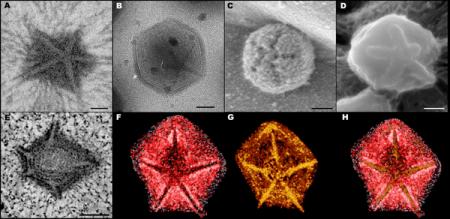
(A) TEM image of cryo-fixed sectioned and stained extracellular Mimivirus particles revealing a star-shaped structure at a unique vertex.
(B) Cryo-TEM image of a whole vitrified fiber-less Mimivirus.
(C) SEM image of the star-shaped structure in a mature extracellular Mimivirus particle.
(D) Cryo-SEM of an immature, fiber-less particle.
(E) Tomographic slice of a mature intracellular Mimivirus particle captured at a late (12 h post infection) infection stage.
(F and G) Volume reconstruction of the particle shown in (E), revealing the presence of an outer (red) and inner (orange) capsid shells. The star-shaped structure is present in both shells but adopts partially open (dark, star-like region), and completely sealed configurations in the outer and inner shells, respectively.
(H) Superposition of the two shells in (F) and (G).
Scale bars, 100 nm in (A, B, D, and E), and 200 nm in (C).

Schematic Representation of a Mimivirus Particle at Its Final Uncoating Stage

Zauberman N, Mutsafi Y, Ben Halevy D, Shimoni E, Klein E, et al. (2008) Distinct DNA exit and packaging portals in the virus PLoS Biol 6(5): e114.   doi:10.1371/journal.pbio.0060114


Schematic Representation of a Mimivirus Particle at Its Final Uncoating Stage

Schematic Representation of a Mimivirus Particle at Its Final Uncoating Stage


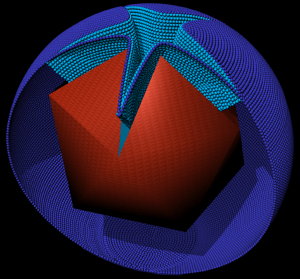
The capsid (red) is opened at the stargate, allowing for fusion of the viral and phagosome membranes (light and dark blue, respectively), thus forming a star-shaped membrane conduit.

Zauberman N, Mutsafi Y, Ben Halevy D, Shimoni E, Klein E, et al. (2008) Distinct DNA exit and packaging portals in the virus PLoS Biol 6(5): e114.   doi:10.1371/journal.pbio.0060114


 I commented at the time of Alan’s blog that:

“It is becoming apparent to me – especially now as I do a 10-year revision of my Web teaching material – that there is a hitherto unsuspected level of complexity in the way big viruses get their genomes into cells – and back out into virions. Phycodnaviruses may emulate phages in dissolving their way through cell walls AND injecting DNA; now mimiviruses have special mechanisms for both loading virions and getting their DNA out.

Watch this space: a major growth area in structural biology and virology.”

And, of course, it has come to pass: Michael Rossmann’s group at Purdue University and their collaborators have just published a paper entitled “Structural Studies of the Giant Mimivirus” , also in PLoS Biology, in which they explore in greater detail aspects of the structure, particularly as this is related to getting DNA out of the particles.

Their paper has the most stunning images and reconstructions, including images which show that the “starfish” shaped portal seems to be detachable – and that the unique stargate-associated 5-fold rotational axis of symmetry also has associated with it a depression in the inner nucleocapsid, which is undoubtedly associated with delivery of the DNA within.

Stargate

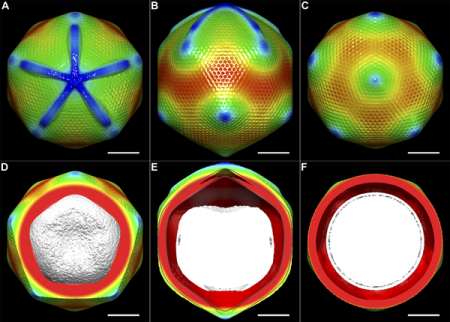
(A–C) Surface-shaded rendering of cryoEM reconstruction of untreated Mimivirus. (A) Looking down the starfish-shaped feature associated vertex, (B) looking from one side, and (C) looking from the opposite side of the “starfish”-associated vertex.

(D) The “starfish”-associated vertex was removed to show the internal nucleocapsid with its concave surface facing the special vertex.

(E) Central slice of the reconstruction looking from the side of the particle showing the concave face of the nucleocapsid and the low density space beneath the “starfish”-associated vertex. A perfectly icosahedral particle is outlined in gray to show the extension of the unique vertex.

(F) Central slice of the reconstruction looking along the 5-fold axis from the starfish-shaped feature showing the enveloped nucleocapsid surrounded by a lower density space. The coloring is based on radial distance from the center of the virus. Gray is from 0 to 1,800 Å, red from 1,800 to 2,100 Å, and rainbow coloring from red to blue between 2,100 and 2,500 Å.

The scale bars in all panels represent 1,000 Å.

doi:10.1371/journal.pbio.1000092.g005

This latest paper makes summary comments as follows:

“The enveloped genome within the larger viral capsid, perhaps supported by fibers …, has some similarity to eukaryotic cells. In contrast, the external peptidoglycan component mimics bacterial cell walls …. In addition, the existence of a unique vertex in Mimivirus, possibly for genome delivery …, is reminiscent of tailed bacteriophages. These observations are consistent with other results …, implying that Mimiviruses and some other large icosahedral dsDNA viruses have gathered genes from eukaryotic, prokaryotic, as well as archaeal origins [my emphasis].

The three-dimensional cryoEM reconstruction reported here, which was made possible in part by relaxing the icosahedral symmetry, is of a virus whose volume is an order of magnitude larger than has previously been reported. Thus, the detection of a unique vertex may have been missed in other structural studies in which strict icosahedral symmetry had been imposed [my emphasis].”

There are two important points here – one of which may be wrong.

The first is that mimiviruses et alia “…have gathered genes from eukaryotic, prokaryotic, as well as archaeal origins”: given the evolutionary speculations published by Susan-Monti et al. (Virus Research 117 (2006) 145–155), who say:

“Our current hypothesis is that DNA viruses are of deep evolutionary origin close to the origin of the other domains of life.”,

and point out the virus does not seem to have exchanged much DNA (=horizontal gene transfer) with its host despite a presumably ancient association.  This builds on Suhre et al. (PNAS 102 : 14689-14693, 2005), who say:

“Our bioinformatics and comparative genomics study revealed a unique feature of Mimivirus among the eukaryotic domain [sic]: the presence of a highly conserved AAAATTGA motif in the immediate 5′ upstream region of 50% of its protein-encoding genes. By analogy with the known promoter structures of unicellular eukaryotes, amoebal organisms in particular, we propose that this motif corresponds to a TATA box-like core promoter element. This element, and its conservation, appears to be specific of the Mimivirus lineage and might correspond to an ancestral promoter structure predating the radiation of the eukaryotic kingdoms ….

Mimivirus genes exhibiting this type of promoter might be ancestral as well. [my emphasis].”

Thus, it is possibly more likely that eukaryotes and possibly prokaryotes have garnered genes from mimi- and other viruses, rather than the converse!

The second point, given that they ARE a structural biology group, is much more likely: missing unique non-icosahedral capsid structures because of averaging could mean there is a whole world of specialised machinery in large DNA viruses which has simply been missed up till now.

I reiterate, watch this research space….  Anyone interested in mimivirus basics would also be well advised to look here.

INFLUENZA VACCINES: A Conference Report

21 May, 2009

THIRD INTERNATIONAL CONFERENCE ON INFLUENZA VACCINES FOR THE WORLD, 27 – 30 APRIL 2009, CANNES, FRANCE

 REPORT by Dr Elizabeth Mortimer

Subinit Vaccine Group, UCT

 In general, the conference encompassed a wide array of subjects which included pandemic awareness and strategies, antiviral development and stockpiling, socio-economic implications, clinical safety trials of seasonal and H5N1 vaccines, influenza virus evolution, new techniques including antigenic cartography, new vaccine production systems (plant-produced and virus-like particle (VLP)-based vaccines) and novel adjuvant developments. Pharmaceutical companies also used the conference as a platform to discuss their own products via satellite symposiums for example ‘Novartis’ discussed their promising and safe adjuvant MF59® while ‘Sanofi Pasteur’ introduced their new micro-injection intra-dermal vaccine.

Influenza virus

Influenza virus

Speakers like John Oxford (Retroscreen Virology Ltd, UK) and David Fedson (Independent, France) highlighted the fact that an influenza pandemic is imminent (as currently underscored by the H1N1 influenza outbreak). John Oxford specifically discussed the 1918 pandemic and the lessons to be learned from it. John Oxford discussed general pandemic preparedness and global vaccine demand. Approximately 12% of the world’s countries produce influenza vaccines and these countries use 55-60% of the global vaccine demand. It was reiterated that during a pandemic, the remainder of countries especially the developing countries will struggle to get hold of newly produced pandemic vaccine stock. This will eventually lead to a global political crisis. Therefore, the need to use cell-based (tissue culture) instead of the egg-based vaccines for rapid up-scaling of pandemic vaccine production was considered essential. The importance of developing and including adjuvants in vaccine stocks was also discussed during the conference, especially by Derek O’Hagan (Novartis vaccines, USA), Alex von Gabain (Intercell AG, Austria) and Horoshi Kido (University of Tokushima, Japan). Most speakers suggested that pre-pandemic preparedness by stockpiling is necessary, while some argued that the focus should be on vaccinating live stock (for example against H5N1) to limit outbreaks in the human population. For H5N1 prepandemic preparedness, ‘Novartis’ also presented and discussed the efficacy of their AFLUNOV® (A/Vietnam/1194/2004) and AFLUNOV®-like (A/turkey/Turkey/1/2005) vaccines containing the MF59® adjuvant (oral and numerous poster presentations).

 When considering seasonal influenza vaccines, clinical trials from vaccines produced in various countries were discussed. Vaccines were compared (LAIV versus TIV) as well as their administration (intramuscular versus intranasal). Some speakers, for example Kristen Nichol (University Minnesota, USA) remarked on vaccines specifically designed for the elderly, while Peter Richmond (Western Australia Department of Health, Australia), discussed influenza vaccines for children. The current seasonal influenza vaccine deficiencies were discussed by Arnold Monto (University of Michigan, USA), which include the overestimation of the efficacy of vaccines, the breadth of protection, the duration of protection and needle administration. Most speakers agreed that there is room for improvement and that vaccines that are currently FDA approved (USA), are designed for the individual rather than for the population.

 The topics that were of specific of interest to me were plant-based and VLP-based vaccines. Plant-based vaccines are cheap and can quickly be scaled-up, which are major advantages when a pandemic strikes. Vidadi Yusibov (Fraunhofer USA, USA) presented his group’s plant-based subunit vaccines based on various seasonal and pandemic influenza strains. Yusibov’s group specialised in large scale transient Agro-infiltration of tobacco plants using launch vectors that target recombinant protein expression to the endoplasmic reticulum (ER), to avoid complex glycosylation. They investigated glycosylation of plant-produced recombinant proteins like haemagglutinin (HA) and it was found to be correctly glycosylated and should therefore be safe for human vaccines. Their plant-produced HA vaccine will enter phase I human trials later this year (2009). In addition, this group proved that when the Brisbane H3N2 influenza strain that killed a number of children in Australia was published, they were able to design the sequence, optimise and produce purified HA (800mg/kg plant tissue) within 36 days of announcement. They proved that plant-based vaccines can be produced at a faster rate than traditional egg-based vaccines that can take up to 6 months to produce.

 Nathalie Landry’s group (Medicago Inc, Canada) also focussed on plant-produced vaccines, specifically VLPs containing HA. These self-assembled particles of HA bud out of the plasma of plants. VLPs based on the H5N1 strain were purified by conventional methods (ion exchange) and tested in mice and ferrets. The plant-based vaccine was able to elicit a humoral and cellular immunity in these animals. They are going to do a phase I human trial in August 2009 with 48 subjects.

 When considering other VLP-based vaccines, Ted Ross (University of Pittsburgh, USA) discussed a vaccine that was based on the 1918 H1N1 virus which caused 20 – 50 million deaths worldwide. HA and neuraminidase (NA) were incorporated into a lentiviral core (HIV Gag particles). The intranasally administered VLPs protected mice and ferrets against lethal virus challenge. It was also shown that the vaccine was cross-protective against other strains found in the same phylogenetic clade. Martin Bachman (Cytos Biotechnology, Switzerland) discussed VLPs containing the ectodomain of the matrix 2 protein (M2e) or partial HA proteins of various seasonal influenza strains. These VLPs were expressed via insect cells (baculovirus-mediated) and Escherichia coli and were shown to be protective.

 Lastly, a very interesting poster presentation by Kenny Roose (Ghent University, Belgium) depicted a vaccine that mimics the natural tetrameric structure of influenza M2e. M2e was fused to a modified form of yeast transcription factor’s leucine zipper domain which resulted in four chain coiled coils. This vaccine was able to elicit antibodies that were specific to the natural tetrameric M2e and protected mice against lethal challenge with H3N2 and H1N1.

It’s not going awaa-ay….

19 May, 2009

Fro ProMED Mail today:

To summarize the current situation, as of 6:00 AM GMT on 18 May 2009 there have been a total of 8829 cases and 74 deaths of influenza A (H1N1) infection officially reported to WHO coming from 40 countries, up from 8480 confirmed cases and 72 deaths from 39 countries yesterday (17 May 2009). Chile is the new country confirming cases through the WHO summary report. As of 18:00 GMT-4, there have been a total of 9372 cases and 79 deaths reported worldwide, with 14 countries in the Americas reporting cases. According to newswires, there has been the 1st confirmed case in Greece with a history of travel to the USA prior to onset. Newswires continue to demonstrate significant increases in confirmed cases in Japan during the past 24 hours.The USA has officially reported 5123 laboratory confirmed cases coming from 48 states (compared with 4714 cases from 47 states on 15 May 2009), and 5 deaths (all in individuals with pre-existing illnesses). Canada has reported 496 cases from 10 provinces with 1 death in an individual with pre-existing illness, unchanged from the 496 cases and one death reported from 10 provinces/territories on 15 May 2009.

For a map of reported confirmed cases, worldwide, as of 06:00 GMT 18 May 2009, see here” 
– Mod.MPP

So it is NOT going away…and has a case fatality rate, from these numbers, of 0.84%.  This is significantly higher than the ~0.2% quoted for annual flu epidemics – which, if they kill ~400 000 people per annum, must infect ~200 million people.

Meaning if this flu infects the same number of people, >1.6 million people may die, over and ABOVE the normal toll.

HIV Vaccine Day

19 May, 2009

And as one involved (or formerly involved, thanks to the effective demise of our funding agency…) in HIV vaccine research, it is criminal that I missed this yesterday – but the UCT Monday paper caught it, so let’s see what they said:

First human trial of UCT’s HIV vaccine
18 May 2009

 World AIDS Vaccine Day, May 18, marks the occasion in 1997 when US President Bill Clinton challenged researchers to come up with an AIDS vaccine within the following decade, stating that such a vaccine was the only way to eliminate the threat of AIDS. …

Researchers from UCT’s Institute of Infectious Disease and Molecular Medicine (IIDMM) have announced that their two new preventative HIV vaccines have reached the first stage of human clinical trials, a first for Africa.

This trial, called SAAVI 102/HVTN 073, is also a milestone for South Africa. The country is one of the few developing nations to have developed an HIV vaccine and progressed it into human clinical trials.

Professor Anna-Lise Williamson is leader of the team at the IIDMM.

The Desmond Tutu HIV Centre, based at the IIDMM, is one of three sites in the world that will conduct the trials. The others sites are in Johannesburg and Boston in the US.

These vaccines are a culmination of eight years of research by scientists at the IIDMM, UCT, and collaborators from the US National Institutes of Health and the Vaccine Research Centre. Their development and testing has been underpinned by funding from the South African AIDS Vaccine Initiative (SAAVI) and the US National Institute of Allergy and Infectious Diseases (NIAID).

…The initial human trial is being conducted jointly with the HIV Vaccine Trials Network and the NIAID, part of the US National Institutes of Health.

There is a wealth of science behind the vaccines, of course: I am listing a few of the papers giving the historical background to the DNA and the modified vaccinia Ankara virus (MVA, a smallpox vaccine strain) that are about to be used in the trial, below.

Broad, high-magnitude and multifunctional CD4+ and CD8+ T-cell responses elicited by a DNA and modified vaccinia Ankara vaccine containing human immunodeficiency virus type 1 subtype C genes in baboons.  Burgers WA, Chege GK, Müller TL, van Harmelen JH, Khoury G, Shephard EG, Gray CM, Williamson C, Williamson AL.  J Gen Virol. 2009 Feb;90(Pt 2):468-80.

A multigene HIV type 1 subtype C modified vaccinia Ankara (MVA) vaccine efficiently boosts immune responses to a DNA vaccine in mice.  Shephard E, Burgers WA, Van Harmelen JH, Monroe JE, Greenhalgh T, Williamson C, Williamson AL.  AIDS Res Hum Retroviruses. 2008 Feb;24(2):207-17.

Construction, characterization, and immunogenicity of a multigene modified vaccinia Ankara (MVA) vaccine based on HIV type 1 subtype C.  Burgers WA, Shephard E, Monroe JE, Greenhalgh T, Binder A, Hurter E, Van Harmelen JH, Williamson C, Williamson AL.  AIDS Res Hum Retroviruses. 2008 Feb;24(2):195-206.

Design and preclinical evaluation of a multigene human immunodeficiency virus type 1 subtype C DNA vaccine for clinical trial.  Burgers WA, van Harmelen JH, Shephard E, Adams C, Mgwebi T, Bourn W, Hanke T, Williamson AL, Williamson C.  J Gen Virol. 2006 Feb;87(Pt 2):399-410.

Construction and characterisation of a candidate HIV-1 subtype C DNA vaccine for South Africa.  van Harmelen JH, Shephard E, Thomas R, Hanke T, Williamson AL, Williamson C.  Vaccine. 2003 Oct 1;21(27-30):4380-9.

Characterization and selection of HIV-1 subtype C isolates for use in vaccine development.  Williamson C, Morris L, Maughan MF, Ping LH, Dryga SA, Thomas R, Reap EA, Cilliers T, van Harmelen J, Pascual A, Ramjee G, Gray G, Johnston R, Karim SA, Swanstrom R.  AIDS Res Hum Retroviruses. 2003 Feb;19(2):133-44.

The development of HIV-1 subtype C vaccines for Southern Africa.  Williamson AL.  IUBMB Life. 2002 Apr-May;53(4-5):207-8. Review.

Are we there yet??

13 May, 2009

As I sit here in the grip of a rhino/toga/adenovirus infection [yes, acute rhinitis, just recovered from sore throat, feel like cr@p], it is hard to be optimistic about the demise of the Influenza A H1N1 “Mexico Flu” outbreak – but various media are now jumping as enthusiastically onto the “It Was All a False Alarm” bandwagon as they did onto the “We’re All Doomed” train.

Was it a false alarm?

Has the threatened pandemic gone away?

Peter Singer, the director of the McLaughlin-Rotman Centre for Global Health at University Health Network and University of Toronto, wrote this in Canada’s National Post on May 11th [bolded red comments my emphais]:

It’s been a fortnight since global attention began fixating on flu. There have been over 4,379 cases worldwide and more than 280 in Canada. We are likely past the midpoint of this episode and it’s not the “big one.” We learned lessons from SARS that we applied to this flu outbreak. This time, how have we done and what have we learned?

I would give Canadian public health authorities an A grade. …

I would give the global response a B grade. The human flu emergency turned into a mini Mad Cow-type crisis. Calling it “swine flu” initially skewered the international pork trade, even though public health authorities emphasized that you can’t catch flu from eating pork chops. In Egypt, authorities slaughtered pigs owned by a poor Christian minority group, fanning religious conflict. Afghanistan’s only known pig–in the Kabul zoo — has been quarantined. The casual musings of a World Health Organization official, and the outbreak in Alberta pigs, didn’t help.

The World Health Organization response was robust, but its pandemic scale sends the wrong signal to the public. It can reach its top level in a mild pandemic so it appears to foretell doomsday even if people around the world have only the sniffles. Meanwhile, some countries reacted to criticisms of their actions during SARS with questionable quarantines, such as with the group of healthy Quebec students [and Mexicans] quarantined in China.

Well, so far it looks like he agrees with the thesis that the “pandemic” scare was mostly hype.  But he goes on to warn us:

Did we cry wolf ? No. The flu virus is a wolf in sheep’s clothing. Flu, a cunning adversary, can mutate to be more transmissible, lethal and drug resistant. Some have argued the media is drawing attention away from other public health priorities; in fact the flu is probably drawing attention away from Paris Hilton. It is a sad coincidence, though, that while a million people died in the 1957 and 1968 flu pandemics, the same number, mostly children under five in Africa, die each year from malaria.

What is next? This flu episode will probably end like some TV shows: “to be continued.” We’ll be tuning into the flu season just starting in the southern hemisphere and our flu season here next fall.

The threat of flu is constant. It’s like the threat of terrorism. The virus needs to break through only once; we need to stop it every time. But this epidemic of H1N1 has left us better prepared for future pandemics.

So did you all register that?  Possibly, just possibly, the flu outbreak is dying away IN THE NORTHERN HEMISPHERE.  WHERE THE FLU SEASON IS OVER.  JUT IN TIME FOR THE SOUTHERN HEMISPHERE’S SEASON.  And this, we remind you, is followed in October or so by a new northern hemisphere flu season.

Singer finishes with:

In a severe pandemic, most sickness and death will be in the developing world. Unfortunately, the globalization of disease threats is greater than the globalization of health defences. Mexico’s anti-viral stockpile at the beginning of the epidemic was only one million doses for 110 million people [compared to Canada’s 55 million for ~20 million by the end], and there are concerns about future availability of flu vaccine in the developing world. Canada should help because we are compassionate and capable, and because, as this epidemic shows, we are all in this together in an interconnected world.

Amen, brother Singer…so in other words, the developing world epidemic is probably still coming, it will be worse than the outbreak we’ve just seen, and there will be way too few drugs to deal with it.

…And the Virus Rolled On….

4 May, 2009

ProMED – that ever-so-reliable source of breaking epidemiological news – gives us this as of yesterday.

From the WHO:

Influenza A(H1N1) – update 11 — 3 May 2009 [abridged]
As of 3 May 2009, 17 countries have officially reported 898 cases of influenza A(H1N1) infection, and 20 deaths.
Mexico has reported 506 confirmed human cases of infection, including 19 deaths. The higher number of cases from Mexico in the past 48 hours reflects ongoing testing of previously collected specimens.
The United States Government has reported 226 laboratory confirmed human cases, including one death.
The following countries have reported laboratory confirmed cases with no deaths:


  • Austria (1),
  • Canada (85),
  • Colombia (1),
  • China, Hong Kong Special Administrative Region (1),
  • Costa Rica (1),
  • Denmark (1),
  • El Salvador (2),
  • France (2),
  • Germany (8),
  • Ireland (1),
  • Israel (3),
  • Netherlands (1),
  • New Zealand (4),
  • Republic of Korea (1),
  • Spain (13),
  • Switzerland (1)
  • the United Kingdom (15)

Further information on the situation will be available on the WHO [/CDC] website on a regular basis.

WHO advises no restriction of regular travel or closure of borders.

 It is considered prudent for people who are ill to delay international travel and for people developing symptoms following international travel to seek medical attention, in line with guidance from national authorities.

 
And finally, pigs with the virus: 

Canada on [2 May 2009] reported the identification of the A(H1N1) virus in a swine herd in Alberta. It is highly probable that the pigs were exposed to the virus from a Canadian farm worker recently returned from Mexico, who had exhibited flu-like symptoms and had contact with the pigs.

There is no indication of virus adaptation through transfer from human to pigs at this time.

There is no risk of infection from this virus from consumption of well-cooked pork and pork products. [my bold/red]

 From South Africa’s News24:

 
Swine flu vaccine in the works
29/04/2009 14:01  – (SA)  


 Geneva – Four laboratories are at “various stages” of working on a seed virus that is a precursor in a future vaccine against swine flu, the World Health Organisation said on Tuesday.

“There are currently four of our reference laboratories who are working with seed virus, they are at various stages of producing seed virus needed to make the vaccines,” said WHO spokesperson Gregory Hartl.

Hartl said however that the laboratories – in Britain, Canada and the United States – have not been asked to begin production in an extensive manner.

WHO on Monday recommended that the UN agency “take steps to facilitate the development” of a vaccine against the swine flu virus found in the latest outbreak that has likely caused more than 150 deaths in Mexico and has spread worldwide.

But the panel stopped short of recommending a complete shift in global vaccine production capacity, warning that it would be “prudent” to continue regular seasonal vaccine production as well.

A spokesperson in Paris for Sanofi Pasteur, a subsidiary of the French pharmaceutical maker Sanofi-Aventis, had said that the time needed to make a flu vaccine is about four months.

Scaling up production of a vaccine is another hurdle. The main approach is to grow the virus samples in time-honoured fashion in embryo chicken eggs, which is slow and clumsy.

Production capacity of flu vaccines has tripled since 2007 in response to the Sars and H5N1 scares, according to a WHO-funded study published in February.

– AFP

More from News24:

Egypt works on H5N1 chicken vaccine

In news that partially redeems the very controversial decision to cull the country’s pigs – apparently based on a need to regularise the industry, rather than panic over transmission from pigs – AFP details how Egypt plans to produce its own vaccine within two years.

A useful graphic explaining how reassortant viruses occur.

Information on how the virus may have originated:

New virus may be a hybrid

Last updated: Monday, May 04, 2009

The new virus that has killed as many as 177 people and spread globally is a hybrid that appears to have mixed with another hybrid virus containing swine, bird and human bits, US researchers reported.

Raul Rabadan and colleagues at Columbia University in New York analysed the published genetic sequences from the H1N1 virus that has brought the world to the brink of a pandemic. “The closest relatives to the virus we have found are swine viruses,” Rabadan said.

“Six segments of the virus are related to swine viruses from North America, and the other two from swine viruses isolated in Europe/Asia,” they wrote in the online journal Eurosurveillance.

The US Centres for Disease Control and Prevention said last week after discovering this virus in two US children that it had four virus types – two swine, an avian and a human component. It may be even more complex than that.

‘This strain looks like another hybrid’
Influenza viruses mutate constantly, and they also swap genetic material with one another promiscuously – especially if an animal or person is infected with two strains at once.

Rabadan’s team said this particular strain looked partly like another hybrid, or what scientists call a reassortant, virus. “The North American ancestors are related to the multiple reassortants, H1N2 and H3N2 swine viruses isolated in North America since 1998,” they wrote.

“In particular, the swine H3N2 isolates from 1998 were a triple reassortment of human, swine and avian origin.”

For those in search of graphics for their webinar/presentation on flu pandemics: from the US National Archives.

http://www.archives.gov/exhibits/influenza-epidemic/records-list.html

The Influenza Epidemic of 1918 via kwout

http://www.archives.gov/exhibits/influenza-epidemic/records-list.html

And for light relief away from deadly viruses:

“Who would win in a fight: Gandalf or Darth Vader? What about Neo versus Harry Potter?”

Is This The Big One?

28 April, 2009

28th April 2009:

It just HAD to happen.

There was the world’s attention, focussed on H5N1 bird flu from Asia as The Next Big One – including doom and gloom pronouncements from right here (and here) – and of course, another flu comes from another source, in another location entirely.  You can, however, as previously highlighted here in ViroBlogy, use Google “Flu Trends” to track it – and now Google Maps too (thanks, Vernon!).

Flu life cycle

Flu life cycle

So what do we know?  On the 27th of  April, the Mexican government admitted to some 150 deaths, and over 1600 people apparently infected, in an epidemic caused by an Influenza A H1N1 virus that appeared to be a reassortant of viruses from pigs, birds and humans.  The virus has been dubbed “swine flu”; however, there is doubt as to whether it has been shown to even infect pigs, let alone been found in them, and it probably ought to be known as “Mexico Flu”.  There is the problem, of course, that apparently parts of the virus – and the N1 gene in particular – are of Eurasian swine flu origin, so exactly where it comes from may be forever obscure.

 As for current expert knowledge, the Centers for Disease Control and Prevention (CDC) and the World Health Organisation (WHO) have set up dedicated pages to track the potential pandemic – because that is what they are calling it.

The WHO has, as of the 27th April,

“…raised the level of influenza pandemic alert from the current phase 3 to phase 4.

http://blogs.wsj.com/health/2009/04/27/understanding-the-whos-global-pandemic-alert-levels/

Swine Flu: Understanding the WHO’s Global Pandemic-Alert Levels – Health Blog – WSJ via kwout

The change to a higher phase of pandemic alert indicates that the likelihood of a pandemic has increased, but not that a pandemic is inevitable.

As further information becomes available, WHO may decide to either revert to phase 3 or raise the level of alert to another phase.

This decision was based primarily on epidemiological data demonstrating human-to-human transmission and the ability of the virus to cause community-level outbreaks.

Given the widespread presence of the virus, the Director-General considered that containment of the outbreak is not feasible. The current focus should be on mitigation measures.”

All of which begs the questions: what IS it, and how BAD is it??  We know that by the 28th April, the virus had been confirmed in the USA (>40 cases), Spain, Canada, and according the the BBC, the UK, Brazil and New Zealand as well.

While financial markets are panicking , airlines are cancelling flights, and people in Mexico appear to be dying, people infected in the USA seem only to be getting ill, and then recovering.

The bad news is that the virus haemagglutinin – the H1 – is probably only distantly related to that of the currently circulating human variant, so the flu vaccines on release right now will be of only limited efficacy.

The good news – especially for Roche and GlaxoSmithKline – is that the antivirals Tamiflu and Relenza seem to work against the virus.

29th April 2009

The virus continues to spread: according to the WHO site,

“As of 19:15 GMT, 28 April 2009, seven countries have officially reported cases of swine influenza A/H1N1 infection. The United States Government has reported 64 laboratory confirmed human cases, with no deaths. Mexico has reported 26 confirmed human cases of infection including seven deaths. The following countries have reported laboratory confirmed cases with no deaths – Canada (6), New Zealand (3), the United Kingdom (2), Israel (2) and Spain (2).
….
WHO advises no restriction of regular travel or closure of borders. It is considered prudent for people who are ill to delay international travel and for people developing symptoms following international travel to seek medical attention, in line with guidance from national authorities.

There is also no risk of infection from this virus from consumption of well-cooked pork and pork products. Individuals are advised to wash hands thoroughly with soap and water on a regular basis and should seek medical attention if they develop any symptoms of influenza-like illness.

Of course, there is also the inevitable hype – and some humour (thanks, Suhail!):

With a byline reminiscent of the “Ebola Preston” which was coined to satirise the hype generated around the 1995 Ebola hype, we have

 30th April 2009:

…so of course, I talk to a journalist; and of course, I shouldn’t have…!  For an otherwise good article about pandemic preparedness in Africa [ignore the bit about no drug stockpile in South Africa, because apparently we have some], see here.  South Africans: look at info on influenza at the National Institute for Communicable Diseases (NICD) in Johannesburg.

The WHO yesterday raised the level of influenza pandemic alert from the current phase 4 to phase 5.  We owe the WHO Director-General, Dr Margaret Chan, for these comments:

On the positive side, the world is better prepared for an influenza pandemic than at any time in history.

Preparedness measures undertaken because of the threat from H5N1 avian influenza were an investment, and we are now benefitting from this investment.

For the first time in history, we can track the evolution of a pandemic in real-time.”

From the BBC today:

In Mexico, the epicentre of the outbreak, the number of confirmed cases rose to 97 – up from 26 on Wednesday….

  • The Netherlands confirms its first case of swine flu, in a three-year-old boy recently returned from Mexico. Cases have also been confirmed in Switzerland, Costa Rica and Peru
  • The number of confirmed cases in the US rose to 109 in 11 states
  • Japan reported its first suspected case of swine flu
  • China’s health minister says that the country’s scientists have developed a “sensitive and fast” test for spotting swine flu in conjunction with US scientists and the WHO. The country has recorded no incidence of the flu yet.
  • The WHO says it will now call the virus influenza A (H1N1).

And first prize for over-reaction of the year:

On Wednesday, Egypt began a mass slaughter of its pigs – even though the WHO says the virus was now being transmitted from human to human [and there is no evidence it was ever transmitted between pigs].


Index: ViroBlogy / MicrobiologyBytes flu-related posts

Guest Blog: HIV Vaccines

18 March, 2009

You remember we had a competition, end of last year?  Well, the runner-up of same – Dorian McIlroy – has claimed his prize by writing a guest blog.  Clayton, that means you have to do two…?!

And Dorian writes on a subject close to our collective hearts, here in the Subunit Vaccine Group at Univ of CT: HIV vaccines, and how T-cell vaccines in particular may not be down and out after all.  I note that he refers to two published papers that were topics of talks at the recent AIDS Vaccine Conference here at UCT recently, which was covered here in ViroBlogy: always useful to have your material on the verge of being published when you talk…!

HIV vaccine candidates – The return of the recombinants…

Towards the end of 2007 Merck interrupted a large scale clinical trial of a candidate HIV vaccine based on recombinant adenovirus. As well as showing no protective effect, there was a worrying tendency for vaccinees with serum antibodies to the vector – serotype 5 adenovirus (Ad5) – to show greater susceptibility to HIV infection than volunteers receiving placebo injection. This looked like the end of the road for adenovirus-based vaccines, and maybe even for any strategy based on recombinant viruses. However, two recent papers indicate that there may yet be considerable mileage in this approach.

The first, from Dan Barouch’s team in Boston, shows how recombinant adenoviruses could be made considerably more effective. One of the big drawbacks with these recombinant viruses is that repeated injections do not give an immunological booster effect. That is, even though the immune response to a single injection can be strong, there is not much increase after a second, or a third injection of the same recombinant virus. This happens because as well as inducing an immune response to the target antigen (SIV gag, for example), the recombinant virus vector induces an immune response against itself. So when the recombinant virus is injected a second time, it is neutralized by the antibodies induced by the first injection. 

The Barouch paper shows that it is possible to get round this problem by using two recombinant adenoviruses with different serotypes, so that the second injection can provide an effective boost. Giving macaques two injections of SIV gag-recombinant Ad5 gave a good response to the first injection, but no boost. Using an SIV-gag recombinant Ad26 for the first injection, then using the Ad5 recombinant for the second, gave a 9-fold higher T-cell response measured by IFNgELISPOT than two doses of Ad5 recombinant.

So far, so good – but does this immune response translate to protection from infection?

Well, yes and no. After intravenous challenge with highly pathogenic SIVmac251, all animals in all groups were infected, so none of the animals were completely resistant to SIV. Peak viral load in the group vaccinated with Ad26/Ad5 was 1.4 log lower than in the control group, and about a log lower in the group vaccinated with Ad5/Ad5. Set-point viral load was also much lower in the Ad26/Ad5 group compared to the control group, so replication of the challenge virus was controlled to some extent in the animals that received the most effective vaccination protocol.

Overall there are two messages here. The first is that it is possible to do much better than the strategy that failed in the Merck trial, that employed three injections of Ad5 recombinant viruses. That’s the good news. The bad news is that even with a much more effective vaccination, in terms of the T-cell response, the protection against infection, although significant, was relatively modest. This means that vaccine candidates based on T-cell immunity alone are never going to work……. or does it?

Which brings me to the second paper, from Louis Picker’s group in Oregon. The big novelty here is the generation of recombinant rhesus macaque cytomegalovirus (CMV) expressing SIV proteins, that are tested as vaccine candidates in the SIV Mac model.

Why on earth would anyone want to try out CMV, when other recombinant (adeno- and pox-) viruses have been so disappointing? The difference is in the lifestyles of the viruses involved. Both adeno and poxviruses provoke acute infections, whereas CMV both in humans and apparently, in macaques, causes a lifelong infection, in which active viral replication is held in check largely by a robust T-cell response. When the immune response is compromised, as in AIDS patients, or transplant recipients receiving immunosuppressive drugs, CMV infection often reactivates, which can cause serious illness, and even be life-threatening. Because of the persistent nature of both the virus and the cellular immune response, a high-level of effector-memory T-cells (TEM, not to be confused with Transmission Electron Microscopy) specific for CMV are maintained in CMV+ individuals (who probably make up about half of the world population, in case you were wondering).

TEM have two interesting characteristics from a HIV vaccine point of view. Firstly, they are armed and dangerous. If they see their cognate viral antigen, they can either kill the infected cell, or secrete cytokines. Secondly, they migrate to mucosal sites, rather than lymph nodes, so they are in the right place to stop HIV infection after sexual transmission. More sedate central-memory T-cells (TCM), on the other hand, hang around the blood and lymph nodes, and do not immediately have anti-viral effector functions. Their response to HIV infection might be too late to be any use, as the first rounds of productive viral infection occur in the mucosa, not the draining lymph nodes.

Picker’s group points out that most memory T-cells that remain months after a recombinant adenovirus vaccination are TCM, not TEM, and set out to test the hypothesis that using a recombinant virus (CMV) that naturally gives a strong TEM response might be more effective in protecting against SIV infection at a mucosal site. So they generated recombinant, replication competent macaque CMV carrying genes for SIV gag, a Rev-Tat-Nef fusion protein, and an intracellular form of Env. Cells infected with these viruses expressed high levels of the recombinant proteins, and animals inoculated subcutaneously with them became persistently infected – just like wild-type CMV infection.  As predicted, high levels of SIV-specific TEM were found in the blood, and in broncho-alveolar lavage (which is a relatively convenient way to obtain mucosal T-cells). More than one year after vaccination, animals were submitted to a mucosal challenge (intrarectal, if you really want to know) with SIVmac239, which is the same strain as that used to produce the recombinant CMV.

The details of the viral challenge are interesting. In order to simulate a real infection, a low viral dose was used, and this means that not all control animals get infected. So the challenge was repeated weekly until infection (detected by plasma viral load) was observed. I have turned the data from the paper into Kaplan-Meier curves, and used the log-rank test to compare the two groups (BTW: if Louis Picker is reading this, that’s the test you should have used). With p=0.03, survival without infection was significantly prolonged by vaccination, and 4 out of 12 vaccinated macaques were resistant to mucosal challenge. These four animals did not have a latent or cryptic infection, as no SIV DNA or RNA was detectable in CD4 T-cells in blood or lymph nodes, and CD8+ T-cell depletion did not result in viral rebound.
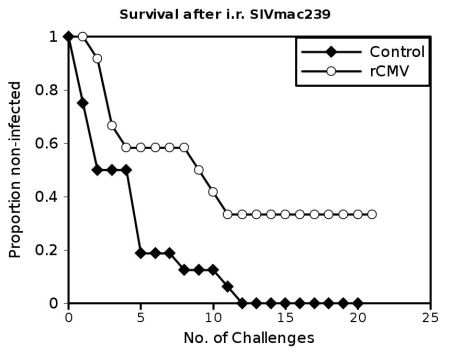
recombinantviruses_032009_html_48846d22This was without any neutralizing antibodies, so for the first time a T-cell vaccination strategy has been shown to confer protection against infection (not just better control of viral load after infection, as with recombinant adenoviruses) in at least some vaccinated animals. Although 33% protection is not enough, at least things are going in the right direction.

So what’s the catch? Well, there are two really. Firstly the SIV sequences in the vaccine and challenge virus were identical. The vaccination strategy may not be so effective against a heterologous challenge, that would be more representative of the real-world. Secondly, the vaccination provokes a persistent infection with a genetically-modified virus, that (unlike other recombinant viruses and gene therapy vectors) remains infectious, so it’s hard to see how this kind of vaccine could be licensed for clinical trials.

Nevertheless, I think this paper is telling us – at last – what kind of T-cell response vaccines should be aiming to induce. Now all we need to do is solve the neutralizing antibody problem, and we’ll really be cooking with charcoal….

Dorian McIlroy
Dorian.Mcilroy@univ-nantes.fr