Posts Tagged ‘vaccine’

Chimaeric plant virus stimulates influenza virus-specific CD8+ T-cell responses

1 September, 2009

Plant-produced potato virus X chimeric particles displaying an influenza virus-derived peptide activate specific CD8+ T cells in mice

 Chiara Lico, Camillo Mancini, Paola Italiani, Camilla Betti, Diana Boraschi, Eugenio Benvenuto, Selene Baschieri

 Vaccine (2009) 27: 5069 – 5076

 The authors used plant Potexvirus Potato virus X (PVX) to display the Db-restricted nonapeptide ASNENMETM of the nucleoprotein (NP) from influenza A virus (strain A/PR/8/34) to activate specific CD8+ T cells in mice. They paid great attention to the design of the NP-peptide to ensure optimum plant virus stability and antigen processing. The modified NP-peptide was fused to the N-terminal of the coat protein (CP) from PVX creating the pVXSma-NP construct that was subsequently inoculated into tobacco leaves. The resulting chimeric virus particles (NP-CVP) were stable and pure with a yield of approximately 1.1 mg NP-CVP / g fresh leaf tissue. Endotoxin tests were also performed to exclude their contribution to the immunoregulatory effects of the CVPs. Mice were inoculated with two different doses of NP-CVP (50 µg or 167 µg) with or without incomplete Freund’s adjuvant (IFA). The IFN-γ ELISPOT assays indicated that NP-CVPs activated the ASNENMETM-specific CD8+ response, especially the highest concentration of the NP-CVP without the adjuvant. Results also indicated that the CP of PVX contained T helper epitopes that contributed to the CD8+ T cell response. Thus, PVX is not only an epitope carrier but an adjuvant as well. This study illustrates the potential of implementing plant viruses displaying foreign epitopes to elicit T cell responses in vaccine development.

Contributed by Dr Elizabeth (Liezl) Mortimer

H1N1 – view on a pandemic

26 August, 2009

Well, “The Big One” that we have all been waiting for since 1968 – or 1977, if you count the accidental re-release of the original humanised H1N1 as a pandemic – is well and truly here.  A nice little animated graphic for depicting how it arose, while a bit simplistic, is available here.

And what have we learned?  Has civilisation fallen; have populations been decimated?

Well, quite a lot; no, and no, in answer.  Explanations for some of this are contained in a survey just released.  Here from the News24 report published today, sourced from SAPA:

Paris – More than half the fatalities from H1N1 swine flu have been among young adults, according to one of the first surveys to gather mortality data from across the globe for the new A(H1N1) virus.

The analysis of 574 pandemic deaths from 28 countries through mid-July, released this week, also found that being diabetic or obese significantly boosted the risk of dying.

Neither children nor the elderly are as vulnerable as initial reports indicated, found the study, published by Eurosurveillance, the monitoring arm of the European Centre for Disease Prevention and Control.

“Most deaths (51%) occurred in the age group of 20-to-49 year-olds, but there is considerable variation depending on country or continent,” the researchers reported.

Only 12% of those who died were 60 or older.

All of these features – high mortality among young adults and the obese, but not the very young or elderly – are sharply different than for the seasonal flu.

More than 90% of deaths from seasonal flu – which claims 250 000 to 500 000 lives annually according to the WHO – are in people over 65.

By contrast, with the pandemic H1N1, “the elderly seem to be protected from infection to some extent, perhaps due to previous exposure to similar strains”, the study conjectured.

Persons born before 1957, other studies have suggested, were almost certainly exposed to the milder seasonal A(H1N1) viruses that evolved from the terrible pandemic of 1918, which left some 40 million dead.

With the 2009 strain, “when infection does occur, however, the percentage of deaths in elderly cases seems to be higher that in others”.

One common target across both pandemic and season strains is pregnant women, according to the study, led by Philippe Barboza of the French Institute for Public Health Surveillance….

And that’s the sinister part…here in South Africa, of 18 fatalities known to have been associated with pandemic AH1N1 infection, NINE were pregnant women, mostly in the third trimester of pregnancy.  In a report published yesterday, SA’s Minister of Health Dr Aaron Motsoaledi said the following:

“We find it very worrying that there is an increasing number of pregnant women who are succumbing to this pandemic,” Motsoaledi said.

“The directive to all health care workers… is to put pregnant women with flu-like symptoms (even if they are mild) on Tamiflu treatment.

“Doctors should not wait for any tests before such treatment is administered.”

Further on in the same report:

On Monday, the National Institute for Communicable Diseases [NICD] also said pregnancy had been identified as a particular risk factor for severe H1N1 flu.

It said that in the second and especially the third trimester, urgent treatment with antiviral drugs should be considered even before any laboratory results were received.

The institute added however that most H1N1 flu cases in South Africa remained mild and “self-limiting”.

Routine H1N1 testing for everyone with flu-like illness was still not recommended.

Nationwide, there had been 5 118 laboratory-confirmed cases of H1N1 flu, it said.

The figure is essentially meaningless, given that most suspected flu cases are not laboratory-diagnosed (it costs R700, or ~US$70, for a single test) and the pandemic flu is pretty much indistinguishable from seasonal, and may in fact have supplanted the normal flu.  It certainly has in Australia and Argentina, which remain the two worst-hit southern hemisphere countries, and probably has in South Africa too: the CDC has a very useful map illustrating this, accessible here.

International news, via the CDC site, is the following:

As of August 13, the World Health Organization (WHO) regions have reported over 182,166 laboratory-confirmed cases of 2009 H1N1 influenza virus (2009 H1N1) with 1,799 deaths. The laboratory-confirmed cases represent an underestimation of total cases in the world as many countries now focus surveillance and laboratory testing only in persons with severe illness. The 2009 H1N1 influenza virus continues to be the dominant influenza virus in circulation in the world.

One very important piece of information further down this report is the following:

There have been no significant changes detected in the 2009 H1N1 influenza virus isolated from persons in the Southern Hemisphere as compared to viruses isolated from persons in the Northern Hemisphere.

This is important because the frantic rush to make vaccines to combat the expected northern hemisphere upsurge in infections in their autumn season – October or so – depends upon the virus not having changed much from the seed material which was derived from virus isolated earlier this year.  This could negate some of theh fears that the much-anticipated “second wave” of virus infections could be a lot worse than the first.

Good news on the vaccine front – for Australians at least – is that an Australian company, CSL Ltd, has the world’s first data from human trials of a pandemic strain vaccine, and looks set to be able to provide Australia with 21 million doses of vaccine – and 2 million doses of the vaccine at the end of the month.

Other vaccine news is also fairly encouraging, notwithstanding a rather alarming report in New Scientist recently about the new strain growing only half as well in eggs as seasonal flu types: while this remains a worry, newer, faster-growing variants have been derived and distributed – though possibly not in time for a northern hemisphere autumn roll-out.

Mind you, all of this production relies on the well-proven-but-seriously-archaic 1930s technology of growing live virus in hen’s eggs: we are still trapped, in the 21st century, into having to use early 20th century methods to produce vaccines for fast-adapting pathogens.  Things ARE changing: various pharma companies are diversifying into mammalian and insect cell culture; people (including us!) are investigating making recombinant subunit vaccines in plants (see here) – and there is at least the tantalising possibility that “universal vaccines” may become available in the not-too-distant future.  These will exploit all or part of the highly conserved M2 “ion channel” protein of influenza viruses as recombinant subunit vaccines.

However, all of this is at least six months in the future for conventional vaccines, and many years hence for newer offerings.  Meantime – there is disturbing news concerning trans-species transmissions of pandemic AH1N1 viruses.

ProMED Mail (ProMED Digest V2009 #394) reports that “Chile finds H1N1 swine flu in turkeys“:

Chilean health authorities announced on Thursday night [20 Aug 2009] that they had detected and controlled an outbreak of swine flu in 2 turkey farms, according to a communication from the Agricultural and Livestock Service (SAG).

“The presence of an influenza type A virus was detected in 2 farms in the Valparaiso Region, and immediate precautionary measures were adopted to prevent the dissemination of the disease and to protect the population’s health,” said the text.

And again from ProMED on 20th August, quoting The Straits Times and AFP:

A 2nd Australian piggery was placed in quarantine due to swine flu on Wednesday [19 Aug 2009] as the number of human deaths from the virus reached 121.

Authorities ordered a biosecurity lockdown at the piggery in Victoria state amid concerns the virus could mutate and return to humans in a more deadly form.

Another piggery in New South Wales state has been quarantined since late July [2009], although the state government said most of the animals had recovered from the disease.

Victoria Agriculture Minister Joe Helper said tests confirmed the presence of influenza at the piggery after its owners reported earlier this week that the animals were not eating.

‘It is important to stress that this is not a human health issue and that national and international food authorities continue to advise that pork and pork products are safe to eat,’ he said.

Media reports said the pigs were believed to have contracted the virus from workers at the property who were suffering the human form of the disease.

Health experts fear swine flu in humans, which is easily spread but has a relatively low fatality rate, could mutate in other animals and emerge in a more virulent form. [my emphasis]

So: two independent incidents, on different continents, of pandemic AH1N1 viruses getting into different species of farmed livestock – and luckily controlled.

What would have happened if domestic fowl and/or pigs had been infected in places like Vietnam, Thailand, Indonesia, Turkey and Egypt – where highly pathogenic avian H5N1 influenza viruses appear to be endemic, and not well controlled?  Given the complex origins of the current pandemic virus – from several swine, avian and human viruses – it could be a recipe for disaster, on a scale even greater than the 1918 pandemic.

The REAL Big One.  Let’s all help get a vaccine, people!!

First African-developed HIV vaccine goes to trial

21 July, 2009

Finally, finally, a product of our 10-odd-year-old South African HIV vaccine development programme goes into Phase I human trial, in South Africa!

I say “our” because I was part of the overall team; however, the two vaccines which comprise the SA AIDS Vaccine Initiative (SAAVI) / HIV Vaccine Trials Network (HVTN) trial – designated SAAVI 102/HVTN 073 – were designed and developed by others.

The vaccines consist of a DNA component, consisting of an artificial “polygene” dubbed Grttn (for Gag-RT-Tat-Nef) and a truncated Env (gp150) cloned separately into vector plasmids, and the same genes recombined under the control of different promoters into the genome of a poxvirus (Modified Vaccinia Ankara, MVA).  These and their testing in mice and non-human primates have been described in published work: see here and here for relevant journal articles on the MVA and DNA components.

From the July 20th SAAVI press release:

The test vaccines – called SAAVI MVA-C and SAAVI DNA-C2 – have shown promising results in animal testing. The SAAVI DNA-C2 vaccine was constructed in South Africa using a plasmid backbone provided by the Dale and Betty Bumpers Vaccine Research Center (VRC) of NIAID, while the MVA vaccine was designed by the team at UCT and constructed and manufactured in the USA.

“Reaching this important milestone of translating our discoveries in the laboratory to testing in humans would not have been possible without the support of a large team of people from the University of Cape Town, together with national and international collaborations.  An effective vaccine against HIV/AIDS remains a top global health priority and it is our hope that the evaluation of these vaccines in clinical trial will provide some important answers that will bring us closer towards this goal,” says Prof. Anna-Lise Williamson, leader of the vaccine development team and joint staff member of UCT’s Institute for Infectious Disease and Molecular Medicine, and the National Health Laboratory Services (NHLS).

The SAAVI DNA-C2 was constructed in South Africa and manufactured in the US by Althea Technologies. The MVA vaccine was manufactured by Therion Biologics, USA. The vaccines will be tested in a prime-boost approach where the SAAVI DNA-C2 vaccine will be given to prime the immune response and the SAAVI MVA-C vaccine to boost or enhance the immune response.

National and international press got hold of the story in a big way – unsurprisingly, given as there is the 5th IAS Conference on AIDS Pathogenesis going in in Cape Town at the same time, which incidentally has its own live blog feed.

The University of Cape Town is obviously pleased with the press release (see here); however, the launch had its fair share of controversy: Associated Press reporter Michelle Faul posted a story yesterday entitled “South Africa begins AIDS vaccine trial, cuts funds“, which has been taken up by a wide spectrum of especially foreign media.  According to Faul:

“South Africa launched a high-profile trial of an AIDS vaccine created by its own researchers Monday, a proud moment in a nation where government denial, neglect and unscientific responses have helped fuel the world’s worst AIDS crisis.

After a government official lauded the project at a ceremony at Cape Town’s Crossroads shantytown, the scientist leading the research said state funding had been halted.

The contrast between Monday’s hopeful vaccine launch and the revelation of funding cuts raised questions about whether the government was backsliding on its pledge to combat AIDS.

Anna-Lise Williamson, an AIDS researcher at the University of Cape Town, told The Associated Press the clinical trial would continue with U.S. money. But she said South Africa’s Department of Science and Technology had pulled its funding in March, while the project’s other sponsor, the state electricity utility Eskom, did not renew its contract when it expired last year.

Neither government spokesmen nor Eskom immediately returned calls seeking comment about funding cuts.”

In the midst of light, there is darkness…frequently, thanks to ESKOM

I have blogged on my personal view elsewhere; suffice it to say that bad decisions were made, and  9 years worth of momentum has effectively been lost – along with a number of very experienced personnel, and many years worth of accumulated and very relevant experience.

For an illustration of the product pipeline which existed behind the current trial offerings – and which may now never be developed – click here  for published descriptions of our plasmid- and BCG-vectored and virus-like particle (VLP) subunit vaccines.

But who knows, this current trial may even show promise – and then it will all have been worth it.  Let’s live in hope!

H1N1: coming to a South African home near you, soon

14 July, 2009

And after a very pleasant holiday, I come back to work to find…85 cases of confirmed pandemic H1N1 in South Africa!

Yes, it is true – at least, as far as the National Institute for Communicable Diseases (NICD) Director, Prof Barry Schoub, is concerned: he was featured yesterday on eTV News explaining how it was all going.  And it is “mild” according to him: it looks the same as standard flu, although most cases so far are due to people bringing it into the country, without much community spread…yet

In an article just published by the Independent Online (IOL), Kanina Foss says:

Swine flu cases will probably spike when schools reopen next week. Health officials will monitor schools, but are still advising that mild cases should be treated no differently from seasonal flu.

Only patients with serious symptoms – such as high fever, persistent vomiting, pain in the chest, or shortness of breath – should seek medical assistance. These are symptoms that people would seek medical assistance for anyway, says National Institute for Communicable Diseases (NICD) deputy director Lucille Blumberg.

The number of confirmed swine flu cases in South Africa is 75 [since modified, see above]. Once this number reaches 100, the NICD will stop counting. It will focus instead on severe cases and those at high risk because of compromised immune systems, such as HIV-positive people.  The institute will also monitor schools.  Counting cases was resource intensive, said the NICD on Monday, and served no more purpose than counting cases of seasonal flu. The overwhelming majority of cases worldwide had been mild, and had required no special treatment.

The World Health Organisation (WHO) has said the spread of the H1N1 virus is inevitable, and the NICD is expecting many more South Africans will be infected. It is unsure how the country’s high HIV prevalence will affect the severity of infections.

“It’s something we need to monitor very carefully,” said Blumberg.

The highest number of confirmed cases are in Gauteng (39), followed by the Eastern Cape (nine), and Western Cape (five).

Oh, and in my other persona, a post on AIDS denialism….

Where the new H1N1 came from

29 June, 2009

Mixing of flu viruses to produce a new strain. copyright Russell Kightley Media

In Nature 459, 1122-1125 (25 June 2009): Smith et al. on “Origins and evolutionary genomics of the 2009 swine-origin H1N1 influenza A epidemic“.

In March and early April 2009, a new swine-origin influenza A (H1N1) virus (S-OIV) emerged in Mexico and the United States1. During the first few weeks of surveillance, the virus spread worldwide to 30 countries (as of May 11) by human-to-human transmission, causing the World Health Organization to raise its pandemic alert to level 5 of 6. This virus has the potential to develop into the first influenza pandemic of the twenty-first century. [I thought a pandemic alert level of 6 meant it had already?? – Ed] Here we use evolutionary analysis to estimate the timescale of the origins and the early development of the S-OIV epidemic. We show that it was derived from several viruses circulating in swine, and that the initial transmission to humans occurred several months before recognition of the outbreak. A phylogenetic estimate of the gaps in genetic surveillance indicates a long period of unsampled ancestry before the S-OIV outbreak, suggesting that the reassortment of swine lineages may have occurred years before emergence in humans, and that the multiple genetic ancestry of S-OIV is not indicative of an artificial origin. Furthermore, the unsampled history of the epidemic means that the nature and location of the genetically closest swine viruses reveal little about the immediate origin of the epidemic, despite the fact that we included a panel of closely related and previously unpublished swine influenza isolates. Our results highlight the need for systematic surveillance of influenza in swine, and provide evidence that the mixing of new genetic elements in swine can result in the emergence of viruses with pandemic potential in humans.
[my bolded sections – Ed]

An important paper for a number of reasons – not the least of which is pigs have

Depiction of virus mixing in a pig

been pushed to the fore as a potential source of new and dangerous human flu viruses.

Through no fault of their own, I might add: the only pigs proven to have had the new virus were probably infected by a handler who had been to Mexico!

The most important observation to emerge from this is that pigs should be surveilled systematically and worldwide – to stop yet another possible avenue for zoonotic infection for us vulnerable humans.

Guest Blog: HIV Vaccines

18 March, 2009

You remember we had a competition, end of last year?  Well, the runner-up of same – Dorian McIlroy – has claimed his prize by writing a guest blog.  Clayton, that means you have to do two…?!

And Dorian writes on a subject close to our collective hearts, here in the Subunit Vaccine Group at Univ of CT: HIV vaccines, and how T-cell vaccines in particular may not be down and out after all.  I note that he refers to two published papers that were topics of talks at the recent AIDS Vaccine Conference here at UCT recently, which was covered here in ViroBlogy: always useful to have your material on the verge of being published when you talk…!

HIV vaccine candidates – The return of the recombinants…

Towards the end of 2007 Merck interrupted a large scale clinical trial of a candidate HIV vaccine based on recombinant adenovirus. As well as showing no protective effect, there was a worrying tendency for vaccinees with serum antibodies to the vector – serotype 5 adenovirus (Ad5) – to show greater susceptibility to HIV infection than volunteers receiving placebo injection. This looked like the end of the road for adenovirus-based vaccines, and maybe even for any strategy based on recombinant viruses. However, two recent papers indicate that there may yet be considerable mileage in this approach.

The first, from Dan Barouch’s team in Boston, shows how recombinant adenoviruses could be made considerably more effective. One of the big drawbacks with these recombinant viruses is that repeated injections do not give an immunological booster effect. That is, even though the immune response to a single injection can be strong, there is not much increase after a second, or a third injection of the same recombinant virus. This happens because as well as inducing an immune response to the target antigen (SIV gag, for example), the recombinant virus vector induces an immune response against itself. So when the recombinant virus is injected a second time, it is neutralized by the antibodies induced by the first injection. 

The Barouch paper shows that it is possible to get round this problem by using two recombinant adenoviruses with different serotypes, so that the second injection can provide an effective boost. Giving macaques two injections of SIV gag-recombinant Ad5 gave a good response to the first injection, but no boost. Using an SIV-gag recombinant Ad26 for the first injection, then using the Ad5 recombinant for the second, gave a 9-fold higher T-cell response measured by IFNgELISPOT than two doses of Ad5 recombinant.

So far, so good – but does this immune response translate to protection from infection?

Well, yes and no. After intravenous challenge with highly pathogenic SIVmac251, all animals in all groups were infected, so none of the animals were completely resistant to SIV. Peak viral load in the group vaccinated with Ad26/Ad5 was 1.4 log lower than in the control group, and about a log lower in the group vaccinated with Ad5/Ad5. Set-point viral load was also much lower in the Ad26/Ad5 group compared to the control group, so replication of the challenge virus was controlled to some extent in the animals that received the most effective vaccination protocol.

Overall there are two messages here. The first is that it is possible to do much better than the strategy that failed in the Merck trial, that employed three injections of Ad5 recombinant viruses. That’s the good news. The bad news is that even with a much more effective vaccination, in terms of the T-cell response, the protection against infection, although significant, was relatively modest. This means that vaccine candidates based on T-cell immunity alone are never going to work……. or does it?

Which brings me to the second paper, from Louis Picker’s group in Oregon. The big novelty here is the generation of recombinant rhesus macaque cytomegalovirus (CMV) expressing SIV proteins, that are tested as vaccine candidates in the SIV Mac model.

Why on earth would anyone want to try out CMV, when other recombinant (adeno- and pox-) viruses have been so disappointing? The difference is in the lifestyles of the viruses involved. Both adeno and poxviruses provoke acute infections, whereas CMV both in humans and apparently, in macaques, causes a lifelong infection, in which active viral replication is held in check largely by a robust T-cell response. When the immune response is compromised, as in AIDS patients, or transplant recipients receiving immunosuppressive drugs, CMV infection often reactivates, which can cause serious illness, and even be life-threatening. Because of the persistent nature of both the virus and the cellular immune response, a high-level of effector-memory T-cells (TEM, not to be confused with Transmission Electron Microscopy) specific for CMV are maintained in CMV+ individuals (who probably make up about half of the world population, in case you were wondering).

TEM have two interesting characteristics from a HIV vaccine point of view. Firstly, they are armed and dangerous. If they see their cognate viral antigen, they can either kill the infected cell, or secrete cytokines. Secondly, they migrate to mucosal sites, rather than lymph nodes, so they are in the right place to stop HIV infection after sexual transmission. More sedate central-memory T-cells (TCM), on the other hand, hang around the blood and lymph nodes, and do not immediately have anti-viral effector functions. Their response to HIV infection might be too late to be any use, as the first rounds of productive viral infection occur in the mucosa, not the draining lymph nodes.

Picker’s group points out that most memory T-cells that remain months after a recombinant adenovirus vaccination are TCM, not TEM, and set out to test the hypothesis that using a recombinant virus (CMV) that naturally gives a strong TEM response might be more effective in protecting against SIV infection at a mucosal site. So they generated recombinant, replication competent macaque CMV carrying genes for SIV gag, a Rev-Tat-Nef fusion protein, and an intracellular form of Env. Cells infected with these viruses expressed high levels of the recombinant proteins, and animals inoculated subcutaneously with them became persistently infected – just like wild-type CMV infection.  As predicted, high levels of SIV-specific TEM were found in the blood, and in broncho-alveolar lavage (which is a relatively convenient way to obtain mucosal T-cells). More than one year after vaccination, animals were submitted to a mucosal challenge (intrarectal, if you really want to know) with SIVmac239, which is the same strain as that used to produce the recombinant CMV.

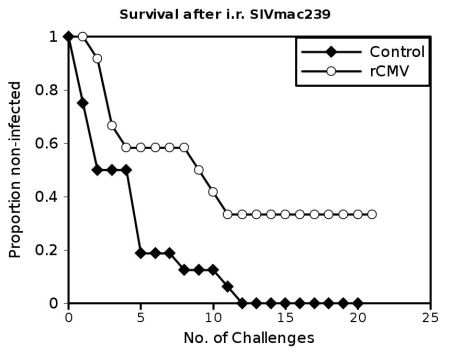
The details of the viral challenge are interesting. In order to simulate a real infection, a low viral dose was used, and this means that not all control animals get infected. So the challenge was repeated weekly until infection (detected by plasma viral load) was observed. I have turned the data from the paper into Kaplan-Meier curves, and used the log-rank test to compare the two groups (BTW: if Louis Picker is reading this, that’s the test you should have used). With p=0.03, survival without infection was significantly prolonged by vaccination, and 4 out of 12 vaccinated macaques were resistant to mucosal challenge. These four animals did not have a latent or cryptic infection, as no SIV DNA or RNA was detectable in CD4 T-cells in blood or lymph nodes, and CD8+ T-cell depletion did not result in viral rebound.

recombinantviruses_032009_html_48846d22This was without any neutralizing antibodies, so for the first time a T-cell vaccination strategy has been shown to confer protection against infection (not just better control of viral load after infection, as with recombinant adenoviruses) in at least some vaccinated animals. Although 33% protection is not enough, at least things are going in the right direction.

So what’s the catch? Well, there are two really. Firstly the SIV sequences in the vaccine and challenge virus were identical. The vaccination strategy may not be so effective against a heterologous challenge, that would be more representative of the real-world. Secondly, the vaccination provokes a persistent infection with a genetically-modified virus, that (unlike other recombinant viruses and gene therapy vectors) remains infectious, so it’s hard to see how this kind of vaccine could be licensed for clinical trials.

Nevertheless, I think this paper is telling us – at last – what kind of T-cell response vaccines should be aiming to induce. Now all we need to do is solve the neutralizing antibody problem, and we’ll really be cooking with charcoal….

Dorian McIlroy
Dorian.Mcilroy@univ-nantes.fr

AIDS Vaccine 2008: Cape Town

26 November, 2008
I was a presenter and rapporteur at this, one of the biggest of this series I have been to – over 900 delegates – held in the Cape Town International Convention Centre (CTICC) in October 2008.  This represents the first time that the organisers, the Global HIV Vaccine Enterprise, have held one of these annual conferences outside of North America or Europe – and certainly the first time in such a high HIV prevalence area (~11%).
The Abstract Book of the conference is now online, courtesy of the journal AIDS & Human Retroviruses, which prompts my publishing the written version of my rapporteur’s report, on Vaccine Concepts and Design.  The oral version had a lot more pictures and Star Wars references in it, but this one is more serious.  A more condensed version will also appear as part of a combined rapporteur’s report in the journal Human Vaccines sometime soon.


AIDS Vaccine 2008, Cape Town – Vaccine Concepts and Design

Ed Rybicki, Institute of Infectious Disease and Molecular Medicine, University of Cape Town

The fallout cloud from the failed STEP and Phambili clinical trials of the Merck adenovirus 5-vectored vaccines cast a long shadow over the conference, and especially over the area of vaccine concepts and design.  Inevitably, there was debate over whether or not T-cell response-based vaccines should ever be tested on a large scale again; and there appeared to be an intense and renewed interest in broadly-neutralising antibodies, and how to elicit them.  It was understandable, then, that those of whose stock in trade is T-cell vaccines were a little apprehensive going into this meeting: however, there was much to excite and much to enthuse, and in particular, several lines of evidence suggesting that T-cell vaccines are not dead and should still be vigorously pursued.

The conference opening was memorable for a number of reasons: among these was the Sizophila Choir of HIV+ folk from Cape Town, who moved many to tears with their amazing harmonies and hymns to ARVs.  Another, very important reason was the presence of South Africa’s new Minister of Health, Barbara Hogan: for the first time in years in a major forum, a senior member of the SA Government affirmed that HIV causes AIDS, and that the search for a vaccine was of paramount importance to SA and the rest of the world.

Arthur C Clarke’s Third Law states that “When an elderly and distinguished scientist says something is possible, he is almost certainly correct”: it was a pleasure, therefore, to hear the certainly distinguished Stanley Plotkin (Sanofi Pasteur / Univ Penn., PA) close the evening with a calm and reasoned explanation of why he thinks vaccines against HIV are possible.  He noted that HIV is not the only vaccine to see major difficulties in its development – and cited measles and CMV as object examples.  He suggested that multivalent vaccine(s) and regular boosters may be necessary; that the immune response needs neutralising Ab and CD4+ and CD8+ cells, in blood and mucosa – and pointed out that these are feasible to produce for other vaccines, so why not for HIV?

The most important Keynote/Plenary talks from the point of view of T-cell vaccines were those by Julie McElrath (Fred Hutchinson Cancer Res Inst, Seattle, WA; Plenary Session 1) on immune responses in the STEP trial; Tony Fauci (NIAID/NIH; Special Keynote) on future strategy, and Bruce Walker (Mass Gen / Harvard U; Plenary 2) on correlates of protective T-cell immunity.  Julie McElrath’s analysis of the STEP data was sobering, and potentially depressing, but there was a positive message: she said that T-cell epitope recognition as a result of the Merck Ad5 vaccine was inadequate, so we needed to use different strategy – such as a protein vaccine, which should almost certainly be adjuvanted for increased immunogenicity.  Tony Fauci summed up current strategic thinking very well, with his analogy of a radio dial, with Discovery and Development at opposite sides: he said that the failure of all large-scale vaccine trials to date meant we should turn the dial back to Discovery, with more focus on innate immunity, animal models and adjuvants, before any more large-scale trials were done.  Bruce Walker’s message, after an exhaustive analysis of “elite controllers”, was that these people have weaker CD8+ T-cell responses to HIV antigens – but they are significantly more Gag-focussed, and that stronger Env responses are correlated with increased risk of progression to AIDS.  His most important comment was that the Merck vaccine / STEP trial result was a failure of product, not of the concept, and that we are not barking the wrong tree with T-cell vaccines.

A novel introduction at the Conference was Special Session 02, Innovations in AIDS Vaccine Discovery: this was chaired by Wayne Koff (IAVI, NY), and had the objective of highlighting novel strategies for vaccine development.  K Reed Clark (Nationwide Children’s Hospital, Columbus, OH) presented a case for “reverse immunisation”, or using a DNA construct to express a humanised neutralising mAb: he used rAAV1 DNA to express scFv-h-C2-C3 IgG2 constructs for sustained delivery of neutralising Ab in macaques.  Sterilising immunity was achieved following NAb gene transfer in the face of a pathogenic SIV challenge, and he achieved sustained (1 yr) circulating levels of 200-400 ug/ml.  As a possible downside, there was an idiotypic anti-NAb response in animals which became  infected.  Sanjay Phogat (IAVI, NY) spoke on the use of immune complexes as vaccines: he used neutralising and non-neutralising MAb complexed to gp120 with an adjuvant (AdjuplexLAP) to generate quick and durable neutralising antibody responses against the Env protein, with immune sera neutralising 6 out of the 10 clade B viruses tested – far better and at much higher titre than adjuvanted gp120 alone.  Clayton Beard (Carolina Vaccine Inst, UNC, NC) had as his goal the use of a chimaeric live alphavirus (VEE) to create a simple self-replicating entity that presents the major antigens of HIV in vivo until an appropriate immune response suppresses its growth, leaving the recipient immune to HIV.  His almost complete redesign of VEE resulted in a virus expressing SIV/HIV Env and a SIV Gag modified to bind the VEE genomic encapsidation  signal, which replicates to titres of ~106/5 ml culture in Ghost cells.  All in all, this session was a welcome addition to the programme, and very well received.

Session OA02 – T-Cell Vaccines and Animal Models – contained several interesting approaches to T-cell vaccines.  Brad Jones (Univ Toronto) opened with a description of how T-cells specific for LINE-1 (long interpersed nuclear element) retrotransposon proteins were effective at eliminating HIV-1 and HIV-2-infected cells: apparently APOBEC-3 family proteins inhibit LINE-1 transposition, and HIV Vif interference with APOBEC allows aberrant LINE-1 expression in HIV-infected cells, which leads to MHC presentation of the LINE-1 proteome, and CTL killing of the affected cells.  A LINE-1-specific T-cell clone recognised, and killed within 2 hours, cells infected with 42 HIV isolates (37 of them primary isolates) from all subtypes, and HIV-2 isolates.  He argued that LINE-1 proteins represented a novel, stable vaccine target as they lacked variability, and speculated that anti-LINE-1 responses could be a part of natural control of HIV, as their T-cell clone was derived from an elite controller.  David Garber (Emory Univ, GA) spoke on the optimisation of modified vaccinia virus Ankara (MVA) to reduce expression of irrelevant antigenic targets: his group had essentially reduced the vector to immediate-early expression only outside of cells used for propagation, as well as lessening its immune evasion capacity by targetted deletions.  Modified vectors with gag and env genes performed 3-5 fold better than MVA in macaques, and it was possible to tune responses for better CD8+ or multifunctional responses.  Tomáš Hanke (Univ Oxford) presented a “universal T-cell vaccine”, HIVconsv: this was a DNA vaccine encoding a spectrum of T-cell epitopes separated by junction regions, derived from the HIV-1 proteome, concentrating on Gag and Pol, with some Env and Vif epitopes.  The vaccine potentially had 270 of a documented 1100 possible HIV-1 CD8+ T-cell epitopes.  T-cells from HIV-infected subjects were stimulated by vaccine epitopes: 11 of 12 subjects reacted to 2 or more peptide pools (covering, indicating good coverage.  Macaque immunisation resulted in a strong, broad response as assessed by ELISpot assay.  His hope was that the vaccine would redirect responses compared to natural infection, so as to negate immunodominance of one or a few epitopes.

Symposium 03 – Next Generation Vaccine Vectors – was a highlight of the Conference, with a number of excellent presentations.  Dan Barouch (Beth Israel Deaconess Med Ctre, Harvard) gave a tour de force talk on what amounted to a rerun of the Merck Ad5 vaccine efficacy trial in macaques, with a gag-only heterologous Ad26/Ad5 or Ad35/Ad5 vaccination regime.  The Ad26/Ad5 combination was best, 2x the Ad35/Ad5 response, which was 2x the Ad5/Ad5 response.  The Ad26/Ad5 regime gave long-term (500 day) durable partial protection against challenge, with a 3x greater breadth of epitope responses than to Ad5/Ad5.  The 26/5 regime elicited a good memory Gag-specific response, and similar to what Bruce Walker had said for elite human controllers, there was a significant correlation of the height and breadth of the Gag–specific response, and reduction of viral load.  Dan repeated Walker’s earlier comment, with some significant evidential weight to his iteration: the STEP trial was a failure of product, not of concept.

Louis Picker (Oregon Health & Science Univ, OR) discussed how a kinetic mismatch between replication and development of T-cell clones at the site of infection could result in infection taking hold – and further, that live attenuated SIV vaccines elicited mainly effector memory (EM) cells, whereas prime-boost vaccine regimes elicited mainly central memory (CM) cells.  His group used rhesus CMV – known to elicit mainly EM-dominated responses, and which can infect and reinfect monkeys, which remain infected lifelong – to vector SIV rev, nef, tat and gag genes into macaques.  In contrast to the CM response of Ad5-vectored genes, these elicited EM responses, enriched in bowel and lung and other mucosa.  Very weak Ab responses with no NAb were seen.  Protection against infection was seen in macaques challenged by repeat low-dose intrarectal SIV, with control groups infected at a median of two doses, and vaccinees taking 8: replication of virus was eliminated or controlled very early in infection, apparently by a CD8+ T-cell independent mechanism.  His message was that the CMV vaccine and the EM cell response drastically cut down transmission.

Anna-Lise Williamson (IIDMM, Univ Cape Town) closed out the session with an account of the vaccine development efforts in Cape Town under the auspices of the SA AIDS Vaccine Initiative (SAAVI).  Her group has brought a DNA and an MVA-vectored heterologous prime-boost multigene HIV vaccine combination to the point of human trial after successful broad-spectrum immunogenicity trials in baboons; however, they are also developing M bovis Bacillus Calmette-Guerin (BCG) auxotrophs and the limited host range Lumpy skin disease capripoxvirus (see also P16-02) as vectors, with very promising baboon and macaque immunogenicity results with HIV genes.  Additionally, the group has gone a long way in developing Pr55Gag and chimaeric Gag virus-like budded particles (VLPs) as vaccines, with good evidence of significant T-cell response boosts by VLPs of DNA-or BCG-primed immunity in mice and baboons.

An important sub-theme at the Conference was DNA vaccines: there has been a lot of disparaging talk in recent years concerning their potential efficacy; however, in the post-STEP era, the usurping adenovirus vectors have lost some popularity, and it seems the original genetic vectors have a new lease on life. 

George Pavlakis (NCI, Frederick, MD) in talk OA05-01 gave a masterly account of how electroporation of optimised DNA vaccines hugely enhanced humoral and mucosal responses.  He made the point forcefully that DNA vaccines had the advantage that there was no immune response to the vector, and that their preparation was rapid, scalable and safe – and that “increased expression improves the DNA vaccine result”.  He noted that different forms of antigen affect the immune response that electroporation as a means of delivery increases both antigen expression and immunogenicity; that natural cytokines delivered as DNAs were effective molecular adjuvants (eg: IL-12, IL-15), and that heterologous combinations such as DNA+protein, or DNA+viral vectors could be very effective.  In macaque vaccination experiments using gag, pol, nef and vif genes in combination with chemokine fusions, the group was able to get very high (30 000 sfu/106 cells) Ifnγ ELISpot results, with ~0.3% of total circulating T-cells being Ag-specific, and high serum Ab response.  They got a balance of central memory and effector CD4+/CD8+ cells, which is a shift of the type of response (central memory CD4+) obtained with previous DNA vaccines.

David Weiner (Univ Pennsylvania, PA) spoke in S03 on a very similar theme – electroporation and molecular adjuvants – and reiterated that optimisation of DNA yielded excellent results.  He also added manufacture as an optimization parameter, noting that it was now possible to get ~15 mg/ml of plasmid DNA: this allowed much higher, less dispersed doses of DNA.  He also noted that electroporation (EP) changes the phenotype of the response.  They tested an SIV DNA vaccine with IL-12, IL-15 or RANTES DNA as adjuvants in macaques: challenge showed IL-12, RANTES gave viral loads 2 log less than IL-15 DNA adjuvanted or DNA vaccine alone.  Concentrated DNA was as good an immunogen as Ad5, and much better when used with IL-12 DNA: there was increased magnitude of individual responses and increased polyfunctionality.

Fiona Tanzer (IIDMM, Univ Cape Town) in OA02-02 gave an excellent example of how to improve a DNA vector.  She used elements from Porcine circovirus (PCV) to significantly enhance expression from and immunogenicity of an already good DNA vector, increasing HIV Ag-specific Ifnγ ELISpot scores by 3 – 5-fold in mice using only 172 bases from the capsid gene promoter of PCV inserted upstream of a HIV-1 polygene vaccine construct. 

Taken together, these talks give an indication that DNA vectors for T-cell and other vaccines are alive and kicking, and on the verge of another growth phase in their deployment.  Improvements in manufacturing, antigen expression levels and DNA delivery, and parallel advances in the use of co-expressed molecular adjuvants, all herald a new era in heterologous prime-boost studies for HIV and other vaccines.

Two posters – one an oral abstract – stood out for me as vaccine design highlights of the very rich and well-attended sessions.  Darrin Martin (IIDMM, Univ Cape Town) spoke briefly on P19-08: designing a recombination-proof HIV vaccine.  His bioinformatic approach identifies “cold spots” for recombination in the HIV-1 genome, and suggests targets for polyepitope-based vaccines.  Champiat et al. (P12-15) found that APOBEC is a T-cell target in HIV+ people: this further extends the range of invariant, HIV-induced potential T-cell vaccine targets. 

A few plant production-related HIV vaccine posters caught the eye, as my group has been involved in this for years, and it is a field with much promise but as yet, no few realised achievements.  Cherni et al. (P02-03) presented interesting data on gp41 MPR on Hepatitis B virus core particles made in plants; Andersson et al. (P12-08) demonstrated that transgenic Arabidopsis expressing p24 is orally immunogenic; Meyers et al. (P12-10) showed that plant-produced vaccine-relevant HIV Ag boosted DNA primed T-cell responses; Regnard et al. (P18-08) showed that plant production of HIV antigens could be significantly increased by used of a replicating geminivirus-derived vector.

 As for other posters, Welte and Walwyn (Univ Witwatersrand, SA) in P01-01 demonstrated elegant mathematical modelling of acute infection and vaccine design – and Guerbois et al. (LB-32) had truly excellent expression of budded Gag-ΔV1V2Env particles from a measles-vectored vaccine. 

All in all, then, the HIV vaccine enterprise is battered but still functional.


Nobel Virology 2008

7 October, 2008

It gives me great and unalloyed pleasure, as someone acquainted with one of the new Nobellists, and who has followed the science behind the awards ever since the beginning, to feature the three virologists who were jointly awarded the Nobel Prize in Medicine for 2008.

http://www.nytimes.com/2008/10/07/health/07nobel.html?hp

Discoverers of AIDS and Cancer Viruses Win Nobel Prize – NYTimes.com via kwout

To quote the NY Times article, written by Lawrence K Altman:

“The Nobel Prize in Medicine was awarded Monday to three European scientists who had discovered viruses behind two devastating illnesses, AIDS and cervical cancer.

Half of the award will be shared by two French virologists, Françoise Barré-Sinoussi, 61, and Luc A. Montagnier, 76, for discovering H.I.V., the virus that causes AIDS. Conspicuously omitted was Dr. Robert C. Gallo, an American virologist who vied with the French team in a long, often acrimonious dispute over credit for the discovery of H.I.V.

The other half of the $1.4 million award will go to a German physician-scientist, Dr. Harald zur Hausen, 72, for his discovery of H.P.V., or the human papilloma virus. Dr. zur Hausen of the German Cancer Research Center in Heidelberg “went against current dogma” by postulating that the virus caused cervical cancer, said the Karolinska Institute in Stockholm, which selects the medical winners of the prize, formally called the Nobel Prize in Physiology or Medicine.

His discovery led to the development of two vaccines against cervical cancer, the second most common cancer among women. An estimated 250,000 women die of cervical cancer each year, mostly in poor countries.”

The news is all the more welcome, because I am very familiar with the entire history.  The HIV pandemic has paralleled most of my career: I remember vividly my then Honours student – now a distinguished Professor in her own right – coming to me in 1984 to tell me that “…they have found the virus that causes acquired immune deficiency syndrome”.  Again, it was greatly of interest when Harald zur Hausen initiated the work that would lead to his award, as it was some of the first hard evidence that viruses were implicated in cancer – which suddenly made learning and teaching Virology a whole lot more sexy.  Especially in view of the mode of transmission of the viruses concerned…I like to think I may have put more people off casual sex by talking about viruses like herpes, HPV and HIV and what they can do to you, than any ten school guidance counsellors – but I digress.

The news is also welcome because I now work with both HPV and HIV: thus, reward for the people who invented our main field of endeavour is especially pleasing.

 But as ever, the Nobel awards are not without controversy.  Altman again:

“In 1983, Dr. Montagnier and Dr. Barré-Sinoussi, a member of his lab at the Pasteur Institute in Paris, published their report of a newly identified virus. The Karolinska Institute said that discovery led to blood tests to detect the infection and to anti-retroviral drugs that can prolong the lives of patients. The tests are now used to screen blood donations, making the blood supply safer for transfusions and blood products.

The viral discovery has also led to an understanding of the natural history of H.I.V. infection in people, which ultimately leads to AIDS and death unless treated.

H.I.V. is a member of the lentivirus family of viruses. The French scientists were cited for identifying a virus they called L.A.V. (now known as H.I.V.) in lymph nodes from early and late stages of the infection.

“Never before has science and medicine been so quick to discover, identify the origin and provide treatment for a new disease entity,” the Karolinska Institute said.

…Nobel Foundation rules limit the number of recipients of its medical prizes to a maximum of three each year, and omissions often create controversy.

The dispute between Dr. Gallo and the French team spanned years and sprawled from the lab into the highest levels of government. Dr. Gallo, 71, now at the University of Maryland in Baltimore, worked for many years at the National Cancer Institute in Bethesda, Md.

While in Bethesda in 1984, a year after the French team’s report, Dr. Gallo reported finding a virus that he called H.T.L.V.-3 and that was later shown to be nearly identical to the French L.A.V. After additional studies, Dr. Gallo said cultures in his laboratory had accidentally become contaminated with the French virus.

In 1986, Dr. Gallo and Dr. Montagnier shared a prestigious Lasker award, given in the United States; Dr. Montagnier was cited for discovering the virus and Dr. Gallo for determining that it caused AIDS.

In 1987, President Reagan and Prime Minister Jacques Chirac of France signed an agreement to share royalties and credit for the discovery.

But Maria Masucci, a member of the Nobel Assembly, told Reuters on Monday that “there was no doubt as to who made the fundamental discoveries.”

Dr. Gallo told The Associated Press on Monday that it was “a disappointment” not to have been honored with the French team. Later, Dr. Gallo issued a statement congratulating this year’s Nobel Prize winners and said he “was gratified to read Dr. Montagnier’s kind statement this morning expressing that I was equally deserving.” “

We’ve been waiting for this for a long time…and the result is interesting indeed, for many of us virologists.  Satisfying too….  I remember wondering at the time how the US team could blithely rename a virus that appeared very similar to one described a year earlier – and was even more fascinated to see how the story unfolded, with LAV becoming HTLV-III becoming HIV, as eventually sense and taxonomy overtook hubris.

The HPV award seems not to be controversial at all, and Professor zur Hausen is seen by everyone I have spoken to as a most worthy recipient.  Now, just to get that vaccine into people who need it….

H5N1 flu: The End is still in sight

15 July, 2008

While the much-dreaded Big One – a major flu pandemic – still seems to be holding off, I am pleased to see that the latest edition of Nature has devoted an editorial and other commentary space to pandemic flu in general, and H5N1 flu in particular.

The Nature issue of 10th July 2008 – which has Ebola virus glycoprotein on the cover, about which, more later – has as its lead editorial title, “The long war against flu“.  The header goes on:

“That the H5N1 strain of bird flu has not yet caused a pandemic is no cause for complacency. Preparations for the inevitable must be redoubled to mitigate the potential devastation.”

My feelings entirely, and especially for the developing world – shared with you here and here, in MicrobiologyBytes, and here, in your own ViroBlogy.  It is all too easy to easy to fall into a state of complacency, or even H5N1 pandemic fatigue: however, this is really dangerous, especially for planners.  The editorial goes on:

“Five years after the deadly H5N1 avian influenza virus exploded into a global epidemic in birds, it has infected more than 300 people. Happily, it has not yet evolved into a strain that can transmit easily between humans — an event that would trigger a pandemic that could kill tens of millions. But as long as H5N1 continues to be present in animals, that risk persists. And with so many other flu strains out in the world, all constantly evolving, a flu pandemic is inevitable.”

 And:

“…improved control measures, especially for H5N1 itself, and public-health infrastructure are our frontline defences against a pandemic. Unfortunately, the overall control picture is bleak. Thailand, Vietnam and China have notched up successes in curbing outbreaks in birds, which is key to minimizing the chance that the virus can pass to humans. But South Korea had its worst outbreak ever in April, and the disease has become endemic in Indonesia, Bangladesh, Vietnam and Egypt. Eradication now seems impossible, and the task of containing the virus has become chronic and costly.”

Which sets the stage for Commentaries in the same issue: in “Ready for Avian Flu“, Tadataka Yamada et al. offer up “…a roadmap for heading off a global avian influenza catastrophe“.  They discuss how the WHO has made plans for stockpiling H5N1 vaccines, and that major vaccine manufacturers have offered to contribute – but also that the necessary allocation plan and ethics framework still need to be worked out.  They discuss how adjuvanting flu vaccines can reduce the dose by up to to four times, and how this together with dedicating the existing manufacturing framework – capable of some 500 million doses of trivalent vaccine a year  – to single-valency production, could allow some 6 billion doses a year to be produced.

Which, of course, would neatly cover the world’s population.  This sounds wonderful – but ignores the fact that H5N1 viruses are notoriously difficult to produce via conventional egg-based methods, which is what provides the bulk of the present manufacturing capacity….  Still, they also point out that adjuvanted, non-matched vaccines can still cross-protect against strains that have undergone seven or so years of genetic drift, meaning that stockpiled H5N1 vaccines could still be relevant in several years time.

They state the following:

“In the next 18 months we [Bill & Melinda Gates Foundation, the Pasteur Institute and the Wellcome Trust] will develop, maintain and disseminate a central inventory of funded research activities that are relevant to human influenza to ensure that stakeholders are well-informed. We will also coordinate roadmapping exercises to identify knowledge gaps. These will assist funders and researchers in establishing research-funding priorities, with specific focus on vaccines, drug therapies and epidemiology/population science (for example, diagnostics, surveillance, transmission and modelling). The Bill & Melinda Gates Foundation and the Wellcome Trust will collaborate to fund these activities.”

And how much developing country input will there be into this?  Distressingly little, probably, given the propensity of these funds to at best give money to developed country groups to work with developing country folk, but at least the roadmap addresses issues that are relevant to the whole world community.  Like intellectual property concerns, coordination of stockpiling and distribution, fair distribution, funding…and surveillance, the forgotten and possibly most important factor in determining if a flu outbreak is getting out of hand.  

Apropos of which, another commentary in the same issue – “The contents of the syringe“, by Steven Salzberg – notes that the influenza vaccine failed this northern hemisphere winter, and that future success relies on sharing data more widely and making the virus strain selection process more transparent.  Salzburg says:

 
“The WHO met on 11–13 February this year to decide on the strains to be included in the vaccine for the 2008–09 season. As usual, the meeting was closed to all but invited participants, who this year included members of the WHO influenza surveillance network, representatives of national drug regulatory agencies, and influenza vaccine manufacturers. The experts involved chose to replace the H3N2 strain with a more recent isolate, from 2007, which should be a better match to the circulating viruses next season. Neither the WHO nor the CDC publishes the evidence used to support their decision [my emphasis]. That evidence includes hemagglutinin inhibition tests of hundreds of isolates, genome sequences of some isolates and data on the ease with which the isolates can be grown in eggs.”

“The process of choosing flu-vaccine strains needs to be much more open. Other scientists, such as those in evolutionary biology with expertise in sequence analysis, could meaningfully contribute to the selection. At present, external scientists cannot review the data that went into the decision, nor can they suggest other types of data that might improve it.”

Whoops…so those who would safeguard us, feel no need to tell us what is going on??  Salzburg has some suggestions:

“The leaders of the influenza community, especially the WHO and the CDC, should create policies — for sharing data and isolates — that are more open, and should insist that their own scientists follow those policies. When these leading organizations set an example, the rest of the community will follow.”

“Of course, preparing vaccine in cell culture could reduce some of the pressures put on that dark room of vaccine predictors. The current system, in which most of the world’s vaccine supply is grown in chicken eggs, is an antiquated, inefficient method requiring six months or more to ramp up production, which in turn means that the vaccine strains must be chosen far in advance of each flu season. More crucially it sometimes prevents the use of the optimal strain, as it did in 2007. And, if the next pandemic is an avian-influenza strain such as H5N1, then it could easily sweep through the chicken farms that we rely on to produce eggs for vaccines. [me again]”

 He goes on to extol the benefits of sharing sequence information in particular, so as to enable rational, evidence-based choice of flu strains for vaccines – and the use of non-egg-based cell culture methods for vaccine production, and how these should allow far quicker development of flu vaccines.

All of this is very cogent and timeous.  However, it begs the question, previously raised in ViroBlogy, as to how production will be increased to take care of everyone who may be affected.

I still think plants are the answer…!  I note the plant-based flu vaccine group paper that I blogged on previously in this forum has a sequel: this is a better paper all around, and points up the need to explore this sort of production system for this kind of virus.

But I digress – so let me do so thoroughly.  The Nature issue also has a news item on the Eppendorf Song, a new piece of viral advertising with a boy band extolling the virtues of a multipettor.  Not a patch on the Biorad PCR Song, guys – but nice to see some popular culture making its way into science equipment advertising!

West Nile virus vaccine: almost a replicant

2 June, 2008

West Nile virus – a member of the family Flaviviridae – has insidiously spread halfway around the world from its origins in Africa, in just a few years.  It invaded the east coast of the USA, probably from the Middle East,  via either infected birds, mosquitoes, humans, or another vertebrate host in around 1999; since then it has spread all the way across the continent to the west coast, and has become truly endemic. 

Virions have a regular icosahedral-type structure, despite being enveloped, as a result of a structured nucleocapsid and a highly-structured array of envelope glycoprotein.  They contain a positive strand RNA genome of ~11 kb with a single long open reading frame that is translated as a polyprotein of about 3400 amino acids, which is then processed into individual regulatory and structural proteins.

The virus subtype spreading in North America – lineage 1 – causes encephalitis in humans, unlike the enzootic variant circulating in birds and animals in Africa.  It also cause severe mortality – near 100% in experimentally infected animals – among American Crows and other corvids: a feature of the spread of the disease has been dead crows found in and around towns in the USA.  A feature of lineage 1 viruses is their infection of horses and other equines as well – with up to one in three clinically-infected horses dying.  The human impact, however, is seen as a major problem: systemic febrile illness develops in ~20% of those infected with WNV, while severe neurologic illness developes in <1% of persons infected – with mortality rates of 5 -14% among persons with neurologic symptoms in recent US, Romanian, Russian, and Israeli outbreaks.

There has been a concentrated effort to develop a human vaccine or vaccines since the onset of the US epidemic – horse vaccines are already commercially available – and our knowledge of the virus has benefitted greatly as a result.  This includes a detailed structure for the virus, obtained by cryoelectron microscopy image reconstruction.

http://www.purdue.edu/uns/html4ever/031009.Kuhn.westnile.html

Purdue team solves structure of West Nile virus via kwout

 Now a team led by Alexander Khromykh from Brisbane in Queensland, Australia, writing in the May issue of Nature Biotechnology, have described a novel “single-round infectious particle” DNA vaccine against WNV which significantly increases protection in mice to lethal challenge with the live virus.   In the words of the authors:

“We augment the protective capacity of a capsid-deleted flavivirus DNA vaccine by co-expressing the capsid protein from a separate promoter. In transfected cells, the capsid-deleted RNA transcript is replicated and translated to produce secreted virus-like particles lacking the nucleocapsid. This RNA is also packaged with the help of co-expressed capsid protein to form secreted single-round infectious particles (SRIPs) that deliver the RNA into neighboring cells. In SRIP-infected cells, the RNA is replicated again and produces additional virus-like particles, but in the absence of capsid RNA no SRIPs are formed and no further spread occurs. Compared with an otherwise identical construct that does not encode capsid, our vaccine offers better protection to mice after lethal West Nile virus infection. It also elicits virus-neutralizing antibodies in horses. This approach may enable vaccination against pathogenic flaviviruses other than West Nile virus.”

Adapted by permission from Macmillan Publishers Ltd: Nature Biotechnology 26, 571 – 577, 20 April 2008 doi:10.1038/nbt1400 Single-round infectious particles enhance immunogenicity of a DNA vaccine against West Nile virus, David C Chang et al., copyright 2008

This is a very clever use of fundamental knowledge of virus structure and assembly: the virus envelope proteins – E and prM – can form budded particles if expressed in isolation; if expressed with the capsid protein, the particles encapsidate RNA with the appropriate encapsidation signal to form virions.  The DNA vaccine encodes a transcriptional unit corresponding to a viral genome which lacks only the capsid protein gene, as well as a separate capsid gene under back-to-back cytomegalovirus (CMV) promoters.  Thus, cells transfected with the DNA vaccine can produce both virus-like prM and E protein and membrane particles (VLPs), or pseudovirions which in addition contain a capsid and the engineered (=lacking capsid protein gene) genome.  While both are highly immunogenic, the pseudovirions can additionally infect other cells to release replicative genomic RNA, which can produce VLPs but not pseudovirions, as the capsid protein-encoding RNA is not encapsidated.  Thus, initial transfection leads to release of particles which allow a single subsequent round of VLP production, but no further spread of the replicative RNA.

A very clever trick – and worthy of being repeated for a number of related pathogenic flaviruses, including dengue and yellow fever viruses.

Even if the particles can’t pass the Voight-Kampff test…B-)