Archive for April, 2012

Febrile Seizure Risk Not Linked to MMRV Vaccine Booster in New Study

3 April, 2012

Via Scoop.itVirology News

A new study examining the link between the Measles, Mumps, Rubella and Varicella vaccination (MMRV) booster in 4 to 6 year old children found no link between the shot and febrile seizures.


Yet more reasons to GET YOUR CHILDREN VACCINATED!!

Via www.inquisitr.com

Inovio gets second grant to fund bioterrorism synthetic vaccines

3 April, 2012

Via Scoop.itVirology News

Inovio Pharmaceuticals (AMEX:INO) received a second grant by the U.S. Defence Department to fund bioterrorism synthetic vaccines program, the company said Monday.

The grant allows Inovio to advance development of a low-cost, non-invasive surface electroporation delivery device and test its utility with its novel synthetic DNA-based vaccines against viruses with a bioterrorism potential, including hanta, puumala,
arenavirus and pandemic influenza.


Good may come of the bioterror hype yet!

Via www.proactiveinvestors.com

NanoViricides says pre-IND meeting with FDA for FluCide “successful”

3 April, 2012

Via Scoop.itVirology News

NanoViricides (OTC:NNVC) said Monday that the U.S. health regulator gave a “good roadmap” toward an investigational new drug (IND) application for the company’s lead candidate FluCide, at a recent pre-IND meeting.
The previously announced meeting was held with the U.S. Food and Drug Administration on March 29, as scheduled.
NanoViricides said the meeting focused on FluCide, designated as NV-INF-1, the company’s anti influenza drug.

Via www.proactiveinvestors.com

[Lack of] Adverse Effects of Vaccines: Evidence and Causality

3 April, 2012

Via Scoop.itVirology News

FEW HEALTH PROBLEMS ARE CAUSED BY VACCINES, IOM REPORT FINDS

WASHINGTON — An analysis of more than 1,000 research articles concluded that few health problems are caused by or clearly associated with vaccines. A committee of experts convened by the Institute of Medicine to review the scientific literature on possible adverse effects of vaccines found convincing evidence of 14 health outcomes — including seizures, inflammation of the brain, and fainting — that can be caused by certain vaccines, although these outcomes occur rarely. It also found indicative though less clear data on associations between specific vaccines and four other effects, such as allergic reactions and temporary joint pain. In addition, the evidence shows there are no links between immunization and some serious conditions that have raised concerns, including Type 1 diabetes and autism. The data were inadequate to reach conclusions about other suggested adverse effects.


There we are then: a reasoned, intelligent account of what LITTLE harm vaccines do.

Via gmopundit.blogspot.fr

College Speaker Describes HIV Vaccine Progress, Roadblocks | The Point News Online – SMCM – St. Mary’s College of Maryland’s bi-weekly news source

3 April, 2012

Via Scoop.itVirology News

In a lecture on March 21 to College students and faculty, National Institute of Health (NIH) Vaccine Branch researcher Marjorie Robert-Guroff, Ph.D., discussed the history, vaccine trials, and treatment roadblocks of Human Immunodeficiency Virus (HIV), the causative agent of AIDS, in her lecture “Developing Vaccines for HIV/AIDS: Challenges and Prospects.”.


Useful summary on HIV vaccines

Via thepointnews.com

Deliberating Over Danger | The Scientist

2 April, 2012

Via Scoop.itVirology News

Deliberating Over Danger

The creation of H5N1 bird flu strains that are transmissible between mammals has thrown the scientific community into a heated debate about whether such research should be allowed and how it should be regulated.

Via the-scientist.com

Antiviral Research – Orthopoxvirus targets for the development of new antiviral agents

2 April, 2012

Via Scoop.itVirology News

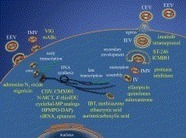
Investments in the development of new drugs for orthopoxvirus infections have fostered new avenues of research, provided an improved understanding of orthopoxvirus biology and yielded new therapies that are currently progressing through clinical trials. These broad-based efforts have also resulted in the identification of new inhibitors of orthopoxvirus replication that target many different stages of viral replication cycle. This review will discuss progress in the development of new anti-poxvirus drugs and the identification of new molecular targets that can be exploited for the development of new inhibitors. The prototype of the orthopoxvirus group is vaccinia virus and its replication cycle will be discussed in detail noting specific viral functions and their associated gene products that have the potential to serve as new targets for drug development. Progress that has been achieved in recent years should yield new drugs for the treatment of these infections and might also reveal new approaches for antiviral drug development with other viruses.


Useful illustration of what a good idea it is to understand the “Entrance, Entertainment and Exit” strategies fo a virus!

Via www.sciencedirect.com

HIV among drug users record high – Islamabad :: Asian Harm …

2 April, 2012

Via Scoop.itVirology News

Islamabad: Enough to set alarm bells ringing, HIV infection rates among injecting drug users in the country has jumped from 10.8 per cent in 2005 to 37.8 per cent in 2011, ‘HIV Second Generation Surveillance in Pakistan …


I remember talking about this back in 2003 or so: the figures for India and Pakistan and China and Russia had started to increase, and I could see a time coming when Africa might be a sideshow in the HIV pandemic.  Because it’s just a sidestep from IV drug users to the heterosexual population….

Via new.ahrn.net

Breastfeeding, Not Formula, for South Africa’s HIV-Positive Mothers – Inter Press Service

2 April, 2012

Via Scoop.itVirology News

Breastfeeding, Not Formula, for South Africa’s HIV-Positive MothersInter Press ServiceBy Lee Middleton CAPE TOWN, South Africa, Apr 1, 2012 (IPS) – South Africa’s nine provinces will begin phasing out provision of free formula to HIV-positive…

Via ipsnews.net

WHO | The influenza enigma

2 April, 2012

Via Scoop.itVirology News

To disease detectives at the world’s leading public health agencies, influenza is an all-too familiar foe. First isolated in 1932, the virus – a single-stranded member of the orthomyxovirus family – occurs every year in every country, seasonally and sporadically, killing between 250 000 and 500 000 people and causing severe illness in several million more, according to the World Health Organization (WHO).

Over the past three centuries, there have been at least 10 global influenza pandemics and three in the last century alone, among them the so-called ‘Spanish flu’ of 1918–1919. The single most devastating disease outbreak in human history, that pandemic is believed to have caused between 20 million and 50 million deaths worldwide. It is the prospect of another such catastrophe, and the staggering toll of seasonal flu, that has made influenza the world’s second-most studied virus, behind HIV.


And my quote of the article:

“Monitoring birds is very important, but we should be doing much more work on influenza in pigs. We know the numbers are huge and we don’t know what exactly is happening there.” – Ab Osterhaus

Via www.who.int