Archive for the ‘biofarming’ Category

Plant-Based Vaccines, Antibodies and Biologics 5: Part 1

27 June, 2013

Plant-Based Vaccines, Antibodies and Biologics: the 5th Conference

Verona, Italy, June 2013

The return of this biennial meeting to Verona – the third time it has been held here – was a welcome change; while the previous meeting in Porto in 2011 may have been good, the city was nothing like as pleasant a place to relax.  My group is now familiar enough with Verona that we know just where to go to get pasta by the riverside – or, on this occasion, “colt loin with braised onion and potatoes” and “stewed horse with red wine”.  Which seem more palatable, somehow, as “Costata di puledro con cipolle brasate e patate” and “Stracotto di cavallo speziata” respectively, but were enjoyed anyway.

The conference kicked off with an opening plenary session, chaired by the Local Organizing Chair, Mario Pezzotti, of the University of Verona.  The headline act was a talk on taliglucerase alfa – aka glucocerebrocidase, a Gaucher Disease therapeutic  –  by Einat Almon of Protalix Therapeutics from Carmiel, Israel.  I featured the product here last year, after an earlier feature here; suffice it to say that it has soared since FDA approval, and now Protalix is pushing hard with new plant-made products to follow it up.  While they use carrot cells for taliglucerase alfa, apparently they are using suspension-cultured tobacco cells for other products – and are using an easily-scalable disposable 800 litre plastic bag system, with air-driven mixing of cells suspended in very simple, completely mammal-derived product free media.  Hundreds of patients had been treated with the drug for up to 5 years with no ill effects, and the possibility of switching therapies from mammalian cell-made products to the plant cell-made had been successfully demonstrated.

Scott Deeter of Ventria Biosciences (Ft Collins, USA) spoke next, on “Commercializing plant-based therapeutics and bioreagents”.  His company has possibly the most pragmatic attitude to the production and sale of these substances that I have yet met, and he struck a number of chords with our thinking on the subject – which of course, post-dates theirs!  Ventria use self-pollinating transgenic cereals for production of seed containing the protein of interest, and rice in particular, for safety reasons – and because the processing of the seeds is very well understood, and the purification processes and schedules are common to many food products and so do not require new technology.  He reckoned that a company starting out in the business needed an approved product in order to give customers confidence – but should also engage in contract services and contract manufacture of client-driven products in order to avoid being a one-product shop.  To this end, they had received APHIS Biological Quality Manufacturing Systems (BQMS) certification (similar to ISO9001), with the help of the US Biotechnology Regulatory Services.

Their therapeutic products included diarrhoea, ulcerative colitis and osteoporosis therapeutics which were already in phase II clinical trial.  Scott noted that in particular, recombinant lactoferrin was a novel product, which could only feasibly be produced in the volumes and at the price required for effective therapy, by recombinant plant-based production systems.  It also filled a high unmet need as a therapy for antibiotic-associated diarrhoea in the US, with +/-3 million patients at risk annually who presently cost service providers over $1500 each for treatment.

A third commercialization option was bioreagents and industrial enzymes, which they marketed via a vehicle called InVitria: they had a number of products already in the market, which Scott claimed gave confidence to the market and to partners, while building capacity to make therapeutics.  Something that was particularly attractive to our prospects was that a collection or pool of small volume products – say $5-10 million each – gave a respectable portfolio.  He noted that Sigma Aldrich and Merck were already marketing their human serum albumin, which competed effectively with serum- and yeast-derived products.

George Lomonossoff from the John Innes Centre in Norwich, UK, spoke next on “Transient expression for the rapid production of virus-like particles in plants” – a subject close to our hearts, seeing as we have for the last five years been associated with George and partners in the Framework 7-funded PlaProVa consortium.  He mentioned as an object example the recent success in both production and an efficacy trial of complete Bluetongue virus (BTV) serotype 8 VLPs, made in Nicotiana benthamiana via transient expression using their proprietary Cowpea mosaic virus (CPMV) RNA2-derived pEAQ vector: this was published recently in Plant Biotechnology Journal.

Another very useful technology was the use of CPMV capsids as engineered nanoparticles: one can make empty VLPs of CPMV at high yield by co-expressing the coat protein (CP) precursor VP60 and the viral 24K protease: the particles are structurally very similar to virions in having a 0.85 nm pore at 5-fold rotational axes of symmetry, meaning they can be loaded with (for example) Co ions.  It is also possible to fuse targeting sequences – such as the familiar RGD loop – into the surface loops of the CPMV CPs, and to modify the inner surface too.  One application would be to engineer Cys residues exposed on the inside, which could bind Fe2+ ions: this would result in particles which could be targeted to cancer cells by specific sequences, then heated using magnetic fields.

John Butler of Bayer Innovation GmbH (Leverkusen, Germany) closed out the session with an account of lessons learned from the development of the plant-derived non-Hodgkins lymphoma (NHL) vaccine, that they had acquired with Icon Genetics, who in turn had inherited it from the sadly defunct Large Scale Biology Corp.  It was rather depressing to hear that Bayer had dumped the vaccine, despite the developers having reached their targets in turning 43 of 45 tumour samples into lifetime individualized supplies of vaccine within12 weeks, and despite the phase I trial being as successful as could be hoped.  To this end, the vaccines had been well tolerated and were immunogenic; of the patients who reacted immunologically, all but one were still tumour-free presently.

He felt that the problem was that NHL trials were too long and therefore too expensive as it was a slow-progressing disease; that a different clinical approach was needed, and that using the vaccines as a first-line therapy instead of only after the 2nd or 3rd relapse would be a much better idea.  The main lesson learned was that proving the technology would be far better done with a therapeutic vaccine for a fast-acting cancer, which would allow 1-2 year clinical trials with overall survival as an endpoint.

(more coming)
Polyclonal antibodies from plants

16 June, 2013

I will be blogging in a LOT more detail soon concerning my group’s attendance of the 5th Plant-Based Vaccines, Antibodies and now also Biologics meeting in Verona less than two weeks ago – but one presentation so caught my eye that I thought I would feature it as a preview of my overall report.

It did not hurt that the presenter, one Diego Orzaez, who describes himself in an email as that “…guy from Valencia who showed those pictures of the virus mosaic”, is also a Twitter and Scoop.it Virology News fan, which will always endear someone to me…no, seriously, I think the potential of the technology is huge – so let me get right to it!

A paper describing the basics of the phenomenon Diego and colleagues utilised in order to potentially get expression of multiple monoclonal Abs in a single leaf, is described in the following paper from April 2013:

Plant Molecular Biology
April 2013, Volume 81, Issue 6, pp 553-564

A coat-independent superinfection exclusion rapidly imposed in Nicotiana benthamiana cells by tobacco mosaic virus is not prevented by depletion of the movement protein

José Manuel Julve, Antoni Gandía, Asun Fernández-del-Carmen, Alejandro Sarrion-Perdigones, Bas Castelijns, Antonio Granell, Diego Orzaez

New evidence is emerging which indicates that population variants in plant virus infections are not uniformly distributed along the plant, but structured in a mosaic-like pattern due to limitation to the superinfection imposed by resident viral clones. The mechanisms that prevent the infection of a challenge virus into a previously infected cell, a phenomenon known as superinfection exclusion (SE) or Homologous Interference, are only partially understood. By taking advantage of a deconstructed tobacco mosaic virus (TMV) system, where the capsid protein (CP) gene is replaced by fluorescent proteins, an exclusion mechanism independent of CP was unveiled. Time-course superinfection experiments provided insights into SE dynamics. Initial infection levels affecting less than 10 % of cells led to full immunization in only 48 h, and measurable immunization levels were detected as early as 6 h post-primary infection. Depletion of a functional movement protein (MP) was also seen to slow down, but not to prevent, the SE mechanism. These observations suggest a CP-independent mechanism based on competition for a host-limiting factor, which operates at very low virus concentration. The possible involvement of host factors in SE has interesting implications as it would enable the host to influence the process.

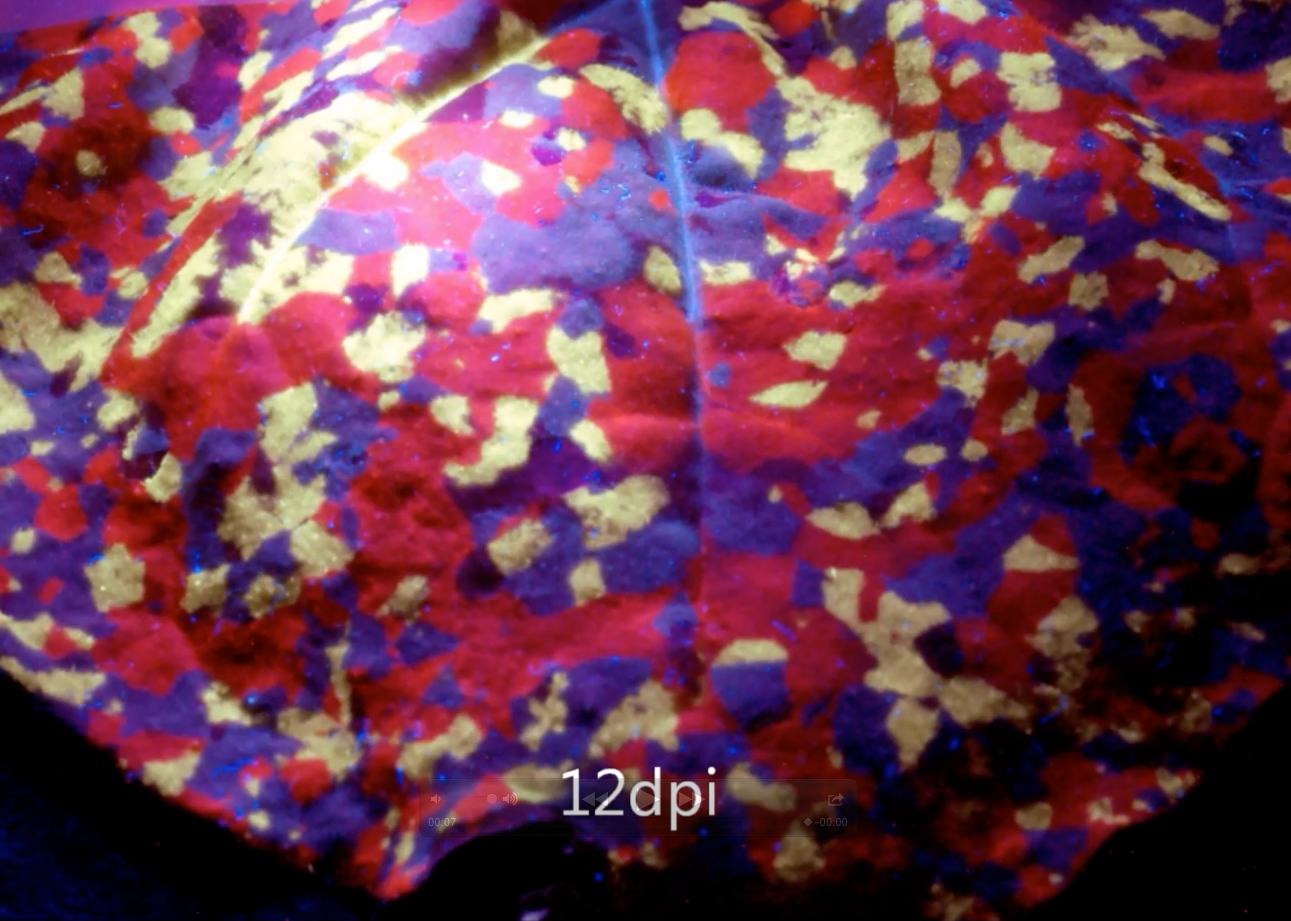
Basically, what this means is that agroinfiltrating a leaf of N benthamiana with a mixture of Agrobacterium tumefaciens clones of deconstructed TMV constructs expressing different fluoresecent proteins, results in “clonal” mosaics of leaf cells, with each individual “tile” expressing a single construct.  This is extremely well shown below, in a screen capture from a MP4 file illustrating progression of the tiling effect from initial stages following agroinfiltration, to several days later.

Expression mosaic in N benthamiana leaf infiltrated with different TMV-based vector constructs

Expression mosaic in N benthamiana leaf infiltrated with different TMV-based vector constructs

This is just a mindblowingly visual proof of superinfection exclusion – and is a phenomenon which could be harnessed for doing things like expressing an Agrobacterium library of an antibody variable region repertoire.

Which would effectively allow a single leaf, or preferably a collection of plants, to express the equivalent of a polyclonal serum, rather than a single monoclonal antibody – something that is pretty much impossible in any other expression system.

Molecular farming is SO cool…B-)

And thanks, Diego!

Hype: “Regulators Discover a Hidden Viral Gene in Commercial GMO Crops!”

2 May, 2013

See on Scoop.itVirology News

by Jonathan Latham and Allison Wilson How should a regulatory agency announce they have discovered something potentially very important about the safety of products they have been approving for over twenty years?

Ed Rybicki‘s insight:

I am rather troubled by this article, because although it is obviously well-researched, it erects a house of cards from some rather flimsy initial premises.

The first is that the gene VI 3′ fragment, included as part of constructs for the 35S promoter, is in fact expressed in ANY of the transgenic plants it appears in: there is NO proof of this.

The second is that this same fragment encodes a polypeptide which has any/all of the functions associated with the full length protein: again, there is NO proof of this, although a throwaway statement is made that hints that it does.

The third is that the polypeptide fragment, IF expressed at all, would have deleterious effects in animals / humans: again, there is no conclusive proof of this at all, despite extensive toxicity trials.

There are other problems with the piece, including the statements:

“In general, viral genes expressed in plants raise both agronomic and human health concerns (reviewed in Latham and Wilson 2008).”

Sorry, this is not GENERALLY taken to be the case at all!

“This is because many viral genes function to disable their host in order to facilitate pathogen invasion. Often, this is achieved by incapacitating specific anti-pathogen defenses. Incorporating such genes could clearly lead to undesirable and unexpected outcomes in agriculture.”

Really? It has been clearly demonstrated that the anti-host function works in very different hosts, meaning this last sentence is true? Where?

“Furthermore, viruses that infect plants are often not that different from viruses that infect humans. For example, sometimes the genes of human and plant viruses are interchangeable, while on other occasions inserting plant viral fragments as transgenes has caused the genetically altered plant to become susceptible to an animal virus (Dasgupta et al. 2001).”

Oooooh…the taurine excreta value is high in this one…while an argument can be made that certain viruses of plants and of animals have a common origin, and are not THAT different in a long-term evolutionary sense, there are NO viruses that have been shown to infect both plants and mammals – NONE.

As for Dasgupta et al., what they showed was that flockhouse virus – an insect virus which replicates in plant cells but does not spread in plants – CAN spread in plants IF these are expressing CERTAIN plant virus-derived movement proteins. Which, I will note, are NOT components of any DNA in released GM plants of which I am aware.

And replication does not = “susceptible”: it means the virus CAN replicate and spread, NOT that it causes disease. I note that there are many viruses which replicate in both an insect and a plant, and others that replicate only in a plant but can be spread by an insect, and yet others which replicate in an insect only but can survive in plants as a reservoir. I note further that there are NO examples which can do any of these things in a plant and a mammal.

So – an interesting article, as I said, but one that is unnecessarily alarmist.

See on independentsciencenews.org

Maize streak virus revisited: 25 years on

20 March, 2013
Maize streak virus: photo from 1978

Maize streak virus: photo by Robert G Milne in Cape Town from 1978

Twenty-five years ago, I wrote a brash, naïve little piece entitled “Maize streak virus virus: an African pathogen come home?” for the South African Journal of Science, laying claim to a virus that we had just started working on – Maize streak virus (MSV) – on the basis that it had first been described from this country in 1901, that it was endemic here, and that it still caused major crop losses.  I did this because research on this and related viruses seemed to have moved almost completely offshore, to Europe and the USA, and

“…the most interesting of the viruses that grow all around us have already been whisked away to foreign laboratories; [that] there they have been cloned, sequenced, and had their most intimate details exposed, far from their native shores”. [Yes, I really did write like that back then].

I asked at that time, if we should

“…perhaps be content to supply foreigners with the (pathogenic) fruits of our fields, and to marvel when the answers come filtering back from abroad?”.

I answered myself by saying that

“…prospects for worthwhile research on African geminiviruses, and on any other indigenous pathogens, are at least as good here as anywhere else.  Our facilities are the equal of those abroad, the necessary expertise is certainly not lacking, and the viruses are on our doorstep.”

I’m a little shocked now that I could have said that then: the paper quotes only three pieces of work from our lab, one of them a Masters dissertation and two papers done by my erstwhile supervisors; we had not yet sequenced any virus, let alone a geminivirus, and all we had was brashness and hope.  Indeed, I went on to say the following:

“We are, incidentally, the only research group with access to molecular biological techniques which is actually working on the virus in its natural environment: this is very useful, as with the virus in all its forms and its vector(s) literally on our doorstep, we can rapidly accumulate, identify and characterize distinct isolates for study here or elsewhere.  We hope there will be a little more of the ‘here’, and a little less of the ‘elsewhere’, from now on”.

I outlined what it was that we ambitiously wanted to do – seeing as we had no money, and only one PhD student at the time – as follows:

“…we now have distinctly different genomic maps of three isolates [!] which differ in serology and symptom expression; we have cloned genomic DNA of several more isolates, and can potentially clone and [restriction] map many more.  With this type of work now solidly established, we intend to investigate other biological variants of MSV – and other native cereal geminiviruses – in maize, cereal grains and other members of the Gramineae.  The aim is to explore the genetic diversity of naturally occurring types of MSV and related viruses, and to identify any isolates that appear unusual in terms of symptom expression, serology or transmission.  These would be interesting to map, and potentially useful in recombinational analyses for the fine mapping of determinants of pathogenicity and host range.” [see later]

The article obviously sank without trace: I can find only three citations to it; two of them mine, and the third from a South African maize breeder.  How the overseas labs that I compared us to must have sniggered…actually, I doubt that happened at all; I am sure none of them ever read it!  In retrospect, we really were regarded as a backwater, and as wannabe geminivirologists; I had at least one collaboration request rebuffed with “we don’t feel our work would be advanced by working with you”, and was told “we’re already working on that, so you shouldn’t bother” for a couple of other proposals.

My hubris was not entirely misplaced, however: we did in fact go on to develop into a world-leading MSV and geminivirus molecular virology laboratory; it just took another fifteen years or so!

So where are we, twenty-five years on from my cheeky article?  Much water has flowed under several bridges; I expanded from molecular virology in the 1990s into plant and vaccine biotechnology in the 2000s, while keeping a geminivirus research group going – and we have published and co-published something like 55 peer-reviewed journal articles and several encyclopaedia and book chapters on MSV and other “African streak viruses” alone, let alone another 14 or so articles on other geminiviruses, with some 1200 citations.  We have papers on geminivirus mapping and sequencing, virus diversity, biogeographical variation, quantitation of symptoms, molecular determinants of pathogenicity, recombination, engineering maize for resistance, the use of two of the viruses as gene expression vectors – and cover pictures for Plant Biotechnology Journal and Journal of Virology.

Cover Illustration: J Virol, October 2011, volume 85, issue 20

Cover Illustration: J Virol, October 2011, volume 85, issue 20

I started with one Honours student in 1986, who went on to do a Masters in 1988; we moved on to having one PhD student in the late 1980s to up four PhD students simultaneously in the mid- to late 1990s, and a postdoc at the same time.  The projects went from simple diversity studies of a few viruses using restriction mapping, through the application of PCR, to partial genome sequencing and studying the molecular biology of infectious clones of the viruses, with a very profitable sideline in phylogenetic analyses; we also moved – with Professor Jennifer Thomson – into a parallel track of plant biotechnology, aimed at engineering resistance to MSV in maize.  We added another track early this century, working on similar ssDNA circoviruses of parrots, using all of the expertise we had accumulated on geminiviruses.  We truly work on “circomics” now – the study of small circular genomes – with its subsets “geminiviromics” and “circoviromics”, with a library of literally hundreds of sequenced MSVs and distinct grass mastreviruses and BFDVs.

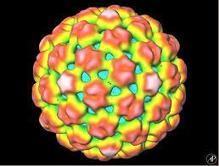
Geminivirus particle: characteristic doubled icosahedron containing a single ssDNA

Geminivirus particle: courtesy of Russell Kightley Media

The geminiviromics group has pretty much got away from me now; the folk I trained as PhD students in the late 1990s and early 2000s were enthused enough with the field that they have gradually usurped my leadership and supervisory role, and made the field their own.  I still maintain an interest in using Bean yellow dwarf mastrevirus (BeYDV) as an expression vector for “biofarming” purposes; I am also maintaining a project on Beak and feather disease circovirus (BFDV) diversity and plant-made vaccines.  I think we pretty much did what we set out to do – including the brave prediction I made about host range and pathogenicity, which led to some very interesting work on recombination and genome modularity, and the successful engineering of pathogen-derived resistance to MSV.

So I owe some thanks, in retrospect: first, to Barbara von Wechmar, who sparked the interest – and provided isolates, leafhoppers, and expertise.  Second, to Bev Clarke and Fiona Tanzer (aka Hughes), who were brave enough to blaze the trail, and clone our first MSVs – and make one infectious, in the case of Fiona.  Thanks to Wendelin “Popeye” Schnippenkoetter, for your single-minded perseverance in mixing and matching genomes; thanks Kenneth Palmer, for showing the way for transient expression assays in maize cells and engineering MSV as a vector.  Thanks Janet Willment, for mapping replication origins in MSV and expanding us into wheat viruses; thanks Jennifer Thomson for the collaboration, and Fiona and Tichaona Mangwende and Dionne Shepherd for breaking us into maize resistance engineering.  Thanks Christine Rey for the collaboration, and Leigh Berrie for your quiet competence in our detour into South African cassava mosaic virus.  Thanks Darrin (aka Darren) Martin and Eric van der Walt, for so brilliantly exploring MSV diversity, evolution and recombination – and Darrin for endless amusement in the lab, as well as for two completely distinct and invaluable software packages, for symptom quantitation and recombination analysis.  In the present generation, thanks to Suhail Rafudeen and our student Rizwan Syed (and Dionne and Darrin as supernumerary supervisors); thanks Aderito Monjane for doing such a ridiculous amount of work for a superlative PhD; thanks Dionne and Marian, for keeping the maize engineering afloat – and thanks also to Arvind Varsani, for retraining himself from a papillomavaccinologist to a circomicist, and for popping up everywhere.

ViroBlogy: 2012 in review

1 February, 2013

So: thank you, anyone who clicked in, and regular visitors.  You make it worthwhile!!

The WordPress.com stats helper monkeys prepared a 2012 annual report for this blog.

Here’s an excerpt:

4,329 films were submitted to the 2012 Cannes Film Festival. This blog had 33,000 views in 2012. If each view were a film, this blog would power 8 Film Festivals

Click here to see the complete report.

Medicago Announces 2012 Second Quarter Financial Results: PR Newswire

15 August, 2012

See on Scoop.itVirology News

Medicago Announces 2012 Second Quarter Financial Results PR Newswire QUEBEC CITY, Aug. 14, 2012 QUEBEC CITY , Aug. 14, 2012 /PRNewswire/ – Medicago Inc.

“Subsequent to the second quarter:

Announced the successful completion of a key milestone under an agreement with the Defense Advanced Research Projects Agency (DARPA). The milestone was the production of at least 10 million doses of H1N1 VLP influenza vaccine candidate in one month (the “rapid fire test”). The rapid fire test was conducted at Medicago’s facility in Durham, North Carolina. As part of the rapid fire test, production of the H1N1 VLP influenza vaccine candidate began on March 25th, 2012, and was completed in 30 days on April 24th, 2012. The production lots were then tested by a third party laboratory to confirm both the immunogenicity of the vaccine candidate and the number of doses produced. Testing confirmed that a single dose of the H1N1 VLP influenza vaccine candidate induced protective levels of neutralizing antibodies in an animal model. The production of significantly more than 10 million doses, as defined by the testing conditions, were confirmed.”

This is a big, big deal – because they did this via transient epxression in plants, thus proving pretty much beyond doubt that this is now a serious vaccine manufacturing technology.

See on money.msn.com

The man with the golden banana

18 July, 2012

See on Scoop.itVirology News

“In Uganda, where food insecurity has been the order of the day, enterprising scientists have taken biotechnology a step further by producing bananas that are rich in vitamin A and iron and that have the colour of carrots once peeled.

During a media tour at the National Agricultural Research Laboratories in Kampala this week, scientists said they aimed to ensure that bananas, a staple food in Uganda, were rich in vitamin A and iron and resistant to nematodes.”


And behind that effort were two things: the Bill and Melinda Gates Foundation, and an Australian scientist named James L Dale.  I photographed him in his office at the Queensland University of Technology in 2010, when he had literally just opened the picture file associated with latest results being reported from his research crew – the banana picture in the background, with the golden vitamin A-containing version on top.

See on www.iol.co.za