As molecular farmers, we were much impressed last year by a technology developed by the folk at the Fraunhofer IME in Aachen: this is “METHOD FOR THE GENERATION AND CULTIVATION OF A PLANT CELL PACK“, with Thomas Rademacher as sole inventor on the patent application. Basically, this involves
- making a “cookie” or cell pack with cultured plant cells, by suction of a suspension onto a membrane
- drizzling recombinant Agrobacterium tumefaciens onto the cookie, then sucking away excess fluid
- incubating the cell cookie in a humid environment for a few days, until the desired level of protein expression has been reached
There are all sorts of things one could dream up for the application of this technology, given that one can make cookies of all sorts of depths and widths, in everything from spin columns to multiwell plates – and high-throughput screening of expression constructs comes to mind immediately.
Now fortunately, Inga Hitzeroth of our Biopharming Research Unit here at UCT (the BRU) has a National Research Foundation-administered bilateral grant with the folk at the Fraunhofer IME, which has meant we have money for joint workshops and the like – so we are having a hands-on Workshop on “Plant Cell Packs for Transient Expression: Innovating the Field of Molecular Biopharming” affiliated to our “Virology Africa 2015” conference next week. We plan to develop an illustrated manual along with a full suite of technical tips after the Workshop.
And as part of which, one has of course to feed and entertain the participants – hence our expedition to The Spice Route wine farm complex yesterday. Hard work, this science…B-)
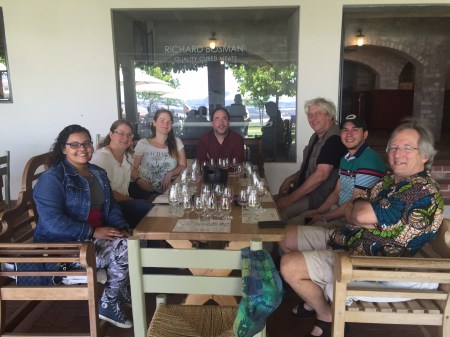
The BRU-IME Cookie Workshop team: from left; Romana Yanez (BRU), Tanja Holland, Susanne Bethke, Markus Sack, Juergen Drossard, Gueven Edgu (all IME), Ed Rybicki (BRU)







 ViroBlogy
This is quite a big deal: there are very few cereal-infecting geminiviruses described from Eurasia, let alone symptomatic maize-infecting mastreviruses whose closest relatives come from Isle de la Reunion in the South Indian Ocean and Nigeria.
Mastreviruses are not seed-transmitted, so how did it get there? What is transmitting it? Is it possibly the elusive Bajra streak virus from India, that was described but never sequenced?
The authors say, in their conclusion:
“To date, other than MSV, MSRV is the only mastrevirus species that has ever been sampled from maize having maize streak disease symptoms. Interestingly, MSRV was also detected from wild grasses such as Setaria barbata and Rottboellia sp. in Nigeria, suggesting expanded host and geographical ranges for this virus [5]. This first report of MSRV isolates in China reveals that this virus is likely to possess a far greater diversity and distribution than has been appreciated. Because 10 of 22 samples from Yunnan Province, China, were infected with MSRV-YN, for an infection rate of 45.5 %, further work on epidemics of MSRV-YN in China is needed.”
Absolutely! Maize streak, whether caused by MSV or potentially by MRSV, can be a devastating disease – and if this is expanding out of endeminicty in grasses thanks to leafhopper population expansion, or climate change, things could get interesting int hat part of the world.