Archive for the ‘Viruses’ Category

Hype: “Regulators Discover a Hidden Viral Gene in Commercial GMO Crops!”

2 May, 2013

See on Scoop.itVirology News

by Jonathan Latham and Allison Wilson How should a regulatory agency announce they have discovered something potentially very important about the safety of products they have been approving for over twenty years?

Ed Rybicki‘s insight:

I am rather troubled by this article, because although it is obviously well-researched, it erects a house of cards from some rather flimsy initial premises.

The first is that the gene VI 3′ fragment, included as part of constructs for the 35S promoter, is in fact expressed in ANY of the transgenic plants it appears in: there is NO proof of this.

The second is that this same fragment encodes a polypeptide which has any/all of the functions associated with the full length protein: again, there is NO proof of this, although a throwaway statement is made that hints that it does.

The third is that the polypeptide fragment, IF expressed at all, would have deleterious effects in animals / humans: again, there is no conclusive proof of this at all, despite extensive toxicity trials.

There are other problems with the piece, including the statements:

“In general, viral genes expressed in plants raise both agronomic and human health concerns (reviewed in Latham and Wilson 2008).”

Sorry, this is not GENERALLY taken to be the case at all!

“This is because many viral genes function to disable their host in order to facilitate pathogen invasion. Often, this is achieved by incapacitating specific anti-pathogen defenses. Incorporating such genes could clearly lead to undesirable and unexpected outcomes in agriculture.”

Really? It has been clearly demonstrated that the anti-host function works in very different hosts, meaning this last sentence is true? Where?

“Furthermore, viruses that infect plants are often not that different from viruses that infect humans. For example, sometimes the genes of human and plant viruses are interchangeable, while on other occasions inserting plant viral fragments as transgenes has caused the genetically altered plant to become susceptible to an animal virus (Dasgupta et al. 2001).”

Oooooh…the taurine excreta value is high in this one…while an argument can be made that certain viruses of plants and of animals have a common origin, and are not THAT different in a long-term evolutionary sense, there are NO viruses that have been shown to infect both plants and mammals – NONE.

As for Dasgupta et al., what they showed was that flockhouse virus – an insect virus which replicates in plant cells but does not spread in plants – CAN spread in plants IF these are expressing CERTAIN plant virus-derived movement proteins. Which, I will note, are NOT components of any DNA in released GM plants of which I am aware.

And replication does not = “susceptible”: it means the virus CAN replicate and spread, NOT that it causes disease. I note that there are many viruses which replicate in both an insect and a plant, and others that replicate only in a plant but can be spread by an insect, and yet others which replicate in an insect only but can survive in plants as a reservoir. I note further that there are NO examples which can do any of these things in a plant and a mammal.

So – an interesting article, as I said, but one that is unnecessarily alarmist.

See on independentsciencenews.org
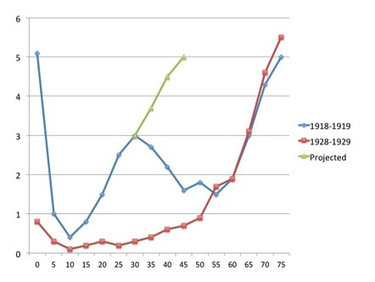
A Brief History of Influenza

5 April, 2013

See on Scoop.itVirology News

I am TRYING to write an eBook on influenza, which stubbornly refuses to be finished – as part of a sabbatical project, which finished in December 2010.  So, like my History of Virology, I am triall…

Ed Rybicki‘s insight:

I will reprise this post, given a considerable recent spike in interest in it as the new H7N9 Shanghai bird flu starts.  Hopefully to fizzle out, but you never know….

Incidentally, I have an almost-finished iBook (for iPad) on influenza: the first five respondents to this post can trial it for free!

See on rybicki.wordpress.com

PLOS Pathogens: Environmental Predictors of Seasonal Influenza Epidemics across Temperate and Tropical Climates

18 March, 2013

See on Scoop.itVirology News

Human influenza infections exhibit a strong seasonal cycle in temperate regions. Recent laboratory and epidemiological evidence suggests that low specific humidity conditions facilitate the airborne survival and transmission of the influenza virus in temperate regions, resulting in annual winter epidemics. However, this relationship is unlikely to account for the epidemiology of influenza in tropical and subtropical regions where epidemics often occur during the rainy season or transmit year-round without a well-defined season. We assessed the role of specific humidity and other local climatic variables on influenza virus seasonality by modeling epidemiological and climatic information from 78 study sites sampled globally. We substantiated that there are two types of environmental conditions associated with seasonal influenza epidemics: “cold-dry” and “humid-rainy”. For sites where monthly average specific humidity or temperature decreases below thresholds of approximately 11–12 g/kg and 18–21°C during the year, influenza activity peaks during the cold-dry season (i.e., winter) when specific humidity and temperature are at minimal levels. For sites where specific humidity and temperature do not decrease below these thresholds, seasonal influenza activity is more likely to peak in months when average precipitation totals are maximal and greater than 150 mm per month. These findings provide a simple climate-based model rooted in empirical data that accounts for the diversity of seasonal influenza patterns observed across temperate, subtropical and tropical climates.

Ed Rybicki‘s insight:

This is really quite a big deal: I blogged recently on the first paper that explored this notion in detail; here we see that paper vindicated, and new data presented.


It is interesting that the virus should have evolved to be spread in this way: in drier cold air in temperate climates, and in warm wet air in more tropical climes.  It also very nicely explains seasonality in influenza transmission.


Now, let’s do something ABOUT it!

See on www.plospathogens.org

A novel coronavirus capable of lethal human infections

3 March, 2013

See on Scoop.itIIDMM News

In September 2012, a novel coronavirus was isolated from a patient in Saudi Arabia who had died of an acute respiratory illness and renal failure.The clinical presentation was reminiscent of the outbreak caused by the SARS-coronavirus (SARS-CoV) exactly ten years ago that resulted in over 8000 cases. Sequence analysis of the new virus revealed that it was indeed a member of the same genus as SARS-CoV. By mid-February 2013, 12 laboratory-confirmed cases had been reported with 6 fatalities. The first 9 cases were in individuals resident in the Middle East, while the most recent 3 cases were in family members resident in the UK. The index case in the UK family cluster had travel history to Pakistan and Saudi Arabia. Although the current evidence suggests that this virus is not highly transmissible among humans, there is a real danger that it may spread to other parts of the world. Here, a brief review of the events is provided to summarize the rapidly emerging picture of this new virus.

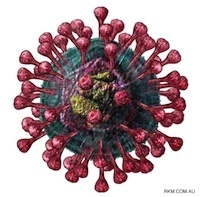
Coronavirus graphic courtesy of Russell Kightley Media

Ed Rybicki‘s insight:

It is truly amazing how fast things can be done these days: it was only in SEPTEMBER that the new virus was isolated; the latest fatality was literally in the last couple of weeks.  It remains to be seen whether or not it will spread – given its apparent lethality, we can only hope it does not!

See on www.virologyj.com

ViroBlogy: 2012 in review

1 February, 2013

So: thank you, anyone who clicked in, and regular visitors.  You make it worthwhile!!

The WordPress.com stats helper monkeys prepared a 2012 annual report for this blog.

Here’s an excerpt:

4,329 films were submitted to the 2012 Cannes Film Festival. This blog had 33,000 views in 2012. If each view were a film, this blog would power 8 Film Festivals

Click here to see the complete report.

CCHFV in South Africa

1 February, 2013

I am indebted to the National Institute for Communicable Diseases (NICD) in Johannesburg for their very informative newsletter, from which I culled this.

I would also like to very sincerely congratulate Professor Barry Schoub, a long-time former Director of the NICD, on his  African Society for Laboratory Medicine (ASLM) Lifetime Achievement Award!  Very well deserved.

Crimean-Congo haemorrhagic fever

Two cases of Crimean-Congo haemorrhagic fever (CCHF)  acquired in South Africa have been laboratory confirmed  in January 2013.

On 1 January 2013, a 31-year-old male working as a  game warden on private game ranch near Jagersfontein  (Free State Province) presented with clinical features  suggestive of CCHF. The patient did not report any tick  bites or direct exposure to unprocessed meat or  slaughtering of animals. The Centre for Emerging and  Zoonotic Diseases of the NICD/NHLS confirmed infection  with CCHF virus by PCR and serology testing.

A second case of CCHF was laboratory confirmed on 12  January 2013 in a 44-year-old male hospitalised in  Bloemfontein, Free State Province. He had been on a  farm in Pomfret, North West Province (situated ±5 km  from the border with Botswana), where he was bitten by  a tick. Three days later he developed symptoms, and  presented with fever, rash, conjunctivitis and pharyngitis.  No laboratory-confirmed cases were identified in 2011- 2012.

Human CCHF cases have been reported annually  from South Africa since 1981, when it was first  recognised in the country; between 0 and 20 cases of  CCHF are diagnosed each year. Through nearly thirty  years of passive surveillance, a total of 187 cases has  been laboratory confirmed. Although cases have been  reported from all of the nine provinces, more than half of  the cases originate from the semi-arid areas of Northern  Cape Province (31.5% of cases) and Free State Province  (23% of cases).

CCHF infection is generally asymptomatic in many species  of wildlife (including antelope) and livestock animals  (including cattle, sheep, goats, hares and ostriches).  Humans  become  infected  sporadically  by  ticks,  particularly  Hyalomma ticks, which are both reservoirs  and vectors for CCHF virus. Other modes of transmission  include direct contact with blood/tissues of infected  animals, and in the case of healthcare workers, through  direct contact with the blood/tissue of infected patients;  nosocomial outbreaks are well described and have been  associated with high mortality rates. Disease may be  severe in people, with case-fatality rates reported as 3 –  30% across various studies.

Detailed information for healthcare workers regarding  CCHF can be found on the NICD website  http:// http://www.nicd.ac.za/ (see General Public FAQ, or Health Workers FAQs here).

Together, we can do more….

17 October, 2012

It gives me great delight to pass on some news about an old friend: I have co-authored two papers with the Pappus (husband and wife), and have maintained a long association with Hanu as a favoured referee for Archives of Virology; he has gone on to achieve some distinction at Washington State University – and recently to have made a fundamental discovery in plant virology.  I thank Eric Sorenson of the Washington State Magazine for sending me this.

Viral alliances overcome plant defenses, according to newly published WSU research

Contact:
Hanu Pappu, professor and chair of plant pathology, Washington State University, 509-335-3752, hrp@wsu.edu

PULLMAN, Wash. – Washington State University researchers have found that viruses will join forces to overcome a plant’s defenses and cause more severe infections.

“These findings have important implications in our ability to control these viruses,” says Hanu Pappu, Sam Smith Distinguished Professor of Plant Virology and chair of WSU’s Department of Plant Pathology. “Mixed infections are quite common in the field, and now we know that viruses in these mixed infections are helping each other at the genetic level to overcome host defenses and possibly lead to the generation of new viruses.”

Pappu publishes his findings in the latest issue of the journal PLOS ONE. Joining him are Ph.D. student Sudeep Bag and Neena Mitter, associate professor at Australia’s University of Queensland.

The researchers focused on iris yellow spot virus and tomato spotted wilt virus after Bag discovered that, when they infect the same plant, they helped each other overcome a plant’s defense response. With Mitter’s help and sophisticated molecular techniques, Bag found both viruses dramatically changed their genetic expression, breaking down the plant’s defenses and leading to more severe disease.

Bag also found that genes from the tomato spotted wilt virus seemed to “aid and abet” iris yellow spot virus as it spread throughout the plant and caused more disease.

Growers should take this phenomenon into account, says Pappu, with broader management tactics that target more than one virus and possible variations.

The research was funded in part by the Specialty Crops Research Initiative of the National Institute of Food and Agriculture, a branch of the U.S. Department of Agriculture.

The paper, “Complementation between Two Tospoviruses Facilitates the Systemic Movement of a Plant Virus Silencing Suppressor in an Otherwise Restrictive Host,” can be found athttp://dx.plos.org/10.1371/journal.pone.0044803.

PS: the Pappus cook REALLY good food – as I discovered in Florida, at Chuck Niblett’s house, back in 1996 or so….

White death: A diabolical pact between an insect and two viruses

22 August, 2012

See on Scoop.itVirology News

This is actually an article in The Economist from 2007 – forwarded to me by a Professor of Philosophy, as it happens, and which has mouldered on my desk lo, these past five years.  Thanks David Benatar!

“Whiteflies are pests in every continent that they are found in—and they are found in every continent except Antarctica. They cause damage directly, by consuming plant juices, and indirectly, by spreading viral diseases. But Liu Shusheng, of Zhejiang University, in Hangzhou, and his colleagues have found a strain of the species that delivers a double whammy. Not only does it spread diseases, but it is also vastly more successful when it lives on plants infected with the diseases in question [tomato yellow leafcurl and tobacco curly shoot begomoviruses, both ssDNA geminiviruses]  than when it subsists on healthy plants.”

This is a fascinating example of just why it is that certain vector-virus-host combinations can lead to success of the vector, and increased spread of the virus.  Basically,

“…type B insects lived six times longer on infected plants than uninfected ones, and their population per infected plant might rise as high as 13 times that on an uninfected one”

This means that geminivirus infection of host plants actually gives a survival advantage to the insects which transmit them.  Simple if unfortunate!!

See on www.economist.com

Papillomavirus and HIV: a nasty combination

17 August, 2012

I started working on human papillomaviruses (HPVs) some 22 years ago, back at the dawn of PCR: I helped my then-new major collaborator (and wife of 2 years), Anna-Lise Williamson, design some degenerate primers for amplifying as wide a range as possible of high-risk HPVs from cervical biopsy samples.  These worked pretty well, and are still highly useful for the purpose, despite the many novel types found since then.

We went on to do another two papers together on looking at variation and typing of HPVs via PCR and and sequencing, then took a deviation into making candidate vaccines for HPV and HIV.  Anna-Lise carried on with surveilling for HPVs, however, and has ended up with a WHO Regional Laboratory for HPV work.  She also started working on HPV infections in HIV-infected women: work on a study cohort showed that while HIV-free women usually had only 1 HPV type, the 109 HIV-infected often were infected with multiple HPV types.  In association with Anna Salimo in my lab, we started a deep sequencing pilot study on the sample with the most HPVs.  This turned this into a regional study, with help on assembling and interpreting sequence data from Prof Johan Burger’s lab at the University of Stellenbosch, and it was revelatory: while a commercial kit could detect 12 HPV types in one sample, next-gen sequencing found 16.

We went on to do PCR on all 109 samples in the cohort with specific primers for the types not found by the kit, and showed prevalences up to 15% in the HIV-infected group.  This is an important result, because otherwise-innocuous HPV types that do not show up in normal women, may well be associated with disease in the HIV-infected – and will probably not be protected against by the current HPV vaccines.

We continue to do work on these samples, and it will be very interesting to see what the new methodologies show up.  Especially as sequencing becomes cheaper, and we can do more samples…!  Meantime, we have published the pilot study:

Next-generation sequencing of cervical DNA detects human papillomavirus types not detected by commercial kits

Tracy L MeiringAnna T SalimoBeatrix CoetzeeHans J MareeJennifer MoodleyInga I HitzerothMichael-John FreeboroughEd P Rybicki and Anna-Lise Williamson

Virology Journal 2012, 9:164 doi:10.1186/1743-422X-9-164

Published: 16 August 2012

Abstract (provisional)

Background

Human papillomavirus (HPV) is the aetiological agent for cervical cancer and genital warts. Concurrent HPV and HIV infection in the South African population is high. HIV positive (+) women are often infected with multiple, rare and undetermined HPV types. Data on HPV incidence and genotype distribution are based on commercial HPV detection kits, but these kits may not detect all HPV types in HIV + women. The objectives of this study were to (i) identify the HPV types not detected by commercial genotyping kits present in a cervical specimen from an HIV positive South African woman using next generation sequencing, and (ii) determine if these types were prevalent in a cohort of HIV-infected South African women.

Methods

Total DNA was isolated from 109 cervical specimens from South African HIV + women. A specimen within this cohort representing a complex multiple HPV infection, with 12 HPV genotypes detected by the Roche Linear Array HPV genotyping (LA) kit, was selected for next generation sequencing analysis. All HPV types present in this cervical specimen were identified by Illumina sequencing of the extracted DNA following rolling circle amplification. The prevalence of the HPV types identified by sequencing, but not included in the Roche LA, was then determined in the 109 HIV positive South African women by type-specific PCR.

Results

Illumina sequencing identified a total of 16 HPV genotypes in the selected specimen, with four genotypes (HPV-30, 74, 86 and 90) not included in the commercial kit. The prevalence’s of HPV-30, 74, 86 and 90 in 109 HIV positive South African women were found to be 14.6 %, 12.8 %, 4.6 % and 8.3 % respectively.

Conclusions

Our results indicate that there are HPV types, with substantial prevalence, in HIV positive women not being detected in molecular epidemiology studies using commercial kits. The significance of these types in relation to cervical disease remains to be investigated.

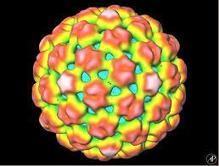
I thank Russell Kightley Media for use of the HPV and cervical cancer graphic.

Hidden evolutionary complexity of Nucleo-Cytoplasmic Large DNA viruses of eukaryotes

15 August, 2012

See on Scoop.itVirology and Bioinformatics from Virology.ca

The Nucleo-Cytoplasmic Large DNA Viruses (NCLDV) constitute an apparently monophyletic group that consists of at least 6 families of viruses infecting a broad variety of eukaryotic hosts. A comprehensive genome comparison and maximum-likelihood reconstruction of the NCLDV evolution revealed a set of approximately 50 conserved, core genes that could be mapped to the genome of the common ancestor of this class of eukaryotic viruses.

Results
We performed a detailed phylogenetic analysis of these core NCLDV genes and applied the constrained tree approach to show that the majority of the core genes are unlikely to be monophyletic. Several of the core genes have been independently acquired from different sources by different NCLDV lineages whereas for the majority of these genes displacement by homologs from cellular organisms in one or more groups of the NCLDV was demonstrated.

Conclusions
A detailed study of the evolution of the genomic core of the NCLDV reveals substantial complexity and diversity of evolutionary scenarios that was largely unsuspected previously. The phylogenetic coherence between the core genes is sufficient to validate the hypothesis on the evolution of all NCLDV from a common ancestral virus although the set of ancestral genes might be smaller than previously inferred from patterns of gene presence-absence.


Interesting stuff!  Strengthens my contention that  “…a virus is an infectious acellular entity composed of compatible genomic components derived from a pool of genetic elements” – https://rybicki.wordpress.com/2012/07/10/a-feeling-for-the-molechism-revisited/

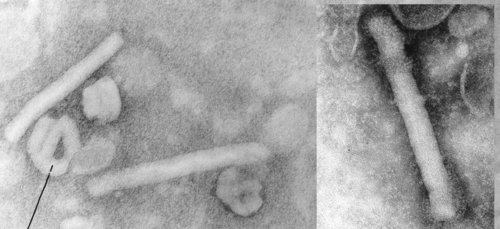
Baculovirus image from my collection

See on www.virologyj.com