I do love it when a paper is published that could have been done pretty much any time in the last 40 years – and with one of my favourite viruses, that I played with a LOT back there before 1980.
Ultracentrifugation, pH meters, ionic strength determinations, EM…all tried and true, and used 40+ years ago. OK, they also used cloned BMV RNA 1 cDNA, and did 3-D image reconstruction from EMs, but hey, they needn’t have done that! Nice, straightforward physicochemical studies, on a well-characterised virus, with good, simple conclusions.
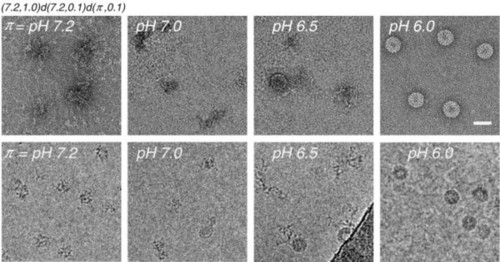
Namely, that assembly of the virus is NOT just a simple mix-CP-and-RNA-and-it-will-happen, but that it depends upon both pH, for modulating ionic interactions,and ionic strength for modulating ionic interactions AND the "hydrophobic effect", as we used to know it.
While their conclusions are relevant for assembly of heat- and nuclease-resistant nano particles in vitro, I wonder if they are physiologically relevant: if "correct" assembly depends upon first, turning on CP-RNA attraction (ionic strength shift), and second, turning on CP-CP attraction (pH shift) – where in the cell does that happen?
In their own words, "It is generally accepted that the cytoplasm of plant cells is maintained near neutral pH with ionic strength of approximately 0.1 M. Our in vitro results show that these conditions are insufficient for nucleocapsid formation in the absence of cellular host factors."
Yeeee-ee-eesssss…precisely. What happens in the cell? The answer could lie in the one thing they don’t report, but that some of the heroes of my distant youth – people like JB Bancroft and Thom Hohn, both quoted (from 1970 and 1969 respectively) in this paper, DID do. Namely, investigate what happens at different CP and RNA concentrations, at constant pH and ionic strength.
You see, it was shown 30+ years ago – and I have been lecturing on it since then – that CP and RNA for viruses like BMV / CCMV and MS2 form different complexes with their cognate partners at different molecular ratios. That is, at low CP:RNA ratios, a high-affinity complex is formed, which is basically a ribonucleoprotein complex without structure. Increasing the CP:RNA ratio for both MS2 and CCMV, as I recall (maybe Dick Verduin was involved with CCMV), results in further lower-affinity association of CP with both RNA and already-bound CP – which acts as a nucleation complex – to result in full capsid assembly.
I note that the process in both cases was shown to be specific, for low CP:RNA ratios: that is, it was cognate CP and RNA doing the high affinity nucleation complex formation.
And these guys deliberately used a heterologous RNA…albeit one from a related virus, but still: what would have happened if they’d used CCMV RNA?
Still – great paper, taking me back to when I wrote an essay on "Assembly of Spherical Plant Viruses" in my Honours year in 1977, quoting quite a few of the same references these folk did. Ah, simpler times…B-)