Archive for the ‘HIV’ Category

No hypothetical vaccines please!

14 January, 2011

A new editorial in Elsevier’s Vaccine, by Gregory Poland and JR Hollingworth, gives one much food for thought…especially if one and one’s associates are engaged in vaccinology, however quixotic that quest may be.

Especially quixotic when certain editors take 11 months not to publish one’s HIV vaccine paper, but that’s a story for another day…!

The article is entitled “From Science II to Vaccinology II: A new epistemology“, and is a thoughtful and quite intellectually challenging piece of work.

I have previously indicated that I am not a fan of hypothesis-driven science, however well entrenched it is in the psyches of most who practice it – in fact, I have gone as far as claiming elsewhere (thanks, Alan C!):

“Profound Insight No. 1: hypotheses are the refuge of the linear-thinking.

…I am quite serious in disliking hypothesis-driven science: I think it is a irredeemably reductionist approach, which does not easily allow for Big Picture overviews, and which closes out many promising avenues of investigation or even of thought. And I teach people how to formulate them so they can get grants and publications in later life, but I still think HDS is a tyranny that should be actively subverted wherever possible.”

And here we have two eminent scientists agreeing with me!  Not that they know that they are (or care, I am sure), and nor is it important – for what they have done is write a tight and carefully reasoned justification for moving away from the classical approach in vaccinology, as the complexities of the immune system and responses to pathogens and vaccines render the reductionist approach inadequate to address the problems at hand, and especially those presented by rapidly-mutating viruses.

This really is quite a profound suggestion for change, as the world of vaccinology is notoriously conservative, and it is really difficult to get people even to discuss only mildly paradigm-nudging concepts – oh, like cellular responses possibly being as important for protection against papillomaviruses as sterilising antibody responses? – let alone publish them.

Their final paragraph is especially apposite:

As we move into the world of Vaccinology II, or the “second golden age of vaccinology”, success will come only with the willingness to minimize the current Newtonian framework of thinking, and to adapt a new framework (Science II) that requires novel advanced bioinformatic and chaos theory-like analytic approaches, as well as multi-level systems biology approaches to studying currently unpredictable and uncertain self-organizing complex systems such as host immune response generation. Such work is difficult, expensive, challenging, and absolutely necessary if major advances are to occur in vaccine biology generally, and vaccine immunogenetics specifically.

This is fundamental stuff: I sincerely hope people in the field of HIV vaccines in particular give it some heed, as there the funding paradigm has actually shifted back towards requiring that everything be “hypothesis-driven”  – and I think this is a retrograde step, when the funding agencies (NIH, Gates Foundation) need to take more, rather than fewer risks, if we are to make any meaningful progress in our lifetimes.

While I am also not a fan of “systems biology” – because I think it is a catch-all term for what amounts to multidisciplinary research, and many of its proponents are brash snake-oil salesmen – modern vaccinology  really is a fertile field to plough using the new approaches.  Poland and Hollingworth put it well:

Similarly, as applied to understanding host variations as causative of inter-individual heterogeneity in immune responses  to such viruses, a Newtonian–Descartian view is entirely inadequate….

Rather than general principles, Vaccinology II and the new biology  is increasingly informed by principles such as pattern recognition, systems with non-linear qualities, and complex networks—often  focused at the individual, rather than population, level.

Amen to that.  Now, to get some money to do that…!!  B-)

HIV: catching it from all sides

10 December, 2010

Back when I started teaching virology – 1981 it was, so I’ve been doing it for 30 years come January! – there were precious few agents that did anything to viruses, apart from antibodies and that wonderful new and precious stuff called interferon.  Oh, and nucleoside analogues like adenine arabinoside (araA), ribavirin, and the legendary amantadine and rimantidine – which pretty much only covered herpes- and influenza viruses, according to Fenner and White’s Medical Virology of 1986.

And then along came HIV….and everything changed.

All of a sudden, we have an embarrassment of riches – against retroviruses, anyway.  Consider the following:

  • Nucleoside and nucleotide reverse transcriptase inhibitors (NRTI) inhibit reverse transcription
  • Non-nucleoside reverse transcriptase inhibitors (NNRTI)
  • Protease inhibitors (PIs) target viral assembly
  • Integrase inhibitors inhibit integration of viral DNA into the DNA of the infected cell
  • Entry inhibitors (or fusion inhibitors) interfere with binding, fusion and entry of HIV-1 to the host cell by blocking one of several targets.
  • Maturation inhibitors inhibit the last step in gag processing in which the viral capsid polyprotein is cleaved

Of course the above serve to vindicate most thoroughly my “Entrance, Entertainment and Exit” mantra / mnemonic for virus replication, in that they block entrance, interfere with entertainment (replication), and mess with exit too.

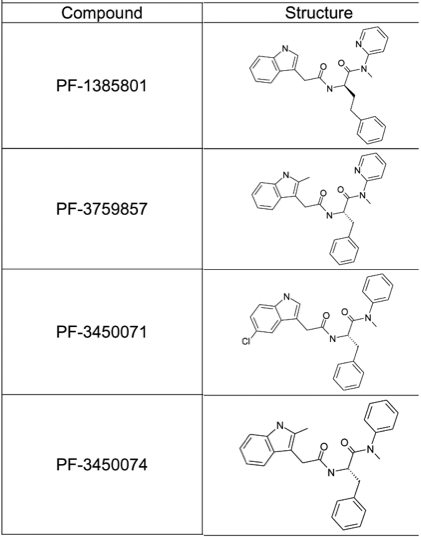
But wait, there’s more: a brand-new paper in PLoS Pathogens describes the wide-spectrum anti HIV-1 and -2 activity of a new class of small molecule antiretroviral compounds.  These directly target HIV-1 capsid (CA; p24 protein) via binding into a “pocket” in the N-terminus, and thereby interfere with both assembly and uncoating of virions.

HIV Capsid is a Tractable Target for Small Molecule Therapeutic Intervention.
Blair WS, Pickford C, Irving SL, Brown DG, Anderson M, et al. (2010)
PLoS Pathog 6(12): e1001220. doi:10.1371/journal.ppat.1001220   Published December 9, 2010

Abstract:
Despite a high current standard of care in antiretroviral therapy for HIV, multidrug-resistant strains continue to emerge, underscoring the need for additional novel mechanism inhibitors that will offer expanded therapeutic options in the clinic. We report a new class of small molecule antiretroviral compounds that directly target HIV-1 capsid (CA) via a novel mechanism of action. The compounds exhibit potent antiviral activity against HIV-1 laboratory strains, clinical isolates, and HIV-2, and inhibit both early and late events in the viral replication cycle. We present mechanistic studies indicating that these early and late activities result from the compound affecting viral uncoating and assembly, respectively. We show that amino acid substitutions in the N-terminal domain of HIV-1 CA are sufficient to confer resistance to this class of compounds, identifying CA as the target in infected cells. A high-resolution co-crystal structure of the compound bound to HIV-1 CA reveals a novel binding pocket in the N-terminal domain of the protein. Our data demonstrate that broad-spectrum antiviral activity can be achieved by targeting this new binding site and reveal HIV CA as a tractable drug target for HIV therapy.

So, yet another target in HIV for chemotherapeutic agents – but what, exactly, are these new magic bullets?

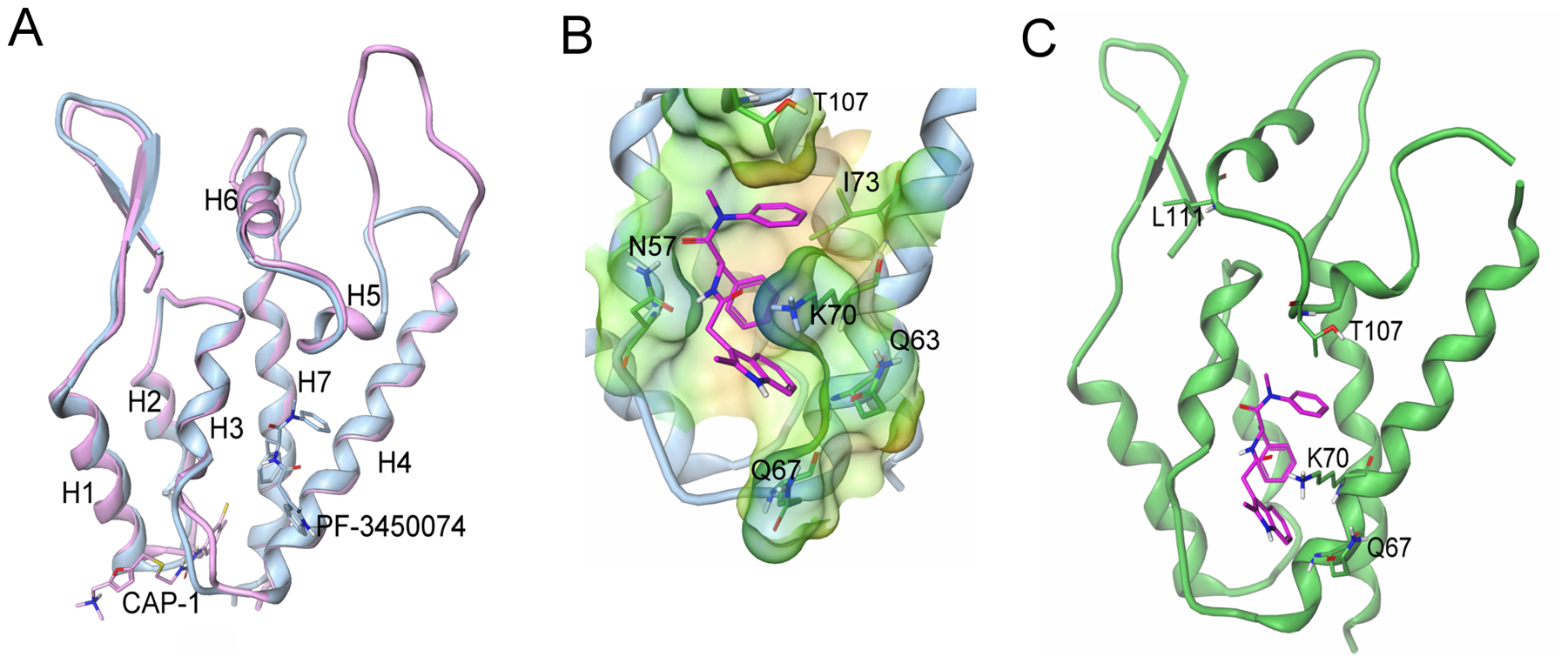
And in Figure 5 of the original paper, you can see what it is that they do:

Figure 5: Structure of the novel inhibitor binding site and context in the NTD

a) Overlays of capsid structures with PF-3450074 in blue and CAP-1 in pink bound to capsid N-terminal domain; b) Close up view of PF-3450074 site (binding site residues labelled in black, R1-3 sub-pockets labelled in purple)…. c) Location of resistant mutations (purple) in relation to PF-3450074 capsid binding site.

The authors conclude their article with this:

The broad spectrum activity of this series [of drugs] is particularly exciting and highlights this novel mechanism [binding the CA protein] as a significant therapeutic opportunity.

Definitely not an over-stated conclusion!  And nicely rounding out a recent series of HIV-combatting articles and developments covered here recently.  And let me also refer you here to AJ Cann’s most recent post, on HIV entry – which, surprisingly, is still not a nailed-down and simple model.  And which I discovered literally while writing this, so seriously hot off the press.

Prophylactically yours….

7 December, 2010

It’s not often we have something to report on locally – I rely on Alan Cann to do that…B-) – but I am very pleased to be able to do so now.

Hot on the heels of another South African success in the fight against HIV and AIDS comes the news (from the UCT Monday Paper) that:

Prophylactic antiretrovirals could check HIV infection

Assoc Prof Linda-Gail BekkerBeing there: UCT’s Assoc Prof Linda-Gail Bekker led the South African component of the six-country study on the prophylactic use of an antiretroviral tablet.

It’s a long way from being the final word in HIV prevention, but a major study involving UCT researchers and published in the New England Journal of Medicine reveals that the daily use of an antiretroviral tablet as a prophylactic could curb infection among those at high risk by nearly 44%.

The findings are based on an HIV-prevention trial conducted at 11 international sites in six countries (including the Desmond Tutu HIV Foundation [DTHF], associated with UCT’s Faculty of Health Sciences), from June 2007 to May 2010. The study, named the Pre-Exposure Prophylaxis Initiative (iPrEx), looked at the prophylactic use – in other words, for people not infected with HIV – of a tablet that contains two widely-used HIV medications, emtricitabine and tenofovir (FTC/TDF).

Results showed that high-risk individuals – men and transgender women who have sex with men – who took the tablet experienced an average of 43.8% fewer HIV infections than those who received a placebo. In all, 64 HIV infections were recorded among the 1 248 study participants who received a placebo pill, while 36 HIV infections were recorded among the 1 251 participants who received the study drug.

The iPrEx study found that this pre-exposure prophylaxis (PrEP) was more effective among those who reported taking the pill more regularly. Among participants who used the tablet on 50% or more of days, as measured by pill counts, bottle counts and self-reports, risk of HIV infection fell by 50.2%; while among those who used the pill on 90% or more of days, as determined by the same measures, the PrEP pill reduced infection risk by 72.8%.

“I think this is a very significant study in that what we have here is the first proof of concept that taking an antiretroviral prophylactically – in other words, taking it before exposure to HIV – would actually prevent HIV infection,” says UCT’s Associate Professor Linda-Gail Bekker, deputy director of the Desmond Tutu HIV Centre.

tablets (brand-named Truvada)As the tablets (brand-named Truvada) are readily available, anyone can buy and use these. But Bekker is quick to point out that a lot of work still has to be done on the treatment, especially on its use outside of trial conditions. (For example, the tablet can affect renal and liver function, so participants’ kidneys and livers were monitored closely.)

Also, those recently infected and still developing antibodies to the HIV (ie seroconverting) are cautioned not to take the tablet, as it exposes the virus to two agents, upping the risk of building resistance to the treatment. “You may inadvertently affect or impact your chances of good treatment down the line,” says Bekker.

Naturally, high-incidence countries like South Africa will take plenty of interest in the study. But at around R400 for 30 tablets, this may not be the treatment to turn things around for the country.

“It is unlikely that we will be able to treat our way out of this epidemic,” said the DTHF in a statement. “We are going to have to find innovative, affordable and practical ways to stop the ongoing transmission of HIV.”

Fortunately, the study found that participants did not relax their use of safer-sex practices. On the contrary, self-reported HIV-risk behaviour decreased among participants, while condom use increased.

Professor Anna-Lise Williamson, of UCT’s Institute for Infectious Disease and Molecular Medicine and a member of the South African AIDS Vaccine Initiative, welcomes the treatment as another valuable advance in curbing the spread of the disease, but remains cautious of the human-behaviour element. For one, she says, people have to recognise that they are at risk before they’ll commit to the tablet.

“But it gives people options, and the more options they have, perhaps they’ll find a prevention strategy that suits their lifestyles,” she says. “But in the long term, I still believe we need a vaccine to prevent HIV infection.”

Concerns about risk compensation – increases in risky behaviour prompted by decreases in perceived risk – will remain, says Bekker. For this, education will be essential.

Also, the tablet’s use as a prophylactic will have to be but one tool in an arsenal of measures.

“We’re going to have to layer different kinds of preventative strategies together to come up with foolproof prevention,” Bekker warns, “but it’s probably not going to be dependent on only one strategy.”

Amen.  So we have – in order of increasing efficacy – an HIV candidate vaccine regime, a vaginal gel, and now pre-exposure prophylaxis.  And if you combine them…??  Basically, an additive effect – except that the vaccine is not available….  Time to fast-track, people!!

Integrating the enemy

23 November, 2010

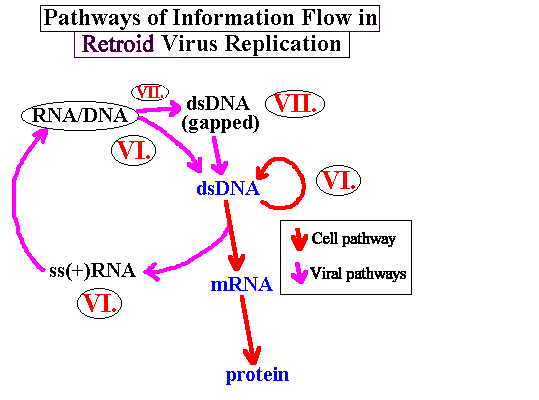
Ever since I first discovered them as a student, sometime in 1976, I have found retroviruses fascinating.  Not quite as fascinating as Ebola, possibly, but captivating nonetheless.  The whole concept of a virus that converts a perfectly ordinary mRNA into dsDNA, then  inserts it into the host chromosome as a provirus in a eukaryotic version of lysogeny – was truly wonderful.

And as the years have gone by, I have seen no reason to lessen the feeling of wonderment: other

The Retroid Virus Replication Cycle

viruses – now called pararetroviruses, including both hepadnaviruses and plant viruses – whose replication  starts at a different position in the  cycle have been found; these and retroviruses have been integrated into a whole family of “reverse transcribing elements” – retrons – which include prokaryote transposons; HIV burst in on the scene, and suddenly we know so much about how the immune system works, because a virus messes with it so well.

But the actual mechanics of one particular process have consistently escaped elucidation – until now.  The 11 November issue of Nature contains, apart from only the second SF short-short story by a South African (kudos, Anand!), a Letter of great interest.

The mechanism of retroviral integration from X-ray structures of its key intermediates
Goedele N. Maertens, Stephen Hare & Peter Cherepanov
Nature 468,326–329 (11 November 2010) doi:10.1038/nature09517

To establish productive infection, a retrovirus must insert a DNA replica of its genome into host cell chromosomal DNA. This process is operated by the intasome, a nucleoprotein complex composed of an integrase tetramer (IN) assembled on the viral DNA ends. The intasome engages chromosomal DNA within a target capture complex to carry out strand transfer, irreversibly joining the viral and cellular DNA molecules. Although several intasome/transpososome structures from the DDE(D) recombinase superfamily have been reported, the mechanics of target DNA capture and strand transfer by these enzymes remained unclear. Here we report crystal structures of the intasome from prototype foamy virus in complex with target DNA, elucidating the pre-integration target DNA capture and post-catalytic strand transfer intermediates of the retroviral integration process. [my emphasis – Ed] The cleft between IN dimers within the intasome accommodates chromosomal DNA in a severely bent conformation, allowing widely spaced IN active sites to access the scissile phosphodiester bonds. Our results resolve the structural basis for retroviral DNA integration and provide a framework for the design of INs with altered target sequences.

Basically, these folk have managed to freeze-frame several different stages of the process in crystals, by clever use of synthetic DNA targets – and then solved the structures.  NOT trivial, and the pictures are absolutely superb.  So are the movies…but you need to subscribe to Nature to see those.

Harking back to a previous post – Entrance, Entertainment and Exit, anyone? –  the more we know about viruses, the more we can mess with them.  And this is a VERY good step along that road.

Vaginal gel works against HIV

20 July, 2010

In a major press release at the International Aids Conference in Vienna today, published simultaneously in Science, South African researchers claimed a significant advance in prevention of HIV infection using a microbicide.

From the Commentary in Science Express by Jon Cohen:

HIV and its life cycle

For the first time ever, a vaginal gel has unequivocally blocked the transmission of HIV.
In a trial that involved nearly 900 South African women, those who received a vaginal gel that contains an anti-HIV drug had a 39% lower chance of becoming infected by the virus than those who received a placebo. …
More than 30 randomized controlled studies of microbicides, vaccines, and drugs to date have failed to thwart sexual transmission of HIV or have yielded such marginal success that researchers wound up hotly debating the data for years after the trials were complete. But there’s no ambiguity about the data from this new microbicide study reported today online in Science and in a presentation at the 18th International AIDS Conference in Vienna: Of the 444 women who received a placebo gel, 60 became infected with HIV versus 38 infections in the 445 women who received the microbicide. The result was statistically significant, and no serious side effects occurred.  “It’s a moment we’ve been waiting for 2 decades,” says epidemiologist Quarraisha Abdool Karim, who, with her husband, Salim Abdool Karim, headed the study, known as CAPRISA 004.

Published online 19 July 2009; 10.1126/science.329.5990.374

This truly is good news – both for the HIV/AIDS research and treatment community, who have needed a shot in the arm recently, and for women in developing countries who often have little choice in how or when they have sex.

From the paper in Science:

Effectiveness and Safety of Tenofovir Gel, an Antiretroviral Microbicide, for the Prevention of HIV Infection in Women

Quarraisha Abdool Karim et al., Published Online July 19, 2010
Science DOI: 10.1126/science.1193748

The CAPRISA 004 trial assessed effectiveness and safety of a 1% vaginal gel formulation of tenofovir, a nucleotide reverse transcriptase inhibitor, for the prevention of HIV acquisition in women. A double-blind, randomized controlled trial was conducted comparing tenofovir gel (n = 445) with placebo gel (n = 444) in sexually active, HIV-uninfected 18- to 40-year-old women in urban and rural KwaZulu-Natal, South Africa. HIV serostatus, safety, sexual behavior, and gel and condom use were assessed at monthly follow-up visits for 30 months. HIV incidence in the tenofovir gel arm was 5.6 per 100 women-years, i.e., person time of study observation (38/680.6 women-years), compared to 9.1 per 100 women-years (60/660.7 women-years) in the placebo gel arm (incidence rate ratio = 0.61; P = 0.017). In high adherers (gel adherence >80%), HIV incidence was 54% lower (P = 0.025) in the tenofovir gel arm. In intermediate adherers (gel adherence 50 to 80%) and low adherers (gel adherence <50%), the HIV incidence reduction was 38% and 28%, respectively. Tenofovir gel reduced HIV acquisition by an estimated 39% overall and by 54% in women with high gel adherence. No increase in the overall adverse event rates was observed. There were no changes in viral load and no tenofovir resistance in HIV seroconverters. Tenofovir gel could potentially fill an important HIV prevention gap, especially for women unable to successfully negotiate mutual monogamy or condom use.

Note my bolding above: while the results were encouraging overall, they were especially good where adherence to the protocol was high.  Moreover, it appears as though tenofovir administered externally does not get into the blood in sufficient amounts to cause infecting virus to develop resistance to any noticeable degree.  As an added bonus, the treatment appeared to reduce the incidence of herpevirus as well.

To paraphrase someone far more famous, this is only the end of the beginning of the fight against HIV and AIDS: this is not the answer; it is merely an indication that this is a strategy that may work – in the absence of a vaccine – to protect people from infection.

But so nice that it came from South Africa….

AIDS vaccines in Paris

21 October, 2009

Because he was in Paris attending the AIDS Vaccine 2009 meeting, and because I asked him to, Dorian McIlroy from the University of Nantes has written an account of the presentation of the recent  Thailand HIV vaccine trial results.  Thanks Dorian!

Ed Rybicki.

Here in Paris, the initial results from the Thai ALVAC/AIDSVAX vaccine trial have just been presented. The first presentation was by Dr Supachai Rerks-Ngarm, who was followed by Colonel Nelson Michael (who gave his presentation in uniform). This was a big double-blinded RCT, with more than 16000 participants, about 8000 people in each arm of the study. I am not a methodologist, but this trial does appear to me to have been very well-designed, carried-out, and analyzed. So I think one should unreservedly treat the results as high-quality.

HIVimmunecells150The headline result – a 31% reduction in HIV transmission in vaccine recipients was reported in the press in September, but the difference between the vaccine and placebo recipients was only just statistically significant. So the big question was, are the data convincing enough to reject the null hypothesis? That is, could the difference in the number of HIV infections in the two groups just be down to chance, rather than vaccine efficacy?

Both presenting scientists involved in the study gave talks that were very scientifically rigorous, explaining the why the data was analyzed the way it was, and what conclusions can and cannot be drawn from the trial.

With regards to the first question, it was pointed out that the statistical analysis of the primary endpoint (new HIV infections in the two groups) was decided before the data were unblinded. That is, the statisticians who analyzed the data did not choose their technique to manipulate the interpretation in any way.

The main statistical approach applied was Kaplan-Meier analysis, looking at the number of people infected in each group over time. Differences between vaccine and placebo arms were tested by the log-rank test. However, there were three different ways of determining exactly which of the people enrolled in the trial were included in the analysis. These were intention-to-treat (ITT), modified ITT, and per protocol (PP).

The ITT definition was everyone who was HIV seronegative at study entry, and received at least one injection. The modified ITT excluded 7 individuals who were found to be positive for HIV infection by PCR at study entry. The PP definition was, everyone who received all of the vaccinations at the allotted times. Now this was a rather strict definition, because a person who got a vaccination one day later than the schedule was excluded from the analysis, leaving only about 6000 people per group in the PP analysis.

Kaplan-Meier curves for all three analyses (ITT, mITT and PP) looked pretty good, and showed more infections in the placebo arm than in the vaccine arm, although the difference was only statistically significant (p=0.04) in the mITT analysis. The reason why the ITT analysis did not show a statistically significative difference was because 5 of the 7 people who were infected (PCR postitive, but not seropositive) at entry into the trial were in the vaccine arm. So a net increase of just three more infections (5 in vaccine arm – 2 in the placebo arm) in the vaccine group changed the p-value from 0.04 to 0.08. However, excluding people who were infected before the beginning of the trial is entirely justified, and it is clear that the mITT analysis was preferable to the raw ITT.

The comparison of the mITT and PP results was more interesting. Although the same tendency was observed (more infections in the placebo arm) the Kaplan-Meier curves looked much more similar. There may be two explanations for this. Firstly, since the number of people in each group was decreased, the statistical power of the test also went down – so the same effect would not be statistically significant. Another factor, that was pointed out by Col. Michael, was that the PP analysis automatically ruled out patients who became infected during the vaccine protocol. That is, over the first six months of the trial. Looking back at the Kaplan-Meier curves from the mITT analysis, the main difference between the vaccine and placebo groups accrued during the first year of the trial. Afterwards, new infections occurred pretty much at the same rate in the two groups. Most of these infections were excluded from the PP analysis, resulting in a non-significant difference between the two groups.

This for me, is the key to the interpretation of the trial. In my opinion, there was a protective effect of vaccination in this study (so yes, the data are convincing enough to reject the null hypothesis) – but it seems to have been short lived. Indeed, Col. Michael also mentioned that innate immune responses (presumably induced by the viral ALVAC vector that was injected four times during the 6 months of the vaccination protocol) could be involved in protection. No empty virus vector was used in the placebo arm, (described here : http://www.fda.gov/OHRMS/DOCKETS/AC/04/briefing/4072B2_2.doc) only “a mixture of virus stabilizer, and freeze drying medium”. So more short-lived, non-specific innate immune responses could have been induced in the vaccine arm compared to the placebo arm. This is also consistent with the higher frequency of adverse reactions in vaccine recipients compared to placebo recipients that was also reported in Dr Rerks-Ngarm’s talk.

If the partial protection that was observed in the Thai trial does turn out to have been due to a transient induction of innate immune responses due to the ALVAC vector, then I’m afraid we won’t be able to say that the ALVAC/AIDSVAX candidate vaccine induced an adaptive immune response that is able to protect people from HIV infection.

Dorian McILROY

HIV vaccines: some glimmer of hope??

19 October, 2009

Cells stimulated by HIV vaccines Copyright Russell Kightley Media

It has taken a while for me to get to this, because I have been waiting for the fallout / comment storm to settle a bit, so that I could get a good clear objective view.

And that is…that the recent Thai trial showed hints of promise, but was largely a failure.  At least it did no harm…!

First things first: Nature News’ Elie Dolgin had this to say on 24th September:

Vaccine protects against HIV virus [!!! sic – I had something to say about this, see Comments]

The largest HIV vaccine trial to date has shown moderate success at preventing infection by the virus.

The experimental vaccine — a combination of two older shots that failed to work on their own — reduced the risk of someone contracting HIV by nearly a third. Scientists, however, are still scratching their heads as to how the double-shot approach blocks the virus….

The US$119 million study involved more than 16,000 HIV-negative men and women from Thailand aged 18–30. The trial was launched in October 2003, conducted by the Thai health ministry and sponsored by the US Army Surgeon General. It tested a two-shot infection-fighting strategy using drugs made by Sanofi-Pasteur of Lyon, France, and VaxGen of Brisbane, Australia. Over the course of 24 weeks, participants received four doses of a ‘primer’ vaccine — a disabled bird virus [canarypox – Ed] containing synthetic versions of three HIV genes [ALVAC, subtype B env, gag and pro – Ed] — and two doses of a ‘booster’, which consisted of a protein called gp120 [AIDSVAX subtypes B/E – Ed], a major component of HIV’s outer coat.  [see here for link describing the components].   Clinicians tested for HIV infection every 6 months for 3 years….

Many HIV vaccine experts had previously criticized the approach as a waste of time because each of the vaccine components had a poor track record. The primer, called ALVAC, conferred little to no immune protection in multiple early-phase clinical trials, and the booster, called AIDSVAX, had flopped twice in high-profile, large-scale trials.

And here’s a thing: a high profile crew of scientists had, in 2004, written an open letter to Science magazine, stating in no uncertain terms that they thought the trial ought to be stopped.  In their words:

“Concerns are expressed by a group of AIDS researchers about the U.S. government’s plans to conduct a phase III trial of a combination HIV-1 vaccine in Thailand despite the cancellation of a trial of a very similar combination vaccine in the U.S.A. last year. One of the vaccine components, recombinant monomeric gp120, has already been shown to be ineffective in phase III trials in Thailand and the United States; the other component, a recombinant canarypox vector, is also poorly immunogenic. The scientific rationale that has been offered for the new trial in Thailand is considered by the authors to be weak.”

And now we have Dan Barouch – not a signatory to the 2004 letter, I note – quoted by Dolgin as saying:

“I don’t think anybody knows why this worked the way it did,” says Dan Barouch, an immunologist at the Beth Israel Deaconess Medical Center in Boston, Massachusetts. “It’s the largest step forward that’s ever occurred in the HIV-vaccine field, but there’s a tremendous amount of more work that will need to be done.”

But exactly what is it that people are hailing as a breakthrough here?  Dolgin again:

The two-pronged vaccine did not affect the amount of virus circulating in the blood of those who acquired HIV during the study. But it did show a protective effect — vaccinated individuals were 31% less likely to become infected. New infections occurred in 74 of the 8,198 people who received dummy shots, but only 51 of the 8,197 in the vaccine group [my emphasis – Ed], the researchers, led by Supachai Rerks-Ngarm of the Thai Ministry of Public Health’s Department of Disease Control, found.

Dorian McIlroy, a regular contributor to Viroblogy, had this to say on the 24th September in an email to me:

I just read the news story about the ALVAC/AIDSVAX trial results in Thailand.  From the numbers on this press release:

http://www3.niaid.nih.gov/news/newsreleases/2009/ThaiVaxStudy.htm

The significance level is extremely slim. For example, if you go to this site

http://www.statpages.org/ctab2x2.html

and type in the numbers you will find that p=0.048 by Fisher’s exact test.

If one more person in the vaccine arm had been infected, or if one less person in the placebo arm had been infected, the difference between the groups would not have been significant. [my emphasis – Ed]

None of the experts (Wayne Koff, Frances Gotch, for example) interviewed in different news stories seems to have noticed just how borderline the “statistical significance” really is, and seem to have accepted the bottom-line 30% reduction figure.

Ah well, I just thought I had to tell someone….

Dorian

Lecturer in Microbiology and Cell Biology,
University of Nantes

Others have also picked up on this – which shows just how desperately slim the hope is.  However, it does remain – although (pleasingly…B-) the pundits have been thrown into a state of confusion, as some strongly-held views have not been vindicated.  Another Nature News article – from Erika Check Hayden, on October 1st – has this to say:

As the dust settles from last week’s surprising announcement that an HIV vaccine combination may protect some people from the virus, scientists are talking about what else the vaccine trial might tell them.

On 24 September, leaders of a US$119-million study of 16,000 people in Thailand reported that the combination of two shots had reduced the risk of HIV infection by one-third …. Now, the vaccine’s fate will depend on whether scientists can figure out its ‘correlate of protection’ — in other words, what caused it to partially protect some people from HIV. The key does not seem to be anything scientists had predicted, which has led to much head-scratching — and some unease.

“It’s a humbling thing, because for the first time we got a positive signal and it doesn’t jump out at us as being related to any classical parameters you would expect from a successful vaccine,” says Anthony Fauci, head of the National Institute of Allergy and Infectious Diseases in Bethesda, Maryland, which supported the trial. “That tells us maybe we were not measuring the right thing.” [my emphasis – Ed]

Amen, brother Tony…a clearer proof of Clarke’s First Law I have yet to see.

So what ARE the things that fall out from this?  First, I would suspect, is that the value of a heterologous prime-boost combination seems to have been shown, albeit weakly.  Second, the use of a poxvirus vaccine in particular in combination with a protein may be a good thing to chase.  I note here that the South Africa / US joint Phase I human trial currently underway with the SAAVI DNA / SAAVI MVA (=modified vaccinia virus Ankara, a poxvirus) was almost certainly considerably more immunogenic in non-humanprimates than either of the ALVAC / AIDSVAX vaccines, so the gleam of hope may soon get brighter.

Third: take heed of Arthur C Clarke before you go sticking your neck out making predictions about HIV vaccines…B-)

First African-developed HIV vaccine goes to trial

21 July, 2009

Finally, finally, a product of our 10-odd-year-old South African HIV vaccine development programme goes into Phase I human trial, in South Africa!

I say “our” because I was part of the overall team; however, the two vaccines which comprise the SA AIDS Vaccine Initiative (SAAVI) / HIV Vaccine Trials Network (HVTN) trial – designated SAAVI 102/HVTN 073 – were designed and developed by others.

The vaccines consist of a DNA component, consisting of an artificial “polygene” dubbed Grttn (for Gag-RT-Tat-Nef) and a truncated Env (gp150) cloned separately into vector plasmids, and the same genes recombined under the control of different promoters into the genome of a poxvirus (Modified Vaccinia Ankara, MVA).  These and their testing in mice and non-human primates have been described in published work: see here and here for relevant journal articles on the MVA and DNA components.

From the July 20th SAAVI press release:

The test vaccines – called SAAVI MVA-C and SAAVI DNA-C2 – have shown promising results in animal testing. The SAAVI DNA-C2 vaccine was constructed in South Africa using a plasmid backbone provided by the Dale and Betty Bumpers Vaccine Research Center (VRC) of NIAID, while the MVA vaccine was designed by the team at UCT and constructed and manufactured in the USA.

“Reaching this important milestone of translating our discoveries in the laboratory to testing in humans would not have been possible without the support of a large team of people from the University of Cape Town, together with national and international collaborations.  An effective vaccine against HIV/AIDS remains a top global health priority and it is our hope that the evaluation of these vaccines in clinical trial will provide some important answers that will bring us closer towards this goal,” says Prof. Anna-Lise Williamson, leader of the vaccine development team and joint staff member of UCT’s Institute for Infectious Disease and Molecular Medicine, and the National Health Laboratory Services (NHLS).

The SAAVI DNA-C2 was constructed in South Africa and manufactured in the US by Althea Technologies. The MVA vaccine was manufactured by Therion Biologics, USA. The vaccines will be tested in a prime-boost approach where the SAAVI DNA-C2 vaccine will be given to prime the immune response and the SAAVI MVA-C vaccine to boost or enhance the immune response.

National and international press got hold of the story in a big way – unsurprisingly, given as there is the 5th IAS Conference on AIDS Pathogenesis going in in Cape Town at the same time, which incidentally has its own live blog feed.

The University of Cape Town is obviously pleased with the press release (see here); however, the launch had its fair share of controversy: Associated Press reporter Michelle Faul posted a story yesterday entitled “South Africa begins AIDS vaccine trial, cuts funds“, which has been taken up by a wide spectrum of especially foreign media.  According to Faul:

“South Africa launched a high-profile trial of an AIDS vaccine created by its own researchers Monday, a proud moment in a nation where government denial, neglect and unscientific responses have helped fuel the world’s worst AIDS crisis.

After a government official lauded the project at a ceremony at Cape Town’s Crossroads shantytown, the scientist leading the research said state funding had been halted.

The contrast between Monday’s hopeful vaccine launch and the revelation of funding cuts raised questions about whether the government was backsliding on its pledge to combat AIDS.

Anna-Lise Williamson, an AIDS researcher at the University of Cape Town, told The Associated Press the clinical trial would continue with U.S. money. But she said South Africa’s Department of Science and Technology had pulled its funding in March, while the project’s other sponsor, the state electricity utility Eskom, did not renew its contract when it expired last year.

Neither government spokesmen nor Eskom immediately returned calls seeking comment about funding cuts.”

In the midst of light, there is darkness…frequently, thanks to ESKOM

I have blogged on my personal view elsewhere; suffice it to say that bad decisions were made, and  9 years worth of momentum has effectively been lost – along with a number of very experienced personnel, and many years worth of accumulated and very relevant experience.

For an illustration of the product pipeline which existed behind the current trial offerings – and which may now never be developed – click here  for published descriptions of our plasmid- and BCG-vectored and virus-like particle (VLP) subunit vaccines.

But who knows, this current trial may even show promise – and then it will all have been worth it.  Let’s live in hope!

HIV Vaccine Day

19 May, 2009

And as one involved (or formerly involved, thanks to the effective demise of our funding agency…) in HIV vaccine research, it is criminal that I missed this yesterday – but the UCT Monday paper caught it, so let’s see what they said:

First human trial of UCT’s HIV vaccine
18 May 2009

 World AIDS Vaccine Day, May 18, marks the occasion in 1997 when US President Bill Clinton challenged researchers to come up with an AIDS vaccine within the following decade, stating that such a vaccine was the only way to eliminate the threat of AIDS. …

Researchers from UCT’s Institute of Infectious Disease and Molecular Medicine (IIDMM) have announced that their two new preventative HIV vaccines have reached the first stage of human clinical trials, a first for Africa.

This trial, called SAAVI 102/HVTN 073, is also a milestone for South Africa. The country is one of the few developing nations to have developed an HIV vaccine and progressed it into human clinical trials.

Professor Anna-Lise Williamson is leader of the team at the IIDMM.

The Desmond Tutu HIV Centre, based at the IIDMM, is one of three sites in the world that will conduct the trials. The others sites are in Johannesburg and Boston in the US.

These vaccines are a culmination of eight years of research by scientists at the IIDMM, UCT, and collaborators from the US National Institutes of Health and the Vaccine Research Centre. Their development and testing has been underpinned by funding from the South African AIDS Vaccine Initiative (SAAVI) and the US National Institute of Allergy and Infectious Diseases (NIAID).

…The initial human trial is being conducted jointly with the HIV Vaccine Trials Network and the NIAID, part of the US National Institutes of Health.

There is a wealth of science behind the vaccines, of course: I am listing a few of the papers giving the historical background to the DNA and the modified vaccinia Ankara virus (MVA, a smallpox vaccine strain) that are about to be used in the trial, below.

Broad, high-magnitude and multifunctional CD4+ and CD8+ T-cell responses elicited by a DNA and modified vaccinia Ankara vaccine containing human immunodeficiency virus type 1 subtype C genes in baboons.  Burgers WA, Chege GK, Müller TL, van Harmelen JH, Khoury G, Shephard EG, Gray CM, Williamson C, Williamson AL.  J Gen Virol. 2009 Feb;90(Pt 2):468-80.

A multigene HIV type 1 subtype C modified vaccinia Ankara (MVA) vaccine efficiently boosts immune responses to a DNA vaccine in mice.  Shephard E, Burgers WA, Van Harmelen JH, Monroe JE, Greenhalgh T, Williamson C, Williamson AL.  AIDS Res Hum Retroviruses. 2008 Feb;24(2):207-17.

Construction, characterization, and immunogenicity of a multigene modified vaccinia Ankara (MVA) vaccine based on HIV type 1 subtype C.  Burgers WA, Shephard E, Monroe JE, Greenhalgh T, Binder A, Hurter E, Van Harmelen JH, Williamson C, Williamson AL.  AIDS Res Hum Retroviruses. 2008 Feb;24(2):195-206.

Design and preclinical evaluation of a multigene human immunodeficiency virus type 1 subtype C DNA vaccine for clinical trial.  Burgers WA, van Harmelen JH, Shephard E, Adams C, Mgwebi T, Bourn W, Hanke T, Williamson AL, Williamson C.  J Gen Virol. 2006 Feb;87(Pt 2):399-410.

Construction and characterisation of a candidate HIV-1 subtype C DNA vaccine for South Africa.  van Harmelen JH, Shephard E, Thomas R, Hanke T, Williamson AL, Williamson C.  Vaccine. 2003 Oct 1;21(27-30):4380-9.

Characterization and selection of HIV-1 subtype C isolates for use in vaccine development.  Williamson C, Morris L, Maughan MF, Ping LH, Dryga SA, Thomas R, Reap EA, Cilliers T, van Harmelen J, Pascual A, Ramjee G, Gray G, Johnston R, Karim SA, Swanstrom R.  AIDS Res Hum Retroviruses. 2003 Feb;19(2):133-44.

The development of HIV-1 subtype C vaccines for Southern Africa.  Williamson AL.  IUBMB Life. 2002 Apr-May;53(4-5):207-8. Review.

Guest Blog: HIV Vaccines

18 March, 2009

You remember we had a competition, end of last year?  Well, the runner-up of same – Dorian McIlroy – has claimed his prize by writing a guest blog.  Clayton, that means you have to do two…?!

And Dorian writes on a subject close to our collective hearts, here in the Subunit Vaccine Group at Univ of CT: HIV vaccines, and how T-cell vaccines in particular may not be down and out after all.  I note that he refers to two published papers that were topics of talks at the recent AIDS Vaccine Conference here at UCT recently, which was covered here in ViroBlogy: always useful to have your material on the verge of being published when you talk…!

HIV vaccine candidates – The return of the recombinants…

Towards the end of 2007 Merck interrupted a large scale clinical trial of a candidate HIV vaccine based on recombinant adenovirus. As well as showing no protective effect, there was a worrying tendency for vaccinees with serum antibodies to the vector – serotype 5 adenovirus (Ad5) – to show greater susceptibility to HIV infection than volunteers receiving placebo injection. This looked like the end of the road for adenovirus-based vaccines, and maybe even for any strategy based on recombinant viruses. However, two recent papers indicate that there may yet be considerable mileage in this approach.

The first, from Dan Barouch’s team in Boston, shows how recombinant adenoviruses could be made considerably more effective. One of the big drawbacks with these recombinant viruses is that repeated injections do not give an immunological booster effect. That is, even though the immune response to a single injection can be strong, there is not much increase after a second, or a third injection of the same recombinant virus. This happens because as well as inducing an immune response to the target antigen (SIV gag, for example), the recombinant virus vector induces an immune response against itself. So when the recombinant virus is injected a second time, it is neutralized by the antibodies induced by the first injection. 

The Barouch paper shows that it is possible to get round this problem by using two recombinant adenoviruses with different serotypes, so that the second injection can provide an effective boost. Giving macaques two injections of SIV gag-recombinant Ad5 gave a good response to the first injection, but no boost. Using an SIV-gag recombinant Ad26 for the first injection, then using the Ad5 recombinant for the second, gave a 9-fold higher T-cell response measured by IFNgELISPOT than two doses of Ad5 recombinant.

So far, so good – but does this immune response translate to protection from infection?

Well, yes and no. After intravenous challenge with highly pathogenic SIVmac251, all animals in all groups were infected, so none of the animals were completely resistant to SIV. Peak viral load in the group vaccinated with Ad26/Ad5 was 1.4 log lower than in the control group, and about a log lower in the group vaccinated with Ad5/Ad5. Set-point viral load was also much lower in the Ad26/Ad5 group compared to the control group, so replication of the challenge virus was controlled to some extent in the animals that received the most effective vaccination protocol.

Overall there are two messages here. The first is that it is possible to do much better than the strategy that failed in the Merck trial, that employed three injections of Ad5 recombinant viruses. That’s the good news. The bad news is that even with a much more effective vaccination, in terms of the T-cell response, the protection against infection, although significant, was relatively modest. This means that vaccine candidates based on T-cell immunity alone are never going to work……. or does it?

Which brings me to the second paper, from Louis Picker’s group in Oregon. The big novelty here is the generation of recombinant rhesus macaque cytomegalovirus (CMV) expressing SIV proteins, that are tested as vaccine candidates in the SIV Mac model.

Why on earth would anyone want to try out CMV, when other recombinant (adeno- and pox-) viruses have been so disappointing? The difference is in the lifestyles of the viruses involved. Both adeno and poxviruses provoke acute infections, whereas CMV both in humans and apparently, in macaques, causes a lifelong infection, in which active viral replication is held in check largely by a robust T-cell response. When the immune response is compromised, as in AIDS patients, or transplant recipients receiving immunosuppressive drugs, CMV infection often reactivates, which can cause serious illness, and even be life-threatening. Because of the persistent nature of both the virus and the cellular immune response, a high-level of effector-memory T-cells (TEM, not to be confused with Transmission Electron Microscopy) specific for CMV are maintained in CMV+ individuals (who probably make up about half of the world population, in case you were wondering).

TEM have two interesting characteristics from a HIV vaccine point of view. Firstly, they are armed and dangerous. If they see their cognate viral antigen, they can either kill the infected cell, or secrete cytokines. Secondly, they migrate to mucosal sites, rather than lymph nodes, so they are in the right place to stop HIV infection after sexual transmission. More sedate central-memory T-cells (TCM), on the other hand, hang around the blood and lymph nodes, and do not immediately have anti-viral effector functions. Their response to HIV infection might be too late to be any use, as the first rounds of productive viral infection occur in the mucosa, not the draining lymph nodes.

Picker’s group points out that most memory T-cells that remain months after a recombinant adenovirus vaccination are TCM, not TEM, and set out to test the hypothesis that using a recombinant virus (CMV) that naturally gives a strong TEM response might be more effective in protecting against SIV infection at a mucosal site. So they generated recombinant, replication competent macaque CMV carrying genes for SIV gag, a Rev-Tat-Nef fusion protein, and an intracellular form of Env. Cells infected with these viruses expressed high levels of the recombinant proteins, and animals inoculated subcutaneously with them became persistently infected – just like wild-type CMV infection.  As predicted, high levels of SIV-specific TEM were found in the blood, and in broncho-alveolar lavage (which is a relatively convenient way to obtain mucosal T-cells). More than one year after vaccination, animals were submitted to a mucosal challenge (intrarectal, if you really want to know) with SIVmac239, which is the same strain as that used to produce the recombinant CMV.

The details of the viral challenge are interesting. In order to simulate a real infection, a low viral dose was used, and this means that not all control animals get infected. So the challenge was repeated weekly until infection (detected by plasma viral load) was observed. I have turned the data from the paper into Kaplan-Meier curves, and used the log-rank test to compare the two groups (BTW: if Louis Picker is reading this, that’s the test you should have used). With p=0.03, survival without infection was significantly prolonged by vaccination, and 4 out of 12 vaccinated macaques were resistant to mucosal challenge. These four animals did not have a latent or cryptic infection, as no SIV DNA or RNA was detectable in CD4 T-cells in blood or lymph nodes, and CD8+ T-cell depletion did not result in viral rebound.
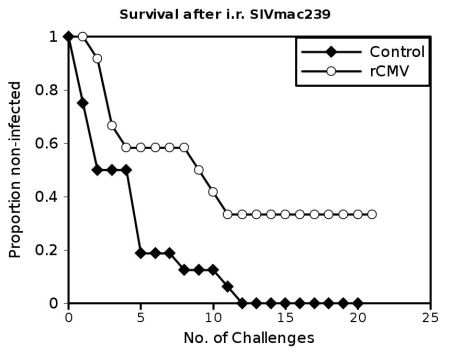
recombinantviruses_032009_html_48846d22This was without any neutralizing antibodies, so for the first time a T-cell vaccination strategy has been shown to confer protection against infection (not just better control of viral load after infection, as with recombinant adenoviruses) in at least some vaccinated animals. Although 33% protection is not enough, at least things are going in the right direction.

So what’s the catch? Well, there are two really. Firstly the SIV sequences in the vaccine and challenge virus were identical. The vaccination strategy may not be so effective against a heterologous challenge, that would be more representative of the real-world. Secondly, the vaccination provokes a persistent infection with a genetically-modified virus, that (unlike other recombinant viruses and gene therapy vectors) remains infectious, so it’s hard to see how this kind of vaccine could be licensed for clinical trials.

Nevertheless, I think this paper is telling us – at last – what kind of T-cell response vaccines should be aiming to induce. Now all we need to do is solve the neutralizing antibody problem, and we’ll really be cooking with charcoal….

Dorian McIlroy
Dorian.Mcilroy@univ-nantes.fr