Archive for the ‘Evolution’ Category

Bats and SARS-CoV: deja vu all over again

1 November, 2013

In 2008, I wrote a blog piece entitled “Who do you bind to, my lovely?”, about a couple of papers on SARS-CoV – the coronavirus that causes severe acute respiratory syndrome.  I closed that piece with the following:

“Adding fuel to the speculative fire is another paper in the same issue: this reports that there is evidence of a recombinant origin for SL-CoVs, and there is probably “…an uncharacterized SLCoV lineage that is phylogenetically closer to S[ARS]CoVs than any of the currently sampled bat SLCoVs.”

So let’s all just wait for the next one, shall we?”

…in connection with the fact that horseshoe bat coronaviruses were VERY similar to SARS-CoV, but bound to different receptors.  And we had to wait five years, but heeeeeere we are… these folk may well have found the missing virus(es) that are directly transmissible from bats to humans:

Isolation and characterization of a bat SARS-like coronavirus that uses the ACE2 receptor

 Xing-Yi Ge et al.

Nature (2013) doi:10.1038/nature12711

Here we report whole-genome sequences of two novel bat coronaviruses from Chinese horseshoe bats (family: Rhinolophidae) in Yunnan, China: RsSHC014 and Rs3367. These viruses are far [! – my comment; the last ones were pretty close…] more closely related to SARS-CoV than any previously identified bat coronaviruses, particularly in the receptor binding domain of the spike protein. Most importantly, we report the first recorded isolation of a live SL-CoV (bat SL-CoV-WIV1) from bat faecal samples in Vero E6 cells, which has typical coronavirus morphology, 99.9% sequence identity to Rs3367 and uses ACE2 from humans, civets and Chinese horseshoe bats for cell entry. Preliminary in vitro testing indicates that WIV1 also has a broad species tropism. Our results provide the strongest evidence to date that Chinese horseshoe bats are natural reservoirs of SARS-CoV, and that intermediate hosts may not be necessary for direct human infection by some bat SL-CoVs. They also highlight the importance of pathogen-discovery programs targeting high-risk wildlife groups in emerging disease hotspots as a strategy for pandemic preparedness.

So – I told you so…B-)


Plant-Based Antibodies, Vaccines and Biologics 5, Part 5

3 September, 2013

Session 6:Vaccines II

This was SUPPOSED to open with a report from Medicago Inc, on ‘Developing plant-made influenza vaccines: From discovery to commercial scale production’  – but didn’t, because they were all shaken up (in a good way) by having been effectively bought by Mitsubishi Tanabe Pharma Corporation, and no-one came.

This is a success story in its own right, however, as their recent and highly successful activities in the areas of making influenza vaccines and human rotavirus VLP-based vaccines in plants marked them out as a target for acquisition by Big(gish) Pharma – for which we commend them.

It is sad, however, that their only presence at the conference was on the back of my windbreaker B-)

Konstantin Musiychuk (Fraunhofer USA) was the first up, then, speaking on ‘Preclinical evaluation of VLP-based malaria transmission blocking vaccine’.  He described how there are 3 types of intervention that may work with malaria: these are at the pre-erythrocytic, blood stage, and transmission blocking stages of infection.  Antibodies to Pfs48/45, Pfs230 proteins block the fertility of or destroy the macrogamete.  Pfs25 and 28 Abs block the ookinete to oocyst developmental phase; all potentially block transmission.  Accordingly, they expressed these as fusions with the alfalfa mosaic virus (AMV) CP with mutation(s) to prevent glycosylation.  The Pfs25 protein was the best candidate; they cloned a mutated version (glyc-), fused at the N-terminus to AMV CP, and expressed via their TMV-based “launch vector” after vacuum infiltration.  He noted that the fusions have full-length and proteolysed products – which is needed for VLP formation as native CP is needed to avoid steric hindrance in assembly.  They obtained nice particles as shown by EM, showing surface decoration.  Dynamic light scattering [Ed: must get me one of those…] results show a nice tight range of 17nm particles.

They used the products with/out Alhydrogel as adjuvant, IM in mice: they got good titres maintained >170 days, with  2x inoculation.  They diluted test sera with naive human serum and used this to membrane-feed mosquitoes, then after 1 week dissected them and assayed for parasites: oocyte counts in mid-gut reflected efficient blocking of acquisition.  The adjuvant+ doses worked well down to 0.1 ug (100%).  Single doses of 1, 5 or 25 worked 100% as well.  After 6 months, 5 and 25 ug doses still gave 90%+ blocking.

They made GMP lots, very pure:  2 doses at 0 and 21 days resulted in complete blocking down to 0.3 ug, with >99% blocking after 40+ days.  Tox studies were fine, although the  Alhydrogel apparently causes some side effects.   Scaleup from 1-50 kg showed no changes in the Ag.  The Phase 1 trial is expected in Q3 2013.

This was most impressive: it is to be hoped that the promise is maintained!

Yoseph Shaaltiel (Protalix Biotherapeutics, Israel) spoke on Protalix’s new product: this was alpha galactosidase-A, for the treatment of Fabry disease.  This is an X-linked lysosomal storage disease that results in massive storage of glycolipid Gb3, in cells, in the vascular system and elswhere, which impairs the tissue of the heart and affects kidney and other organ function.  There were worse consequences than with Gaucher disease, while it was less obvious.  The current therapy was seen as being bad, and patients had reduced life expectancy.  There were 2 therapeutic enzymes on the market: these were Agalsidase Alfa and Beta; these were very inefficient and expensive, so cost benefit was very limited.  1/2 life in blood was normally just a few minutes, and the proteins were very immunogenic.

Protalix aimed at making a biobetter: this was made in tobacco cells cultured in bags (they used Icon vectors, so could not work in their favoured carrot), by cocultivation with Agrobacterium and then killing the bacteria.  The protein subunits were PEGylated to reduce immunogenicity and x-linked using bis-NHS-PEG.  This gave improved stability, longer circulatory 1/2 life, enhanced activity in target organs with similar to improved kinetics, so lower dosing and longer intervals between doses were possible.  Yields were good too, and they could make the enzyme very pure.  The product had the same kinetics as the commercial products with better activity over a wide pH range.

As far as glycosylation was concerned, the commercial product had very complex glycosylation, while the plant-made product’s profile was very consistent and simple.  It had an enhanced circulatory 1/2 life, of 581 vs 13 min, and also had higher activity in target cells – heart, kidney – over time.  Yoseph noted that the  patents on the enzyme(s) were limited to CHO cell production, meaning they had a useful window to exploit.

A comment from Jim Carrick was that the FDA was not interested in PEGylated products, as this could lead to vacuolation of kidneys in the long term.  Yoseph said their product was not the same, as normally PEGylation added 20-40 kDa, whereas theirs was a much shorter x-linker.  Their product was, moreover, already in clinics, as the  FDA had said they should move straight to patients rather than testing it in healthy people.

Lydia Meador (Arizona State University) reported on their lab’s HIV vaccine candidate, made in plants and also vectored by NYVAC-KC delB19 poxvirus.  They had previously shown that a CTB-HIV membrane proximal region (MPR) fusion vaccine resulted in Ab that stops transcytosis of HIV by Ab; she noted that live vectors enhance T-cell responses compared to subunit vaccines, so a combination would be a good idea.

Accordingly, they had cleverly produced whole HIV Gag and a deconstructed gp41 – stable Gag transgenics, and transiently-produced dgp41 – in the same plants, to make 100nm VLPs.  While VLPs are highly immunogenic alone, they wanted to prime with the NYVAC and boost with plant-made antigen.  They obtained good p24 Ab responses with NYVAC and the VLP boost; gp41 less so.  In terms of mucosal immunity, they saw the IgA response against gp41 was significantly higher in the NYVAC+VLP combination, as were CD8+ T-cells.  She noted that the anti-NYVAC titre was high after 3x doses.  In response to my question, she did not know if the NYVAC vaccine made VLPs in mice – which it may not do, even if it works in plants, due to different protein requirements for budding in mouse vs plant cells.

Daniel Tusé (Intrucept Biomedicine, Kentucky) – a company founded with Kenneth Palmer – spoke on ‘Safety and efficacy of plant-produced Griffithsin for antiviral indications’.  He noted that while griffithsin was an excellent anti-HIV microbicide, it was also a reasonably broad-spectrum antiviral lectin, as it was effective against the recently-emerged MERS CoV and  influenza viruses.

The protein was hard to make from seaweed, and E coli was useless for production; however, they got g/kg in tobacco via conventional rTMV vectors, and now even better with Icon and Nomad vectors.  KBP had manufactured it to near-GMP production standards, again at g/kg yields, with product recovery at 30% from leaves and 50% from leaves + stems, to a final purity of 99.8%.  The potency was the same as the alga-derived product, and they had 100s of gm of product.

As griffithsin binds HIV with very high affinity, its primary use would be as a topical microbicide, to prevent transmission of HIV and HSV; to prevent coronavirus infections, and to act on chronic virus infections.  The protein is not mitogenic on PBMC and does not activate T cells; it does not produce inflammatory cytokines in human PBMC, unlike cyanovirin, which had a much worse proinflammatory profile.  The epithelial toxicity was also very low, which was in contrast to some well-publicised agents which had disastrously resulted in increases of HIV acquisition in women using them.

A carbopol-based gel was found to have the best drug-release kinetics, so was adopted for formulating the product for use.  This protects mice against genital herpes: herpes has 2x the risk of infection per exposure compared to HIV infection.  The gel has broad specific activity against coronaviruses too, to a wide spectrum of viruses from human, cow, chicken and pig.  It could protect mice against SARS CoV, if given intranasally at 2 doses/day.

The protein also has uses in prevention of infection in the organ transplant area, eg against hepatitis C virus (HCV): it prevents infection of Huh-7 cells by cell-culture derived HCV, and partially protects hepatocytes from viral spread in vivo.  If injected in animals it persists, and maintains an anti-HIV activity.  It is immunogenic, but only weakly so, and Ab to it don’t neutralize its effects.  Their lab was using rational design to take out T-cell epitopes without affecting antiviral activity.

Daniel stressed that this is a new drug, which can be preferentially be made in plants at high yield, with very low cost of goods; that it was effective and safe.

Hugh Haydon (KBP) mentioned that the cost of goods was “pennies/dose”.

Session 8:

This was an interactive discussion session, addressing the topic ‘Commercialisation of molecular pharming products – objectives and targets for the next 5 years’.
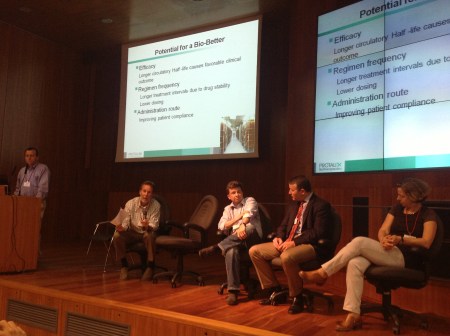
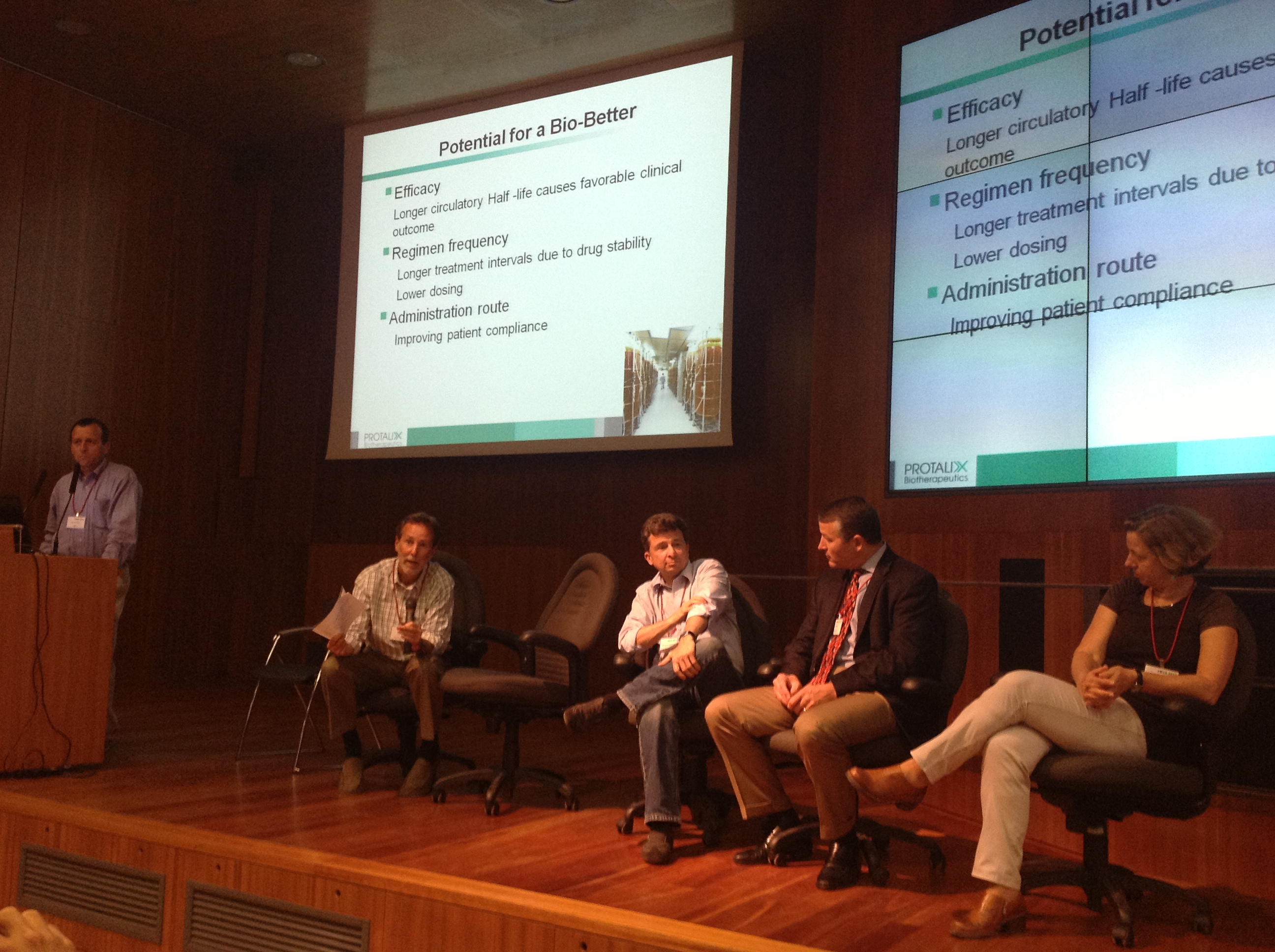
The panel: from left - Hugh Haydon, Kevin Whaley, John Butler, Scott Deeter, Einat Brill

The panel: from left – Hugh Haydon, Kevin Whaley, John Butler, Scott Deeter, Einat Brill

Hugh Haydon of Kentucky BioProcessing (KBP), , speaking on behalf of the new MAPP, KBP and Icon collaboration, addressed product selection.  He noted that MAPP was responsible for product development, Icon for technology development and purification, and KBP for large-scale manufacture.  They had spun out Solmab as a collaborative vehicle for production of MAbs for infectious disease therapy.

He described their product selection rationale: this was based on

  • proof of concept data
  • platform suitability
  • capacity for dual use of product
  • availability of capital
  • speed of the regulatory process
  • regulatory success rate
  • scalability of existing infrastructure

Accordingly, they had selected a “biobetter” of Synagis, and an Ebola MAb cocktail.  The Synagis equivalent was better due platform parameters, known clinical parameters, the fact there were established markets which can grow, government and NGO humanitarian interest, and potential adaptation to other viruses.  For Ebola, they had a 3 MAb cocktail that was known to work, strong government interest (for a stockpile), a more rapid regulatory pathway, and a tropical disease voucher from the FDA.  He pointed out that these products won’t make blockbuster status, but are appropriate for small companies like theirs.

Kevin Whaley (MAPP) spoke on how we needed therapeutics that were multipurpose (disease, indication) as well as multi-vaccines.  The attributes of the new biologics were multi-use, speed of production, scale of production, and cost advantage – especially for global health products costing <$US10/g, at scales of >10K kgs, with increased efficacy (pathology, cancer), increased acceptability and access.  He noted that all modern paediatric vaccines are multi – this saves visits to clinics, especially in developing countries.

Scott Deeter (InVitria) noted that the biologics market was edging up to being worth $US125 billion – and reckons progress with plant-produced products is excellent.

John Butler (Bayer) thinks we are still looking for suitable products!  He was of the opinion that initial targets were too difficult (eg NHL – and flu??!), and that improved product characteristics must benefit from being plant-made.  He was adamant that PMP must not compete on price with other platforms – because there was no such thing as a bottleneck in fermentation capacity world-wide, and established industry could just cut prices if they wanted to.  He spoke of real and perceived hurdles:

  • regulatory pathway isn’t a hurdle
  • plant vs human glycosylation is not either, as plant-specific glycans were not more immunogenic than human

Real risks were that:

  • there were well-established alternatives
  • the plant-made product industry was overstretched in terms of resources

Einat Brill (Protalix) addressed their future strategy:

  • new biologics for orphan indications (clinical trials were smaller, one needed only several 10s kg a year for an entire disease cohort)
  • recombinant vaccines
  • hard to express proteins that were best expressed in plants

ApApproved biologics:

  • Biobetters of commercial products
  • They would continue to establish PMP regulatory environment as a viable route for biologic drugs development
  • Biobetter efficacy: longer circulatory half life for favourable clinical outcome
  • regimen frequency: longer treatment intervals due to increased drug stability, with lower dosing
  • Changing administration route (eg: oral vs injectable): helps to improve patient compliance

This was an excellent session, if only to hear how people who have been involved in getting PMPs to the market viewed the prospects for the industry – and it appeared favourable, despite John Butler’s caveats.
Plant-Based Vaccines, Antibodies and Biologics 5, Part 4

2 September, 2013

PBVAB 5 Part 4

Sessions 5 – 8

The fifth session on Day 2 was “Antibodies 1” – and who better to kick off, than Rainer Fischer (RWTH / Fraunhofer Institute, Aachen), talking about Pharma-Planta – The European project to introduce plant-derived monoclonal antibodies to the clinic’.

One of the most impressive features of the FP6 PharmaPlanta project was its sheer size: 28 academic institutions were involved over 7 years, at a cost of €12 million plus €3 million from the Fraunhofer Institute in Aachen.  Their mission was to move molecular farming beyond proofs of concept, and to develop candidate products.  They selected the anti-HIV-1 subtype B MAb 2G12 as their final candidate, but also developed MAbs to rabies and some vaccine candidates.  Importantly, their IP had a Humanitarian Use Commitment: knowledge created was made freely available for humanitarian purposes.

They had a total of 39 postdocs and 8 students trained; they produced 200 peer-reviewed publications consisting of 150 research papers and 50 reviews, and a spin-out company.  The project also helped to develop a South African plant-made MAb production platform.  Their plant-produced 2G12 was the first plant-made MAb in human clinical trials – and went from gene to clinic in just 7 years.  They had also very materially helped the development of the regulatory regime in Europe, from the viewpoint of pharmaceutical guidelines and environmental safety for PMPs.

Rainer Fischer

Rainer Fischer in full flow

The final yield figures for 2G12 were 5 g of 97% pure MAb from 240 kg of transgenic tobacco, with a recovery of 55%.  The product had a better glycosylation homogeneity than CHO cell-produced 2G12.  In clinical trials of the MAb used as a vaginal microbicide, the product was safe and well tolerated with no serious adverse reactions.  There were no anti-Abs found in serum or in the vagina, with no systemic absorption.  The MAb survived for 8 hrs in the vagina, meaning it had serious potential as a microcode.

The project resulted in great human capital, a manufacturing facility at the Fraunhofer IME, and a number of important follow-on projects.  It also opened bottlenecks in regulatory practice, and in clinical trials of PMPs.  There was a pipeline of additional product candidates, eg anti-rabies MAbs.

Important lessons from the project were the following: one should focus early on on the plants used, the expression technology, the threshold level of production, realistic timelines, the plant line and purification process, production issues, QC stability, regulatory contract – FIND A CLINICAL SPONSOR!, set up contractual framework, draft specifications for drugs, contact authorities in countries for manufacture and testing.

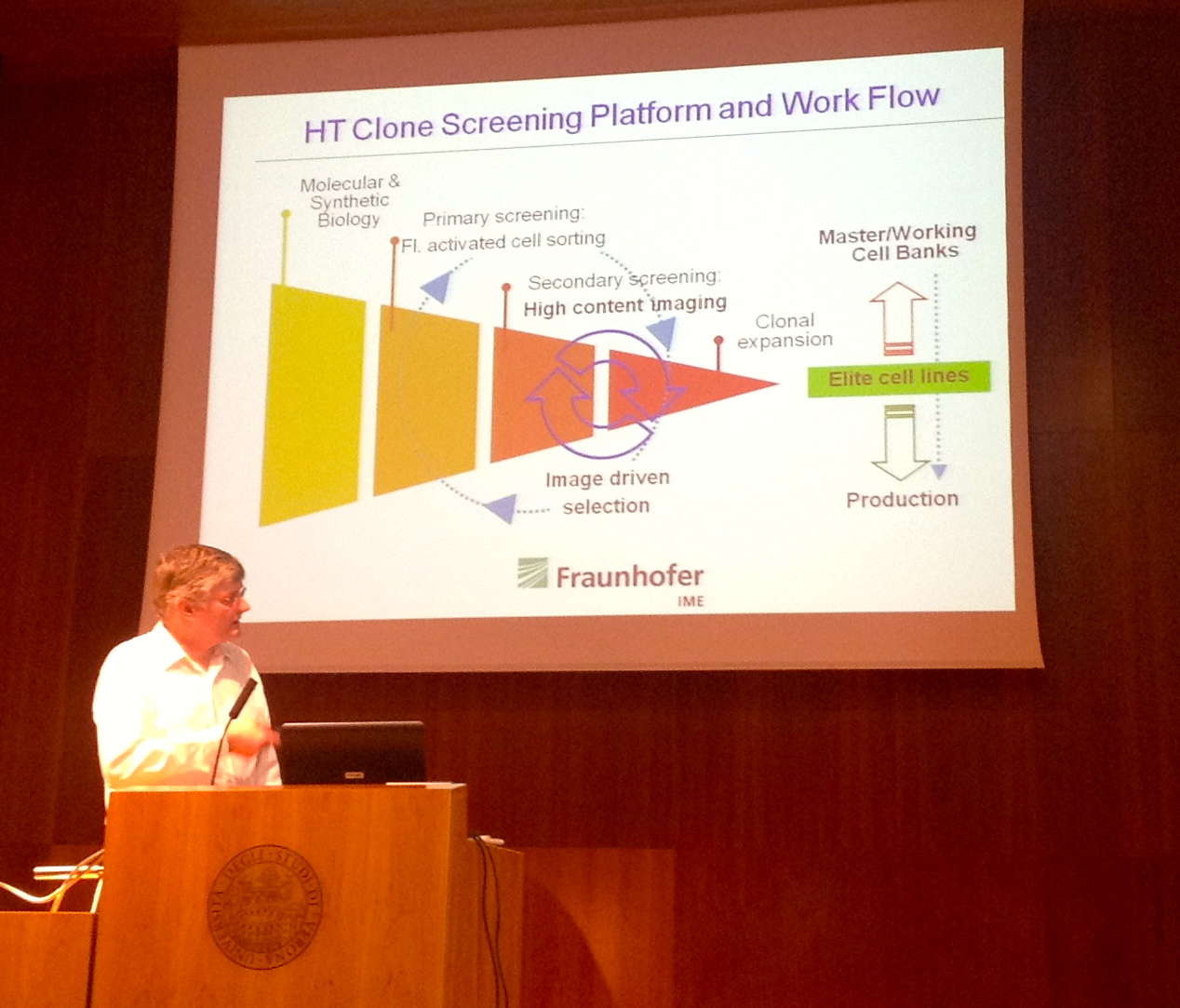
Issues such as smart product selection, synthetic biology/host cell line engineering, glycan/protease profile, hi-throughput cloning, selection of elite lines, scale-up automation / vertical farming, downstream processing, regulatory approval had also surfaced, and were important.

For the future, a fully automated vertical farm unit  for seed development was going to come on stream.  They would move from niche production to mainstream production, taking advantage of economies of scale.  Other developments could be designing an optimal host cell line, with fully human glycosylation, and site-directed transgene integration.

Some day someone should write a book about this endeavour – and I think it should be Rainer.

Larry Zeitlin (MAPP Biopharmaceutical) spoke next, on producing monoclonals against respiratory syncytial virus (RSV): the reason for doing this is that RSV is a major pathogen among small children worldwide, and while there are MAb-based therapeutics (eg: Synagis, from MedImmune), with sales in the order of USD 1 billion annually, these cost around USD 5 000 for one treatment for one child – and premature infants or cardiac / respiratorily challenged children required 4-5 monthly doses per RSV season.  Additionally, infection with RSV in the 1st year of life is associated with development of asthma later, so paediatricians were wanting to treat a much wider spectrum of children.

Accordingly, MAPP was making a Synagis equivalent via Icon vectors in N benthamiana for half the cost of goods, which had the same neutralisation ability and same affinity but a different glycosylation profile and shorter half-life.  When tested in cotton rats it was identical in pharmacokinetics and worked as well as Synagis.  An attempt to reduce the interaction of the IgG1-based MAb with the immune system by changing the subtype to IgG2 failed in rates even though it was neutralising, possibly due to there being less ADCC.  Larry mentioned that they could engineer the Fc region with point mutations to significantly extend the half life – and then use this as a scaffold, possibly for some of their other products.

Michael McLean (Univ Guelph, Canada) described his group’s work on a HIV Ab cocktail theoretically capable of neutralising 99% of HIV strains – this was for PlantForm Corp, who had a mandate to produce biosimilars and novel biologics using plants.  The HIV project was focused presently on demonstrating anti-HIV functionality, and at improving glycosylation profiles of a cocktail of b12, 2F5 and 4E10 broad-spectrum anti-HIV MAbs.

They worked with BeYDV-derived, 2-replicon vectors expressing whole MAbs, as well as their own vectors, using the Steinkellner group glycosylation pathway engineered plants.  With 9 days maximum expression period  they could get 1 g/kg maximum yields.  All the MAbs worked fine, with  similar activity in in vitro HIV pseudovirion neutralisation assays.  Using the deltaFX N benth line, they get uniform glycosylation – and add Gal using their own vectors.

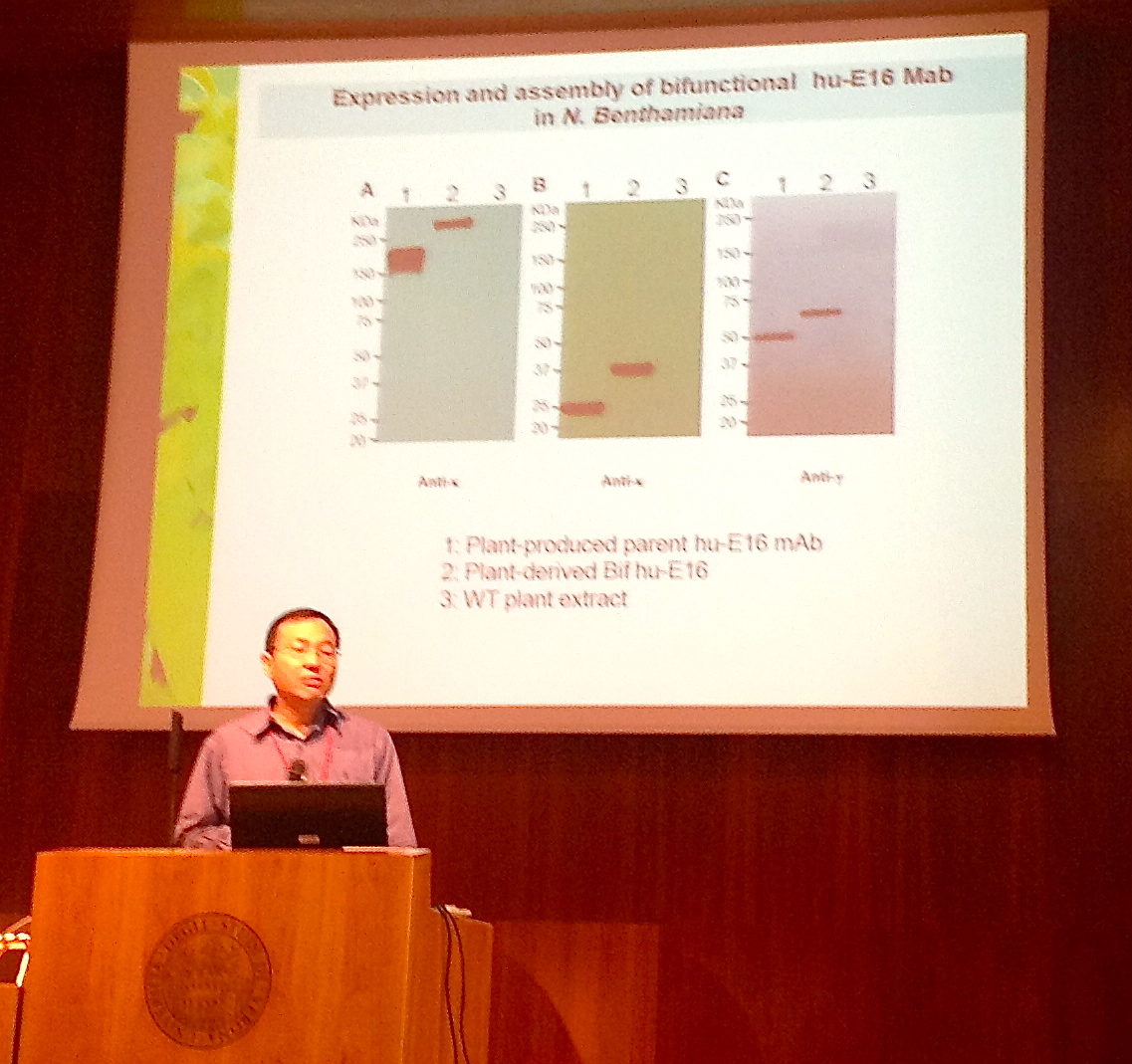
Shawn Chen (BioDesign Inst, Arizona State Univ) described their work on a humanized West Nile virus (WNV) therapeutic MAb which protected mice from WNV infection.  They wanted blood-brain barrier (BBB)-permeable bifunctional Abs to extend efficacy, presently limited because of the barrier.  They got 0.3 – 0.5 g/kg yield of a bifunctional MAb which bound the BBB endothelial receptor and virus Ag, using Icon and BeYDV vectors, and showed endocytosis into brain cells.  He also mentioned that they could “tune” glycoforms to change ADCC.

IMG_0140

Victor Klimyuk (Icon Genetics GmbH, Germany) presented on ‘Biogeneric antibodies made in plants’: these used a generic IgG1 constant region gene codon-optimised for plants, with add-on variable (V) regions derived from other Abs of different types and specificities.  The first product had been the non-Hodgkin lymphoma personalized MAbs: they had done glycotyping of each NHL MAb, all with the same H but diff L chains, to show these were differently glycosylated – and that all the idiotypes were expressed at very different levels.  Interestingly, expression levels had little to do with occupancy of glycosylation sites – and this occupancy could be tuned by directed point mutations.

They had made analogues of trastuzumab and herceptin, etc – and noted that herceptin analogues differed in potency, and wt plants produced lower levels than their engineered plants.  Rituximab analogues were all the same as the original MAb at day 0 of treatment, but MAbs with no fucose were best at persistence – equal to the original.

Vikram Virdi (VIB, University of Gent, Belgium) described passive immunisation of piglets against enterotoxigenic E coli (ETEC) using llama-derived antibodies produced in Arabidopsis.  This was useful in that it extended the maternally-derived passive immunity.  Their product was a “porcinised camellid Ab” against the major adhesion molecule of ETEC, which should survive the digestive tract.  They made MAbs based on a camellid Vh gene fused to IgG and IgA Fc regions, and expressed them in seeds for a piglet feed challenge.  They got a maximum of 15% TSP expressed in seed, 3% of seed weight.  By triple transformation with the 3 genes required for an IgA analogue (Vh:Fc, J chain and secretory component) and then selfing and breeding plant lines, they got in planta assembly of a sIgA analogue (0.2% seed weight).  This worked in inhibiting attachment of  bacteria, so they upscaled production and tested a cocktail of IgG vs IgA types.  The latter was best, with a swift decline of bacterial shedding with a 4  x lower dose than for IgG.  There was also a better weight gain for IgA treated piglets.

Thomas de Meyer (VIB-PSB/University of Gent) compared production of bivalent camellid VHH-derived MAbs in Arabidopsis, N benthamiana and Pichia pastoris, given that the VHH Fc enhanced functional affinity, and led to longer serum 1/2 life, and was a convenient protein tag. They compared VHH and VHH-Fc MAbs with 4 fusions, including anti-globulin, anti-albumin, and anti-GFP.  The products were stable in seed production (with KDEL) in Arabidopsis and also N benthamiana, and  Pichia secreted the products.  They got yields of 1.5 – 27% TSP, 0.1 to 0.82 g/kg in plants, and with Pichia, 15 – 30 mg/l culture.

The MAbs had different size profiles from the different hosts, though all were bivalent VHH, and N benthamiana and Pichia products were fully glycosylated.  Several of the Fc-type MAbs outperformed the VHHs in ELISA.

Overall, it was obvious that expression of a wide variety of antibodies in plants is a maturing technology: yields are high, of antibodies whose glycosylation and retention profiles can be handily engineered, and which perorm equivalently or better than their conventional homologues in in vitro and in vivo assays.

Go Green, he said, not quietly…B-)

Hype: “Regulators Discover a Hidden Viral Gene in Commercial GMO Crops!”

2 May, 2013

See on Scoop.itVirology News

by Jonathan Latham and Allison Wilson How should a regulatory agency announce they have discovered something potentially very important about the safety of products they have been approving for over twenty years?

Ed Rybicki‘s insight:

I am rather troubled by this article, because although it is obviously well-researched, it erects a house of cards from some rather flimsy initial premises.

The first is that the gene VI 3′ fragment, included as part of constructs for the 35S promoter, is in fact expressed in ANY of the transgenic plants it appears in: there is NO proof of this.

The second is that this same fragment encodes a polypeptide which has any/all of the functions associated with the full length protein: again, there is NO proof of this, although a throwaway statement is made that hints that it does.

The third is that the polypeptide fragment, IF expressed at all, would have deleterious effects in animals / humans: again, there is no conclusive proof of this at all, despite extensive toxicity trials.

There are other problems with the piece, including the statements:

“In general, viral genes expressed in plants raise both agronomic and human health concerns (reviewed in Latham and Wilson 2008).”

Sorry, this is not GENERALLY taken to be the case at all!

“This is because many viral genes function to disable their host in order to facilitate pathogen invasion. Often, this is achieved by incapacitating specific anti-pathogen defenses. Incorporating such genes could clearly lead to undesirable and unexpected outcomes in agriculture.”

Really? It has been clearly demonstrated that the anti-host function works in very different hosts, meaning this last sentence is true? Where?

“Furthermore, viruses that infect plants are often not that different from viruses that infect humans. For example, sometimes the genes of human and plant viruses are interchangeable, while on other occasions inserting plant viral fragments as transgenes has caused the genetically altered plant to become susceptible to an animal virus (Dasgupta et al. 2001).”

Oooooh…the taurine excreta value is high in this one…while an argument can be made that certain viruses of plants and of animals have a common origin, and are not THAT different in a long-term evolutionary sense, there are NO viruses that have been shown to infect both plants and mammals – NONE.

As for Dasgupta et al., what they showed was that flockhouse virus – an insect virus which replicates in plant cells but does not spread in plants – CAN spread in plants IF these are expressing CERTAIN plant virus-derived movement proteins. Which, I will note, are NOT components of any DNA in released GM plants of which I am aware.

And replication does not = “susceptible”: it means the virus CAN replicate and spread, NOT that it causes disease. I note that there are many viruses which replicate in both an insect and a plant, and others that replicate only in a plant but can be spread by an insect, and yet others which replicate in an insect only but can survive in plants as a reservoir. I note further that there are NO examples which can do any of these things in a plant and a mammal.

So – an interesting article, as I said, but one that is unnecessarily alarmist.

See on independentsciencenews.org

A Brief History of Influenza

5 April, 2013

See on Scoop.itVirology News

I am TRYING to write an eBook on influenza, which stubbornly refuses to be finished – as part of a sabbatical project, which finished in December 2010.  So, like my History of Virology, I am triall…

Ed Rybicki‘s insight:

I will reprise this post, given a considerable recent spike in interest in it as the new H7N9 Shanghai bird flu starts.  Hopefully to fizzle out, but you never know….

Incidentally, I have an almost-finished iBook (for iPad) on influenza: the first five respondents to this post can trial it for free!

See on rybicki.wordpress.com

Maize streak virus revisited: 25 years on

20 March, 2013
Maize streak virus: photo from 1978

Maize streak virus: photo by Robert G Milne in Cape Town from 1978

Twenty-five years ago, I wrote a brash, naïve little piece entitled “Maize streak virus virus: an African pathogen come home?” for the South African Journal of Science, laying claim to a virus that we had just started working on – Maize streak virus (MSV) – on the basis that it had first been described from this country in 1901, that it was endemic here, and that it still caused major crop losses.  I did this because research on this and related viruses seemed to have moved almost completely offshore, to Europe and the USA, and

“…the most interesting of the viruses that grow all around us have already been whisked away to foreign laboratories; [that] there they have been cloned, sequenced, and had their most intimate details exposed, far from their native shores”. [Yes, I really did write like that back then].

I asked at that time, if we should

“…perhaps be content to supply foreigners with the (pathogenic) fruits of our fields, and to marvel when the answers come filtering back from abroad?”.

I answered myself by saying that

“…prospects for worthwhile research on African geminiviruses, and on any other indigenous pathogens, are at least as good here as anywhere else.  Our facilities are the equal of those abroad, the necessary expertise is certainly not lacking, and the viruses are on our doorstep.”

I’m a little shocked now that I could have said that then: the paper quotes only three pieces of work from our lab, one of them a Masters dissertation and two papers done by my erstwhile supervisors; we had not yet sequenced any virus, let alone a geminivirus, and all we had was brashness and hope.  Indeed, I went on to say the following:

“We are, incidentally, the only research group with access to molecular biological techniques which is actually working on the virus in its natural environment: this is very useful, as with the virus in all its forms and its vector(s) literally on our doorstep, we can rapidly accumulate, identify and characterize distinct isolates for study here or elsewhere.  We hope there will be a little more of the ‘here’, and a little less of the ‘elsewhere’, from now on”.

I outlined what it was that we ambitiously wanted to do – seeing as we had no money, and only one PhD student at the time – as follows:

“…we now have distinctly different genomic maps of three isolates [!] which differ in serology and symptom expression; we have cloned genomic DNA of several more isolates, and can potentially clone and [restriction] map many more.  With this type of work now solidly established, we intend to investigate other biological variants of MSV – and other native cereal geminiviruses – in maize, cereal grains and other members of the Gramineae.  The aim is to explore the genetic diversity of naturally occurring types of MSV and related viruses, and to identify any isolates that appear unusual in terms of symptom expression, serology or transmission.  These would be interesting to map, and potentially useful in recombinational analyses for the fine mapping of determinants of pathogenicity and host range.” [see later]

The article obviously sank without trace: I can find only three citations to it; two of them mine, and the third from a South African maize breeder.  How the overseas labs that I compared us to must have sniggered…actually, I doubt that happened at all; I am sure none of them ever read it!  In retrospect, we really were regarded as a backwater, and as wannabe geminivirologists; I had at least one collaboration request rebuffed with “we don’t feel our work would be advanced by working with you”, and was told “we’re already working on that, so you shouldn’t bother” for a couple of other proposals.

My hubris was not entirely misplaced, however: we did in fact go on to develop into a world-leading MSV and geminivirus molecular virology laboratory; it just took another fifteen years or so!

So where are we, twenty-five years on from my cheeky article?  Much water has flowed under several bridges; I expanded from molecular virology in the 1990s into plant and vaccine biotechnology in the 2000s, while keeping a geminivirus research group going – and we have published and co-published something like 55 peer-reviewed journal articles and several encyclopaedia and book chapters on MSV and other “African streak viruses” alone, let alone another 14 or so articles on other geminiviruses, with some 1200 citations.  We have papers on geminivirus mapping and sequencing, virus diversity, biogeographical variation, quantitation of symptoms, molecular determinants of pathogenicity, recombination, engineering maize for resistance, the use of two of the viruses as gene expression vectors – and cover pictures for Plant Biotechnology Journal and Journal of Virology.

Cover Illustration: J Virol, October 2011, volume 85, issue 20

Cover Illustration: J Virol, October 2011, volume 85, issue 20

I started with one Honours student in 1986, who went on to do a Masters in 1988; we moved on to having one PhD student in the late 1980s to up four PhD students simultaneously in the mid- to late 1990s, and a postdoc at the same time.  The projects went from simple diversity studies of a few viruses using restriction mapping, through the application of PCR, to partial genome sequencing and studying the molecular biology of infectious clones of the viruses, with a very profitable sideline in phylogenetic analyses; we also moved – with Professor Jennifer Thomson – into a parallel track of plant biotechnology, aimed at engineering resistance to MSV in maize.  We added another track early this century, working on similar ssDNA circoviruses of parrots, using all of the expertise we had accumulated on geminiviruses.  We truly work on “circomics” now – the study of small circular genomes – with its subsets “geminiviromics” and “circoviromics”, with a library of literally hundreds of sequenced MSVs and distinct grass mastreviruses and BFDVs.

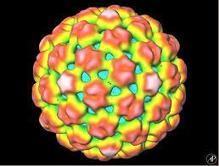
Geminivirus particle: characteristic doubled icosahedron containing a single ssDNA

Geminivirus particle: courtesy of Russell Kightley Media

The geminiviromics group has pretty much got away from me now; the folk I trained as PhD students in the late 1990s and early 2000s were enthused enough with the field that they have gradually usurped my leadership and supervisory role, and made the field their own.  I still maintain an interest in using Bean yellow dwarf mastrevirus (BeYDV) as an expression vector for “biofarming” purposes; I am also maintaining a project on Beak and feather disease circovirus (BFDV) diversity and plant-made vaccines.  I think we pretty much did what we set out to do – including the brave prediction I made about host range and pathogenicity, which led to some very interesting work on recombination and genome modularity, and the successful engineering of pathogen-derived resistance to MSV.

So I owe some thanks, in retrospect: first, to Barbara von Wechmar, who sparked the interest – and provided isolates, leafhoppers, and expertise.  Second, to Bev Clarke and Fiona Tanzer (aka Hughes), who were brave enough to blaze the trail, and clone our first MSVs – and make one infectious, in the case of Fiona.  Thanks to Wendelin “Popeye” Schnippenkoetter, for your single-minded perseverance in mixing and matching genomes; thanks Kenneth Palmer, for showing the way for transient expression assays in maize cells and engineering MSV as a vector.  Thanks Janet Willment, for mapping replication origins in MSV and expanding us into wheat viruses; thanks Jennifer Thomson for the collaboration, and Fiona and Tichaona Mangwende and Dionne Shepherd for breaking us into maize resistance engineering.  Thanks Christine Rey for the collaboration, and Leigh Berrie for your quiet competence in our detour into South African cassava mosaic virus.  Thanks Darrin (aka Darren) Martin and Eric van der Walt, for so brilliantly exploring MSV diversity, evolution and recombination – and Darrin for endless amusement in the lab, as well as for two completely distinct and invaluable software packages, for symptom quantitation and recombination analysis.  In the present generation, thanks to Suhail Rafudeen and our student Rizwan Syed (and Dionne and Darrin as supernumerary supervisors); thanks Aderito Monjane for doing such a ridiculous amount of work for a superlative PhD; thanks Dionne and Marian, for keeping the maize engineering afloat – and thanks also to Arvind Varsani, for retraining himself from a papillomavaccinologist to a circomicist, and for popping up everywhere.

PLOS Pathogens: Environmental Predictors of Seasonal Influenza Epidemics across Temperate and Tropical Climates

18 March, 2013

See on Scoop.itVirology News

Human influenza infections exhibit a strong seasonal cycle in temperate regions. Recent laboratory and epidemiological evidence suggests that low specific humidity conditions facilitate the airborne survival and transmission of the influenza virus in temperate regions, resulting in annual winter epidemics. However, this relationship is unlikely to account for the epidemiology of influenza in tropical and subtropical regions where epidemics often occur during the rainy season or transmit year-round without a well-defined season. We assessed the role of specific humidity and other local climatic variables on influenza virus seasonality by modeling epidemiological and climatic information from 78 study sites sampled globally. We substantiated that there are two types of environmental conditions associated with seasonal influenza epidemics: “cold-dry” and “humid-rainy”. For sites where monthly average specific humidity or temperature decreases below thresholds of approximately 11–12 g/kg and 18–21°C during the year, influenza activity peaks during the cold-dry season (i.e., winter) when specific humidity and temperature are at minimal levels. For sites where specific humidity and temperature do not decrease below these thresholds, seasonal influenza activity is more likely to peak in months when average precipitation totals are maximal and greater than 150 mm per month. These findings provide a simple climate-based model rooted in empirical data that accounts for the diversity of seasonal influenza patterns observed across temperate, subtropical and tropical climates.

Ed Rybicki‘s insight:

This is really quite a big deal: I blogged recently on the first paper that explored this notion in detail; here we see that paper vindicated, and new data presented.


It is interesting that the virus should have evolved to be spread in this way: in drier cold air in temperate climates, and in warm wet air in more tropical climes.  It also very nicely explains seasonality in influenza transmission.


Now, let’s do something ABOUT it!

See on www.plospathogens.org

14 adults ‘cured’ of killer HIV virus [NOT!!]

16 March, 2013

See on Scoop.itVirology News

TWO weeks after doctors rid a baby of the disease, it appears the treatment has worked on full-grown men and women

Ed Rybicki‘s insight:

You have to hate sub-editors – the people who are tasked, in papers like the Sun, to come up with the most lurid headline possible.


The facts are these: a number of people were treated, soon after infection with HIV-1, with a course of combo ARVs.  For one reason or another, they stopped taking them – and they are, up to seven years out – controlling their virus load to undetectable levels.


Note: they are almost certainly NOT cured; the virus is integrated into their CD4+ T-cells, and is simply quiescent or ticking over at a very low level of expression.


Howevr, it is potentially good news – IF it can be replicated in a wider cohort, and IF people can be caught at an early stage of infection.

See on www.thesun.co.uk

A novel coronavirus capable of lethal human infections

3 March, 2013

See on Scoop.itIIDMM News

In September 2012, a novel coronavirus was isolated from a patient in Saudi Arabia who had died of an acute respiratory illness and renal failure.The clinical presentation was reminiscent of the outbreak caused by the SARS-coronavirus (SARS-CoV) exactly ten years ago that resulted in over 8000 cases. Sequence analysis of the new virus revealed that it was indeed a member of the same genus as SARS-CoV. By mid-February 2013, 12 laboratory-confirmed cases had been reported with 6 fatalities. The first 9 cases were in individuals resident in the Middle East, while the most recent 3 cases were in family members resident in the UK. The index case in the UK family cluster had travel history to Pakistan and Saudi Arabia. Although the current evidence suggests that this virus is not highly transmissible among humans, there is a real danger that it may spread to other parts of the world. Here, a brief review of the events is provided to summarize the rapidly emerging picture of this new virus.

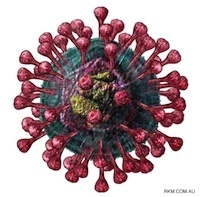
Coronavirus graphic courtesy of Russell Kightley Media

Ed Rybicki‘s insight:

It is truly amazing how fast things can be done these days: it was only in SEPTEMBER that the new virus was isolated; the latest fatality was literally in the last couple of weeks.  It remains to be seen whether or not it will spread – given its apparent lethality, we can only hope it does not!

See on www.virologyj.com

ViroBlogy: 2012 in review

1 February, 2013

So: thank you, anyone who clicked in, and regular visitors.  You make it worthwhile!!

The WordPress.com stats helper monkeys prepared a 2012 annual report for this blog.

Here’s an excerpt:

4,329 films were submitted to the 2012 Cannes Film Festival. This blog had 33,000 views in 2012. If each view were a film, this blog would power 8 Film Festivals

Click here to see the complete report.