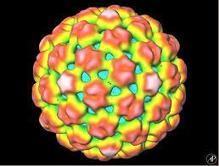
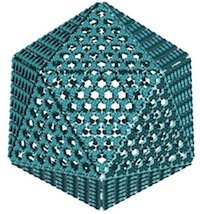
Recombinant Monovalent Llama-Derived Antibody Fragments (VHH) to Rotavirus VP6 Protect Neonatal Gnotobiotic Piglets against Human Rotavirus-Induced Diarrhea

10 May, 2013

See on Scoop.itVirology News

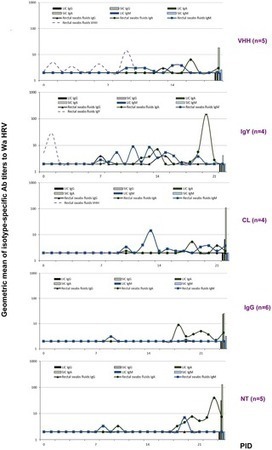
This study shows that the oral administration of rotavirus VP6-VHH nanoAb is a broadly reactive and effective treatment against rotavirus-induced diarrhea in neonatal pigs. Our findings highlight the potential value of a broad neutralizing VP6-specific VHH nanoAb as a treatment that can complement or be used as an alternative to the current strain-specific RVA vaccines. Nanobodies could also be scaled-up to develop pediatric medication or functional food like infant milk formulas that might help treat RVA diarrhea.

Ed Rybicki‘s insight:

Always nice to Scoop a paper from a co-author, in this case Andres Wigdorovitz and friends.  Nice work, too – shows that rotavirus VP6 is a useful recombinant protein target for use as a vaccine, given that llama single-chain Abs specific to it can protect.  But why not make them in plants, Andres??

See on www.plospathogens.org

Antigenic Drift of the Pandemic 2009 A(H1N1) Influenza Virus in a Ferret Model

10 May, 2013

See on Scoop.itVirology News

Infection with influenza virus leads to significant morbidity and mortality. Annual vaccination may prevent subsequent disease by inducing neutralizing antibodies to currently circulating strains in the human population. To escape this antibody response, influenza A viruses undergo continuous genetic variation as they replicate, enabling viruses with advantageous antigenic mutations to spread and cause disease in naïve or previously immune or vaccinated individuals. To date, the 2009 pandemic virus (A(H1N1)pdm09) has not undergone significant antigenic drift, with the result that the vaccine remains well-matched and should provide good protection to A(H1N1)pdm09 circulating viruses. In this study, we induced antigenic drift in an A(H1N1)pdm09 virus in the ferret model. A single amino acid mutation emerged in the dominant surface glycoprotein, hemagglutinin, which had a multifaceted effect, altering both antigenicity and virus receptor specificity. The mutant virus could not be isolated using routine cell culture methods without the virus acquiring additional amino acid changes, yet was fit in vivo. The implications for surveillance of circulating influenza virus are significant as current assays commonly used to assess vaccine mismatch, as well as to produce isolates for vaccine manufacture, are biased against identification of viruses containing only this mutation.


Ed Rybicki‘s insight:

There is a rather disturbing result in this paper: that is, that the mutation in the H1N1 HA that emerged in serial ferret transfers that was responsible for antigenic drift, resulted in a virus that could NOT be cultured by routine methods despite being quite happy in ferrets.  In fact, adapting the virus to culture meant it accumulated MORE mutations, meaning the thing they got out by "current assays" was NOT the same thing that was causing disease.


This is worrying for a number of reasons, not least of which is that informed decisions on probable vaccine efficiacy are made as a result of such assays – and the vaccines themselves, in some cases.  And if what these decisions are based on is incorrect…?


Time for some better science here, people – like next-gen sequencing rather than isolation as a measure of what is causing disease!

See on www.plospathogens.org

The highly pathogenic H7N3 avian influenza strain from July 2012 in Mexico acquired an extended cleavage site through recombination with host 28S rRNA

3 May, 2013

See on Scoop.itVirology News

A characteristic difference between highly and non-highly pathogenic avian influenza strains is the presence of an extended, often multibasic, cleavage motif insertion in the hemagglutinin protein.

Conclusions

This highly pathogenic H7N3 avian influenza strain acquired a novel extended cleavage site which likely originated from recombination with 28S rRNA from the avian host. Notably, this new virus can infect humans but currently lacks critical host receptor adaptations that would facilitate human to human transmission.

Ed Rybicki‘s insight:

This is rather sinister!  Not only can influenza viruses mutate, for antigenic drift, and reassort with one aother for antigenic shift – they can now recombine with HOST sequences to increase pathogenicity!

See on www.virologyj.com

Hype: “Regulators Discover a Hidden Viral Gene in Commercial GMO Crops!”

2 May, 2013

See on Scoop.itVirology News

by Jonathan Latham and Allison Wilson How should a regulatory agency announce they have discovered something potentially very important about the safety of products they have been approving for over twenty years?

Ed Rybicki‘s insight:

I am rather troubled by this article, because although it is obviously well-researched, it erects a house of cards from some rather flimsy initial premises.

The first is that the gene VI 3′ fragment, included as part of constructs for the 35S promoter, is in fact expressed in ANY of the transgenic plants it appears in: there is NO proof of this.

The second is that this same fragment encodes a polypeptide which has any/all of the functions associated with the full length protein: again, there is NO proof of this, although a throwaway statement is made that hints that it does.

The third is that the polypeptide fragment, IF expressed at all, would have deleterious effects in animals / humans: again, there is no conclusive proof of this at all, despite extensive toxicity trials.

There are other problems with the piece, including the statements:

“In general, viral genes expressed in plants raise both agronomic and human health concerns (reviewed in Latham and Wilson 2008).”

Sorry, this is not GENERALLY taken to be the case at all!

“This is because many viral genes function to disable their host in order to facilitate pathogen invasion. Often, this is achieved by incapacitating specific anti-pathogen defenses. Incorporating such genes could clearly lead to undesirable and unexpected outcomes in agriculture.”

Really? It has been clearly demonstrated that the anti-host function works in very different hosts, meaning this last sentence is true? Where?

“Furthermore, viruses that infect plants are often not that different from viruses that infect humans. For example, sometimes the genes of human and plant viruses are interchangeable, while on other occasions inserting plant viral fragments as transgenes has caused the genetically altered plant to become susceptible to an animal virus (Dasgupta et al. 2001).”

Oooooh…the taurine excreta value is high in this one…while an argument can be made that certain viruses of plants and of animals have a common origin, and are not THAT different in a long-term evolutionary sense, there are NO viruses that have been shown to infect both plants and mammals – NONE.

As for Dasgupta et al., what they showed was that flockhouse virus – an insect virus which replicates in plant cells but does not spread in plants – CAN spread in plants IF these are expressing CERTAIN plant virus-derived movement proteins. Which, I will note, are NOT components of any DNA in released GM plants of which I am aware.

And replication does not = “susceptible”: it means the virus CAN replicate and spread, NOT that it causes disease. I note that there are many viruses which replicate in both an insect and a plant, and others that replicate only in a plant but can be spread by an insect, and yet others which replicate in an insect only but can survive in plants as a reservoir. I note further that there are NO examples which can do any of these things in a plant and a mammal.

So – an interesting article, as I said, but one that is unnecessarily alarmist.
See on independentsciencenews.org

A novel platform for virus-like particle-display of flaviviral envelope domain III: induction of Dengue and West Nile virus neutralizing antibodies

1 May, 2013

See on Scoop.itVirology News

CD16-RIgE is a chimeric human membrane glycoprotein consisting of the CD16 ectodomain fused to the transmembrane domain and cytoplasmic tail of the gamma chain of the high affinity receptor of IgE (RIgE). Coexpression of CD16-RIgE and HIV-1 Pr55Gag polyprotein precursor (Pr55GagHIV) in insect cells resulted in the incorporation of CD16-RIgE glycoprotein into the envelope of extracellular virus-like particles (VLPs), a phenomenon known as pseudotyping. Taking advantage of this property, we replaced the CD16 ectodomain of CD16-RIgE by the envelope glycoprotein domain III (DIII) of dengue virus serotype 1 (DENV1) or West Nile virus Kunjin (WNVKun). The two resulting chimeric proteins, DIII-DENV1-RIgE and DIII-WNVKun-RIgE, were addressed to the plasma membrane, exposed at the surface of human and insect cells, and incorporated into extracellular VLPs when coexpressed with Pr55GagHIV in insect cells. The DIII domains were accessible at the surface of retroviral VLPs, as shown by their reactivity with specific antibodies, and notably antibodies from patient sera. The DIII-RIgE proteins were found to be incorporated in VLPs made of SIV, MLV, or chimeric MLV-HIV Gag precursors, indicating that DIII-RIgE could pseudotype a wide variety of retroviral VLPs. VLP-displayed DIII were capable of inducing specific neutralizing antibodies against DENV and WNV in mice.

Although the neutralization response was modest, our data confirmed the capability of DIII to induce a flavivirus neutralization response, and suggested that our VLP-displayed CD16-RIgE-based platform could be developed as a vaccine vector against different flaviviruses and other viral pathogens.

HIV matrix illustration by Russell Kightley Media

Ed Rybicki‘s insight:

Love it: using retrovirus Gag polyproteins that bud out of insect cells to carry a chimaeric protein that elicits neutralising antibodies against dengue and West Nile viruses.  Love it because my lab has huge experience in making such particles, and we have tried to tout them as vehicles for display of other antigens…but haven’t actually done it!


Modest titres, it must be noted: while I think this is a great paper, I am NOT convinced that retrovirus-derived VLPs will be of any use in such an application, because yields of particles via insect cells are simply too low.  Sad, but true.  HOWEVER: making a DNA vaccine out of it, on the other hand…would allow particles to be made in cells that receive the DNA, which would significantly increase their immunogenicity as it would expose cells that have NOT received DNA, to the immunogens.


Just a thought.

See on www.virologyj.com

H7N9 virus: Should SA be worried?

30 April, 2013

See on Scoop.itVirology News

It has been described as one of the world’s most lethal flu viruses.

More than 20 people have already died from it in China, and more than 100 are infected.

The new strain of bird flu, the H7N9, has caused such a stir in the medical field that local practitioners are on a drive to educate South Africans on the importance of getting flu vaccines.

“This strain is actually nothing new, but the virus is changing itself… it’s becoming bigger and it is absolutely critical that everyone be vaccinated. It doesn’t appear that any South Africans have contracted or are in danger of the virus. but flu spreads quickly, and while we don’t want to scare people, there needs to be awareness,” said Professor Lynne Webber, head of the medical virology department at the University of Pretoria.

Ed Rybicki‘s insight:

Seconded on people getting flu vaccines…although there IS no available vaccine that would protect against this one, so the point is moot!


What this points up rather strongly is that SA needs a capacity to make emergency response vaccines – because we most definitely will not get any from anyone else, if this one goes pandemic, just as happened in 2009 with the H1N1pdm virus.

See on www.iol.co.za

WHO: New flu passes more easily from bird to human

29 April, 2013

See on Scoop.itVirology News

A new strain of bird flu that emerged in China over the past month is one of the “most lethal” flu viruses so far, worrying health officials because it can jump more easily from birds to humans than the one that started killing people a decade ago,…

Ed Rybicki‘s insight:

Frightening…!  Which is the adult way of saying "scary".

See on www.galvestondailynews.com

Carlos Slim Joins Bill Gates, Other Billionaires, With $100 Million To Fight Polio

29 April, 2013

See on Scoop.itVirology News

The move marks the highest-profile joint philanthropic effort so far by the world’s two richest men.

Ed Rybicki‘s insight:

So, Tokyo S and various Oppenheimers: time to GIVE!!!

See on www.forbes.com

Characterizing the killer H7N9

29 April, 2013

See on Scoop.itVirology News

What scientists are learning about the zoonotic flu virus that has infected more than 100 people in China since February.

The virus appears to be more virulent than past H7 avian flu viruses in past outbreaks, which have caused conjunctivitis but have only been blamed for one death. Furthermore, this virus appears to be spreading from its hosts to humans unusually readily

Ed Rybicki‘s insight:

March 31 to April to publish several papers on the virus: new technology has enabled SUCH rapid progress these days, it is almost unbelievable.

See on www.the-scientist.com

Ineffective – HIV Vaccine Trial Discontinued

27 April, 2013

See on Scoop.itVirology News

The National Institute of Allergy and Infectious Diseases (NIAID) has announced that it will halt its HVTN 505 HIV vaccine

trial due to a perceived lack of efficacy. A scheduled review by an independent data and safety monitoring board found that the vaccine regimen neither prevented HIV infection nor reduced viral load in vaccine recipients who became infected with HIV.

The announcement will come as a blow to those hoping the HVTN 505 would be an effective intervention to stem the HIV pandemic.

Ed Rybicki‘s insight:

And another one bites the dust…not only not effective, suspected of increasing infection rates.  VERY sad!

See on blogs.terrapinn.com