Schmallenberg Virus Pathogenesis, Tropism and Interaction with the Innate Immune System of the Host

1 February, 2013

See on Scoop.itVirology News

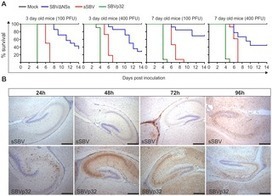
Schmallenberg virus (SBV) was discovered in Germany (near the town of Schmallenberg) in November 2011 and since then has been found to be the cause of malformations and stillbirths in ruminants. SBV has spread very rapidly to many European countries including the Netherlands, Belgium, France and the United Kingdom. Very little is known about the biological properties of this virus and there is no vaccine available. In this study (i) we developed an approach (called reverse genetics) that allows the recovery of “synthetic” SBV under laboratory conditions; (ii) we developed a mouse model of infection for SBV; (iii) we showed that SBV replicates in neurons of experimentally infected mice similar to naturally infected lambs and calves; (iv) we developed viral mutants that are not as pathogenic as the original virus due to the inability to counteract the host cell defenses; and v) we identified mutations that are associated with increased virulence. This work provides the experimental tools to understand how this newly emerged virus causes disease in ruminants. In addition, it will now be possible to manipulate the SBV genome in order to develop highly effective vaccines.


Ed Rybicki‘s insight:

A timely paper on a serious new emerging virus of livestock.

See on www.plospathogens.org

PLOS Pathogens: The Importance of Prions

1 February, 2013

See on Scoop.itVirology News

While agent host-range and strain properties convinced early researchers of a viral etiology, the once unorthodox postulate that prion transmission occurs by conformational corruption of host-encoded cellular prion protein (PrPC) by a pathogenic isoform (PrPSc) is now widely accepted. Indeed, conformational templating is increasingly understood to be a general mechanism of protein-mediated information transfer and pathogenesis. The high infectivity of prions, their capacity to cause neurodegeneration in genetically tractable animal models, as well as the ability to culture prions in cells, or under cell-free conditions using defined components, provide finely controlled experimental settings in which to elucidate general mechanisms for all diseases involving protein conformational templating, and thus to develop integrated therapeutic approaches.

Ed Rybicki‘s insight:

These things have fascinated me since I heard and read about kuru and scrapie as a student – and they still do.  Alternative protein folding as a route to pathology – and transmissible!


Prion transmission graphic by Russell Kightely Media.

See on www.plospathogens.org

Dual Short Upstream Open Reading Frames Control Translation of a Herpesviral Polycistronic mRNA

1 February, 2013

See on Scoop.itVirology News

Kaposi’s sarcoma-associated herpesvirus (KSHV) is the etiologic agent of multicentric Castleman’s disease, primary effusion lymphoma and Kaposi’s sarcoma. KSHV expresses a number of transcripts with the potential to generate multiple proteins, yet relies on the cellular translation machinery that is primed to synthesize only one protein per mRNA. Here we report that the viral transcript encompassing ORF35–37 is able to direct synthesis of two proteins and that the translational switch is regulated by two short upstream open reading frames (uORFs) in the native 5′ untranslated region. uORFs are elements commonly found upstream of mammalian genes that function to interfere with unrestrained ribosomal scanning and thus repress translation of the major ORF. The sequence of the viral uORF appears unimportant, and instead functions to position the translation machinery in a location that favors translation of the downstream major ORF, via a reinitiation mechanism. Thus, KSHV uses a host strategy generally reserved to repress translation to instead allow for the expression of an internal gene.

 
See on www.plospathogens.org

123 Against HPV – info

31 January, 2013

See on Scoop.itVirology News

This website provides information for the general
public on HPV (Human Papillomavirus), its links
with cervical cancer and genital warts, and the
HPV vaccination.

See on www.123againsthpv.co.uk

Virus-like particle and Nano-particle vaccines 2012: a conference report

30 January, 2013

Alta van Zyl, Virology Group, Molecular & Cell Biology Department, UCT

Introduction:
VLP flusm

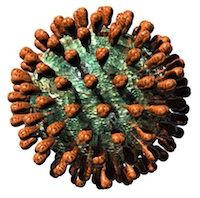
Haemagglutinin-only Influenza A virus VLP. Courtesy of Russell Kightley Media

The new international conference on virus-like particles and nano-particles (VLPNPV) took place in Cannes, France at The Novotel Montfleury Hotel from the 28th to the 30th of November 2012.  The scope of the conference included virus-like particles (VLPs), the plant-based expression of VLP vaccines as well as expression and optimisation of VLPs.

Other topics included in the conference were:

  • VLP platform delivery systems
  • VLP vaccines
  • Nano-particles and nano-particulate vaccines

A multitude of topics were covered during the conference and many of the talks pertained to the immunogenicity of the VLPs and nano-particles and how they compared with the immunogenicity of DNA or subunit vaccines.

Talks were given by researchers from companies such as Medicago, Mucosis, Pevion Vaccines and Novavax. These talks gave a perspective on factors that need to be considered when commercialising VLP/nano-particle vaccines and to be GMP compliant.

Compelling presentations:

Developing plant-made virus-like particle vaccine products: An integrated platform from discovery to commercial scale

Marc-Andre D’Aoust, Nathalie Landry, Sonia Trepanier, Michele Dargis, Manon Couture and Louis-Philippe Vezina (Medicago, Quebec City, Quebec, Canada)

This talk was about a plant-made VLP against both pandemic and seasonal influenza- these vaccines are now in the clinical trial phase. What was especially interesting was the view from an industry point of view where expression had to be scaled up to produce large amounts of vaccine.  The Medicago platform can synthesize and clone approximately 100 gene constructs in two weeks, they can prepare 100 bacterial cultures per week and they have automated infiltration where 200 plant transformations can be performed per day and 150 VLP engineering approaches can be tested in one week.  For influenza Medicago tested 48 different infiltration approaches in one day for HA, NA, M1, M2 as well as P1 Gag and HGalT.  Medicago has been able to produce 10 million doses of HA VLPs in just one month.

See also: 

  • D’Aoust et al (2010) PBJ 8:  607-619 – The production of hemagglutinin-based virus-like particles in plants: a rapid, efficient and safe response to pandemic influenza.
  • http://www.medicago.com

Development of RNA-free plant VLPs a source of novel therapeutics

George Lomonossoff (John Innes Centre, Norwich, UK)

This group made empty Cowpea Mosaic Virus (CPMV) VLPs that contained no RNA.  CPMV VLPs are versatile nanoparticles to which organic, inorganic and biological molecules can be bound.  The empty nature of the particle means that they can be used as carrier molecules for therapies; this could prove to be potentially useful as a cancer-treatment therapy.  The system is advantageous because of the lack of RNA which makes the particles non-infectious and no bio-containment is needed for the production of these VLPs.

Immunogenicity of VLPs: an immunological perspective

Martin Bachmann (University of Zurich, Zurich, Switzerland)

Background was given from immunological point of view about what makes VLPs so immunogenic. Three properties contribute to the immunological properties of VLPs (1) their size, (2) the repetitiveness of the particle capsid which provides multiple sites for antibody binding and (3) TLR ligands – the particle can be disassembled, the RNA removed and replaced with a TLR ligand to enhance immunogenicity. Also, the size of VLPs is optimal for drainage to the lymph nodes.

Immunogenicity optimization strategies for public-sector development of vaccines: the critical role of optimizing the antigen.

Martin Howell Friede (WHO, Geneva, Switzerland)

This talk was about looking at VLPs from the vaccine development view.  Monomeric antigens are not very immunogenic; therefore adjuvants were developed and came into use. For an efficient vaccine the antigen must be multimeric as antigen alone is insufficient to be immunogenic without adjuvant. Two factors have to be considered when producing a vaccine for FDA approval; (1) optimise the antigen before using an adjuvant, (2) use an adjuvant that has already been approved by the FDA. VLPs as vaccines provide the potential for immune-stimulation without the addition of adjuvant as the multimeric presentation of the antigen will enhance its immunogenicity.

Enhancing the immunogenicity of VLP vaccines

Richard W. Compans (Emory University, Atlanta, Georgia, USA)

This talk highlighted strategies which could be used to enhance the immunogenicity of VLPs.

  1. Look at alternate routes for vaccine delivery (intranasal, intramuscular, subcutaneous etc)
  2. Increase the breadth of immunity by enhancing responses to conserved antigens/epitopes
  3. Increase the amount of antigen incorporated into VLPs
  4. Incorporate the adjuvant into the VLPs as part of the structure

See also:

  • Ye et al (2011) PLoS One 6(5):  e14813
  • Wang et al (2008) J Virol

Innate and adaptive responses to plant-made VLP vaccines

Brian Ward (McGill University, Montreal, Quebec, Canada)

Brain Ward is also the medical officer at Medicago.  Humans rarely react to plant proteins/antigens. The plant glycans fucose/xylose at the N-terminal is an allergen and can cause anaphylaxis in humans. During trial experiments with influenza no individuals developed IgE responses to plant glycans, therefore plant produced vaccine is safe. The H1 VLP induced long lasting memory multifunctional T-cell responses in humans.

Impressions of the conference:

The conference was well organised with leaders in the field presenting their work. Interaction with the delegates aid in building crucial networking opportunities and work relationships. The international arena is packed with new technology development allowing us the opportunity to learn and improve our own understanding of various concepts.

This conference proved to be an invaluable learning experience and I thank the NRF for this opportunity and for providing me with the funding to attend this conference.  The exposure to conferences, especially those in the international arena, aid in the development of students and contribute to the quality of research that is conducted at UCT.

References:

1. VLPNPV website

(http://www.meetingsmanagement.co.uk/index.php?option=com_content&view=article&id=33&Itemid=83)

2.  Personal notes taken at the conference
One Of My Favorite Charts On The Power Of Vaccines

28 January, 2013

See on Scoop.itVirology News

I’m posting this because I found the graphic in a file folder on my computer and didn’t want to lose it. It’s originally from my profile of Bill Gates from last year’s Forbes Power List issue.

Ed Rybicki‘s insight:

Amen!

See on www.forbes.com

Drinking water unexpectedly rich in microbial life

27 January, 2013

See on Scoop.itVirology News

Flow cytometry can now be officially used for the quantification of microbial cells in drinking water. The new analytical method provides much more realistic results than the conventional method, in which bacterial colonies are grown on agar plates.

Ed Rybicki‘s insight:

Pretty much mirrors phage practicals we used to do in MCB here at UCT: tap water was always cleaner in terms of coliphages than bottled mineral water.  I’d still go with phages over flow cytometry, though: it was exquisitely sensitive, and a LOT cheaper.

See on www.sciencedaily.com

And so it went – 2012, that is

14 December, 2012

…like a rocket…flashed past; I’m still emotionally in August or so!

I meant to do some more substantive posts instead of only copying Scoop.it Virology News posts here; however, the best-laid plans and such, and I didn’t.  I will in 2013, though – and there will be an iBook coming or possibly even two (influenza and PCR), so I will use this forum to announce glad tidings.

Then there’s the ZA Virus [=Zombie Apocalypse, obviously] novel, and Green Vaccines, and…OK, getting ahead of myself here!

Thanks for the support and readership, I hope everyone has a good solstice break!

Best,

Ed

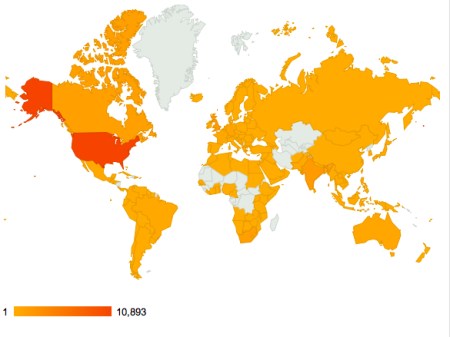
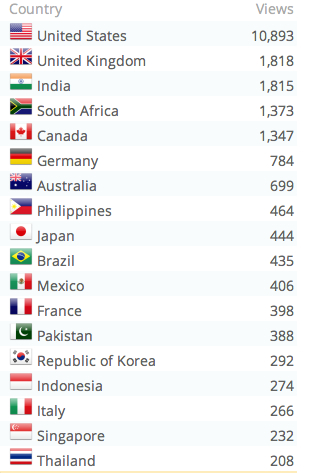
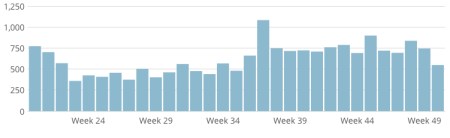
PS: some access stats for 2012 for you.  Looks like the only places that DON’T access ViroBlogy are parts of central and west Africa, central Asia and Greenland.

Screenshot 14:12:2012 12:11

Screenshot 14:12:2012 12:09


Screenshot 14:12:2012 12:20

PLOS Pathogens: Tubular Structure Induced by a Plant Virus Facilitates Viral Spread in Its Vector Insect

7 December, 2012

See on Scoop.itVirology News

“Numerous plant viruses that seriously damage agricultural crops are transmitted by insects. However, the mechanisms enabling virus transmission by vector insects have been poorly understood, in part, due to the lack of useful tools. A persistent-propagative plant virus replicates and encodes nonstructural proteins to form various cytopathological structures in their two types of hosts: plants and vector insects. Here, we took advantage of unique biological tools, including insect vector cell culture and RNA interference (RNAi) induced by synthesized dsRNA, to investigate the molecular mechanisms facilitating the efficient spread of Rice dwarf virus (RDV), a persistent-propagative plant virus, among cells and organs of leafhopper vector. Our experimental evidence shows that RDV exploited virus-containing tubules composed of nonstructural viral protein Pns10 to traffic along actin-based cellular machinery, allowing efficient cell-to-cell spread of the virus in leafhopper vector. Consistently, and in support of a function of Pns10 tubules as a determinant for viral spread in vector insect, the introduction of dsRNA from Pns10 gene into cultured insect vector cells or intact insect strongly inhibited such tubule formation, preventing efficient viral intercellular spread in the leafhopper in vitro and in vivo and subsequent transmission by the vector, without significant effect on viral multiplication in leafhopper cells.”


This paper has some of what HAVE to be some of the nicest confocal pics I have ever seen illustrating structures to do with viruses in cells – and explains an old mystery, which is – why do many plant-infecting viruses induce the formation of tubular structures?  In this case, to spread the virus between cells of the vector.  Nice!

See on www.plospathogens.org

Making a Flu Vaccine Without the Virus | Wired Science | Wired.com

6 December, 2012

See on Scoop.itVirology News

A new vaccine strategy could make flu shots cheaper, safer, and easier to produce.

…scientists at the Friedrich-Loeffler-Institute (Germany’s Federal Research Institute for Animal Health), and biotech company CureVac in Tübingen have … designed a piece of mRNA encoding the hemagglutinin of the influenza strain H1N1. Cells use mRNA to shuttle the information contained in the genome from the nucleus into the periphery of the cell, where it is translated into a protein. By injecting synthetic mRNA into the skin of mice, the researchers coaxed the animals’ cells into producing the virus protein themselves. This elicited an immune response that later protected the animals from infection with otherwise lethal doses of influenza virus, the researchers reported online on 25 November in Nature Biotechnology.


Yessss….welll….ummmmm….  No, it wouldn’t be cheaper: RNA is EXPENSIVE to make under any circumstances.  And there is a published alternative that would probably be MUCH easier: encapsidating mRNA made in cells via an alphavirus vector, in Tobacco mosaic virus coat protein!


Virology. 2007 Feb 20;358(2):321-33. Epub 2006 Oct 2.
Assembly of trans-encapsidated recombinant viral vectors engineered from Tobacco mosaic virus and Semliki Forest virus and their evaluation as immunogens.
Smith ML, Corbo T, Bernales J, Lindbo JA, Pogue GP, Palmer KE, McCormick AA.

See on www.wired.com