Evaluation of methods to concentrate and p… [Environ Microbiol. 2012] – PubMed – NCBI

9 August, 2012

See on Scoop.itAquatic Viruses

“Viruses have global impact through mortality, nutrient cycling and horizontal gene transfer, yet their study is limited by complex methodologies with little validation. Here, we use triplicate metagenomes to compare common aquatic viral concentration and purification methods across four combinations as follows: (i) tangential flow filtration (TFF) and DNase + CsCl, (ii) FeCl(3) precipitation and DNase, (iii) FeCl(3) precipitation and DNase + CsCl and (iv) FeCl(3) precipitation and DNase + sucrose. Taxonomic data (30% of reads) suggested that purification methods were statistically indistinguishable at any taxonomic level while concentration methods were significantly different at family and genus levels. Specifically, TFF-concentrated viral metagenomes had significantly fewer abundant viral types (Podoviridae and Phycodnaviridae) and more variability among Myoviridae than FeCl(3) -precipitated viral metagenomes. More comprehensive analyses using protein clusters (66% of reads) and k-mers (100% of reads) showed 50-53% of these data were common to all four methods, and revealed trace bacterial DNA contamination in TFF-concentrated metagenomes and one of three replicates concentrated using FeCl(3) and purified by DNase alone. Shared k-mer analyses also revealed that polymerases used in amplification impact the resulting metagenomes, with TaKaRa enriching for ‘rare’ reads relative to PfuTurbo. Together these results provide empirical data for making experimental design decisions in culture-independent viral ecology studies.”


Things just keep getting easier and easier…now to do some work!

Mimivirus graphic courtesy of Russell Kightely Media

See on www.ncbi.nlm.nih.gov

Ebola Outbreak in Uganda: CDC Rushes to Contain Virus

8 August, 2012

See on Scoop.itVirology News

Dr. Richard Besser travels with American doctors as they race to stop a global threat.


Really? Because local doctors were doing nothing about it? Because it was really a global threat? Come on! The Kikwit outbreak in the 1990s was MUCH worse, occurred in a much more chaotic public health setting – and less than 0.1% of the city of 500 000 was affected, and it didn’t spread.
Be more afraid of…oh, I don’t know, maybe West Nile virus, Dengue virus, Yellow fever virus?? WAAY more cases, and far closer to the US of A!

See on www.youtube.com

Setting your virus free

7 August, 2012

I was reminded, as I walked in my garden in the Cape Town late afternoon sun a short while ago, of a Master’s degree project I had started with a very bright young person.  A young person who didn’t finish, because she abandoned her degree in the interests of finding herself – and subsequently got into computer-based education some 16 years ago, but that’s another story.

I have written about her previously, as it happens: she is the “Dr” Jacobson in this story, written about a year after her Honours essay on Emerging Viruses became the most authoritative source in the world on Ebola virus that was available electronically – and the Kikwit Ebola outbreak that occurred soon afterwards caused the world to go frantically looking for information.

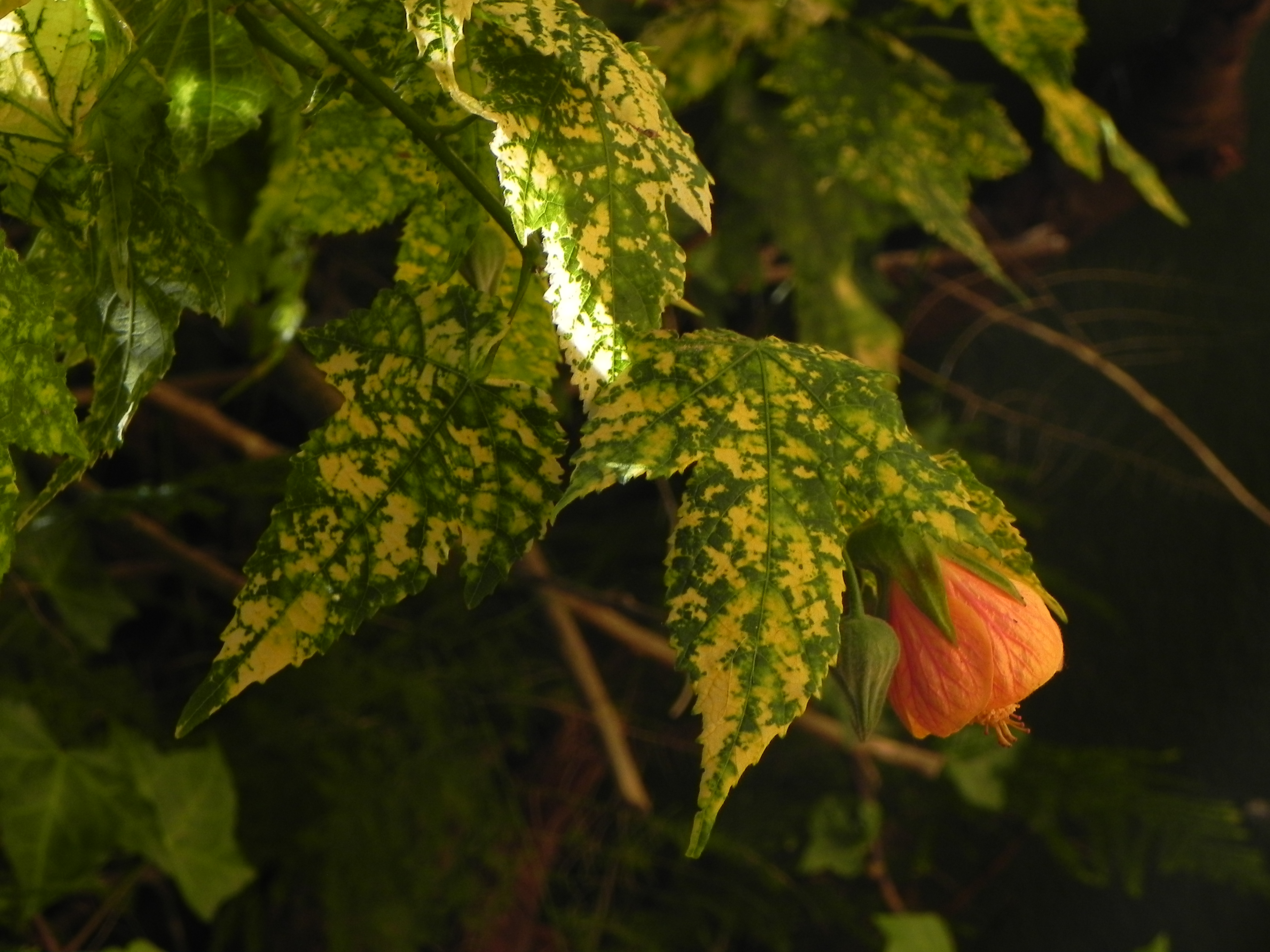
Sadly for her, she could not work on Ebola for her Master’s, so I gave her what I thought was the next best thing: a project on making a replicating DNA vector system out of Abutilon mosaic virus (AbMV), a two-component ssDNA begomovirus.  The project started in the easiest way imaginable: she went to the local plant nursery, and bought a variegated Abutilon striatum in a pot, and planted it in our Departmental plant room.

Abutilon leaves and flower

AbMV in what is now an ornamental abutilon produces very striking symptoms, which accounts for the popularity of the plant, and its spread across much of the world – by cuttings, mainly.  This is fortunate, as in most cases the virus has lost its natural mode of transmission, which is only via whiteflies (Bemisia tabaci).  Thus, by fortuitous accident, a virus that is  effectively crippled is now spread far beyond its point of origin in South America, purely by human intervention.

Be this as it may, our mission was to harness the fact that AbMV maintains itself as an episome for the lifetime of a plant by making it into an expression vector for plant-made vaccines.  Kenneth Palmer in my lab had already done similar work with Maize streak virus; however, maize was not really a usable host because it is an annual and was hard to infect and the vector did not spread.  It was also not usable in dicot hosts, so we settled on AbMV as being available in our and many other back yards.

We did not get far: while Alison was really bright, by this time she had discovered that science really wasn’t for her, and made essentially no progress beyond cloning a B genome and getting some sequence out of it.  She left to find more fulfilling things to do, and her experimental material continued to grow in the plant room – and gather red spider mites.  I still have the badge off her labcoat, incidentally: I couldn’t let it go; it was and is the only Led Zeppelin logo I have ever seen on the standard white coat.

This is where we get to the title of this post. In 1996 or so, I took the by-now largish plant in its pot back home, and set it free: I planted it in my garden.  It eventually developed into a large bush, easily 3 x 2 metres wide and tall – and has just been cut back, after some 16 years, to allow it to redevelop.  I get a little kick out of seeing civilians step nervously away from it, after I have walked them up to it, and say: “And this is the biggest virus you will ever meet”.  Let’s see you do THAT, Ebola virologists!

Oh, it isn’t entirely free: we sampled it again a couple of years ago when the fearsomely efficient geminivirus-hunting crew that grew out of my lab wanted samples to test their then-new phi29 rolling circle amplification chops on.  We could still only get a B genome out of it, and one that was 10% different from any other published AbMV – so maybe there’s still a story there.

But all it has to do now is keep on growing.  And look beautiful.

Viruses linked to prostate cancer – ABC News (Australian Broadcasting Corporation)

1 August, 2012

See on Scoop.itVirology News

Australian scientists have made an important discovery about prostate cancer.

Nice little video: of course, they don’t say WHICH papillomaviruses are involved, along with Epstein-Barr virus.  Anyway – as long as it’s 16 and 18, good reason to get vaccinated, boys!  I thank Russell Kightley for sending me the clip.

See on www.abc.net.au

More Ugandans Admitted with Possible Ebola

1 August, 2012

See on Scoop.itVirology News

Date: Tue 31 Jul 2012
Source: Time Healthland, Associated Press report [edited]
http://healthland.time.com/2012/07/30/6-more-ugandans-admitted-with-possible-ebola/

More Ugandans Admitted with Possible Ebola
——————————————
A total of 6 more patients suspected to have Ebola have been admitted to the hospital days after investigators confirmed an outbreak of the highly infectious disease in a remote corner of western Uganda, a health official said on Monday [30 Jul 2012]. Stephen Byaruhanga, health secretary of the affected Kibaale district, said possible cases of Ebola, at 1st concentrated in a single village, are now being reported in more villages. “It’s no longer just one village. There are many villages affected,” Byaruhanga said. In a national address on Monday, Uganda’s President advised against unnecessary contact among people, saying suspected cases of Ebola should be reported immediately to health officials.

Officials from Uganda’s Ministry of Health and the World Health Organization announced on Saturday [28 Jul 2012] that the deadly Ebola virus killed 14 Ugandans this month, ending weeks of speculation about the cause of a strange illness that had some people fleeing their homes in the absence of reliable answers. If the 6 new cases are confirmed as Ebola fever, it would bring to 26 the number of Ugandans infected with Ebola [virus].

This is the 4th occurrence of Ebola in Uganda since 2000, when the disease killed 224 people and left hundreds more traumatized in norther Uganda. At least 42 people were killed in another outbreak in 2007, and there was a lone Ebola case in 2011. Investigators took nearly a month to confirm Ebola’s presence in Uganda this year. In Kibaale, a district with 600 000 residents, some villagers started abandoning their homes to escape what they thought was an illness caused by bad luck. One family lost 9 members, and a clinical officer and her 4-month-old baby died from Ebola, Byaruhanga said.

D.K. Lwamafa, of Uganda’s Ministry of Health, told reporters on Saturday that one Ebola patient from Kibaale had been referred to the national hospital in the capital but had then died in Kibaale.

The confirmation of Ebola’s presence in the area has spread anxiety among sick villagers, who are refusing to go the hospital for fear they don’t have Ebola and will contract it there. All suspected Ebola patients have been isolated at one hospital where patients admitted with other illnesses fled after Ebola was announced. Only the hospital’s maternity ward still has patients, officials said, highlighting the deadly reputation of Ebola in a country where the authorities do not always respond quickly and effectively to emergencies and disasters. Barnabas Tinkasimire, a lawmaker from the area, said that some nurses refused to look after Ebola patients after one clinical officer died and another was taken ill.

“They are saying, ‘We can’t remain here if there is no sufficient allowance’,” Tinkasimire said of medical officers handling Ebola cases. The lawmaker said the government’s response so far has been poor and that it would have been worse without the technical support of organizations such as the World Health Organization and the U.S. Centers for Disease Control and Prevention (CDC). “It took long for the government to respond, and up to now many people don’t know how to guard against Ebola. We need sensitization,” he said.

Ebola, which manifests itself as a hemorrhagic fever [But not in this outbreak – Mod.CP], is highly infectious and kills quickly. It was 1st reported in 1976 in Congo and is named for the river where it was recognized. A CDC factsheet on Ebola says the disease is “characterized by fever, headache, joint and muscle aches, sore throat, and weakness, followed by diarrhea, vomiting, and stomach pain. A rash, red eyes, hiccups and internal and external bleeding may be seen in some patients.”

Scientists don’t know the natural reservoir of the virus, but they suspect the 1st victim in an Ebola outbreak gets infected through contact with an infected animal. The virus can be transmitted through direct contact with the blood or secretions of an infected person, or objects that have been contaminated with infected secretions. During communal funerals, for example, when the bereaved come into contact with an Ebola victim, the virus can be contracted, health officials said.


Communicated by:
ProMED-mail from HealthMap alerts

See on www.promedmail.org
Ebola reaches Uganda’s capital

31 July, 2012

See on Scoop.itVirology News

Uganda’s president has warned against shaking hands and other physical contact after the first death from the deadly Ebola virus in the capital.

The latest outbreak started in Uganda’s western Kibale district, about 200km from Kampala, and around 50km from the border with Democratic Republic of Congo.

The fatal case in Kampala was a health worker who “had attended to the dead at Kagadi hospital” in Kibale, Health Minister Christine Ondoa told reporters.


And it’s deja vu all over again…this is how I started reporting virology on the Web, back in 1995 – with the Kikwit Ebola outbreak.  It’s possibly the first time Ebola has hit a major centre, so it could be interesting to see what develops.  Let’s hope nothing…!


I thank Russell Kightley Media for the Ebola virus graphic

See on news.ninemsn.com.au

‘SA safe from Ebola’ – Times LIVE

31 July, 2012

See on Scoop.itVirology News

South Africans need not be worried about contracting the Ebola virus after a new outbreak of the disease in Uganda.

The SA National Institute for Communicable Diseases said the risk of South Africans being infected was “extremely low”.

Ugandan President Yoweri Museveni has placed a ban on physical contact in the country after the virus was reported in the capital, Kampala, for the first time.

The institute’s spokesman, Professor Lucile Blumberg, said yesterday: “There is no travel restriction. It is unlikely that patients from the Kibaale district, Uganda, who are very sick, will find their way here. One does need direct contact with infected patients to become ill.”


As with ANY Ebola outbreak in fact, the peril for any but the immediately exposed is more imgained than real.  What Ed Regis once termed “Ebola Preston”, or a virus that is spread by print and electronic media, rather than by droplets.

See on www.timeslive.co.za

A bit of viral archeology

20 July, 2012

We were sifting through stuff found in a service room the other day, when I found a box of glass slides – undisturbed since about 1979 or so.  A very interesting box: double- and triple-width microscope slides, coated with dried agarose gel, and stained with Coomassie Brilliant Blue.  With my handwriting on them.  With whole virus electropherograms on them….

Backing up a bit: back in a previous research career, I was a plant virologist who had become an expert, during my MSc project, on physical and serological techniques to do with plant viruses, and the multicomponent isometric bromoviruses in particular.  This included differential, density gradient and analytical centrifugation; methods for purification of virus, capsid protein and genomic nucleic acid (all ssRNA); double-diffusion gel precipitin (=Ouchterlony’s technique) assays; the then new-fangled enzyme-linked immunosorbent assays (ELISA) – and whole-virus agarose gel electrophoresis, and immunoelectrophoresis.

This is mostly published – in my first-ever paper published in 1981, that I was too naive to know I shouldn’t submit to a good journal, so got it into Virology.

However, there were some bits that only ever made it into my Masters write-up – and then only in monochrome.  Here, then, is a little piece of virological and personal history: electropherograms of Brome mosaic bromovirus strains, electrophoresed in 1% agarose on glass slides, then dried down and stained with CBB.  Left all alone, in a drawer, undisturbed from then till now.

It is very easy to see how the three strains on the right have a pI between pH 6.0 and pH 7.5, and that the two on the left and the one on the furthest right seem to be mixtures of differently-charged variants.

Interesting technique, this: it’s a very nice way of characterising and in fact separating virus strains that differ only in a couple of charges in their capsid proteins – for future infectivity assays, if need be, or for preparative purposes by sucrose gradient “zone” electrophoresis, as done here.  The thing about the slide gels, though, is that it is very cheap, very easy, and very quick – ideal for practicals and demonstrations.

I’m going to make my current MSc student characterise his plant-made virus-like particles this way…B-)

Oh, and while we’re archeologising: here is a 30+ year experiment in sedimentation at one gravity, of Tobacco mosaic virus.  Shows why one should stay in one place for a while.  Or not…B-)

Evidence for Antigenic Seniority in Influenza A (H3N2) Antibody Responses in Southern China

20 July, 2012

See on Scoop.itVirology and Bioinformatics from Virology.ca

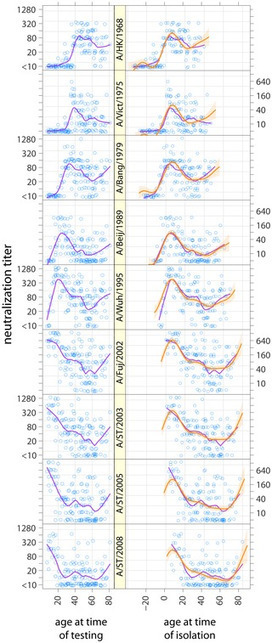
“A key observation about the human immune response to repeated exposure to influenza A is that the first strain infecting an individual apparently produces the strongest adaptive immune response. Although antibody titers measure that response, the interpretation of titers to multiple strains – from the same sera – in terms of infection history is clouded by age effects, cross reactivity and immune waning. From July to September 2009, we collected serum samples from 151 residents of Guangdong Province, China, 7 to 81 years of age. Neutralization tests were performed against strains representing six antigenic clusters of H3N2 influenza circulating between 1968 and 2008, and three recent locally circulating strains. Patterns of neutralization titers were compared based on age at time of testing and age at time of the first isolation of each virus. Neutralization titers were highest for H3N2 strains that circulated in an individual’s first decade of life (peaking at 7 years). Further, across strains and ages at testing, statistical models strongly supported a pattern of titers declining smoothly with age at the time a strain was first isolated. Those born 10 or more years after a strain emerged generally had undetectable neutralization titers to that strain (<1:10). Among those over 60 at time of testing, titers tended to increase with age. The observed pattern in H3N2 neutralization titers can be characterized as one of antigenic seniority: repeated exposure and the immune response combine to produce antibody titers that are higher to more ‘senior’ strains encountered earlier in life.”


An interesting paper, which helps explain several observations made over the years with pandemic flu: for example, in the 2009 H1N1 pandemic, older people seemed to be more protected – and rhe same was probably true of the 1918 pandemic.

See on www.plospathogens.org

The man with the golden banana

18 July, 2012

See on Scoop.itVirology News

“In Uganda, where food insecurity has been the order of the day, enterprising scientists have taken biotechnology a step further by producing bananas that are rich in vitamin A and iron and that have the colour of carrots once peeled.

During a media tour at the National Agricultural Research Laboratories in Kampala this week, scientists said they aimed to ensure that bananas, a staple food in Uganda, were rich in vitamin A and iron and resistant to nematodes.”


And behind that effort were two things: the Bill and Melinda Gates Foundation, and an Australian scientist named James L Dale.  I photographed him in his office at the Queensland University of Technology in 2010, when he had literally just opened the picture file associated with latest results being reported from his research crew – the banana picture in the background, with the golden vitamin A-containing version on top.

See on www.iol.co.za