Archive for the ‘Viruses’ Category

Adaptive Changes in Alphavirus mRNA Translation Allowed Colonization of Vertebrate Hosts

10 August, 2012

See on Scoop.itVirology and Bioinformatics from Virology.ca

“Genetic, phylogenetic, and biochemical data presented here support an evolutionary scenario for the natural history of alphaviruses, in which the acquisition of DLP structure in their mRNAs probably allowed the colonization of vertebrate host and the consequent geographic expansion of some of these viruses worldwide.”


I have taught for some time now that the evolution of many mammalian viruses must have involved adaptation of originally (and sometimes still) insect-infecting agents – given that insects crawled out onto dry land quite a long time before vertebrates did.  This is a nice illustration of that.  Pity I don’t teach anymore B-(

See on jvi.asm.org

A feeling for the Molechism* – revisited

10 July, 2012

This is an update of a post I did on Alan Cann’s MicrobiologyBytes back in 2007, before i started ViroBlogy: I am doing this because (a) it’s mine, (b) I want to update it – and the MB version is archived, so I can’t.  So here we are again:

I think it’s permissible, after working on your favourite virus for over 20 years, to develop some sort of feeling for it: you know, the kind of insight that isn’t directly backed up by experiment, but that may very well be right. Or not – but in either case, it would take a deal of time and a fair bit of cash to prove or disprove, and would have sparked some useful discussion in the meantime. And then, of course, the insights you have into (insert favourite virus name here) – if correct – can usually be extended into the more general case, and if you are sufficiently distinguished, people may actually take them on board, and you will have contributed to Accepted Wisdom.

I can’t pretend – at least, outside of my office – to any such Barbara McClintock-like distinction; however, I have done a fair bit of musing on my little sphere of interest as it relates (or not) to the State of the Viral Universe, and I will share some of these rambles now with whomever is interested.

I have been in the same office now, and teaching the same course, more or less, for 32-odd years. In that time I have worked on the serology and epidemiology of the bromoviruses, cucumovirus detection, potyvirus phylogeny, geminivirus diversity and molecular biology, HIV and papillomavirus genetic diversity, and expressing various bits of viruses and other proteins in plants and in insect cells. However, much of my interest (if not my effort) in that time has been directed towards understanding how grass-infecting mastreviruses in particular interact with their environment and with each other, in the course of their natural transmission cycle.

Maize streak virus

Maxwell’s Demon (left, lower) and Martian Face (right, upper) visible on a MSV virion

Fascinating little things, mastreviruses: unique geminate capsid architecture, and at around a maximum of 2.8 kb of single-strand circular DNA, we thought they were the smallest DNA genomes known until the circoviruses and then the zoo of anello- and anello-like viruses were discovered. Their genomes code for only 4 proteins – two replication-associated, one movement and one capsid – yet we have managed to work on just one subgroup of mastrevirus species for 27 years, without exhausting its interest – at least, to us… (see PubMed list here). We also showed that one could see Martian faces quite distinctly on virions – and possibly even Maxwell’s Demon. But I digress….

Maize streak

Severe symptoms of MSV on sweetcorn

We have concentrated on the “African streak viruses” – related species Maize streak virus, Panicum streak virus, Digitaria streak virus, Sugarcane streak virus and friends – for two very simple reasons:
1. They occur in Africa, near us, and nowhere else;
2. Maize streak virus is the worst viral pathogen affecting maize in Africa.

So we get situational or niche advantage, and we get to work on an economically-important pathogen. One that was described – albeit as “…not of…contagious nature” – as early as 1901, no less.

Maize streak virus

Maize streak virus or MSV, like its relatives, is obligately transmitted by a leafhopper (generally Cicadulina mbila Naudé): this means we have a three-party interaction – of virus-host-vector – to consider when trying to understand the dynamics of its transmission. Actually, it’s more complicated than that: we have also increasingly to consider the human angle, given that the virus disease affects mainly the subsistence farming community in Africa, and that human activity has a large influence on the spread of the disease. So while considering just the virus – as complicated as that is – we have to remember that it is only part of the whole picture.

So how complicated is the virus? At first sight, not very: all isolates made from severe maize infections share around 97% of their genome sequence. However, however…that 3% of sequence variation hides a multitude of biological differences, and there is a range of relatives infecting grasses of all kinds, some of which differ by up to 35% in genome sequence. Moreover, maize is a crop plant first introduced to Africa a maximum of 500 years ago, so it is hardly a “natural” host – yet, all over Africa, it is infected by only a very narrow range of virus genotypes, from a background of very wide sequence diversity available.

So here’s an insight:

the host selects the virus that replicates best in it.

And lo, we found that in the Vaalharts irrigation area in the north of South Africa that the dominant virus genotype in winter wheat was a different strain – >10% sequence difference – to the one in the same field, in summer maize. Different grass species also have quite different strains or even species of streak viruses best adapted to them.

DendrogramNot all that profound a set of observations, perhaps, but they lead on to another insight:

streak viruses travel around as a cloud of variants or virus complex.

Not intuitively obvious, perhaps…but testable, and when we did, we found we were right: cloning virus genomes back out of maize or from a grass infected via leafhoppers gave a single predominant genotype in each case, with a number of other variants present as well. Looking further, we discovered that even quite different viruses could in fact trans-replicate each other: that is, the Rep/RepA complex of one virus could facilitate the replication of the genome of a virus differing by up to 35% in DNA sequence. We have also – we think – made nonsense of the old fancy that you could observe “host adaptation” of field isolates of MSV: we believe this was due to repeated selection by a single host genotype from the “cloud” of viruses transmitted during the natural infection cycle.

So, insight number three:

there is a survival benefit for the viruses in this strategy.

This is simple to understand, really, and relates to leafhopper biology as well as to host: the insects move around a lot, chasing juicy grasses, and it would be an obvious advantage to the streak virus complex to be able to replicate as a complex in each different host type – given that different virus genotypes have differential replication potential in the various backgrounds. This is quite significantly different, incidentally, to what happens with the very distantly-related (in terms of geological time) begomoviruses, or whitefly-transmitted geminiviruses: these typically do not trans-replicate each other across a gap of more than 10% of sequence difference.

Boring, I hear you say, but wait…. Add another factoid in, and profound insights start to emerge. In recent years, the cloud of protégés or virologist complex around me has accumulated to critical mass, and one of the most important things to emerge – apart from some frighteningly effective software for assessing recombination in viral genomes, which I wish he’d charge for – was Darren Martin’s finding that genome recombination is rife among African streak viruses. This was unexpected, given the expectation that DNA viruses simply don’t do that sort of thing; that promiscuous reassortment of components between genomes is a hallmark of RNA viruses. Makes sense in retrospect (an exact science), however, because of the constraints on DNA genomes: how else to explore sequence space, if the proof-reading is too good? And if you travel in a complex anyway…why not swap bits for biological advantage?

MSV web

Linkage map of the MSV genome, showing what interacts with what

So Darren swapped a whole lot of bits, in a tour-de-force of molecular virology, to create some 54 infectious chimaeric MSV genomes – and determined that

The pathogenicity of chimeras was strongly influenced by the relatedness of their parental viruses and evidence was found of nucleotide sequence-dependent interactions between both coding and intergenic regions“.

In other words –new insight:

the whole genome is a pathogenicity determinant, and bits of it interact with other bits in unexpected ways.

At this point you could say “Hey, all his insights are in fact hypotheses!” – and you would be partially correct, except for

Profound Insight No. 1hypotheses are the refuge of the linear-thinking.

Or its variant, found on my office wall:

“**c* the hypotheses, let’s just discover something”. I also have

“If at first you don’t succeed, destroy all evidence that you tried” and a number of exotic beer bottle labels on my wall – but I digress….

As an aside here, I am quite serious in disliking hypothesis-driven science: I think it is a irredeemably reductionist approach, which does not easily allow for Big Picture overviews, and which closes out many promising avenues of investigation or even of thought. And I teach people how to formulate them so they can get grants and publications in later life, but I still think HDS is a tyranny that should be actively subverted wherever possible.

Be all this as it may, now follows

Profound Insight No. 2genome components may still be individually mobile even when covalently linked.

Now take a moment to think on this: recombination allows genes to swap around inside genetic backgrounds so as to constitute novel entities – and the “evolutionary value of exchanging a genome fragment is constrained by the number of ways in which the fragment interacts with the rest of the genome*“. Whether or not the genome is RNA, DNA, in one piece or divided. All of a sudden, the concept of a “virus genome” as a gene pool rather than a unitary thing becomes obvious – and so does the reductionism inherent in saying “this single DNA/RNA sequence is a virus”.

So try this on for size for a brand-new working definition of a virus – and

Profound Insight No. 3a virus is an infectious acellular entity composed of compatible genomic components derived from a pool of genetic elements.

Sufficiently paradigm-shifting for you? Compare it to more classical definitions – yes, including one by AJ Cann, Esq. – and see how much simpler it is. It also opens up the possibility that ANY virus as currently recognised is simply an operational assembly of components, and not necessarily the final article at all.

Again, my favourite organisms supply good object examples: the begomoviruses – whitefly-transmitted geminiviruses –

  • may have one- or two-component genomes;
  • some of the singleton A-type components may pick up a B-type in certain circumstances;
  • some doubletons may lose their B without apparent effect in model hosts;
  • some A components may apparently share B components in natural infections;
  • the A and B components recombine like rabbits with cognate molecules (or Bs can pick up the intergenic region from As);
  • in many cases have one or more satellite ssDNAs (β DNA, or nanovirus-related components) associated with disease causation;

…and so on, and on…. An important thing to note here is the lab-rat viruses – those isolated early on, and kept in model plant species in greenhouses – often don’t exhibit any of these strangenesses, whereas field-isolated viruses often do.

Which tells you quite a lot about model systems, doesn’t it?

But this is not only true of plant viruses: the zoo of ssDNA anello-like viruses found in humans and in animals – with several very distantly-related viruses to be found in any individual, and up to 80% of humans infected – just keeps on getting bigger and weirder. Added to the original TT virus – named originally for the initials of the Japanese patient from whom it was isolated, and in a post hoc exercise of convoluted logic, named Torque teno virus (TTV) [why don’t people who work with human or animal viruses obey ICTV rules??] – are now Torque teno minivirus (TTMV) and “small anellovirus” SAV) – all of which have generic status. And all of which may be the same thing – as in, TTVs at a genome size of 3.6–3.8 kb may give rise to TTMVs (2.8-29 kb) and SAVs (2.4-2.6 kb) as deletion mutants as part of a population cloud, where the smaller variants are trans-replicated by the larger. Thus, a whole lot of what are being described as viruses – without fulfilling Koch’s Postulates, I might point out – are probably only “hopeful monsters” existing only as part of a population. Funnily enough, this sort of thing is much better explored in the ssDNA plant virus community, given that working with plant hosts is so much easier than with human or animal.

And now we can go really wide, and attempt to be profound on a global scale: it should not have escaped your notice that the greatest degree of diversity among organisms on this planet is that of viruses, and viruses that are found in seawater in particular. There is a truly mind-boggling number of different viruses in just one ml of seawater taken from anywhere on Earth, which leads respectable authors such as Curtis Suttle to speculate that viruses almost certainly have a significant influence on not only populations of all other marine organisms, but even on the carbon balance of the world’s oceans – and therefore of the planet itself.

Which leads to the final, and most obvious,

Profound Insight (No. 4)in order to understand viruses, we should all be working on seawater…. 

That is where the diversity is, after all; that is where the gene pool that gave rise to all viruses came from originally – and who knows what else is being
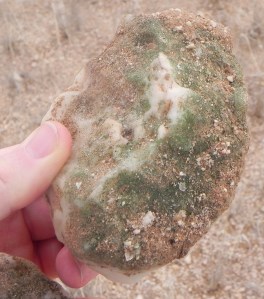
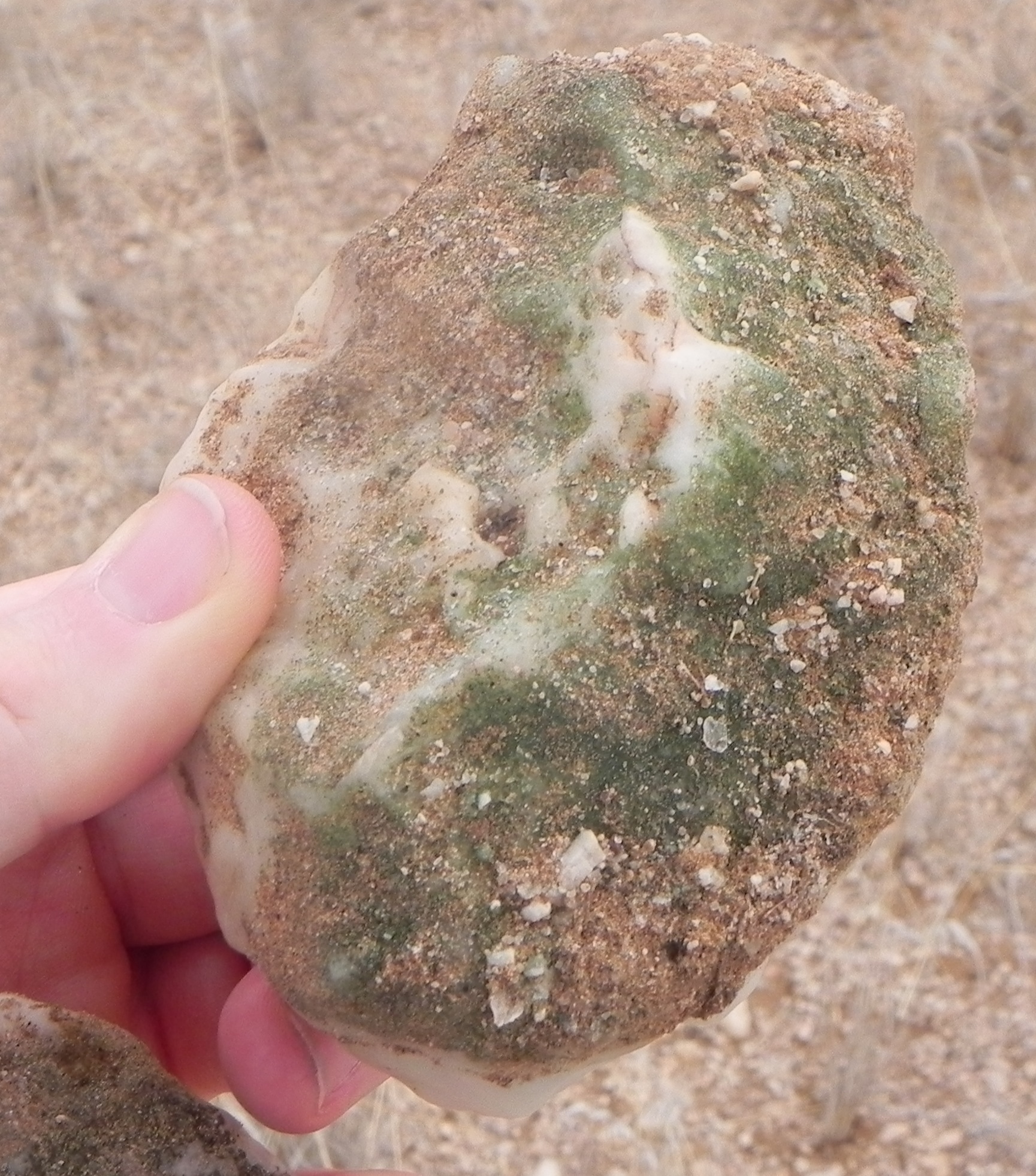
Hypolith – cyanobacteria-derived, probably – under a piece of Namib quartzite from near Gobabeb Research Station

cooked up down there?

And this is the major update: not only have I managed to get funded for a project on “Marine Viromics” from our local National Research Foundation – a process akin to winning the lottery, and about as likely to succeed – I am also collaborating with friends and colleagues from the Institute for Microbial Biotechnology and Metagenomics at the University of the Western Cape on viruses in desert soils, and associated with hypoliths– or algal growths found under quartzite rocks in extreme environments.

Thus, I shall soon be frantically learning how to deal with colossal amounts of sequence data, and worse, learning how to make sense of it.  We should have fun!

——————————————————————————————————————–

* And as a final curiosity, I find that while I – in common with the World Book Encyclop[a]edia and Learning Resources – take:mol|e|chism or mol|e|cism «MOL uh KIHZ uhm», noun. to mean any virus, viewed as an infective agent possessing the characteristics of both a living microorganism and a nonliving molecule; organule.
[molechism < mole(cule) + ch(emical) + (organ)ism; molecism < molec(ule) + (organ)ism] –
There is another meaning… something to do with sacrifice of children and burning in hellfire eternally. This is just to reassure you that this is not that.

How Seanan McGuire Perfected Her Fictional Zombie Virus

27 June, 2012

See on Scoop.itVirology News

When Seanan McGuire set out to write her Newsflesh trilogy, she went to some extreme lengths to make her zombie virus as realistic as possible….


OK, ONE more on zombie apocalyspes (thanks @gussilber)!  Except she didn’t: a quote-

“when those two viruses met, they had babies, and what you got was a shifting-antigen flu that does not leave the body under any circumstances but is capable of turning into something that converts human tissue into more of the virus. And that’s how we got Kellis-Amberlee, which makes zombies” – don’t make it for me.  Human tissue turning into viruses = bloody slime, NOT walking corpses!  Rabies: now THERE’S yer zombie virus!

See on www.wired.com

Five Mutations Make H5N1 Airborne | The Scientist

23 June, 2012

See on Scoop.itVirology News

“After more than 6 months of heated discussion, the second group that succeeded in making the H5N1 avian flu transmissible between ferrets, considered a good model for human transmission, has published its results. The paper, which came out today (June 21) in Science, demonstrates that only five mutations are needed to confer this aerosol transmissibility among mammals, and that re-assortment between different types of viruses—a technique used by the other group, which published its results last month in Nature—is not necessary.

Said Fouchier in a press conference “We both find … loss of glycosylation at the tip of the HA molecule, and this loss of glycosylation seems to increase the receptor binding specificity of the HA”. And though not all the mutations identified in the two studies match, “the mutations that are not identical still have a similar phenotypic trait,” he added.”


So this is what all the fuss was about?  This is what the NSABB did not want everyone to know?  How could they POSSIBLY think that the international virology and infectious disease community should be kept in the dark about this?  What this work has done has pointed the way along a path that will lead us to understand why and how influenza viruses change in order to more effectively get transmitted when they switch hosts – which is a good thing, surely.

And yet all they see is bioterrorism.

See on the-scientist.com

Avian flu viruses which are transmissible between humans could evolve in nature

23 June, 2012

See on Scoop.itVirology News

It might be possible for human-to-human airborne transmissible avian H5N1 influenza viruses to evolve in nature, new research has found.

The findings, from research led by Professor Derek Smith and Dr Colin Russell at the University of Cambridge, were published June 22 in the journal Science.
Currently, avian H5N1 influenza, also known as bird flu, can be transmitted from birds to humans, but not (or only very rarely) from human to human. However, two recent papers by Herfst, Fouchier and colleagues in Science and Imai, Kawaoka and colleagues in Nature reveal that potentially with as few as five mutations (amino acid substitutions), or four mutations plus reassortment, avian H5N1 can become airborne transmissible between mammals, and thus potentially among humans. However, until now, it was not known whether these mutations might evolve in nature.
The Cambridge researchers first analysed all of the surveillance data available on avian H5N1 influenza viruses from the last 15 years, focusing on birds and humans. They discovered that two of the five mutations seen in the experimental viruses (from the Fouchier and Kawaoka labs) had occurred in numerous existing avian flu strains. Additionally, they found that a number of the viruses had both of the mutations.
Colin Russell, Royal Society University Research Fellow at the University of Cambridge, said: “Viruses that have two of these mutations are already common in birds, meaning that there are viruses that might have to acquire only three additional mutations in a human to become airborne transmissible. The next key question is ‘is three a lot, or a little?’ “


So: was it a good idea to publish those two papers on mutating H5N1 viruses, or not?  Given that as I and many other more famous people pointed out, if you don’t know what makes the viruses mammal-to-mammal transmissible, you don’t know what to look for – and now we do, and look what they found.  This story will run, and run, and run – so we really, really should include an H5 consensus HA in seasonal flu vaccines!!

See on www.sciencedaily.com

Endogenous RNA viruses of plants in insect genomes

5 June, 2012

See on Scoop.itVirology News

“Endogenous viral elements (EVEs) derived from RNA viruses with no DNA stage are rare, especially those where the parental viruses possess single-strand positive-sense (ssRNA +) genomes. Here we provide evidence that EVEs that share a sequence similarity to ssRNA + viruses of plants are integrated into the genomes of a number of insects, including mosquito, fruit flies, bees, ant, silkworm, pea aphid, Monarch butterfly, and wasps. A preliminary phylogenetic analysis places these EVEs as divergent relatives of the Virgaviridae and three currently unclassified plant viral species.”

I have covered this before, in ViroBlogy, (and here, in 2007)as an interesting and probably under-appreciated phenomenon.  I note Eddie Holmes and colleagues have now taken it much, much further – which incidentally lends significant credence to my supposition that virus/vector/plant coevolution was probably a fair bit more intimate than has been supposed, with the newly-emerged (in evolutionary terms) insects and their viruses meeting terrestrial plants and THEIR viruses.  And mixing everything up, as I have speculated elsewhere (Origins of Viruses).

I thank Jean-Marie Verchot for drawing my attention to this!

See on www.sciencedirect.com

Biology Direct | Abstract | A novel virus genome discovered in an extreme environment suggests recombination between unrelated groups of RNA and DNA viruses

20 April, 2012

See on Scoop.itVirology News

“Viruses are known to be the most abundant organisms on earth, yet little is known about their collective origin and evolutionary history.  With exceptionally high rates of genetic mutation and mosaicism, it is not currently possible to resolve deep evolutionary histories of the known major virus groups. Metagenomics offers a potential means of establishing a more comprehensive view of viral evolution as vast amounts of new sequence data becomes available for comparative analysis.

Bioinformatic analysis of viral metagenomic sequences derived from a hot, acidic lake revealed a circular, putatively single-stranded DNA virus encoding a major capsid protein similar to those found only in single-stranded RNA viruses. The presence and circular configuration of the complete virus genome was confirmed by inverse PCR amplification from native DNA extracted from lake sediment. The virus genome appears to be the result of a RNA-DNA recombination event between two ostensibly unrelated virus groups.”

Not the first time this is postulated to have happened, although the authors have cited the first one: Gibbs and Weiller, 1999.

See on www.biology-direct.com

Engineered H5N1: the wheels grind on, and on, and on….

19 April, 2012

The Scientist has a nice collection of articles on this topic, which I have commented on all over the place, so I though I might consolidate some of it in one place.

In response to the article entitled “Deliberating Over Danger“, I wrote the following:

The point I and others have made before is that H5N1 and other influenza viruses are not waiting for us to let engineered versions loose, before they cause pandemics: all of the mutations noted by the Fouchier and Kawaoka groups are almost certainly present in the several environments where H5N1 viruses are now endemic – and all it takes for all of them to be present together is a little more mixing.

Don’t discount other flu subtypes, either: while everyone is obsessing about H5N1, H3N2 is busy popping out of pigs in the USA; H9N2 in birds in Bangladesh; H5N2 in ostriches in South Africa – and all it would take is one or a couple of fortuitous reassortments, and a whole new flu virus could be unleashed.

While the “deadly” H5N1s are being worked on in lockdown facilities.

If we don’t know what the virus does, we won’t know what it can do. If we don’t know what to look for, we may be taken unawares, when the next 1918-type pandemic strikes.

I want to have universal flu vaccines by then – so we won’t HAVE to worry about a new flu

.

There are also three newer articles covering the controversy: these are

  • H5N1 Researcher to Defy Dutch Gov’t?
  • (with my comment – “Export permit to publish something?  Really?  A complete misapplication of laws to material that should not be subject to them.”)
  • White House Weighs in on H5N1
  • Flu Review Criticized
  • (with my comment – “So after a full and frank hearing did not go his way, after changes had been made to the paper in question (Fouchier’s), Osterholm complains.  Such is life….”

There is the slightly older article – “Bird Flu Papers to Publish” – describing the reversal of the NSABB’s decision to ask for redaction of the two papers describing mammal-to-mammal aerosol-transmissible H5N1.

An interesting article also describes Yoshihiro Kawaoka’s results:

“First, he introduced two mutations—N224K and Q226L—into the haemagglutinin (HA) protein of H5N1 that made the virus capable of sticking to receptors on human tracheal cells. Then he created a chimeric virus by combining the mutated HA protein with genes from the H1N1 virus, which sparked a pandemic in 2009. Kawaoka identified another HA mutation, called N158D, that allowed the virus to spread between ferrets that were not in direct physical contact. A fourth mutation, T318I, also showed up in the H5N1 strain, but its role in making the virus more transmissible among mammals is less clear.”

So there you are: an actual recipe for aerosol-transmissible H5N1.  It was always going to come out somehow, and now these two papers will probably the most cited flu papers ever.  Nothing like a little hype!  Meanwhile, H5 and its brothers and sisters are out there mutating away, with no help needed from anyone.  Roll on universal flu vaccines!!

The origin of HIV: still so much garbage out there

20 February, 2012

While curating Virology News today, I came across another reprocessing of new that I had come across earlier concerning apparent natural protection of some African female sex workers against HIV infection: this was the intriguingly-entitled “African women’s genitals provide clue to HIV prevention“, in what appears to be an online Nigerian newspaper.

This recapitulates, very accurately, the information I reported in Virology News, which was the subject of a news release following the publication in the September 2011 edition of PLoS One of a study entitled “High Level of Soluble HLA-G in the Female Genital Tract of Beninese Commercial Sex Workers Is Associated with HIV-1 Infection”.  The gist of this is that:

“HIV-resistant sex workers in Africa have a weak inflammatory response in their vaginas – a surprise for the researchers, who were expecting the contrary considering the women’s high exposure to the virus.”

This may lend further credence to the observation that progression to AIDS in HIV-infected people is associated with a state of chronic immune activation – and that SIV-infected vervet monkeys do not exhibit such chromic immune activation, and do not progress like humans do.

What is interesting about the Nigerian article, however, is not what it reports – it is the online comments that follow it.  Here is a selection:

“Was HIV realy discovered in Africa ? Forget the western media propaganda . I have believed , for years , that HIV is a laboratory virus designed for genocide in the thick of apartheid inhuman policies in South Africa .”

“Neither did HIV originate  nor was it perculiar to Africa. It was the creation of the Western countries to stsyematically reduce African population. that the subjects of this study were exposed to HIV virus attests to this fact.”

And my personal favourite:

“So you have already swallowed up the white propaganda that the AIDS virus was first discovered in 1981 in a remote area of central Africa in the green monkey!  A fairy tale, which never explains why prior to its first clinical detection among western homosexual men in the late seventies, no case was found in Africans, and no animal or human population died off in Africa, yet the homosexual population of the west was seriously threatened until their protected sex campaign took off.

You must be unaware that about 35 years ago the Soviet KGB told the world the truth about AIDS….

Jakob Segal, a former biology professor at Humboldt University in then-East Germany, proposed that HIV was engineered at a U.S. military laboratory at Fort Detrick, by splicing together two other viruses, Visna and HTLV-1. According to his theory, the new virus, created between 1977 and 1978, was tested on prison inmates who had volunteered for the experiment in exchange for early release. He further suggested that it was through these prisoners, most of who were homosexuals, that the virus was spread to the population at large.”

What is depressing is that there is just one comment saying “…where HIV started is of little significance now. the issue is that our brothers Africans are the ones affected so we must work hard to find the cure and save our brothers.”

What is obvious is that, even in an environment such as one of the most developed nations in Africa, where intelligent science reporting is happening, the public seems to be alarmingly misinformed about the origin of HIV and predisposed to believe racist conspiracy theories that were debunked years ago.

FACT:
HIV did not come from “green monkeys” and was not discovered in 1981: the virus was described in 1983 and 1984, and HIV entered the  human population in central Africa multiple times, from chimpanzees and possibly also from gorillas, almost certainly via bushmeat – and this happened in the 1930s or even earlier.

FACT:
HIV could not possibly have resulted  from the splicing together of Visna virus and HTLV-1, as no HIV sequence bears any strong resemblance to either virus – and especially not to both of them in different parts of their genomes, as they would be expected to if they were artificial recombinants.  Moreover, the first HIV that has been reliably dated comes from a sample taken in the Congo in 1959.

All of these facts can be easily discovered by a trawl of either the scientific literature, or a first-level digest of that literature by reputable journalists.  All else is fiction…and malicious fiction at that, whether or not such supposed luminaries as Thabo Mbeki believe it.

12th May 2015

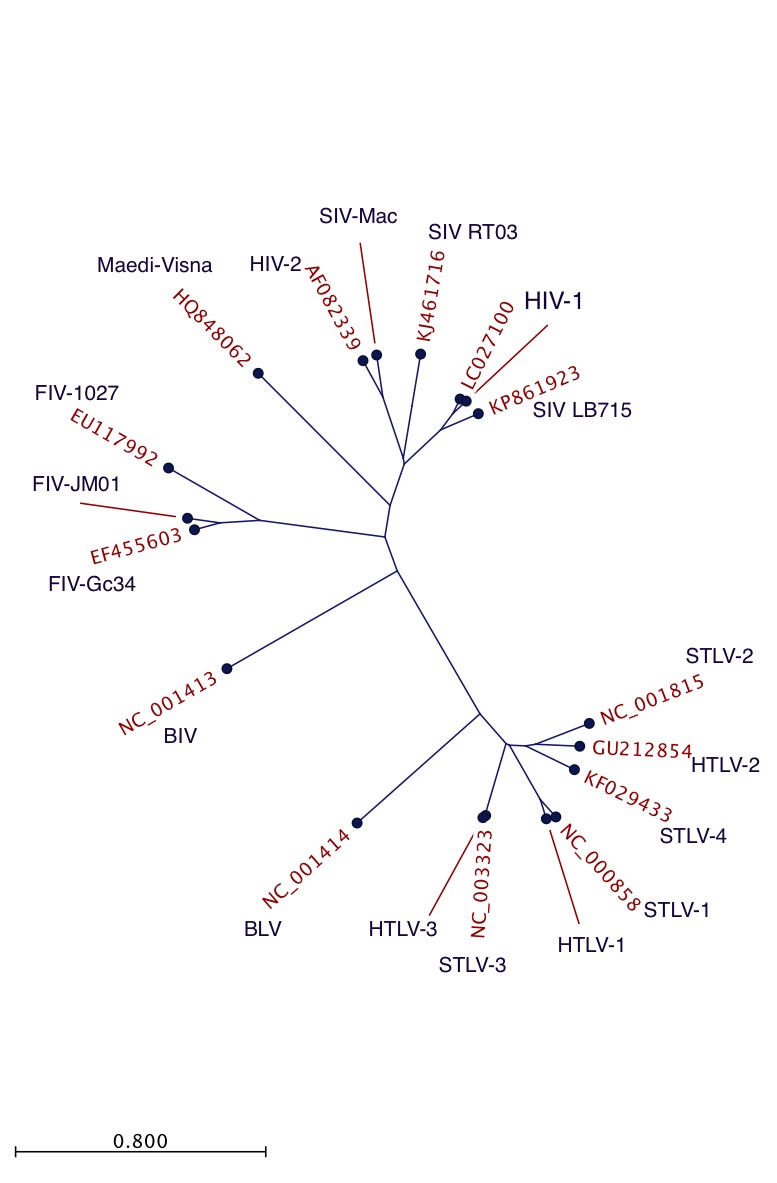
ANOTHER note added in response to Timothy Julian, below, who seems not to understand anything about retrovirus and especially lentivirus evolution.  Here is an unrooted radial relationship diagram (aka “phylogenetic” diagram) depicting whole genome sequence relationships between HIV-1, HIV-2, 2 SIVs, Maedi-Visna ad bovine leukaemia viruses, feline and bovine immunodeficiency and human and simian T-cell lymphotropic viruses.  Done by me today from Genbank sequences, using CLC Genomics Workbench ver 7.

Radial tree for retrovirus complete genome sequences

Radial tree for retrovirus complete genome sequences

What it shows is that:

  • there is a distinctive clustering of HIVs and of SIVs, with MVV as a apparently closer relative than the FIVs, in a cluster of lentiviruses that includes BIV – and I note HIV-1 is more closely related to an SIV than it is to HIV-2, and there are three branches to the H/SIV tree ALL of which are internal to MVV and the FIVs and BIV.
  • the H/STLVs cluster together as relatives, with HTLV-1/2/3 being most closelt related to STLV-1/2/3 – which, seeing as the HTLVs are supposed to have derived from the STLVs, is hardly surprising.
  • BLV is only distantly related to the TLV cluster, as is expected given that it is a leukaemia virus but one of a very different species

If HIV-1 derives from artificial constructs derived from FIVs, which are less closely related to  them than is MVV, then is the same true for the whole primate cluster?  Really?  When it is pretty obvious that they are (a) evolutionarily related most closely to one another, (b) evolutionarily diverged to quite a considerable extent?  So were they all made individually??  Then cleverly given to different bush-dwelling primates in Africa?  How desperately unlikely is that??  You appear not to have heard of teh principle of parsimony, which is that the simplest explanation that covers all of the facts is probably correct – which in this case, is that both HIVs and all of the SIVs have a common evolutionary origin, thousands of years ago – and that all lentiviruses also have a common origin, millions of years ago.

Seriously, Timothy: give it a rest.  You know less than Jon Snow.

When dinner could kill you: smoked chimpanzee, anyone?

14 January, 2012

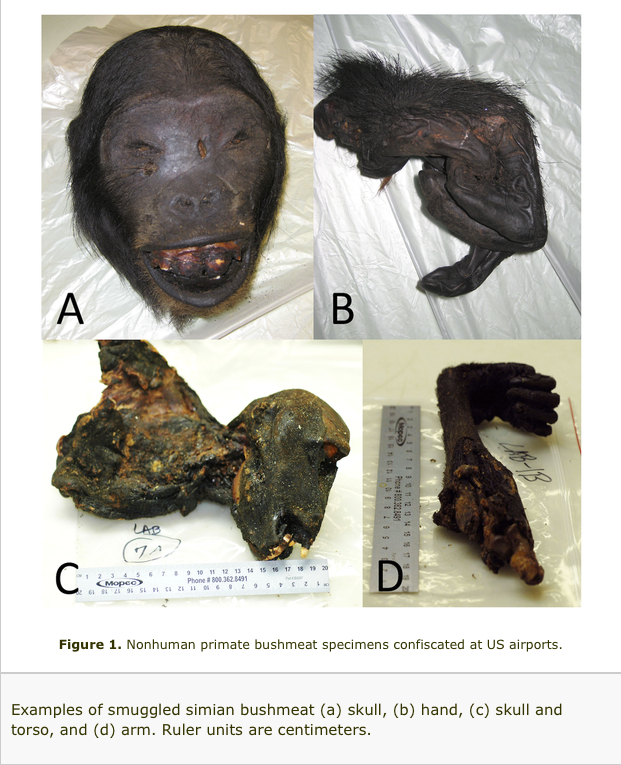
ProMED Mail this morning had a rather alarming item: “BUSHMEAT TRADE, DISEASE TRANSMISSION RISK”.  They reported on a study, highlighted in a BBC report, of possible pathogens imported into the USA via bushmeat from Africa, confiscated at airports.  This in turn derived from a PLoS One paper – “Zoonotic Viruses Associated with Illegally Imported Wildlife Products“, by Kristine Smith et al., published on January 10th 2012.  Their abstract:

The global trade in wildlife has historically contributed to the emergence and spread of infectious diseases. The United States is the world’s largest importer of wildlife and wildlife products, yet minimal pathogen surveillance has precluded assessment of the health risks posed by this practice. This report details the findings of a pilot project to establish surveillance methodology for zoonotic agents in confiscated wildlife products. Initial findings from samples collected at several international airports identified parts originating from nonhuman primate (NHP) and rodent species, including baboon, chimpanzee, mangabey, guenon, green monkey, cane rat and rat. Pathogen screening identified retroviruses (simian foamy virus) and/or herpesviruses (cytomegalovirus and lymphocryptovirus) in the NHP samples. These results are the first demonstration that illegal bushmeat importation into the United States could act as a conduit for pathogen spread, and suggest that implementation of disease surveillance of the wildlife trade will help facilitate prevention of disease emergence.

What was even more horrifying were the pictures of confiscated items – herewith their Figure 1.

doi:10.1371/journal.pone.0029505.g001

It boggles my mind how anyone could even consider smuggling this sort of thing into anywhere – and I am hoping that the US Customs has the same sorts of detection mechanism – as in, well-trained beagles – as they used to have in Miami Airport to detect biltong [dried spiced meat] smuggled in from South Africa.  Those dogs were seriously good – trouble is, they really loved the biltong they got as a reward, too, and it makes my skin crawl rather to imagine a beagle salivating over smoked vervet monkey.

The ProMED post comments further:

No one really knows the scale of the illegal trade in wildlife meat, or bushmeat as it is often called, but a 2010 study estimated that 5 tonnes of the material per week was being smuggled in personal baggage through Roissy-Charles de Gaulle airport in Paris, France. And in addition to the meat products, there is a big trade in live wild animals. Much of this is perfectly legal and supplies the pet industry. Nonetheless, these animals also require improved pathogen surveillance, say the researchers.

One has only to remember that the monkeypox outbreak in the USA in recent times originated in an African animal imported live – see Viroblogy here – to realise the potential danger posed by international movement of wild-caught animals – or even of laboratory animals, as happened in the Ebola Reston incident.

The list of animals from whom parts were found is also rather disturbing: this included chimpanzee, sooty mangabey, and “green monkey” or vervet.  Virologists will not need reminding, but others may, that HIV-1 originated in chimpanzees and HIV-2 in mangabeys – and that although these viruses were not found this time, the PLoS One paper notes:

“Although we did not find SIV or STLV in the limited number of specimens in this study, these viruses have been found in high prevalences in NHP specimens at bushmeat markets and in hunted NHPs [8], [32], [33]. HIV-1 and HIV-2 emerged as a result of several spillover events of SIV from chimpanzees and mangabeys, respectively, that were likely hunted for bushmeat in central and western Africa [30]. Serosurveillance studies have shown thirty-five different species of African NHPs harbor lentivirus infections, with a prevalence of SIV in up to 35% of free-ranging chimpanzees, and 30–60% of free-ranging sooty mangabeys and green monkeys [30], [31], [33], [34].”

So really, it is just a matter of time before meat that contains SIVs or STLVs gets through into the USA and other world centres – and a whole new wave of zoonotic infection could start.  It really is inexcusable that people living in developed countries should be importing meat derived from endangered species in the first place.  It is made worse that developed countries like the USA find it necessary to import LIVE animals as pets – and while the monkeypox outbreak was caught early, the next one may not be.

So forget the “engineered” H5N1 paranoia, folks – be a LOT more scared of the cute rodent in a cage near you, or what your neighbour may be eating….